Free tool
Flower identifier by description
Pick what you see. Every answer is optional, and the list of 80 garden, balcony and wild flowers re-sorts itself after each one.
In short
This flower identifier by description works without a photo: pick the flower's color, shape, petal count, where it grows, the month and the plant's height, and 80 common garden and wild flowers of Europe and North America are ranked by how many answers they match. Each result gives one field mark that confirms it and names its closest look-alike.
- Shape and petal count beat color: many garden flowers come in five or six colors, and some change color as they open or age.
- Every answer is optional; “I'm not sure” never removes a flower, and with three or more answers a flower that misses one still shows as a close match.
- Your answers live in the page address, so a result can be shared; nothing is sent to a server.
Flower identifier by description
Tell it what you see. Every answer is optional, and the list of 80 common garden and wild flowers narrows as you go, best matches first.
Your answers stay in this page's address, so you can share the result. Nothing is sent anywhere.
80 of 80 flowers
Best matches
No answers yet: here is every flower in the set, A to Z.
African lily (agapanthus)
Agapanthus praecox · Amaryllidaceae
How to confirm: A round head up to 12 cm of tubular blue or white flowers, each with a darker stripe, on a long bare stalk; arching strap leaves at the base.
Look-alike: Ornamental onion (Allium). Ornamental onions have star-shaped flowers, usually purple, and leaves that smell of onion.
Sources: Agapanthus praecox (NC State Extension Gardener Plant Toolbox)
Azalea
Rhododendron (azaleas) · Ericaceae
How to confirm: Funnel flowers with five lobes, the upper lobe often freckled, in April–May; small oval leaves crowded at the shoot tips.
Look-alike: Large-leaved rhododendron. Rhododendrons bear bell flowers in dense round trusses, later in spring, above big leathery leaves.
Sources: Rhododendron (NC State Extension Gardener Plant Toolbox)
Bearded iris
Iris × germanica · Iridaceae
How to confirm: Three drooping 'falls' with a fuzzy beard and three upright 'standards'; flat, sword-shaped leaves in a fan from a thick rhizome.
Look-alike: Yellow flag iris (Iris pseudacorus). Yellow flag is yellow, has no beard and grows in wet ground.
Sources: Iris x germanica (NC State Extension Gardener Plant Toolbox); Iris × germanica (GBIF (Global Biodiversity Information Facility))
Bigleaf hydrangea
Hydrangea macrophylla · Hydrangeaceae
How to confirm: A big ball or a flat 'lacecap' of four- or five-parted florets; large, glossy, coarsely toothed leaves in opposite pairs on woody stems.
Look-alike: Common lilac. Lilac flowers in spring in cone-shaped, strongly scented clusters, and its heart-shaped leaves have no teeth.
Sources: Hydrangea macrophylla (NC State Extension Gardener Plant Toolbox)
Black-eyed Susan
Rudbeckia hirta · Asteraceae
How to confirm: 10–20 golden rays around a dark brown, dome-shaped center; heads 5–10 cm; bristly-hairy stems and leaves.
Look-alike: Sunflower. Sunflowers have much bigger heads, broad leaves and are often taller than 1.5 m.
Sources: Rudbeckia hirta (NC State Extension Gardener Plant Toolbox)
Bluebell
Hyacinthoides non-scripta · Asparagaceae
How to confirm: Narrow, deep violet-blue bells hanging from one side of a stem that droops at the tip; tips of the bells curl back; cream anthers; carpets in woods.
Look-alike: Spanish bluebell (Hyacinthoides hispanica). The Spanish bluebell has an upright stem with wider bells all round it and blue anthers.
Sources: Hyacinthoides non-scripta (Missouri Botanical Garden Plant Finder); Hyacinthoides non-scripta (GBIF (Global Biodiversity Information Facility))
Bougainvillea
Bougainvillea (B. glabra, B. spectabilis and hybrids) · Nyctaginaceae
How to confirm: The color comes from three papery bracts, each holding a tiny white tubular flower; thorny, climbing stems.
Look-alike: Oleander. Oleander has real five-petalled flowers, no papery bracts, and grows as an upright shrub without thorns.
Sources: Bougainvillea (NC State Extension Gardener Plant Toolbox)
Busy Lizzie (impatiens)
Impatiens walleriana · Balsaminaceae
How to confirm: Flat, five-petalled flowers with a slender spur behind; soft, juicy stems; grows happily in shade.
Look-alike: Wax begonia. Wax begonia has waxy, rounded leaves and no spur on the flower.
Sources: Impatiens walleriana (NC State Extension Gardener Plant Toolbox)
Butterfly bush
Buddleja davidii · Scrophulariaceae
How to confirm: Arching spikes 10–25 cm long of tiny lilac tubes, each with an orange eye; lance-shaped leaves, gray-felted beneath; often grows out of walls and railway banks.
Look-alike: Common lilac. Lilac flowers in spring and has smooth, heart-shaped leaves.
Sources: Buddleja davidii (NC State Extension Gardener Plant Toolbox)
Camellia
Camellia japonica · Theaceae
How to confirm: Thick, glossy, dark evergreen leaves with fine teeth; rose-like flowers 7–12 cm in late winter and early spring that drop whole.
Look-alike: Rose. Roses have prickly stems and divided leaves and flower in summer.
Sources: Camellia japonica (NC State Extension Gardener Plant Toolbox)
Canada goldenrod
Solidago canadensis · Asteraceae
How to confirm: Arching plumes of hundreds of tiny yellow heads in late summer, in dense stands on waste ground; narrow leaves with three main veins.
Look-alike: Common ragwort (Jacobaea vulgaris). Ragwort carries bigger daisy heads in flat-topped clusters and has ragged, lobed leaves.
Sources: Solidago canadensis (NC State Extension Gardener Plant Toolbox)
Chicory
Cichorium intybus · Asteraceae
How to confirm: Sky-blue heads 2.5–4 cm, stalkless along stiff, branched stems on roadsides; open in the morning, often closed by midday.
Look-alike: Cornflower. Cornflower heads sit on their own stalks and have funnel-shaped outer florets.
Sources: Cichorium intybus (NC State Extension Gardener Plant Toolbox); Cichorium intybus (GBIF (Global Biodiversity Information Facility))
Want a name from a photo instead? Plant Identifier names a flower from one photo on your iPhone. Get Plant Identifier on the App Store
This tool doesn't judge toxicity, and a missing note says nothing either way. If a child or a pet has eaten part of a plant, call poison control (US), NHS 111 (UK) or the ASPCA Animal Poison Control Center.
Describe the flower in front of you and the list sorts itself: the flowers that match every answer first, then, once you have given three answers, the ones that miss just one.
How to use the flower identifier
- Set the region. English pages start with Europe and North America together; pick one to drop flowers you won't meet there (great white trillium and common milkweed are North American only, bluebell and cow parsley European).
- Pick every color you see on the petals. A pansy with violet and yellow petals gets both. Leave the stamens and the center out.
- Pick a shape, looking at one flower, or at the whole head when the flowers are tiny (lavender, clover, yarrow).
- Count the petals on one open flower. A tube that splits into five lobes counts as five. If you can't count them, leave it at "I'm not sure": flowers whose petals can't be counted in the field (lavender spikes, clover heads, snapdragons) are never marked down for it.
- Add place, month and height if you know them. The month can be a range, and it wraps past December, so November to February finds the winter flowers.
- Read the field mark on the top cards. "Hold a leaf to the light: tiny see-through dots" settles St John's wort in seconds; the look-alike line tells you what else it could be.
Every card cites the pages its traits came from. Copy the link to send the result to someone; the answers are in the address, and nothing leaves your browser.
What to look at on a flower, and why color alone misleads
Color is the first thing everyone notices and the least reliable thing to filter on:
- Garden breeding. Purple coneflower is lavender-pink in the wild, but NC State Extension lists cultivars in white, red, orange and yellow. Roses, dahlias, zinnias and tulips each come in six colors in the set.
- Color that changes. Viper's bugloss opens pink and turns vivid blue; great white trillium turns pink with age; the Christmas rose blushes pink as it fades.
- Color that isn't a petal. The magenta of a bougainvillea is three papery bracts around a tiny white tubular flower, as the NC State Plant Toolbox describes it.
So read the build of the flower too. A daisy-like head is a crowd of tiny florets (the daisy family); a banner over two wings and a keel is a pea; a flat umbrella of small flowers is the carrot family or an onion relative. Then count petals, and look at one leaf: long and narrow, cut into leaflets, a single blade, or round to heart-shaped. The wildflower guide walks through the seven common flower builds in more detail, and the plant identification guide covers leaves, bark and whole-plant clues.
The flowers it covers
Eighty flowers that people in Italy, Germany, Austria, Switzerland, France, the US, Canada and the UK actually meet, chosen because they are common, not because they are rare or showy:
- Garden and balcony (51): geranium, petunia, rose, tulip, daffodil, bigleaf hydrangea, lavender, dahlia, French and pot marigold, sunflower, cosmos, zinnia, wax begonia, busy Lizzie, pansy, Chinese hibiscus, rose of Sharon, oleander, bougainvillea, common and star jasmine, lily, daylily, bearded iris, peony, chrysanthemum, gerbera, scarlet sage, fuchsia, camellia, azalea, clematis, wisteria, snapdragon, sweet pea, lupin, hollyhock, foxglove, agapanthus, hyacinth, crocus, snowdrop, lily of the valley, forsythia, lilac, butterfly bush, nasturtium, Christmas rose, purple coneflower and black-eyed Susan.
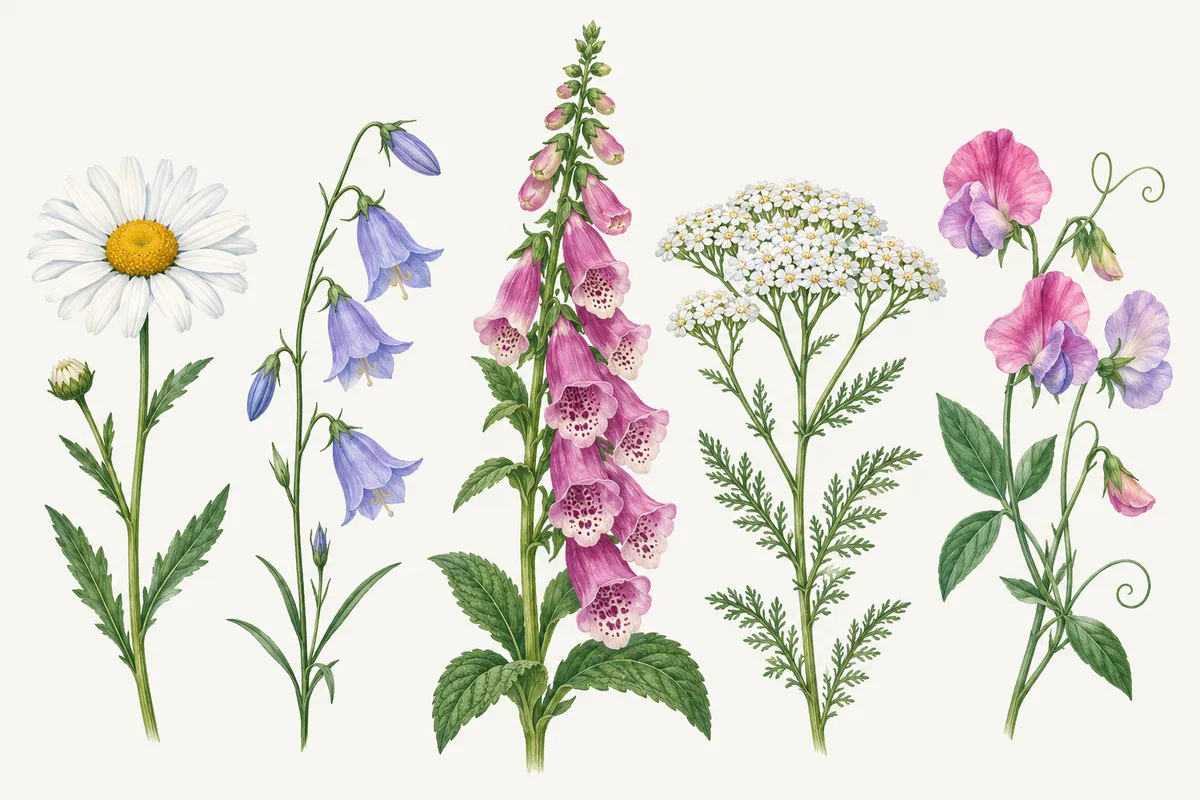
- Meadows and roadsides: common poppy, cornflower, oxeye and common daisy, chicory, dandelion, meadow buttercup, red and white clover, wild carrot (Queen Anne's lace), viper's bugloss, purple loosestrife, yarrow, St John's wort, Canada goldenrod, field bindweed, harebell, New England aster and common milkweed.
- Woodland: cow parsley, bluebell, wood anemone, primrose, sweet violet, lesser celandine, red campion and great white trillium.
- Walls and paving: ivy-leaved toadflax and red valerian, with dandelion, butterfly bush, snapdragon and hollyhock also seeding into cracks.
Four flowers carry a toxicity note, each quoting the ASPCA's plant list: oleander, foxglove, lily of the valley and lilies. For houseplants, use the houseplant identification key instead.
Sources and limits
Colors, shapes, petal counts, heights and bloom seasons come from the NC State Extension Plant Toolbox and the Missouri Botanical Garden Plant Finder, which also give the months; range and habitats in Europe from each flower's species page on GBIF. Scientific names were checked against the World Flora Online list on 21 October 2026, with the older name kept as a synonym where it changed (wood anemone is now Anemonoides nemorosa, red valerian Valeriana rubra).
What it can't do:
- It only knows 80 flowers. A flower outside the set will bring up its nearest look-alikes, never its own name.
- Seasons were turned into months for a temperate climate; in the Mediterranean or the US South many garden flowers bloom earlier and longer.
- It says nothing about edibility, and it doesn't judge toxicity: a flower without a note may still be toxic.
When the description runs out, one photo usually settles it: Plant Identifier names a flower from a single photo on your iPhone, and you can ask its plant expert a follow-up question about the result.
Questions people ask
Can I identify a flower by its description alone?
Often, if it is one of the 80 common flowers in the set and you answer shape and petal count as well as color. Treat the top result as a candidate and check the field mark it gives; a flower outside the set will only find its nearest look-alikes.
Why does the tool ask about shape before petals?
Shape splits the set fastest. A daisy-like head is really hundreds of tiny florets, an umbrella cluster points to the carrot or onion family, and a pea-like flower to the pea family. Petal count then separates flowers of the same shape.
What does it mean when a flower has no toxicity note?
Nothing. The tool shows a note only where the ASPCA lists a flower as toxic, and a missing note says nothing either way. If a child or pet has eaten part of a plant, call poison control or the ASPCA Animal Poison Control Center.
Sources
- Echium vulgare — NC State Extension Gardener Plant Toolbox
- Bougainvillea — NC State Extension Gardener Plant Toolbox
- Echinacea purpurea — NC State Extension Gardener Plant Toolbox
- Hibiscus syriacus — Missouri Botanical Garden Plant Finder
- Foxglove — ASPCA Animal Poison Control Center
- WFO Plant List — World Flora Online