Free tool
Houseplant identification key
Answer one question at a time about the plant in front of you. No photo, no upload, no account: the key runs in your browser.
In short
Houseplant identification without a photo works best as a key: you answer one question at a time about leaf thickness, holes, stems and flowers until one plant is left. This key covers 35 common indoor plants, from monstera and pothos to snake plant, ZZ plant and moth orchid. Each result lists 2 to 3 field marks and the look-alike people confuse it with.
- Start with a leaf you can touch: the first question is whether it is thick and juicy or thin.
- “Not sure” never strands you: it lists every plant that still fits your earlier answers.
- Every question and result names the extension or botanical source it rests on.
Houseplant identification key
Answer one question at a time about the leaves, the stems and, if your plant is in bloom, the flowers. The key covers 35 of the houseplants most often sold in Europe and North America, and “Not sure” always shows you the plants that still fit.
Question 1
Thick, fleshy leaves?
Press a leaf gently between finger and thumb. Succulent leaves, or flat stem segments, are thick, firm and juicy inside; ordinary leaves are thin, even when they feel leathery.
Source: Dracaena trifasciata (NC State Extension Gardener Plant Toolbox); Crassula ovata (NC State Extension Gardener Plant Toolbox); Aloe vera (NC State Extension Gardener Plant Toolbox); Schlumbergera (NC State Extension Gardener Plant Toolbox)
Nothing is sent anywhere. Your answers live in the page address, so the link opens the same step.
Pets or children? Check the ASPCA list of toxic and non-toxic plants or call Poison Control: this key does not judge toxicity.
The whole key as a list
Houseplant identification key: The whole key as a list
The same key in the classic printed form: start at 1, pick the line that fits, and follow the number. A plant that people describe in two ways appears in two places.
1. Thick, fleshy leaves?
1a Yes: thick, fleshy leaves, or chains of flat, fleshy stem segments, several millimetres thick → go to 2
1b No: thin leaves, papery, soft or leathery, that bend without feeling juicy → go to 3
2. Flat segments instead of leaves?
2a Yes: chains of flat, glossy green segments about 4 to 6 cm long, joined end to end; flowers open at the tips → Christmas cactus (holiday cactus) (Schlumbergera)
2b No: it has true leaves → go to 4
3. Feather-like fronds?
3a Yes: each leaf is a frond of many leaflets in two rows along a central stalk → go to 5
3b No: each leaf is a single blade, even if it has holes, slits or lobes → go to 6
4. A rosette, or leaves on stems?
4a All the leaves rise from one central point at soil level, in a rosette or fan → go to 7
4b The leaves sit along visible stems, or on separate stalks → go to 8
5. A fern?
5a Soft, lacy fronds 60 to 90 cm long rising from the soil; many small leaflets with scalloped edges; rows of brown dots may line their undersides; it never flowers → Boston fern (Nephrolepis exaltata)
5b Leaflets smooth-edged and longer, or thick and glossy; no brown dots underneath → go to 9
6. Holes or slits in the leaves?
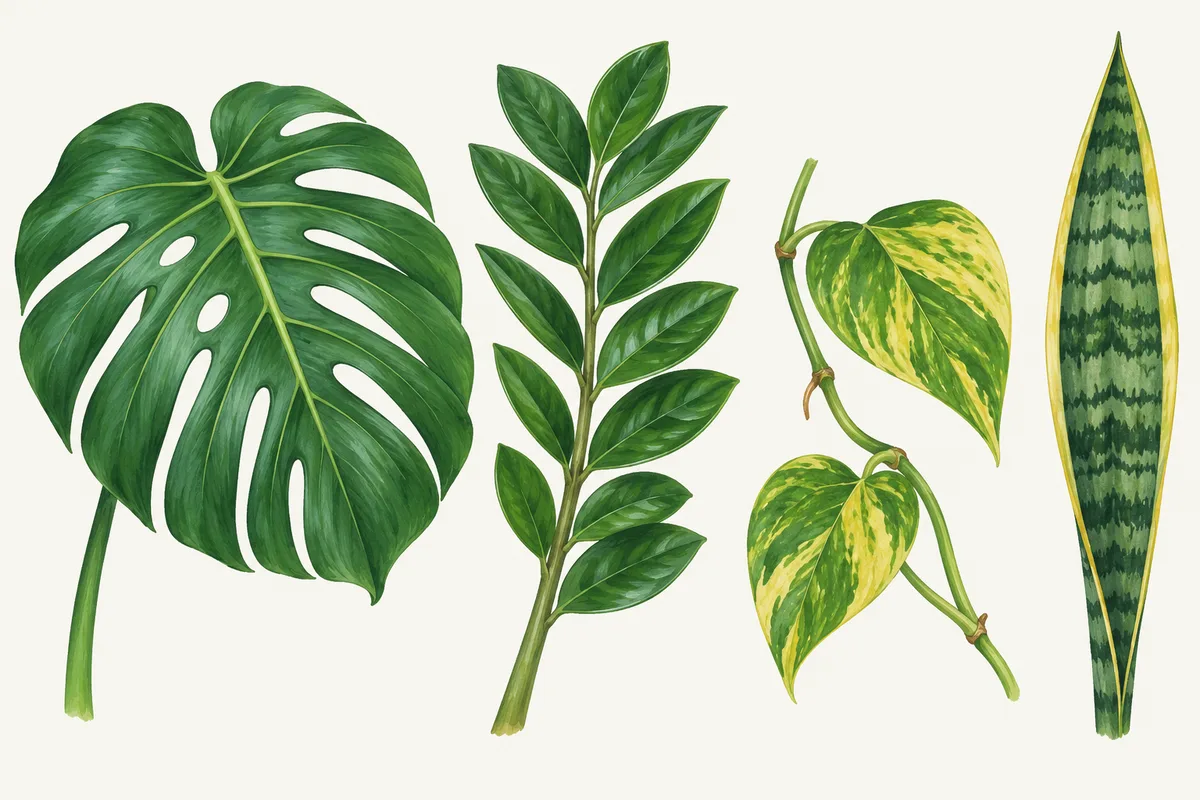
6a Yes: large, glossy leaves with holes in the blade and slits running in from the edge → Swiss cheese plant (monstera) (Monstera deliciosa)
6b No holes or slits (lobed edges are fine) → go to 10
7. Tall upright swords?
7a Stiff, flat, upright sword-like leaves up to 1.2 m long, banded across with darker and lighter green → Snake plant (mother-in-law's tongue) (Dracaena trifasciata (Sansevieria trifasciata))
7b Leaves spread, curve or stay low: not upright banded swords → go to 11
8. Rows of leaflets on stalks from the soil?
8a Yes: each stalk rising from the soil carries two rows of glossy, oval leaflets and is swollen at the base → ZZ plant (Zamioculcas zamiifolia)
8b No: single leaves along branching stems → go to 12
9. Fleshy stalks, or palm stems?
9a Thick, glossy stalks rise straight from the soil, swollen at the base, each with 6 to 8 pairs of oval leaflets → ZZ plant (Zamioculcas zamiifolia)
9b Fronds arch from slender green stems ringed like bamboo; leaflets long and narrow → go to 13
10. Trailing or climbing stems?
10a Yes: long, thin stems hang over the pot or climb a support, with leaves spaced along them → go to 14
10b No: it grows upright, bushy, or as a clump at soil level → go to 15
11. A few broad leaves and green roots?
11a Only 3 to 6 broad, thick, glossy leaves, 8 to 25 cm long, with few visible veins; thick roots that turn green, often in a clear pot → Moth orchid (Phalaenopsis)
11b Many narrower, pointed or rounded leaves packed into the rosette → go to 16
12. Coin-shaped leaves, stalk at the centre?
12a Round, flat leaves about 10 cm across, each stalk attached near the middle of the underside, like a lily pad → Chinese money plant (Pilea peperomioides)
12b The stalk joins the leaf at its edge, or the leaf has hardly any stalk → go to 17
13. A few thin stems, or a clump?
13a One or a few slender stems up to about 2 cm thick, often several young plants per pot; fronds with 11 to 20 narrow leaflets; usually under 1.5 m → Parlour palm (Chamaedorea elegans)
13b Many stems in a clump; long arching fronds with 40 to 60 pairs of leaflets on a yellowish stalk, the leaflets rising in a V → Areca palm (butterfly palm) (Chrysalidocarpus lutescens (Dypsis lutescens))
14. Grass-like leaves and dangling baby plants?
14a Yes: narrow, grass-like leaves 30 to 45 cm long in a clump, often striped white, with long runners carrying small plantlets → Spider plant (Chlorophytum comosum)
14b No: broader leaves sit along the stems themselves → go to 18
15. A stem or trunk?
15a The leaves are carried on a visible stem, cane or trunk → go to 19
15b No visible stem: each leaf rises on its own stalk from the soil → go to 20
16. Teeth along the edges?
16a Small pale teeth along the edges; long, pointed grey-green leaves that show clear gel when broken → Aloe vera (Aloe vera)
16b Smooth edges, no teeth → go to 21
17. Pairs of leaves on woody stems?
17a Oval leaves 2.5 to 9 cm long in opposite pairs, almost stalkless, on thick ringed stems that turn brown and woody: a miniature tree → Jade plant (Crassula ovata)
17b A small, soft-stemmed plant 15 to 30 cm tall; leaves heart-shaped, round or lance-shaped, smooth, ridged, striped or furry depending on the kind → Peperomia (radiator plant) (Peperomia)
18. Lobed leaves?
18a Leaves with 3 to 5 pointed lobes and pale veins, about 10 cm long, on stems with tiny clinging roots → English ivy (Hedera helix)
18b Leaves without lobes → go to 22
19. Long narrow leaves in tufts at the top?
19a Long strap- or sword-shaped leaves crowded in tufts at the top of a woody cane, with leaf scars below → go to 23
19b Broader leaves spread along the stems or branches → go to 24
20. Long, narrow leaves?
20a Long, narrow leaves, many times longer than they are wide → go to 25
20b Broader leaves: oval, heart-shaped, lance-shaped or paddle-shaped → go to 26
21. White bumps, or a powdery bloom?
21a Stiff, dark green, narrow triangular leaves with raised white bumps or stripes running across them → Zebra haworthia (Haworthiopsis (Haworthia))
21b Smooth leaves, often blue-grey, pink or purple with a powdery bloom, in a tight, rose-like rosette → Echeveria (Echeveria)
22. Silver stripes and purple undersides?
22a Pointed leaves 2.5 to 8 cm long with two silver stripes along them and purple underneath, on juicy stems that root at the joints → Silver inch plant (Tradescantia zebrina)
22b Heart-shaped leaves, plain green or splashed with yellow or cream → go to 27
23. Leaves about 1 cm wide?
23a Very narrow leaves about 1 cm wide and up to 60 cm long, often edged red, on thin canes marked with diamond-shaped scars → Madagascar dragon tree (Dracaena reflexa var. angustifolia (Dracaena marginata))
23b Leaves several centimetres wide → go to 28
24. A woody little tree?
24a A woody stem or trunk with bark, like a small tree; leathery or glossy leaves → go to 29
24b Soft, green or fleshy stems without bark → go to 30
25. Soft and arching, or stiff and upright?
25a Soft, arching, grass-like leaves 30 to 45 cm long, often striped white or cream; long runners carry baby plants → Spider plant (Chlorophytum comosum)
25b Stiff, upright, sword-like leaves banded across with darker and lighter green → Snake plant (mother-in-law's tongue) (Dracaena trifasciata (Sansevieria trifasciata))
26. Small, furry leaves in a flat rosette?
26a Thick, furry leaves 2.5 to 8 cm long on long stalks, in a low rosette, often red or purple beneath; violet-like flowers above the leaves → African violet (Streptocarpus ionanthus (Saintpaulia))
26b Larger leaves, not furry → go to 31
27. A groove on the leaf stalk?
27a The leaf stalk has a groove along its top; leaves thick and glossy, often streaked yellow, cream or white → Pothos (devil's ivy) (Epipremnum aureum)
27b The stalk is round, with no groove; new leaves come out of a papery sheath that browns and falls; leaves thinner, often bronze when new → Heartleaf philodendron (Philodendron hederaceum (P. scandens))
28. Stiff and bluish, or glossy and arching?
28a Stiff, leathery, pale to blue-green sword leaves 30 to 45 cm long with soft tips, in spiral rosettes on a thick trunk → Spineless yucca (Yucca gigantea (Yucca elephantipes))
28b Glossy, softer leaves up to 45 cm long that droop like corn leaves, often with a yellow or white central stripe, on a tan cane → Corn plant (Dracaena fragrans)
29. Small leaves on drooping branches?
29a Leaves 5 to 13 cm long with a long drip tip, on slender branches that droop → Weeping fig (Ficus benjamina)
29b Large leaves, 20 to 45 cm long → go to 32
30. Lopsided leaves?
30a Leaves lopsided at the base, one side larger than the other, often toothed, hairy, spotted or metallic → Begonia (Begonia)
30b Leaves even on both sides of the midrib → go to 33
31. Lopsided leaves?
31a Leaves lopsided at the base, one side larger than the other, often toothed, hairy, spotted or metallic → Begonia (Begonia)
31b Leaves even on both sides of the midrib → go to 34
32. Violin-shaped, or oval?
32a Leaves wider near the tip, shaped like a violin, dull green and puckered, with prominent veins and wavy edges → Fiddle-leaf fig (Ficus lyrata)
32b Leaves oval, smooth, very glossy and stiff; each new leaf unrolls from a pink to purple sheath at the shoot tip → Rubber plant (Ficus elastica)
33. Coin-shaped leaves, stalk at the centre?
33a Round, flat leaves about 10 cm across, each stalk attached near the middle of the underside, like a lily pad → Chinese money plant (Pilea peperomioides)
33b The stalk joins the leaf at its edge → go to 35
34. Painted patterns and purple undersides?
34a Leaves painted with lines, feathers or blotches in several greens or pinks, often purple underneath; new leaves unroll from a tight tube and the leaves rise or fold at night → go to 36
34b Leaves plain green and glossy, without painted patterns → go to 37
35. A compact plant, or a cane?
35a A compact plant 15 to 30 cm tall and wide, on soft, smooth or slightly hairy stems, often red → Peperomia (radiator plant) (Peperomia)
35b Larger leaves on a thick, upright cane ringed with leaf scars → go to 38
36. Herringbone veins, or feathered patterns?
36a A low, spreading plant; oblong leaves with red herringbone veins, or dark blotches on each side of the midrib like rabbit tracks → Prayer plant (Maranta leuconeura)
36b An upright clump; papery leaves up to 30 cm on long stalks, with feathered or striped patterns → Calathea (Goeppertia (Calathea))
37. Banana-like paddles?
37a Very large, stiff, grey-green paddle leaves on long, thick stalks, like small banana leaves; flowers shaped like a bird's head → Bird of paradise (Strelitzia reginae, Strelitzia nicolai)
37b Smaller leaves, not banana-like → go to 39
38. Count the side veins
38a Lance-shaped leaves 10 to 30 cm long with only 5 to 8 main side veins, often patterned silver, grey, pink or red → Chinese evergreen (Aglaonema)
38b Broad leaves with many side veins, blotched cream, white or yellow, on a stout, fleshy cane → Dumb cane (Dieffenbachia seguine)
39. A few broad leaves and green roots?
39a Only 3 to 6 broad, thick, glossy leaves, 8 to 25 cm long, with few visible veins; thick roots that turn green, often in a clear pot → Moth orchid (Phalaenopsis)
39b Thinner leaves, more of them, or roots hidden in the soil → go to 40
40. Heart-shaped, or lance-shaped?
40a Heart- or arrowhead-shaped leaves on long stalks → go to 41
40b Lance-shaped to oval pointed leaves with deep side veins; white, sail-like flowers above the leaves → Peace lily (Spathiphyllum)
41. Waxy heart flowers, or huge veined leaves?
41a Glossy, dark green, heart-shaped leaves 20 to 30 cm long; flowers are a flat, waxy, heart-shaped bract in red, pink, green or white, with a straight spike → Flamingo flower (anthurium) (Anthurium andraeanum)
41b Heart- to arrow-shaped leaves 30 to 90 cm long, each held alone on a sturdy, juicy stalk, with bold veins → Elephant ear (alocasia) (Alocasia)
The key above asks one question at a time about the plant in your pot. It works from what you can see and touch at home, without tools, and each answer narrows 35 plants down to one.
How the key works and how to use it
Every step offers two answers and a third button, “Not sure”. Pick the line that fits your plant; if neither does, “Not sure” shows every plant that is still possible after your earlier answers, each with its field marks, so you can compare them with the plant in front of you. A result shows the common name, the current scientific name (with the older name people still use, such as Sansevieria for the snake plant), two or three field marks to check, and the look-alike most often confused with it.
Your answers are kept in the page address, so the browser's Back button steps back one question and a copied link reopens the same result. Nothing is sent anywhere. Open “The whole key as a list” under the key for the classic numbered version, which you can print and carry to a plant shop.
Some plants are described in two ways by different people. A ZZ plant feels fleshy to some readers and leathery to others, so it sits on both sides of the first question; the same goes for the snake plant, the moth orchid, the Chinese money plant, the peperomias and the begonias.
How to look at your plant
Start with the questions the key asks first, in this order:
- Squeeze a leaf. Succulent leaves are thick, firm and juicy. Aloe, jade plant, echeveria and the zebra haworthia are clear cases; snake plant and ZZ plant are borderline, which is why the key accepts either answer.
- Follow one leaf to the plant. A frond is one leaf split into many leaflets along a central stalk: Boston fern, the palms and the ZZ plant have fronds. Monstera has single leaves with holes, even though they look divided.
- Look at the growth habit. Long stems that hang or climb point to pothos, heartleaf philodendron, English ivy, silver inch plant or spider plant runners. A stem or cane points to the figs, dracaenas, yucca, dumb cane and Chinese evergreen. Leaves straight from the soil point to peace lily, calathea, prayer plant, anthurium and their relatives.
- Then the details: the groove on a pothos leaf stalk, the herringbone veins of a prayer plant, the 5 to 8 side veins of a Chinese evergreen, the pink sheath on a new rubber plant leaf, flowers if there are any.
Check two or three leaves, not one: a single damaged or young leaf can mislead you. Young monstera leaves have no holes yet, as NC State Extension's monstera page notes. For the pothos and philodendron pair, the side-by-side page pothos vs philodendron walks through the stalk test with more detail.
The plants the key covers
| Plant | Scientific name | What gives it away |
|---|---|---|
| Swiss cheese plant | Monstera deliciosa | Holes and slits in mature leaves |
| Pothos | Epipremnum aureum | Groove on the leaf stalk |
| Heartleaf philodendron | Philodendron hederaceum | Round stalk, papery sheaths |
| Snake plant | Dracaena trifasciata (Sansevieria) | Upright banded swords |
| ZZ plant | Zamioculcas zamiifolia | Fleshy stalks with rows of leaflets |
| Peace lily | Spathiphyllum | White sail-like flower, no stem |
| Fiddle-leaf fig | Ficus lyrata | Violin-shaped, puckered leaves |
| Rubber plant | Ficus elastica | Glossy oval leaves, pink sheath |
| Weeping fig | Ficus benjamina | Small drip-tip leaves, drooping twigs |
| Spider plant | Chlorophytum comosum | Runners with baby plants |
| Aloe vera | Aloe vera | Toothed edges, gel inside |
| Jade plant | Crassula ovata | Paired fleshy leaves, woody stems |
| Echeveria | Echeveria | Powdery rose-like rosette |
| Zebra haworthia | Haworthiopsis (Haworthia) | White bumps in bands |
| Christmas cactus | Schlumbergera | Flat jointed segments |
| Moth orchid | Phalaenopsis | 3 to 6 thick leaves, green roots |
| Calathea | Goeppertia (Calathea) | Painted leaves on long stalks |
| Prayer plant | Maranta leuconeura | Herringbone veins, low habit |
| Chinese evergreen | Aglaonema | 5 to 8 side veins |
| Dumb cane | Dieffenbachia seguine | Blotched leaves on a fleshy cane |
| Corn plant | Dracaena fragrans | Drooping strap leaves on a cane |
| Madagascar dragon tree | Dracaena reflexa var. angustifolia (D. marginata) | Narrow leaves with red edges |
| Spineless yucca | Yucca gigantea (Y. elephantipes) | Stiff blue-green swords on a trunk |
| Bird of paradise | Strelitzia reginae, S. nicolai | Banana-like paddles |
| Elephant ear | Alocasia | Huge arrow leaves, bold veins |
| Flamingo flower | Anthurium andraeanum | Waxy heart-shaped bract |
| Peperomia | Peperomia | Compact, soft-stemmed, often fleshy |
| Chinese money plant | Pilea peperomioides | Stalk at the center of a round leaf |
| Silver inch plant | Tradescantia zebrina | Silver stripes, purple underside |
| English ivy | Hedera helix | 3 to 5 lobes, clinging roots |
| Boston fern | Nephrolepis exaltata | Lacy fronds, brown spore dots |
| Parlor palm | Chamaedorea elegans | Few thin stems, 11 to 20 leaflets |
| Areca palm | Chrysalidocarpus lutescens (Dypsis lutescens) | Clumps of stems, yellow stalks |
| Begonia | Begonia | Lopsided leaf base |
| African violet | Streptocarpus ionanthus (Saintpaulia) | Furry leaves in a flat rosette |
Sources and limits
Every question and every result in the key names its source under the text. Most come from the NC State Extension Gardener Plant Toolbox, with UF/IFAS Gardening Solutions and Clemson Extension for the jade plant, Christmas cactus, African violet, dumb cane and Chinese evergreen. Scientific names follow the NC State Plant Toolbox; for the two that changed most recently, the areca palm and the dragon tree, we checked the World Flora Online Plant List, classification of June 2026.
A key can only choose among the plants it knows. Hybrids and new cultivars change leaf color and size, and a stressed plant can lose the marks the key relies on. When the answer still feels wrong, one photo in Plant Identifier names the plant from a leaf, a flower or the whole pot, and you can ask a follow-up question under the result; the guide to identifying plants explains when a photo beats a key.
The key does not say whether a plant is toxic. If you have pets or small children, look the name up on the ASPCA toxic and non-toxic plants list, read the plants toxic to cats guide, and call your vet or poison control if a plant was chewed.
What a photo can't settle
- The key covers 35 common houseplants. A plant outside that list will still land on the closest match, so always read the field marks before you trust a result.
- Cultivars change color, variegation and size; a heavily bred plant may not look like the species description.
- The key does not judge toxicity. Look up the plant's name on the ASPCA list and call a vet or poison control if anything was eaten.
Questions people ask
How do I identify a houseplant without a photo?
Check three things in order: whether the leaves are thick and juicy, whether each leaf is one blade or a frond of leaflets, and whether the plant trails, has a stem or grows straight from the soil. The key above asks exactly those questions, then narrows down by shape, pattern and flowers.
What is the difference between pothos and heartleaf philodendron?
Look at a leaf stalk. Pothos stalks have a groove along the top and the leaves are thicker, often streaked yellow. Philodendron stalks are round, new leaves come out of a papery sheath that falls off, and young leaves often open bronze, according to NC State Extension.
My monstera has no holes. Is it still a monstera?
Probably, if it is young. NC State Extension notes that only mature monstera leaves develop holes and slits; young leaves are whole and heart-shaped. If yours has no holes, answer “No holes” and follow the key, or use “Not sure” to compare the climbing plants side by side.
Does the key tell me whether a houseplant is toxic to cats or dogs?
No. The key names the plant only. Once you know the name, look it up on the ASPCA toxic and non-toxic plants list, and if a pet or child has chewed a plant, call your vet, the ASPCA Animal Poison Control Center at (888) 426-4435, or Poison Control at 1-800-222-1222.
What if my plant is not one of the 35?
The key will still end at the closest of the 35, so read the field marks and the look-alike line before you trust the answer. If nothing fits, one photo in an identification app or a question to a local garden center or extension office is the faster route.
Sources
- Monstera deliciosa — NC State Extension Gardener Plant Toolbox
- Philodendron hederaceum — NC State Extension Gardener Plant Toolbox
- Maranta leuconeura — NC State Extension Gardener Plant Toolbox
- Aglaonema — UF/IFAS Gardening Solutions
- Jade Plant — Clemson Cooperative Extension, Home & Garden Information Center
- Chrysalidocarpus lutescens H.Wendl. (WFO Plant List) — World Flora Online
- Toxic and Non-Toxic Plants List — ASPCA Animal Poison Control Center