Houseplant comparison
Pothos vs philodendron: how to tell them apart
Both trail, both have glossy heart-shaped leaves, and both are sold side by side. Look at the leaf stalk and the newest leaf before anything else.
In short
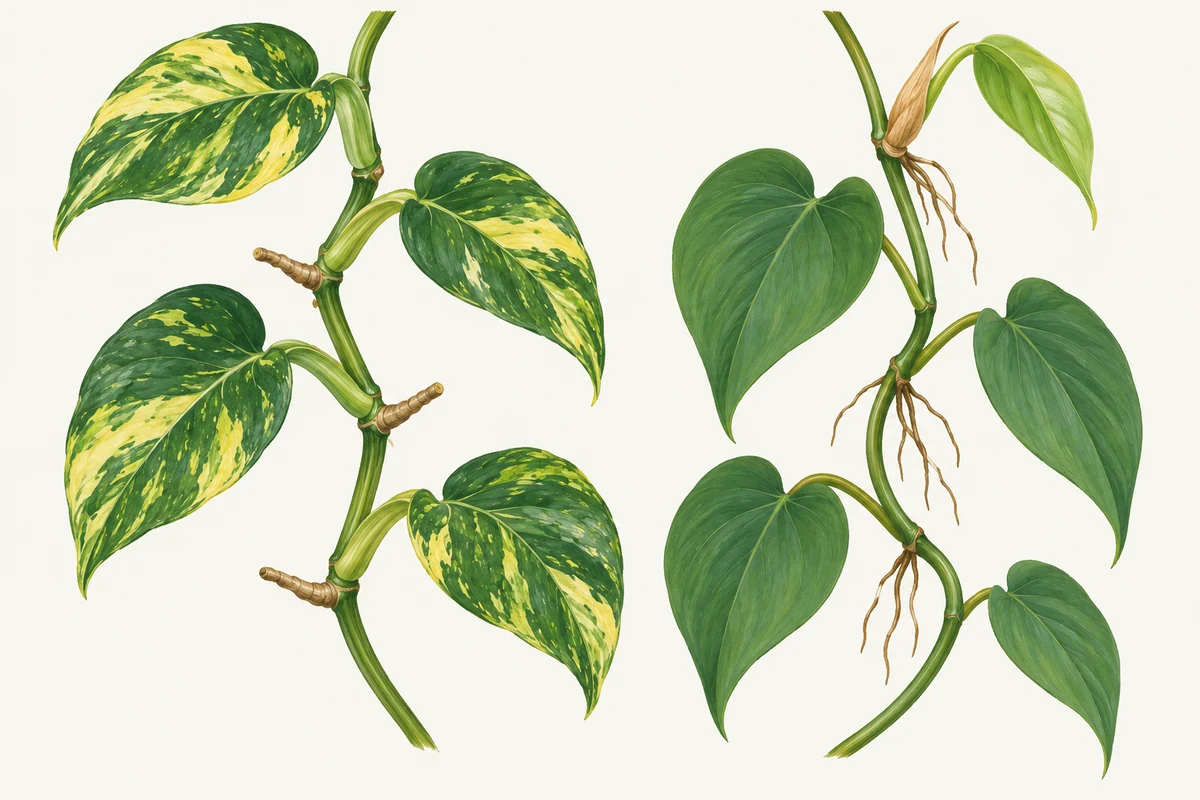
Pothos vs philodendron comes down to two field tests. Pothos (Epipremnum aureum) has a leaf stalk with a groove along it, clearest where it clasps the stem, and its new leaves unfold without a sheath. Heartleaf philodendron (Philodendron hederaceum) has rounded, ungrooved stalks, and each new leaf emerges from a papery sheath (cataphyll) that dries brown and drops. Leaf texture and roots are weaker hints.
- Groove in the leaf stalk: pothos. Rounded stalk: heartleaf philodendron.
- A brown, papery sheath at the base of the newest leaf means philodendron; pothos has none.
- Neon pothos and Philodendron 'Lemon Lime' are the hardest pair to tell by color; the stalk test still works.
Field marks at a glance
- Scientific name
- Epipremnum aureum
- Family
- Araceae (arum family)
- Type
- Houseplant, perennial, evergreen
- Leaf stalk
- Pothos: slender and grooved, the groove clasping the stem. Heartleaf philodendron: rounded, not grooved.
- New leaves
- Pothos: unfold without a cataphyll. Philodendron: emerge from a papery sheath that dries brown and falls, leaving messy remains on older stems.
- Color of new leaves
- Heartleaf philodendron leaves often emerge bronze and quickly turn green (NC State). Pothos leaves open in their cultivar's color.
- Leaf size and shape
- Pothos: heart-shaped, 3 to 6 in long and about as wide, folding inward along the midrib. Heartleaf philodendron: heart-shaped, 2 to 6 in long but only 1 to 3 in wide.
- Leaf surface
- Both glossy and leathery in NC State's descriptions. Heartleaf philodendron's underside can be green or red-purple.
- Variegation
- Pothos cultivars: yellow, cream or white streaks and marbling. Philodendron cultivars: often a central stripe ('Brasil') or all-chartreuse ('Lemon Lime').
- Aerial roots
- Both have aerial (adventitious) roots on the stems; Penn State says pothos roots form at each node. Root count per node is not a reliable test in the sources we checked.
- Native range
- Pothos: Society Islands (NC State) or Solomon Islands (Penn State). Heartleaf philodendron: Mexico to tropical America.
Pothos and heartleaf philodendron are the two trailing houseplants most often sold under each other's names. Both have glossy, heart-shaped leaves on long stems, both come in plain green and variegated forms, and both belong to the arum family. They are different genera, though, and two checks you can do in ten seconds separate them: the leaf stalk and the newest leaf.
The two field tests: leaf stalk and new leaf
Test 1: the groove in the leaf stalk. Pick a leaf and look at its stalk (petiole), especially where it joins the stem. Penn State Extension gives this as the first distinguishing feature: "the petioles of pothos have a groove, especially noticeable where they seem to 'grasp' the stem." NC State's Epipremnum aureum page describes pothos petioles as "grooved to clasp the stem," while its Philodendron hederaceum page lists "petioles are entire, not grooved" as a quick ID hint. Run a fingernail along the upper side of the stalk: a channel means pothos, a smooth round stalk means philodendron.
Test 2: the sheath on the newest leaf. Go to the tip of a growing stem. Penn State explains that newly emerging philodendron leaves have a protective sheath, a cataphyll, "that will eventually dry, turn brown, and drop off," while pothos leaves "emerge cleanly along the stem without a cataphyll." NC State describes the same thing as "conspicuous stipules on new growth" and "messy, falling stipules on older growth" in philodendron, and "no free stipules on new growth" in pothos. On an older philodendron stem, look for the dry brown scraps of old sheaths at the nodes.
| Field test | Pothos (Epipremnum aureum) | Heartleaf philodendron (Philodendron hederaceum) |
|---|---|---|
| Leaf stalk | Grooved, clasping the stem | Rounded, not grooved |
| Newest leaf | Unfolds without a sheath | Emerges from a papery sheath (cataphyll) |
| Older stems | No loose sheaths; the stalk's thin edges may dry and drop | Messy, falling sheath remains |
| Color of a just-opened leaf | Cultivar color | Often bronze, quickly turning green |
| Leaf size (houseplant) | 3 to 6 in long, 3 to 6 in wide | 2 to 6 in long, 1 to 3 in wide |
| Leaf surface | Glossy, leathery, folds inward along the midrib | Glossy, leathery; underside green or red-purple |
| Aerial roots | Brown, at each node | Present on slender stems |
| Native range | Society Islands or Solomon Islands | Mexico to tropical America |
Sources for the table: Penn State Extension, NC State Plant Toolbox, and UF/IFAS Gardening Solutions, which gives heartleaf philodendron leaves as generally 2 to 4 inches (NC State gives 3 to 6 inches long).
If both tests are hard to see in your light, one photo of a stem tip in Plant Identifier gives you a name to start from. The app shows no confidence score and no list of alternatives, so confirm its answer with the stalk groove before you relabel the pot.
Weaker hints: texture, size and aerial roots
Most online comparisons add three more tests. They help, but none is as reliable as the two above.
Leaf texture and thickness. Grower guides often describe pothos leaves as thicker and waxier and philodendron leaves as thinner and softer. NC State, however, describes both species' leaves as glossy and leathery (coriaceous), so texture is a judgment call, not a test. One detail is better documented: Penn State notes that pothos leaves fold inward along the midrib.
Leaf size and shape. On houseplants, NC State gives pothos leaves 3 to 6 inches long and wide, and heartleaf philodendron leaves 3 to 6 inches long but only 1 to 3 inches wide; UF/IFAS gives 2 to 4 inches for heartleaf philodendron. So a noticeably narrow leaf leans philodendron and a broad one leans pothos, but the ranges overlap. Both plants make much bigger leaves when they climb: UF/IFAS says heartleaf philodendron leaves can reach 12 inches or more on a tree, and the Missouri Botanical Garden gives up to 30 inches, with deep lobes, for mature pothos.
Aerial roots per node. A popular hobbyist rule says pothos has one thick aerial root per node and philodendron several thinner ones. Penn State confirms that pothos aerial roots develop at each node, and NC State describes heartleaf philodendron stems with adventitious roots, but neither gives a count. We found no extension or botanical-garden source that confirms the one-versus-several rule, so treat it as a hint at best.
Cultivars that look the most alike
Color is where most mix-ups happen, because both plants have been bred into similar shades. NC State lists these cultivars:
- Neon pothos vs Philodendron 'Lemon Lime'. Neon has yellow leaves (NC State), bright chartreuse in Penn State's words; 'Lemon Lime' has bright yellow to chartreuse foliage. By color alone they can be identical. The stalk groove and the sheath settle it.
- Golden pothos vs Philodendron 'Brasil'. Golden pothos has golden, yellow-green variegated leaves; 'Brasil' has a yellow to light-green stripe down the center with dark green borders. A central stripe points to 'Brasil', but variegation is unstable on both, so check the stalk.
- Marble Queen pothos vs Philodendron 'Cream Splash' or 'Silver Stripe'. Marble Queen has green leaves and stems marbled with white; the philodendrons carry cream to light-green centers or a silver stripe with dark green edges.
- Jade pothos vs plain heartleaf philodendron. Both are solid green. Here the bronze color of a newly opened philodendron leaf, plus the sheath, are the quickest clues.
Penn State and NC State both note that low light fades pothos variegation, and NC State notes that 'Brasil' variegation is unstable, so a plant that has gone greener is not proof of either identity. For the full list of pothos cultivars, see the pothos page.
Other plants sold as pothos or philodendron
Satin pothos (Scindapsus pictus) is a third genus. Its leaves are matte and satiny with silver-gray blotches on the upper side; neither pothos nor heartleaf philodendron has silver blotches.
Split-leaf philodendron usually means Monstera deliciosa, which is not a philodendron at all, or the shrubby Philodendron bipinnatifidum. UF/IFAS notes that philodendrons range from vining types for hanging baskets to "tree" philodendrons, and that identifying the many species is complicated by juvenile and adult leaf differences and the vast number of commercial hybrids.
Toxicity, and why the name still matters
The ASPCA lists golden pothos as toxic to cats and dogs, and lists heartleaf philodendron as toxic to dogs, cats and horses; both contain insoluble calcium oxalates. Telling them apart does not change what to do: if a pet has chewed either plant, call your vet or the ASPCA Poison Control at (888) 426-4435 (a consultation fee may apply); for a person, call Poison Control at 1-800-222-1222.
The name matters for care. UF/IFAS advises watering heartleaf philodendron when the top inch of soil is dry and keeping it above 50°F; Penn State says pothos is better kept too dry than too wet. Both want bright, indirect light and tolerate less. The houseplant identification key covers other heart-leaved vines, and how to identify plants explains the general method of checking leaves, stems and growth points in order.
Look-alikes and how to tell them apart
Heartleaf philodendron (Philodendron hederaceum)
Find the newest leaf: a philodendron leaf sits in a papery sheath that dries brown and drops, and young leaves often open bronze. Then check the stalk: rounded with no groove. Pothos has a grooved stalk and no separate sheath.
Philodendron 'Lemon Lime'
Bright yellow to chartreuse leaves like Neon pothos. Check the stalk and the newest leaf: a rounded stalk and a papery sheath mean the philodendron; a grooved stalk and no sheath mean Neon pothos.
Philodendron 'Brasil'
A heartleaf philodendron with a yellow to light-green stripe down the center of each leaf and dark green borders. NC State describes golden pothos as yellow-green variegated, without a central stripe; the stalk groove confirms it.
Satin pothos (Scindapsus pictus)
Neither a pothos nor a philodendron: matte, satin-textured leaves with silver-gray blotches on the upper side only. Both pothos and heartleaf philodendron have glossy leaves without silver blotches.
What a photo can't settle
- The stalk groove and the sheath on new growth are small: a photo of a single leaf, or of an old stem with no new growth, may not show either, so photograph a stem tip with its leaf stalks.
- UF/IFAS warns that philodendron identification is complicated by juvenile and adult leaf differences and by the vast number of commercial hybrids, so a photo may confirm Philodendron but not always the species or cultivar.
- Leaf color overlaps between cultivars (Neon pothos and 'Lemon Lime', golden pothos and 'Brasil'), and both plants lose variegation in low light; color alone cannot settle the pair.
Questions people ask
How can you tell a pothos from a philodendron?
Check the leaf stalk and the newest leaf. Pothos stalks have a groove along them, most visible where they clasp the stem, and new pothos leaves unfold without a sheath. Heartleaf philodendron stalks are rounded, and each new leaf emerges from a papery sheath that dries brown and falls off.
Are pothos and philodendron the same plant?
No. They belong to the same family, Araceae, but to different genera: pothos is Epipremnum aureum, heartleaf philodendron is Philodendron hederaceum. Penn State Extension notes that pothos is sometimes mistaken for the vining heartleaf philodendron; the leaf stalk groove tells them apart.
Is Neon pothos the same as Philodendron Lemon Lime?
No. Both have bright chartreuse leaves, but Neon is a cultivar of pothos (Epipremnum aureum) and 'Lemon Lime' a cultivar of heartleaf philodendron (Philodendron hederaceum). Use the stalk test: grooved means Neon pothos, rounded with a papery sheath on new growth means 'Lemon Lime'.
Are pothos and philodendron toxic to cats and dogs?
The ASPCA lists both golden pothos and heartleaf philodendron as toxic to dogs and cats, and heartleaf philodendron also to horses; both contain insoluble calcium oxalates. If a pet chewed either, call your vet or the ASPCA Poison Control at (888) 426-4435. For a person, call Poison Control at 1-800-222-1222.
Do pothos leaves feel thicker than philodendron leaves?
Many grower guides say so, but NC State describes the leaves of both as glossy and leathery, so texture is a weak test on its own. Size helps a little more: NC State gives pothos leaves 3 to 6 inches wide and heartleaf philodendron leaves 1 to 3 inches wide.
Sources
- Pothos as a Houseplant — Penn State Extension
- Epipremnum aureum — NC State Extension Gardener Plant Toolbox
- Philodendron hederaceum — NC State Extension Gardener Plant Toolbox
- Heartleaf Philodendron — UF/IFAS Gardening Solutions
- Philodendrons — UF/IFAS Gardening Solutions
- Epipremnum aureum (Plant Finder) — Missouri Botanical Garden
- Golden Pothos (Epipremnum aureum) — ASPCA
- Heartleaf Philodendron (Philodendron hederaceum) — ASPCA
Keep reading
- Houseplant profilePothos (Epipremnum aureum): how to identify it
- Houseplant profileMonstera deliciosa (Swiss cheese plant): how to identify it
- Houseplant profilePhilodendron: how to identify the vining and split-leaf types
- Field guideHow to identify a plant, step by step
- Pet safety guidePlants toxic to cats, and what to do if your cat chewed one