Pet safety guide
Plants toxic to cats, and what to do if your cat chewed one
Call first, identify second. Then a table of common houseplants and garden plants as the ASPCA lists them, with the signs it names, and why lilies come first.
In short
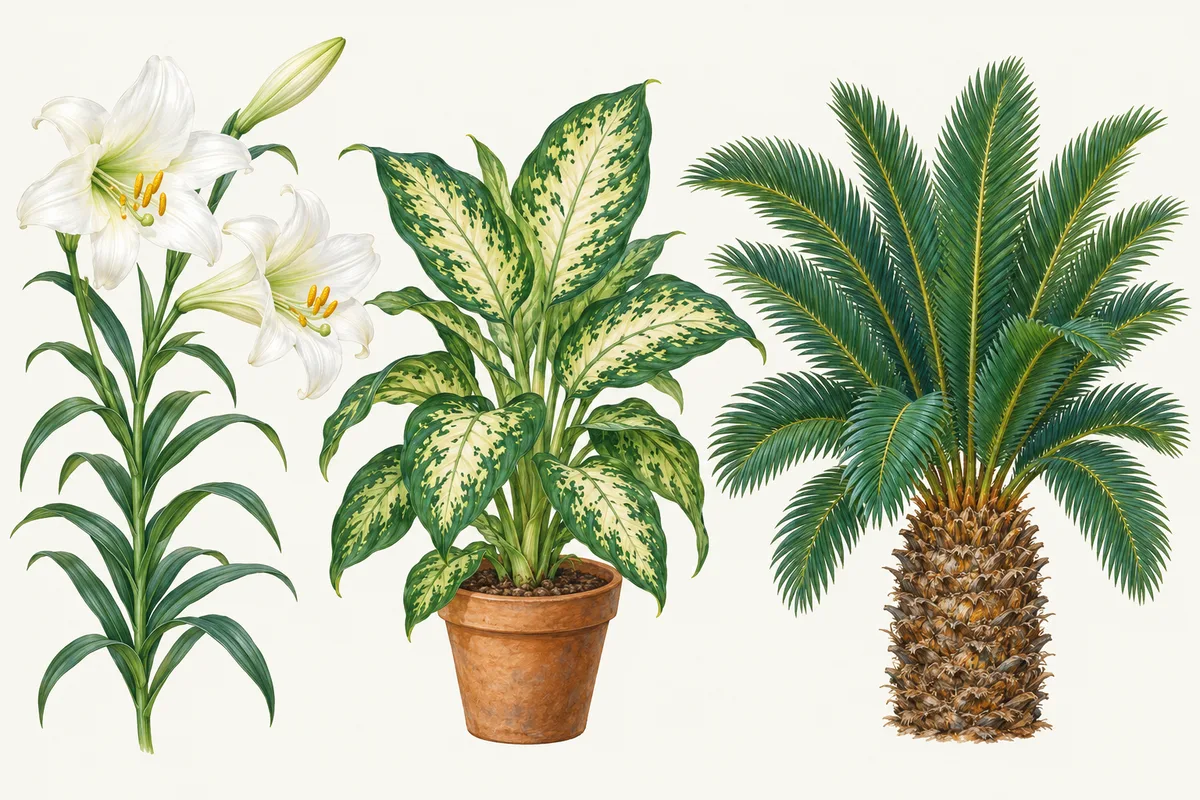
Plants toxic to cats include true lilies and daylilies, which can cause kidney failure, plus pothos, peace lily, monstera, philodendron, dieffenbachia, snake plant, aloe, jade plant, kalanchoe, sago palm, oleander, azalea, tulip and daffodil bulbs, all listed by the ASPCA. If your cat chewed any plant you can't name, call your vet or ASPCA Animal Poison Control at (888) 426-4435 now, and keep a piece of the plant.
- Any part of a true lily (genus Lilium) or a daylily, even pollen licked off fur or vase water, can cause kidney failure in cats, per the FDA.
- ASPCA Animal Poison Control: (888) 426-4435, 24 hours; a consultation fee may apply. UK: your vet, or Animal PoisonLine on 01202 509 000 (£35 to £45 per call).
- The ASPCA says its list is not all-inclusive and that eating any plant can cause vomiting in cats, so no list proves a plant harmless.
If your cat has just chewed a plant, you need two things fast: someone qualified on the phone, and the plant's name. This page gives the numbers first, then how to name the plant, then how the ASPCA lists 25 common houseplants and garden plants, with lilies in their own section because they are the plants most likely to cause lasting harm.
Your cat chewed a plant: what to do now
- Call before you search. In the US, call your vet or the ASPCA Animal Poison Control Center at (888) 426-4435, open 24 hours a day, 365 days a year. The ASPCA says a consultation fee may apply. Pet Poison Helpline is a second 24-hour line, (855) 764-7661, with a $99 per-incident fee stated on its site (read October 21, 2026).
- In the UK, call your vet or Animal PoisonLine on 01202 509 000, run by the Veterinary Poisons Information Service. It charges £35 per call from 8am to 8pm Monday to Friday and £45 at other times. Its own page says to contact your vet immediately, not the line, for true lilies in a cat, or if your pet has collapsed, is having convulsions or has trouble breathing.
- Keep a piece of the plant, or the pot label, and take photos of the whole plant and any chewed leaves. The FDA asks owners to bring the plant to the clinic or photograph it, and the RHS says to take samples of the plant to the vet.
- Don't try home remedies. Pet Poison Helpline says not to give home antidotes and not to make your pet vomit without first talking to a vet or a poison line.
- Don't wait for signs. Pet Poison Helpline says early treatment is vital for cats after any exposure to true lilies, so call even if your cat still seems fine.
If a child or adult has eaten part of a plant, call Poison Control at 1-800-222-1222 in the US, or NHS 111 in the UK (999 in an emergency).
How to find out what the plant is
Poison lines ask for the plant's name, and "the green one by the window" slows them down. In this order:
- The label. A nursery tag or florist card often gives the scientific name, which is what the ASPCA list is sorted by. Common names overlap: "lily" covers dangerous true lilies and much milder peace lilies.
- The receipt or the seller. A bouquet's florist can tell you whether it held lilies or alstroemeria.
- A photo. Take one sharp picture of a leaf and, if there is one, a flower; our guide to photographing a plant for identification shows what to frame. A plant identification app gives you a name to check in seconds.
Plant Identifier names a plant from one photo, and its Toxicology tool adds AI-written notes on the toxic parts and the symptoms in people, dogs and cats, plus what to do. Treat those notes as a pointer to the right ASPCA entry, never as a verdict: an AI can misname a plant or miss a risk, and it can't judge how much your cat ate. Plant Identifier's result also shows the scientific name, which is the name to match against the ASPCA entry. If you're not sure of the plant, say so on the phone.
How the ASPCA lists common houseplants and garden plants
Each row links to the ASPCA's own entry and repeats the signs that entry names. "Toxic to cats" is the ASPCA's classification, read October 21, 2026. The ASPCA says its list "is not meant to be all-inclusive", and that eating any plant material may cause vomiting and stomach upset in cats.
| Plant (scientific name) | ASPCA listing | Signs the ASPCA names |
|---|---|---|
| Lilies (Lilium: Easter, tiger, stargazer, Japanese show) | Toxic to cats; non-toxic to dogs | Vomiting, loss of appetite, lethargy, kidney failure; death is possible |
| Lily of the valley (Convallaria majalis) | Toxic to cats and dogs | Vomiting, irregular heartbeat, low blood pressure, disorientation, coma, seizures |
| Peace lily (Spathiphyllum) | Toxic to cats and dogs | Burning of mouth, tongue and lips, drooling, vomiting, difficulty swallowing |
| Calla lily (Zantedeschia aethiopica) | Toxic to cats and dogs | Mouth irritation, drooling, vomiting, difficulty swallowing |
| Golden pothos (Epipremnum aureum) | Toxic to cats and dogs | Mouth irritation, drooling, vomiting, difficulty swallowing |
| Monstera (Monstera deliciosa, listed as Mexican breadfruit) | Toxic to cats and dogs | Mouth irritation, drooling, vomiting, difficulty swallowing |
| Philodendron (Philodendron, incl. heartleaf) | Toxic to cats and dogs | Mouth irritation, drooling, vomiting, difficulty swallowing |
| Dieffenbachia (dumb cane) | Toxic to cats and dogs | Mouth irritation, drooling, vomiting, difficulty swallowing |
| Snake plant (Sansevieria trifasciata) | Toxic to cats and dogs | Nausea, vomiting, diarrhea |
| Aloe (Aloe vera) | Toxic to cats and dogs | Vomiting, lethargy, diarrhea |
| Jade plant (Crassula) | Toxic to cats and dogs | Vomiting, depression, incoordination |
| Kalanchoe (Kalanchoe) | Toxic to cats and dogs | Vomiting, diarrhea, abnormal heart rhythm (rare) |
| Poinsettia (Euphorbia pulcherrima) | Toxic to cats and dogs | Irritates mouth and stomach, sometimes vomiting; the ASPCA calls it "generally over-rated in toxicity" |
| English ivy (Hedera helix) | Toxic to cats and dogs | Vomiting, abdominal pain, drooling, diarrhea |
| Cyclamen (Cyclamen) | Toxic to cats and dogs | Drooling, vomiting, diarrhea; after large amounts of tuber, heart rhythm problems and seizures |
| Amaryllis (Amaryllis) | Toxic to cats and dogs | Vomiting, depression, diarrhea, abdominal pain, drooling, tremors |
| Tulip (Tulipa) | Toxic to cats and dogs | Vomiting, depression, diarrhea, drooling; most toxin in the bulb |
| Daffodil (Narcissus) | Toxic to cats and dogs | Vomiting, drooling, diarrhea; bulbs are the most poisonous part |
| Hyacinth (Hyacinthus orientalis) | Toxic to cats and dogs | Intense vomiting, diarrhea, depression, tremors |
| Chrysanthemum (mum) | Toxic to cats and dogs | Vomiting, diarrhea, drooling, incoordination, dermatitis |
| Azalea (Rhododendron) | Toxic to cats and dogs | Vomiting, diarrhea, weakness, cardiac failure |
| Hydrangea (Hydrangea) | Toxic to cats and dogs | Vomiting, depression, diarrhea |
| Oleander (Nerium oleander) | Toxic to cats and dogs | Drooling, abdominal pain, diarrhea, depression, death |
| Sago palm (Cycas revoluta) | Toxic to cats and dogs | Vomiting, bloody stools, jaundice, bruising, liver failure, death |
| Autumn crocus (Colchicum autumnale) | Toxic to cats and dogs | Bloody vomiting, diarrhea, shock, multi-organ damage |
The Cornell Feline Health Center adds mistletoe, holly, foxglove, baby's breath and sweet William to the plants it calls toxic for cats, and says its list is not limited to those. If you're reading in the UK and searching for plants poisonous to cats, the same plants apply; the RHS also lists ZZ plant (Zamioculcas) as harmful if eaten, a plant we could not find on the ASPCA list. If your plant isn't here, use the ASPCA's full list or our houseplant identification key to put a name to it first.
Lilies: the plants to keep away from cats
True lilies (genus Lilium) and daylilies (Hemerocallis) are a different level of risk. The FDA says every part is toxic to cats: stem, leaves, flowers, pollen and even the water in the vase. Eating a small amount of leaf or petal, licking pollen off fur or drinking vase water can cause kidney failure in less than three days. The toxin has not been identified, and it affects cats only; dogs may get an upset stomach but not kidney failure.
Pet Poison Helpline names Easter, Madonna, Oriental, stargazer and tiger lilies among the Lilium lilies it covers, counts any amount of leaf, stem, flower, pollen, vase water or rhizome, and says early treatment is vital for cats. The FDA's list of lilies dangerous to cats: Asiatic (including hybrids), daylily, Easter, Japanese show, Oriental, rubrum, stargazer, tiger and wood lilies.
Not every plant called a lily works this way:
- Peace lily and calla lily are aroids, not true lilies. The FDA says their calcium oxalate crystals irritate the mouth and throat (pawing, drooling, foaming, vomiting) and don't cause kidney failure. The ASPCA still lists both as toxic to cats, and both belong to the arum family (Araceae) on their ASPCA entries, not the lily family. Our peace lily page covers how to recognize the plant.
- Lily of the valley is not a true lily, but the FDA calls it very dangerous to cats and dogs because it can cause abnormal heart rhythms.
- Gloriosa (flame) lily: the FDA says its roots or tubers can cause serious organ failure in cats and dogs.
- Peruvian lily (Alstroemeria), common in bouquets: the FDA says a large amount may cause mild stomach upset and that it does not cause kidney failure in cats.
The FDA advises keeping true lilies and daylilies out of homes with cats, and out of gardens cats can reach. Check bouquets before they come inside: lilies are common in spring and sympathy arrangements.
Listed as non-toxic is not the same as harmless
The ASPCA list also marks some plants as non-toxic. That is the ASPCA's classification, not ours, and this page doesn't repeat those entries as a shopping list, because the classification comes with limits:
- The ASPCA says eating any plant material may cause vomiting and stomach upset, and that plants listed as non-toxic or as causing mild stomach upset are "not expected to be life-threatening". Not expected is not never.
- Plants are often sold under the wrong common name. Check the scientific name on the label against the ASPCA entry.
- Potting soil, fertilizer and pest sprays on a plant can cause problems of their own.
- A plant missing from any list has not been cleared; it may simply not be there.
So if your cat chewed something and is acting unwell, call your vet whatever the list says. For dogs, the plants that cause the most serious cases are different; see our guide to poisonous plants for dogs.
What a photo can't settle
- A photo app can't tell you how much your cat ate, whether it needs treatment, or how urgent it is. Only your vet or an animal poison line can.
- Lilies out of flower are hard to name from a photo, and a true lily (Lilium) can look like a daylily (Hemerocallis) or a Peruvian lily (Alstroemeria). Treat any lily-like plant as an emergency until a vet says otherwise.
- AI-written toxicity notes, ours included, can be wrong or incomplete. Check the plant against the ASPCA entry and your vet's advice before you rely on them.
Questions people ask
Is a peace lily as dangerous to cats as an Easter lily?
No, according to the FDA. Peace and calla lilies are not true lilies; their calcium oxalate crystals irritate the mouth and can cause drooling and vomiting, but not the kidney failure true lilies and daylilies can cause. The ASPCA still lists both as toxic to cats, so call your vet or poison control.
Are snake plants toxic to cats?
The ASPCA lists snake plant (Sansevieria trifasciata, also called mother-in-law's tongue) as toxic to cats and dogs, naming nausea, vomiting and diarrhea as the signs. If your cat chewed one, call your vet or ASPCA Animal Poison Control at (888) 426-4435.
Is the ZZ plant on the ASPCA list?
We could not find a ZZ plant entry on the ASPCA plant list on October 21, 2026. The UK's RHS lists Zamioculcas as harmful if eaten and a skin and eye irritant. A missing entry tells you nothing either way, so treat a chewed ZZ plant like any other and call your vet.
Can I trust a list of non-toxic plants for my cat?
Use it as a starting point only. The ASPCA says its list covers the most frequently encountered plants, is not all-inclusive, and that eating any plant material may cause vomiting and stomach upset. Plants are also often sold under the wrong name, so check the scientific name on the label.
How much does ASPCA Animal Poison Control cost?
The ASPCA's own pages say a consultation fee may apply and do not state an amount. Pet Poison Helpline, (855) 764-7661, states a $99 per-incident fee. In the UK, Animal PoisonLine charges £35 to £45 per call. Fees as read on October 21, 2026.
Sources
- Toxic and Non-Toxic Plants List — ASPCA Animal Poison Control
- ASPCA Poison Control — ASPCA
- Lovely Lilies and Curious Cats: A Dangerous Combination — U.S. Food and Drug Administration
- Lilies — Pet Poison Helpline
- Common Cat Hazards — Cornell Feline Health Center, Cornell University College of Veterinary Medicine
- Animal PoisonLine — Animal PoisonLine (Veterinary Poisons Information Service)
- 24/7 Animal Poison Control Center — Pet Poison Helpline
- Potentially harmful garden plants — Royal Horticultural Society (RHS)
Keep reading
- Pet safety guidePoisonous plants for dogs, and what to do if your dog ate one
- Houseplant profilePeace lily (Spathiphyllum): how to identify it
- Houseplant profilePothos (Epipremnum aureum): how to identify it
- Free toolHouseplant identification key
- Photo checklistHow to photograph a plant for identification