Houseplant profile
Peace lily (Spathiphyllum): how to identify it
A stemless clump of glossy, dark green, pointed leaves with sunken side veins, and white 'flowers' that are really one hooded leaf around a spike. Here is what to check.
In short
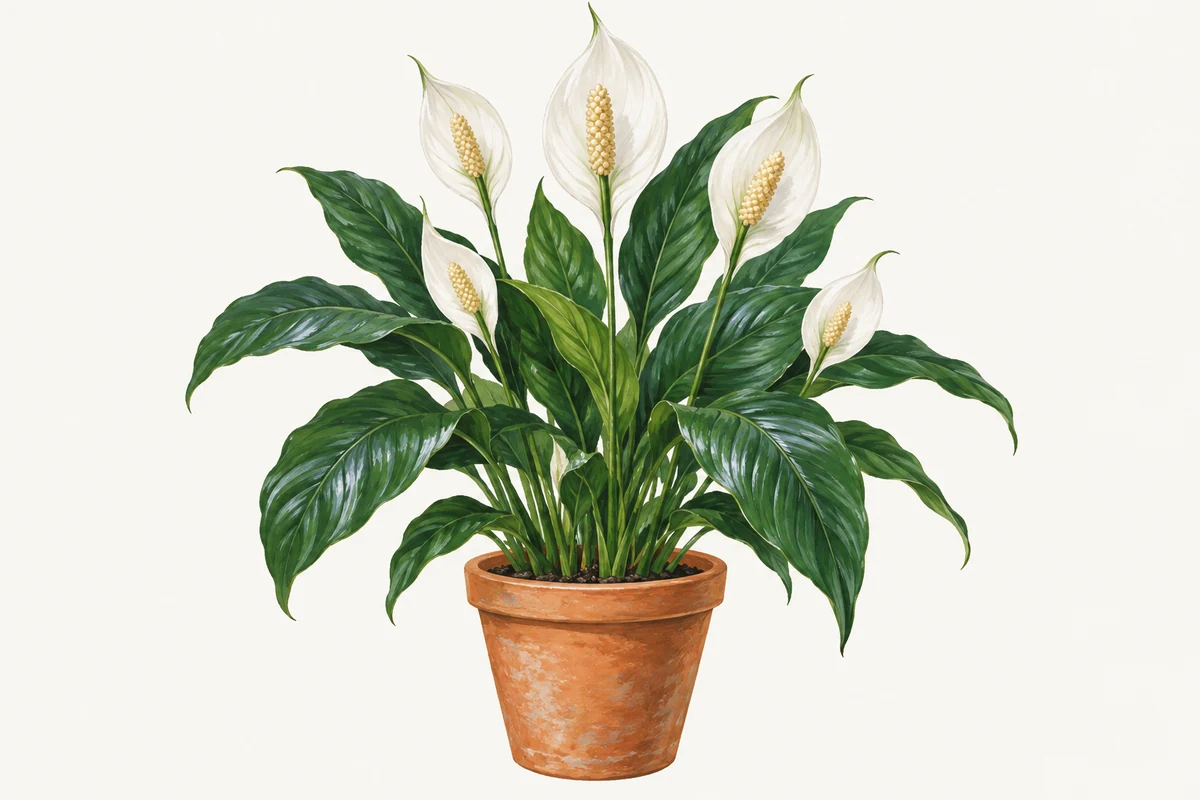
A peace lily plant (Spathiphyllum) is a stemless clump of glossy, dark green, lance-shaped leaves with deeply impressed side veins. Its white "flower" is a single oblong spathe, slightly cupped around an upright cream spadix, held on a stalk above the leaves; it turns pale green as it ages. Indoors it usually reaches about 3 feet. Despite its name, it is an aroid, not a lily.
- Pointed, lance-shaped leaves plus a white spathe around a cream spadix point to Spathiphyllum.
- Heart-shaped leaves and a flat, waxy spathe mean anthurium; a funnel-shaped spathe around a yellow spadix means calla lily.
- The ASPCA lists peace lily as toxic to dogs and cats (insoluble calcium oxalates).
Field marks at a glance
- Scientific name
- Spathiphyllum
- Family
- Araceae (arum family)
- Type
- Houseplant, perennial, evergreen
- Leaves
- Simple, erect, in basal rosettes; ovate-lanceolate to elliptic-oblong with a long-pointed tip, 4 to 25 inches long and 1 to 10 inches wide (NC State).
- Leaf surface
- Dark green, glossy and slightly wrinkled, with a prominent midrib and numerous sunken side veins (NC State). Hairless.
- Leaf stalk
- Shorter than or as long as the blade (NC State); stalks rise from the base of the clump.
- Stem
- None visible: a clumping plant whose leaves and flower stalks come up from soil level.
- Flower (spathe)
- One white to greenish-white spathe, oblong, flat to cupped, curving around the spadix; 4 to 12 inches, held above the foliage. It turns pale green after about 10 days.
- Spadix
- An upright, greenish-white or cream spike of tiny true flowers, shorter than the spathe (NC State).
- Size
- 1 to 6 ft tall and 1 to 5 ft wide (Missouri Botanical Garden, NC State); indoors more typically about 3 ft. UF/IFAS gives 1 to 4 ft.
- Native range
- Tropical America (Mexico southward) and Malesia to the western Pacific (NC State); MBG says forest floors of tropical Central America and Southeast Asia.
- Genus
- About 50 species (Missouri Botanical Garden) or about 60 (NC State). Most houseplants are named cultivars, such as 'Mauna Loa', 'Domino' and 'Sensation'.
The peace lily (Spathiphyllum) is a clumping tropical aroid grown indoors for its glossy leaves and its long-lasting white "flowers". It is easy to confuse with other white-flowered aroids, so check the leaf and the flower structure in the order below.
How to identify a peace lily plant in four checks
1. The leaf shape. Hold a leaf flat. A peace lily leaf is lance-shaped to elliptic, widest near the middle and tapering to a long point; the base narrows into the stalk rather than forming a heart or an arrow. The NC State Plant Toolbox gives 4 to 25 inches long and 1 to 10 inches wide, a range that covers both small and giant cultivars.
2. The veins. Look along the blade. There is a prominent midrib and numerous side veins pressed into the surface, so the leaf looks slightly ribbed or wrinkled. The surface is dark green and glossy.
3. The flower. The white part is not a petal but a spathe, a modified leaf. On a peace lily it is a single oblong spathe, flat to cupped, curving around an upright, cream or greenish-white spadix that is shorter than the spathe. NC State gives 4 to 12 inches for the inflorescence, held on a stalk above the leaves, and notes that the spathe turns pale green after about 10 days and stays attractive for at least another month.
4. The base. Part the leaves at soil level. There is no trunk or cane: leaves and flower stalks rise from a clump. A plant with a visible upright stem and patterned leaves is more likely a Chinese evergreen (see below).
When a plant arrives without a tag, Plant Identifier can give a common and scientific name from one photo; include a leaf and, if there is one, a flower. The app shows no confidence score and no list of alternatives, so compare its answer with the checks above.
Peace lily cultivars and sizes
The Missouri Botanical Garden describes Spathiphyllum as a genus of around 50 species of clumping evergreen perennials from tropical forest floors; NC State counts about 60. Size ranges from 1 to 6 feet tall, though NC State notes that indoor plants more typically reach about 3 feet high and wide, and UF/IFAS Gardening Solutions gives one to four feet. Plants sold in stores are usually named cultivars. NC State lists these:
- 'Mauna Loa': large, with leaves nearly 3 feet long and a large white spathe.
- 'Sensation' (S. wallisii): over 5 feet tall.
- 'Domino' (S. wallisii): 1 to 3 feet, deep green leaves streaked pale green to cream.
- 'Gemini' and 'Variegata' (S. wallisii): up to 12 inches, with irregular white stripes, more prominent in 'Variegata'.
- 'Petite': small, bred for houseplant culture.
NC State describes S. wallisii itself as native to Colombia and Venezuela and up to about 12 inches tall. A striped or very large plant can still be a peace lily: the leaf shape, the sunken veins and the spathe-and-spadix flower stay the same.
Peace lily vs anthurium, calla lily and Chinese evergreen
All four are aroids with a spathe and spadix, which is why they get mixed up. The leaf usually settles it before the flower does.
| Feature | Peace lily | Anthurium | Calla lily | Chinese evergreen |
|---|---|---|---|---|
| Leaf shape | Lance-shaped, long-pointed | Heart-shaped | Arrow- to heart-shaped, wavy edge | Lance-shaped, often patterned |
| Spathe | White, oblong, cupped | Flat, waxy heart, red, pink, orange or white | White funnel or trumpet | Greenish-white, 1 to 3 in, uncommon |
| Spadix | Cream, shorter than the spathe | Straight, cream to yellow | Yellow | Whitish-yellow |
| Visible stem | No | No | No (leaves from a rhizome) | Yes, cane-like |
Sources: NC State on anthurium, NC State on calla lily and NC State on Aglaonema. NC State notes that calla lilies are not true lilies either, and that calla is a garden plant hardy to about zone 8, blooming in June and July, while the peace lily is grown indoors. For a step-by-step route through other houseplants, try the houseplant identification key.
Is a peace lily toxic to pets
The ASPCA lists peace lily (Spathiphyllum, also Mauna Loa peace lily) as toxic to dogs and cats. It names insoluble calcium oxalates as the toxic principle and lists oral irritation, intense burning and irritation of the mouth, tongue and lips, excessive drooling, vomiting and difficulty swallowing. NC State lists the leaves as the poisonous part.
If a pet has chewed a leaf or flower, call your vet or the ASPCA Animal Poison Control Center at (888) 426-4435. For a person, call Poison Control at 1-800-222-1222 (poison.org). Plant Identifier's Toxicology tool gives AI-written notes for people, dogs and cats; treat them as a starting point, not as the answer. More houseplants on the ASPCA's lists are in plants toxic to cats and poisonous plants for dogs.
A short care note
Missouri Botanical Garden recommends evenly moist but not soggy soil, letting it dry between waterings without letting the plant wilt, and bright filtered light out of direct sun; it tolerates lower light. It advises fertilizer at a quarter of the recommended strength, since overfeeding can burn leaf tips and roots, and warns that long periods below 40°F can damage leaves, stems and roots. NC State adds that direct sun can cause brown leaf tips and that bottom watering works well. For yellowing leaves, see yellow leaves on plants.
Look-alikes and how to tell them apart
Anthurium, flamingo flower (Anthurium andraeanum)
Check the leaf base and the spathe. Anthurium leaves are heart-shaped, 8 to 12 inches long, and its spathe is a flat, glossy, waxy heart, usually red, pink or orange (NC State). Peace lily leaves taper at both ends and its spathe is oblong and cupped, never heart-shaped.
Calla lily (Zantedeschia aethiopica)
Look into the flower. Calla's white spathe rolls into a funnel or trumpet around a yellow spadix, and its leaves are arrow- to heart-shaped with wavy edges (NC State). A peace lily spathe stays open, around a cream spadix, above narrow, pointed leaves.
Chinese evergreen (Aglaonema)
Look for a stem. Aglaonema grows on upright, cane-like stems often blotched silver-gray, its leaves are 4 to 8 inches and often patterned silver, pink or red, and its rare spathe is only 1 to 3 inches (NC State). A peace lily has no visible stem and plain dark green leaves.
What a photo can't settle
- Peace lilies sold in stores are mostly named cultivars, and many differ only in size or leaf width; a photo can name the genus but often not the cultivar.
- Without its white spathe, a young peace lily can look like several other plain-leaved aroids. Wait for a flower, or check the leaf shape and veins carefully.
- Whether a pet that chewed a leaf needs treatment is for your vet or a poison control center to decide, not for this page or an app.
Questions people ask
Is a peace lily a real lily?
No. Peace lilies belong to the arum family, Araceae, with anthurium, calla and monstera; true lilies are a different family. The white flower is a spathe, a modified leaf around a spike of tiny flowers. The genus name comes from the Greek for spathe leaf (NC State).
Why is my peace lily flower turning green?
That is normal aging. NC State notes that the white spathe turns pale green after about 10 days and stays attractive for at least another month. A green spathe does not mean the plant is sick.
What is the biggest peace lily?
Size depends on the cultivar. NC State describes 'Sensation' as growing over 5 feet tall and 'Mauna Loa' with leaves nearly 3 feet long, while S. wallisii 'Gemini' and 'Variegata' stay around 12 inches. The genus ranges from 1 to 6 feet overall.
Is a peace lily poisonous to cats and dogs?
The ASPCA lists peace lily as toxic to dogs and cats, naming insoluble calcium oxalates and signs such as burning and irritation of the mouth, tongue and lips, drooling, vomiting and difficulty swallowing. If your pet chewed it, call your vet or the ASPCA Animal Poison Control Center at (888) 426-4435. For a person, call Poison Control at 1-800-222-1222.
Sources
- Spathiphyllum — North Carolina Extension Gardener Plant Toolbox (NC State)
- Spathiphyllum (peace lily), Plant Finder — Missouri Botanical Garden
- Peace Lily — UF/IFAS Gardening Solutions
- Peace Lily — ASPCA Animal Poison Control Center
- Anthurium andraeanum — North Carolina Extension Gardener Plant Toolbox (NC State)
- Zantedeschia aethiopica — North Carolina Extension Gardener Plant Toolbox (NC State)
- Aglaonema — North Carolina Extension Gardener Plant Toolbox (NC State)
- Poison Control — National Capital Poison Center
Keep reading
- Houseplant profileKentia palm (Howea forsteriana): how to identify it
- Pet safety guidePlants toxic to cats, and what to do if your cat chewed one
- Pet safety guidePoisonous plants for dogs, and what to do if your dog ate one
- Plant profileBoston fern (Nephrolepis exaltata): how to identify it
- Houseplant profileMonstera deliciosa (Swiss cheese plant): how to identify it