Houseplant profile
Kentia palm (Howea forsteriana): how to identify it
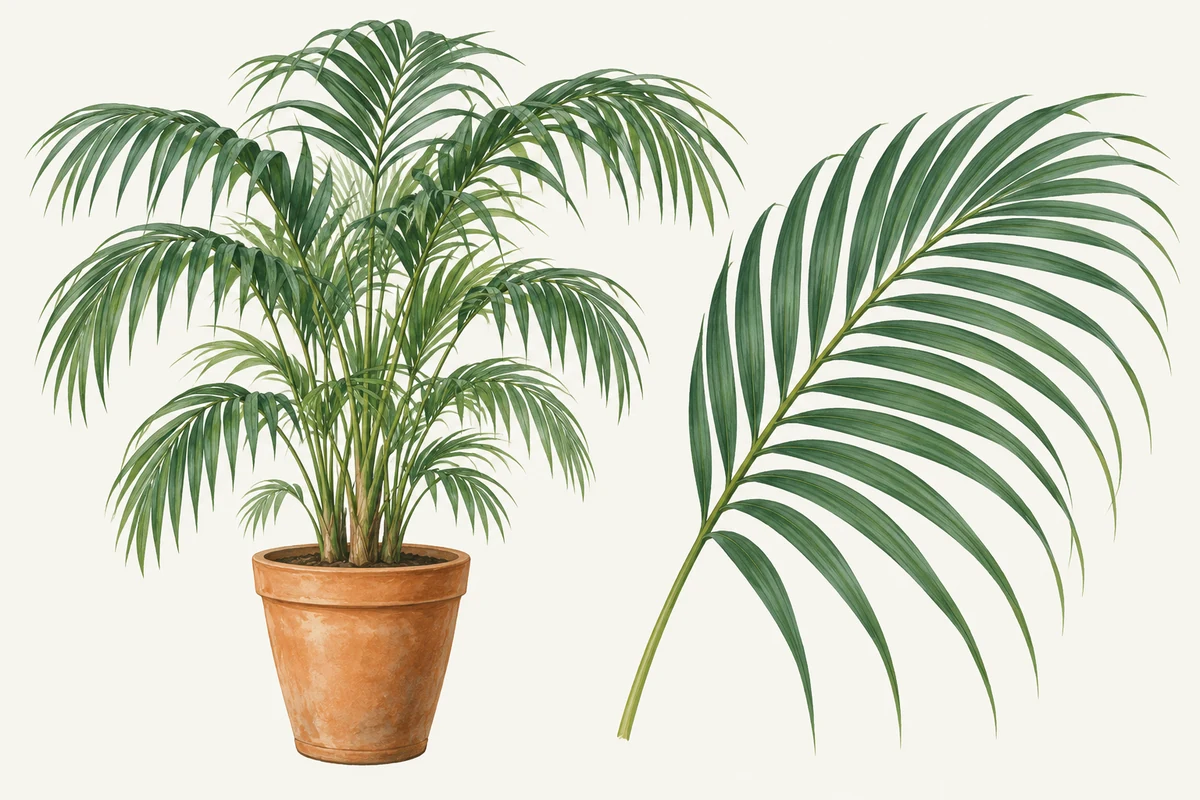
Dark green, feather-shaped fronds that arch out and let their leaflets hang down, on long stalks from single, unbranched stems, often three or more to a pot.
In short
A kentia palm (Howea forsteriana) has feather-shaped fronds that arch outward on long stalks, with dark green leaflets that droop downward, lighter green underneath. Each stem is single and never suckers, though nurseries often pot several together. NC State gives fronds up to 10 to 12 feet long with up to 90 leaflets in the wild. It comes only from Lord Howe Island, Australia.
- Drooping, dark green leaflets on single, non-clumping stems point to kentia; upright yellowish stalks in clumps point to areca.
- Lady palm leaves are fans, not feathers; parlor palm fronds are small, with 11 to 20 narrow leaflets.
- The ASPCA lists kentia palm as non-toxic to dogs and cats; a listing is not a guarantee.
Field marks at a glance
- Scientific name
- Howea forsteriana
- Family
- Arecaceae (palm family)
- Type
- Houseplant, perennial, evergreen
- Leaf type
- Pinnate (feather-shaped) fronds that arch outward; leaflets bend downward instead of standing stiffly (NC State).
- Leaflets
- Dark green on the upper side, lighter green underneath, smooth-edged; up to 90 per frond and about 2.5 ft long by 2 in wide on mature plants (NC State).
- Frond size
- Up to 10 to 12 ft long on mature plants; much shorter on young potted palms.
- Stems
- Single-stemmed, not suckering. A pot with several trunks is several plants grown together (NC State). Young stems are dark green, turning brown with age.
- Leaf curve
- Fronds arch but are not recurved; the closely related Belmore sentry palm has fronds that curl into almost a half circle.
- Flowers
- White, on 3 to 7 spikes fused at the base, an inflorescence about 3.5 ft long that hangs below the leaves; fall to winter (NC State). Rare indoors.
- Fruit
- Oval, pointed at each end, ripening reddish-brown; NC State says fruit appears once the palm is about 15 years old.
- Native range
- Endemic to Lord Howe Island, Australia, in coastal and low-elevation habitats (NC State).
- Other names
- Thatch palm, sentry palm, paradise palm; formerly Kentia forsteriana.
The kentia palm (Howea forsteriana) has been a parlor and hotel-lobby palm since Victorian times, and NC State notes it tolerates low light, dust, central heating and neglect. It is a feather palm with a quiet look: dark green fronds that arch out and let their leaflets hang. Check the leaflets first, then the stems, then the curve of the fronds.
How to identify a kentia palm in four checks
1. The frond. Look at one whole leaf. It is pinnate, shaped like a feather: a long central stalk with narrow leaflets on both sides. On a kentia, the NC State Plant Toolbox says the fronds arch and the leaflets bend downward, so a mature plant looks soft and drooping rather than spiky. Mature fronds reach 10 to 12 feet with up to 90 leaflets; a young potted palm carries far fewer.
2. The leaflet color. Turn a leaflet over. NC State describes leaflets dark green on the upper side and lighter green underneath, about 2.5 feet long and 2 inches wide on mature fronds. The stalks are green, not yellow or golden.
3. The stems. Part the fronds at soil level. Each kentia stem is single and unbranched: the species is not a suckering palm. Nurseries often pot three or more seedlings together for a fuller look, so count trunks, not leaves. Young stems are dark green and turn brown as the palm ages.
4. The curve. Step back and look at the outline. Kentia fronds arch outward but do not curl back on themselves. If they curve into almost a half circle, you may have the Belmore sentry palm, its sister species from the same island.
If you can't place the palm, one photo of a whole frond plus the base of the stems is enough for Plant Identifier to suggest a common and scientific name. The app shows no confidence score and no list of alternatives, so check its answer against the four marks above.
Kentia palm vs parlor, areca and lady palm
These four are the palms most often sold for homes and offices. Two marks separate them: feather or fan, and single stems or clumps.
| Feature | Kentia palm | Parlor palm | Areca palm | Lady palm |
|---|---|---|---|---|
| Scientific name | Howea forsteriana | Chamaedorea elegans | Chrysalidocarpus lutescens | Rhapis excelsa |
| Leaf type | Feather, arching | Feather, small | Feather, upward-curving | Fan, 3 to 10 segments |
| Leaflets | Up to 90, drooping | 11 to 20, narrow | 40 to 60 pairs, in a V | Square, toothed tips |
| Stems | Single, green to brown | Single, thin, bamboo-like | Clumping, ringed, yellowish | Clumping, fiber-covered |
| Native range | Lord Howe Island | Mexico to Honduras | Madagascar | Southern China, Vietnam |
The parlor palm figures are from NC State on Chamaedorea elegans, which notes that growers also put three or more plants in a pot, so count leaflets rather than stems for that one. NC State on the areca palm now files it as Chrysalidocarpus lutescens, previously Dypsis lutescens, the name still on many tags and on the ASPCA's list. NC State on Rhapis excelsa gives the lady palm's quick ID: palmately divided leaves, usually 5 to 7 segments, with blunt, shredded-looking tips. For other indoor plants, the houseplant identification key works through the same leaf-first questions, and how to identify plants explains the method.
Names and the Belmore sentry palm
The genus Howea is named for Lord Howe Island, its only home, and forsteriana honors William Forster, a 19th-century New South Wales senator. Older books call the plant Kentia forsteriana, which is where "kentia" comes from; other common names are thatch palm, sentry palm and paradise palm.
NC State on Howea belmoreana describes the only other species in the genus. Both are endemic to Lord Howe Island, but kentia favors the coast while the Belmore sentry palm grows higher up. The Belmore palm grows more slowly, stays smaller, has closely spaced trunk rings and fronds that curl into almost a half circle. Confusingly, NC State lists "kentia palm" among its common names too, so check the curve of the fronds rather than the label.
Is kentia palm toxic to pets
The ASPCA lists kentia palm (Howea forsteriana) as non-toxic to dogs and cats. That is the ASPCA's classification, not a guarantee. Its plant list warns that eating any plant material may cause vomiting and stomach upset, and that plants may differ in appearance from its photos, so confirm the name first.
If a pet is unwell after chewing a plant, call your vet or the ASPCA Animal Poison Control Center at (888) 426-4435. For a person, call Poison Control at 1-800-222-1222 (poison.org). Plant Identifier's Toxicology tool gives AI-written notes for people, dogs and cats, but it does not replace that call. Houseplants the ASPCA does list as toxic are gathered in plants toxic to cats.
A short care note
NC State describes a slow-growing, forgiving palm. Indoors it needs moderate light, room temperatures and a well-drained, humus-rich potting mix that does not dry out, with houseplant fertilizer given infrequently. Keep it out of direct sun. The most serious problem it names is potassium deficiency, which shows as dead tissue at the leaflet tips of older fronds; manganese and boron deficiencies affect new leaves. Watch for spider mites, mealybugs and scale insects, and for fungal leaf spot.
Look-alikes and how to tell them apart
Parlor palm (Chamaedorea elegans)
Count the leaflets and check the stem. NC State describes parlor palm fronds as light green with 11 to 20 narrow leaflets, on thin, erect, bamboo-like green stems up to 3/4 inch across, with the leaf base clasping the stem. A kentia frond is dark green with far more leaflets.
Areca palm (Chrysalidocarpus lutescens, formerly Dypsis lutescens)
Look at the stalks and the base. NC State describes a clumping palm with several ringed, bamboo-like stems from one base and yellow-green stalks; its 40 to 60 pairs of leaflets point upward in a V along the midrib. Kentia stems are single, and its leaflets hang down.
Lady palm (Rhapis excelsa)
Check whether the leaf is a feather or a fan. Lady palm leaves are palmately divided into 3 to 10 segments with square, toothed tips, on slender stems covered in coarse dark fibers (NC State). A kentia frond has leaflets along a central midrib.
Belmore sentry palm (Howea belmoreana)
Look at the curve of the fronds. NC State says Belmore sentry palm fronds are distinctly recurved, curling into almost a half circle, and the palm grows more slowly and stays smaller. Kentia fronds arch but are not recurved.
What a photo can't settle
- Young kentia palms in small pots have short fronds with few leaflets and can look much like other feather palms; the stem and the leaflet color are steadier marks than frond size.
- Kentia and Belmore sentry palm are close relatives from the same island; a young plant before its fronds curve may be hard to place from a photo.
- The ASPCA's non-toxic listing does not mean a pet can eat the plant without effects; only a vet can judge a pet that is unwell.
Questions people ask
Why does my kentia palm have several trunks?
Because several plants share the pot. NC State says the kentia palm is single-stemmed and not a suckering palm, but it is often sold as a group in one large pot. Each trunk is a separate palm, and NC State notes that a palm grown on its own grows faster than one in a group.
What is the difference between a kentia palm and an areca palm?
Areca is a clumping palm with many stems from one base, yellow-green stalks and leaflets that angle upward in a V along the midrib (NC State). Kentia has single stems, dark green fronds and leaflets that droop. Areca is now named Chrysalidocarpus lutescens; tags often still say Dypsis lutescens.
Is a kentia palm the same as a parlor palm?
No. The parlor palm, Chamaedorea elegans, comes from southern Mexico and northern Central America and has small, light green fronds with 11 to 20 narrow leaflets on thin, bamboo-like stems (NC State). The kentia palm comes from Lord Howe Island, Australia, and has much longer, dark green fronds.
Is kentia palm toxic to cats?
The ASPCA lists kentia palm (Howea forsteriana) as non-toxic to dogs and cats. That is the ASPCA's classification, not a guarantee: its plant list notes that eating any plant material may cause vomiting and stomach upset. If your cat is unwell after chewing it, call your vet or the ASPCA Animal Poison Control Center.
Sources
- Howea forsteriana — North Carolina Extension Gardener Plant Toolbox (NC State)
- Howea belmoreana — North Carolina Extension Gardener Plant Toolbox (NC State)
- Chamaedorea elegans — North Carolina Extension Gardener Plant Toolbox (NC State)
- Chrysalidocarpus lutescens — North Carolina Extension Gardener Plant Toolbox (NC State)
- Rhapis excelsa — North Carolina Extension Gardener Plant Toolbox (NC State)
- Kentia Palm — ASPCA Animal Poison Control Center
- Toxic and Non-Toxic Plant List — ASPCA Animal Poison Control Center
- Poison Control — National Capital Poison Center
Keep reading
- Plant profileMoth orchid (Phalaenopsis): how to identify it
- Houseplant profileSnake plant (Dracaena trifasciata): how to identify it
- Houseplant profileDracaena: how to identify corn plant, dragon tree and their relatives
- Houseplant profilePeace lily (Spathiphyllum): how to identify it
- Plant profileBoston fern (Nephrolepis exaltata): how to identify it