Houseplant profile
Dracaena: how to identify corn plant, dragon tree and their relatives
Strap-like or sword-shaped leaves with no leaf stalk, clasping a cane-like stem, often striped or red-edged. Here is how to tell the common indoor dracaenas apart, and from the plants sold beside them.
In short
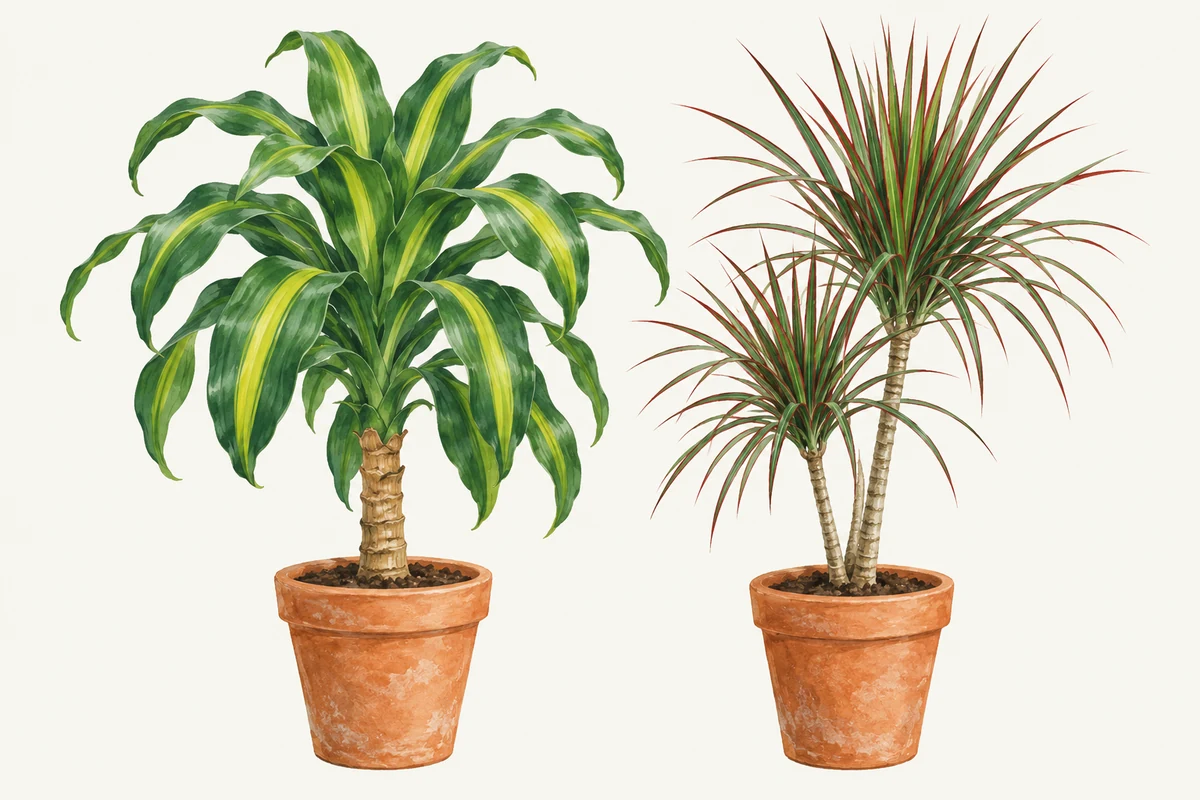
Dracaena is a genus of about 198 tropical plants in the asparagus family (Asparagaceae), several of them common houseplants. Indoors you will mostly meet the corn plant (Dracaena fragrans), with broad, strap-like leaves on a thick, unbranched stem, and the dragon tree, with narrow red-edged leaves on slender canes. Their leaves have no stalk. The snake plant, Dracaena trifasciata, belongs here too.
- No leaf stalk: dracaena leaves clasp the stem directly, while the look-alike ti plant has grooved leaf stalks (NC State).
- Broad, striped leaves on a thick cane point to corn plant; narrow, red-edged leaves on slender canes to dragon tree.
- The dragon tree sold as Dracaena marginata is Dracaena reflexa var. angustifolia in World Flora Online.
Field marks at a glance
- Scientific name
- Dracaena
- Family
- Asparagaceae (asparagus family)
- Type
- Houseplant, perennial, evergreen
- Leaf attachment
- No leaf stalk. Leaves are sessile, clasping or sheathing the stem, crowded and spirally arranged (NC State).
- Leaf shape
- Simple, strap-like, sword-shaped or lance-shaped, with smooth (entire) margins and parallel veins.
- Stem
- A single erect stem, a cane or a branching stem depending on the species; lower leaves fall with age and leave a bare stem marked with leaf scars.
- Corn plant leaves
- Glossy, 12 to 18 in long and 1 to 5 in wide (NC State), often with a lengthwise yellow, lime or white stripe; they droop as they lengthen.
- Dragon tree leaves
- About 2 ft long and only ½ in wide, glossy green with reddish edges; cultivars add pink, white or yellow stripes (NC State).
- Size indoors
- Usually 2 to 10 ft tall and 1 to 2 ft wide across the genus; corn plant up to about 6 ft, dragon tree up to about 6 ft as a houseplant (NC State).
- Flowers
- Rare indoors. Corn plant flowers open white from pink buds in long clusters and are strongly fragrant at night (NC State).
- Native range
- Tropical and subtropical Africa, Asia, Australia and the Americas; corn plant from tropical Africa, dragon tree from Madagascar and nearby islands (NC State).
Dracaena is the name on many of the tall, leafy houseplants in offices and living rooms: the corn plant, the dragon tree, the lucky bamboo, and since a recent reclassification even the snake plant. They look different, but they share one detail you can check in seconds: the leaves have no stalk.
What plant is dracaena: three checks
1. The leaf base. Follow a leaf to where it meets the stem. A dracaena leaf has no stalk: it clasps or sheathes the stem directly, and the leaves are crowded and spirally arranged (NC State). If there is a distinct leaf stalk with a groove in it, look at the ti plant instead (see below).
2. The leaf shape. Dracaena leaves are simple, linear, strap-like or sword-shaped, with smooth edges and veins running lengthwise. The NC State genus page adds that the color may be solid, variegated or striped in green, red, yellow or white.
3. The stem. Dracaenas grow on a single erect stem, a cane or branching stems, depending on the species. Lower leaves fall with age, so older plants show a bare stem with a tuft of leaves at the top, and the scars of old leaves ring the cane. The snake plant is the exception, with no stem at all; it has its own page, snake plant.
Then decide which dracaena you have from the width of the leaf: broad and striped means corn plant, narrow and red-edged means dragon tree. If the label is long gone, one photo of the whole plant plus one of the leaf base gives Plant Identifier enough to suggest a name; the app shows no confidence score and no list of alternatives, so confirm with the checks on this page.
Corn plant (Dracaena fragrans)
NC State says the corn plant takes its name from its tall, unbranched stem carrying many broad, strap-like leaves, like a stalk of corn. The leaves are glossy, up to 18 inches long and 1 to 5 inches wide, and they droop as they get longer. The plain-green wild type is less common in stores than cultivars with white or lime-green stripes running along the leaf. The genus page gives the corn plant up to 6 feet tall, and the species page a range of 3 to 14½ feet.
Cultivars NC State lists include:
- 'Massangeana' (mass cane): cornstalk-like leaves with a yellowish-lime stripe down the center, the classic striped corn plant.
- 'Janet Craig' ('Compacta'): solid green, with dense clusters of short leaves with wavy margins, 3 to 6 feet tall.
- 'Warneckii': grayish-green leaves with white or green stripes.
- 'Lemon Lime': sword-like leaves striped cream, greenish-yellow and lime.
- 'Bausei': a central white band on each leaf.
Several of these were sold as Dracaena deremensis, which NC State now lists as a former name of Dracaena fragrans. Flowers are rare indoors; when they appear they open white from pink buds in long clusters and are strongly fragrant at night.
Dragon tree (Dracaena marginata, now D. reflexa var. angustifolia)
The dragon tree, or Madagascar dragon tree, is the narrow-leaved dracaena on slender canes, which growers often braid or spiral. NC State describes glossy, sword-shaped green leaves about 2 feet long and half an inch wide with reddish edges, and notes that cultivars add pink, white or yellow stripes; its cultivar 'Colorama' has pink leaves striped white and green. Lower leaves fall with age, and pruned stems usually branch into two or more. Indoors it reaches about 6 feet; in its native Madagascar it can reach 20.
The name has moved. World Flora Online lists Dracaena marginata Lam. as a synonym of Dracaena reflexa var. angustifolia, and NC State files it the same way. Its close relative 'Song of India' (Dracaena reflexa) has broader, lance-shaped leaves with cream margins.
| Feature | Corn plant | Dragon tree |
|---|---|---|
| Scientific name | Dracaena fragrans | Dracaena reflexa var. angustifolia (sold as D. marginata) |
| Leaf width | 1 to 5 in | About ½ in |
| Leaf edge | Green; stripes run along the center or the leaf | Red to purplish edge |
| Stem | Thick, unbranched cane | Slender canes that branch when pruned |
Dracaena vs ti plant and yucca
The ti plant (Cordyline fruticosa) is the dracaena look-alike that catches most people out, and it was once called Dracaena terminalis. NC State gives the field test directly: ti plant leaves have grooved leaf stalks, and it is often confused with dracaenas, which have none. Its leaves are also wider, up to 6 inches, and usually pink, purple or red.
The giant yucca (Yucca gigantea) grows into a similar cane with a tuft of leaves, but its trunk is thick and woody at the base and its leaves are stiff, leathery and pale green to blue-green. If the leaves are soft, glossy and arching, think dracaena; if they are stiff and the trunk swells at the base, think yucca. For other tall, leafy houseplants, the houseplant identification key asks about leaf, stem and habit in turn.
Is dracaena toxic to pets
The ASPCA lists the corn plant (Dracaena fragrans) as toxic to dogs, cats and horses, and lists the Madagascar dragon tree (Dracaena marginata) the same way. Both entries name saponins, with vomiting (occasionally with blood), depression, loss of appetite, drooling and dilated pupils in cats as clinical signs. NC State adds that some dracaenas are reported toxic to people if eaten and that the sap can irritate skin.
If a pet has chewed a dracaena, call your vet or the ASPCA Animal Poison Control Center at (888) 426-4435 (a consultation fee may apply). If a person has eaten part of the plant, call Poison Control at 1-800-222-1222. Plant Identifier's Toxicology tool gives AI-written notes for people, dogs and cats, but it does not replace that call. More plants on the ASPCA's lists are gathered in poisonous plants for dogs.
A short care note
NC State recommends bright, indirect light, a moist, well-drained potting mix and letting the top inch of soil dry between waterings; for the dragon tree it advises letting the mix dry between waterings, but not severely. Dracaenas are sensitive to the salts, chlorine and fluoride in tap water, which brown the leaf tips, so filtered water or rainwater helps. Keep them between 60 and 75°F, away from frost. Lower leaves fall with age on a cane, but NC State names overwatering as a cause of yellowing leaves too; yellow leaves on plants walks through the other causes.
Look-alikes and how to tell them apart
Ti plant (Cordyline fruticosa)
Look for a leaf stalk. NC State notes that ti plant leaves have grooved stalks and are often confused with Dracaena, which has none. Ti plant leaves are also wider, up to 6 in, and usually flushed pink, purple or deep red.
Giant yucca (Yucca gigantea)
Feel the trunk and the leaf. Giant yucca has a thick, woody trunk like an elephant's foot and stiff, leathery, pale green to blue-green leaves in spiral rosettes, some cultivars with small teeth on the margins (NC State). Corn plant leaves are glossy, softer and droop as they lengthen.
Snake plant (Dracaena trifasciata)
Same genus, different shape: stiff, flat leaves rise straight from the soil with no stem and carry gray-green crosswise bands. Corn plant and dragon tree carry their leaves on a cane above the pot.
Lucky bamboo (Dracaena braunii, sold as D. sanderiana)
Also a dracaena. Its bright green, strappy leaves are widely spaced along upright stems that are often braided or spiralled and sold standing in water (NC State genus page). Corn plant leaves are crowded in a tuft at the top of the cane.
What a photo can't settle
- Dracaena cultivars differ mainly in stripe color and leaf width, and stripes fade or narrow in low light; a photo may confirm the species but not always the cultivar.
- Young canes sold as cuttings can carry few leaves, and without the leaf base in view a dracaena and a cordyline are hard to separate in a photo.
- A photo cannot tell whether a pet ate enough to matter; that is a question for your vet or the ASPCA Animal Poison Control Center.
Questions people ask
Is a corn plant a dracaena?
Yes. The corn plant is Dracaena fragrans, named for its tall, unbranched stem with broad, strap-like leaves that look like a cornstalk (NC State). 'Janet Craig', 'Massangeana' (mass cane), 'Warneckii' and 'Lemon Lime' are all cultivars of the same species.
Is Dracaena marginata the same as Dracaena reflexa?
World Flora Online lists Dracaena marginata Lam. as a synonym of Dracaena reflexa var. angustifolia, and NC State files the dragon tree under that name too. Stores and the ASPCA still say Dracaena marginata, so search under both names.
Is a snake plant a dracaena?
Yes, since its move from Sansevieria. NC State explains that molecular research showed the former Sansevieria species to be a succulent lineage within Dracaena, so the snake plant is now Dracaena trifasciata. It looks very different from a corn plant: no stem, stiff banded leaves straight from the soil.
Is dracaena toxic to cats and dogs?
The ASPCA lists the corn plant and the Madagascar dragon tree as toxic to dogs, cats and horses, naming saponins and signs such as vomiting, drooling, depression, loss of appetite and dilated pupils in cats. If a pet chewed one, call your vet or the ASPCA Animal Poison Control Center at (888) 426-4435.
Sources
- Dracaena — North Carolina Extension Gardener Plant Toolbox (NC State)
- Dracaena fragrans — North Carolina Extension Gardener Plant Toolbox (NC State)
- Dracaena reflexa var. angustifolia — North Carolina Extension Gardener Plant Toolbox (NC State)
- Cordyline fruticosa — North Carolina Extension Gardener Plant Toolbox (NC State)
- Yucca gigantea — North Carolina Extension Gardener Plant Toolbox (NC State)
- Dracaena marginata Lam. — World Flora Online
- Corn Plant — ASPCA Animal Poison Control Center
- Madagascar Dragon Tree — ASPCA Animal Poison Control Center
Keep reading
- Houseplant profileSnake plant (Dracaena trifasciata): how to identify it
- Houseplant profileCalathea (Goeppertia): how to identify it
- Houseplant profileCroton (Codiaeum variegatum): how to identify it
- Pet safety guidePoisonous plants for dogs, and what to do if your dog ate one
- Plant healthYellow leaves on plants, and what each pattern means