Houseplant profile
Calathea (Goeppertia): how to identify it
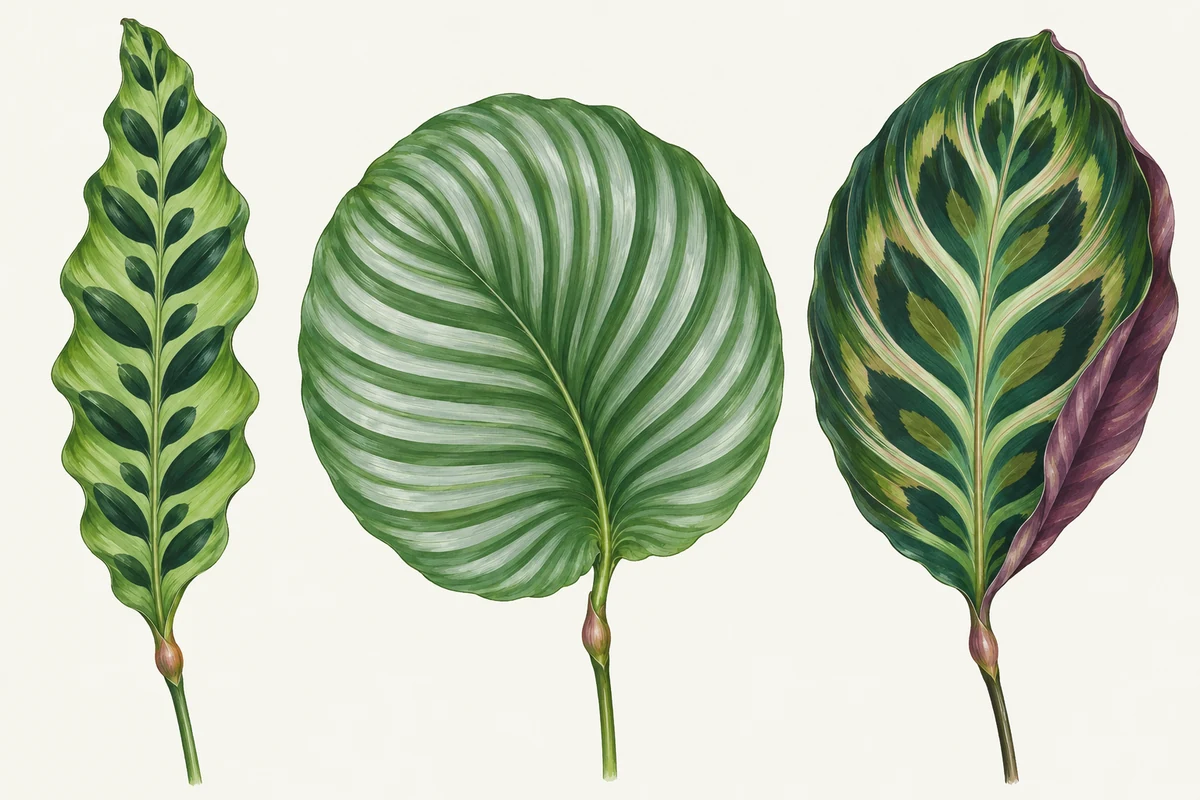
Patterned leaves on long, slender stalks rising from the soil, often purple underneath, that lift and fold at night. Most calatheas sold today are filed under Goeppertia.
In short
A calathea is a clump-forming houseplant of the prayer plant family (Marantaceae) with broad, boldly patterned leaves held upright on long, slender stalks straight from the soil. The undersides are often purple or maroon, and the leaves fold up at night. Most species sold as Calathea, such as the peacock plant and Calathea orbifolia, are now named Goeppertia; labels still use both names.
- Long leaf stalks from the soil, a patterned blade, a purple underside and night-time folding point to a calathea.
- Calathea makoyana is now Goeppertia makoyana and Calathea orbifolia is Goeppertia orbifolia (World Flora Online, NC State).
- A low, spreading plant with red fishbone veins is the prayer plant, Maranta leuconeura, not a calathea.
Field marks at a glance
- Scientific name
- Goeppertia (formerly Calathea)
- Family
- Marantaceae (prayer plant family)
- Type
- Houseplant, perennial, evergreen
- Growth habit
- An erect clump of leaves rising from rhizomes, with short stems or none visible (NC State). No trailing vines, no trunk.
- Leaf stalks
- Long and slender, sheathing at the base, each holding one leaf upright; on the peacock plant the stalks are reddish (NC State).
- Leaf blade
- Simple, broad, oval, oblong, lance-shaped or round depending on the species, often with wavy margins; usually more than 6 in long and 3 to 6 in wide in the genus (NC State).
- Pattern
- Painted, feathered, striped or mosaic markings in cream, silver, pink or lime green on a medium to dark green blade.
- Underside
- Often purple, maroon or burgundy; Goeppertia orbifolia is the exception, pale green to silver beneath (NC State).
- Night movement
- Leaves fold up or lift in the evening and reopen in the morning, the habit that gives the family its prayer plant name.
- New leaves
- Unfurl from a tight roll; on the peacock plant the rolled leaf shows its pinkish-red underside (NC State).
- Flowers
- Small, tubular and rarely produced on houseplants; color varies by species (NC State).
- Size indoors
- About 9 in to 3 ft tall across the genus; the peacock plant 1 to 2 ft, Goeppertia orbifolia 2 to 3 ft (NC State).
- Native range
- Tropical Central and South America; the peacock plant comes from the rainforests of southeastern Brazil (NC State).
Calatheas are the houseplants with leaves that look painted: feathered, striped or mottled patterns on broad blades held up on long stalks. They belong to the prayer plant family, and most of them now carry the name Goeppertia. Four checks, done in order, tell you whether the plant in front of you is one.
How to identify a calathea in four checks
1. The leaf stalk. Follow a leaf down to the soil. A calathea leaf sits on a long, slender stalk that rises straight from the base of the plant, and NC State notes the stalks are sheathing at the base. The NC State Plant Toolbox describes the genus as clump-forming with rhizomatous roots and short, erect stems, so there is no trunk and no trailing vine.
2. The pattern. Look at the upper surface in good light. NC State lists the patterns you will meet: stained-glass mottling, mosaic, stripes, feathering and blotches, in white, cream, silver, pink or lime green on a medium to dark green blade. The leaf shape varies by species, from lance-shaped to almost round, and the margins are often wavy.
3. The underside. Turn a leaf over. Most calatheas are purple, maroon or burgundy underneath, and the stalks often share the color. The peacock plant repeats its upper pattern in reddish purple below. Goeppertia orbifolia is the common exception: its round leaves are pale green to silver beneath (NC State).
4. The evening test. Check the plant after dark. Calathea leaves fold or lift at night and reopen in the morning, a movement NC State calls nyctinastic. If the leaves of your plant stand noticeably higher at night than at noon, you are looking at a member of the prayer plant family.
If you have no label at all, a photo of one whole leaf, top and underside, is enough for Plant Identifier to suggest a name. The app shows no confidence score and no list of alternatives, so check its answer against the four marks above.
Calatheas you will see in stores
Dozens of species and hybrids are sold, often only by a cultivar name. The NC State genus page profiles twenty; these are the ones most often on shelves, with NC State's descriptions:
- Peacock plant (Goeppertia makoyana): oval leaves with a pale green to cream background, dark green feathering from the midrib and a dark green border; papery thin and reddish purple beneath. Its leaves reach up to 12 inches long on a plant 1 to 2 feet tall (NC State).
- Goeppertia orbifolia: round leaves up to 12 inches wide, dark green with silver-green stripes, pale beneath.
- Rattlesnake plant (Goeppertia insignis): narrow, wavy, light green leaves with dark green to black spots either side of the midrib, burgundy beneath.
- Pinstripe plant (Goeppertia ornata): dark green leaves with fine pink to white stripes on young leaves, purple beneath.
- Rose-painted calathea (Goeppertia roseopicta): glossy, elliptical leaves with a cream to pink brush stroke along the midrib and edges.
- Zebra plant (Goeppertia zebrina): velvety dark green leaves with lime green midrib, veins and margins.
- Furry feather calathea (Goeppertia rufibarba): narrow, wavy green leaves with reddish hairs along the midrib and beneath.
The pattern changes from plant to plant, but the long stalk, the clumping habit and the night movement stay the same, which is why the four checks work across all of them.
Why the label says Calathea and the botanist says Goeppertia
Genetic and botanical studies split the old genus Calathea, and most of the species grown as houseplants were reclassified to Goeppertia, NC State explains; you will still find them called Calathea in books and stores. World Flora Online lists Calathea makoyana as a synonym of Goeppertia makoyana, and NC State gives Calathea orbifolia as the former name of Goeppertia orbifolia.
The common name stayed. Gardeners and garden centres still say calathea, and this page does too. When you look a plant up, try both names.
Calathea vs prayer plant, stromanthe and ctenanthe
Three relatives from the same family are sold beside calatheas, and NC State lists them among the plants most often confused with the peacock plant.
| Feature | Calathea (Goeppertia) | Prayer plant (Maranta leuconeura) | Stromanthe 'Triostar' | Ctenanthe |
|---|---|---|---|---|
| Habit | Upright clump | Low, spreading, 6 to 12 in | Upright clump, 2 to 3 ft indoors | Bushy, up to about 3 ft |
| Leaf | Broad, oval to round, wavy | Oblong with a blunt tip | Elliptical to oblong, glossy | Long, narrow, lance-shaped |
| Typical marking | Feathers, stripes, mosaics | Red fishbone veins, dark "rabbit track" spots | White, cream and pink streaks | Silver bands along the veins |
| Underside | Usually purple to maroon | Reddish to gray-green | Pink to burgundy | Purple-red |
The prayer plant is the easiest to separate: it is low and spreading, often grown in hanging baskets, and its leaves lie flat by day and stand up at night. Stromanthe 'Triostar' gives itself away with pink. Ctenanthe is the hardest; its narrow, leathery, silver-banded leaves look like a striped calathea, so trust the label when there is one.
If the leaves are arrow-shaped, thick and glossy, with pale veins standing out, you are more likely looking at an aroid such as an alocasia. The houseplant identification key walks through these leaf features one question at a time.
Is calathea toxic to pets
The ASPCA's Prayer Plant entry, filed under Calathea insignis and also naming maranta, peacock plant, rattlesnake plant and zebra plant, lists it as non-toxic to dogs, cats and horses. NC State tags the peacock plant and G. orbifolia the same way. That is the ASPCA's classification, not a promise that a pet can chew the leaves without effect, and only a vet can judge a pet that is unwell.
One trap: the ASPCA's separate Peacock Plant entry is Kaempferia, a ginger, not the calathea of the same nickname. Always match the scientific name before you rely on a listing.
If a pet is unwell after chewing a plant, call your vet or the ASPCA Animal Poison Control Center at (888) 426-4435. For a person, call Poison Control at 1-800-222-1222. Plant Identifier's Toxicology tool gives AI-written notes for people, dogs and cats, but it does not replace that call. Houseplants the ASPCA does list as toxic are gathered in plants toxic to cats.
A short care note
NC State describes calatheas as higher-maintenance plants. They want bright, indirect light or partial shade, a moist but never soggy, well-drained mix rich in organic matter, temperatures of 65 to 75°F and high humidity, with no cold drafts. Distilled water or rainwater is recommended because fluoride in tap water can brown the leaves. Brown leaf edges usually point to low humidity, curling or yellowing to underwatering, and faded patterns to too little light. For other causes of yellowing, see yellow leaves on plants; Plant Identifier's Diagnose tool can give a first read on a spotted leaf.
Look-alikes and how to tell them apart
Prayer plant (Maranta leuconeura)
Check the height and the veins. Prayer plant is low and spreading, 6 to 12 in tall, with oblong leaves marked by red fishbone veins and dark spots like rabbit tracks either side of the midrib (NC State). A calathea is an upright clump of long-stalked leaves without red fishbone veins.
Stromanthe (Stromanthe thalia 'Triostar')
Look for pink. 'Triostar' has olive-green leaves streaked white, cream and pink, with pink to burgundy undersides, on a plant 2 to 3 ft tall indoors (NC State). Calathea patterns follow the veins or the midrib in green, cream or silver; a random pink streaking points to stromanthe.
Never-never plant (Ctenanthe oppenheimiana)
Compare the leaf shape. Ctenanthe has long, narrow, lance-shaped, leathery leaves banded silver along the veins, purple-red beneath (NC State). NC State lists it among the plants most often confused with calathea, so a store label is the surest guide.
Peacock plant label on a ginger (Kaempferia)
Not a look-alike in the pot but on paper: the ASPCA's Peacock Plant entry is Kaempferia, peacock ginger, a ginger family plant. Check the scientific name, not only the common name, before you rely on any toxicity listing.
What a photo can't settle
- Calathea species and their many hybrids differ mostly in leaf pattern; a photo can confirm the genus, but a close pattern match is not proof of the species or cultivar.
- Flowers are rarely produced indoors, so the identification rests on leaves, which fade and lose pattern in poor light (NC State).
- A photo cannot tell whether a pet ate enough plant material to matter; that is a question for your vet.
Questions people ask
Is calathea the same as Goeppertia?
For most houseplants, yes. Many species formerly classified as Calathea were moved to Goeppertia after genetic studies, NC State explains, and World Flora Online lists Calathea makoyana as a synonym of Goeppertia makoyana. Stores and the ASPCA still use Calathea, so search under both names.
Is a calathea a prayer plant?
It belongs to the prayer plant family, Marantaceae, and its leaves fold at night like the family's namesake. The plant sold simply as prayer plant is a different genus, Maranta leuconeura: lower, spreading, with red fishbone veins. NC State lists the two as often confused.
Why do calathea leaves move at night?
NC State calls it nyctinastic movement: the leaves fold in response to darkness and reopen at sunrise, driven by changes in light and temperature. It is normal and a useful identification clue, not a sign that the plant is wilting.
Is calathea toxic to cats and dogs?
The ASPCA's Prayer Plant entry (Calathea insignis, also listing peacock plant, rattlesnake plant and zebra plant) classifies it as non-toxic to dogs, cats and horses. That is a listing, not a guarantee. If your pet is unwell after chewing a plant, call your vet or the ASPCA Animal Poison Control Center at (888) 426-4435.
Sources
- Goeppertia — North Carolina Extension Gardener Plant Toolbox (NC State)
- Goeppertia makoyana — North Carolina Extension Gardener Plant Toolbox (NC State)
- Goeppertia orbifolia — North Carolina Extension Gardener Plant Toolbox (NC State)
- Maranta leuconeura — North Carolina Extension Gardener Plant Toolbox (NC State)
- Stromanthe thalia — North Carolina Extension Gardener Plant Toolbox (NC State)
- Calathea makoyana É.Morren — World Flora Online
- Prayer Plant — ASPCA Animal Poison Control Center
- Peacock Plant — ASPCA Animal Poison Control Center
Keep reading
- Houseplant profileDieffenbachia (Dieffenbachia seguine): how to identify it
- Houseplant profilePeace lily (Spathiphyllum): how to identify it
- Houseplant profileAlocasia elephant ear: how to identify it
- Plant healthYellow leaves on plants, and what each pattern means
- Field guideHow to identify a plant by its leaf