Houseplant profile
Dieffenbachia (Dieffenbachia seguine): how to identify it
A stout, fleshy cane ringed with leaf scars, topped by large, glossy leaves splashed with cream, white or yellow. Here is what to check, and how to tell it from its look-alikes.
In short
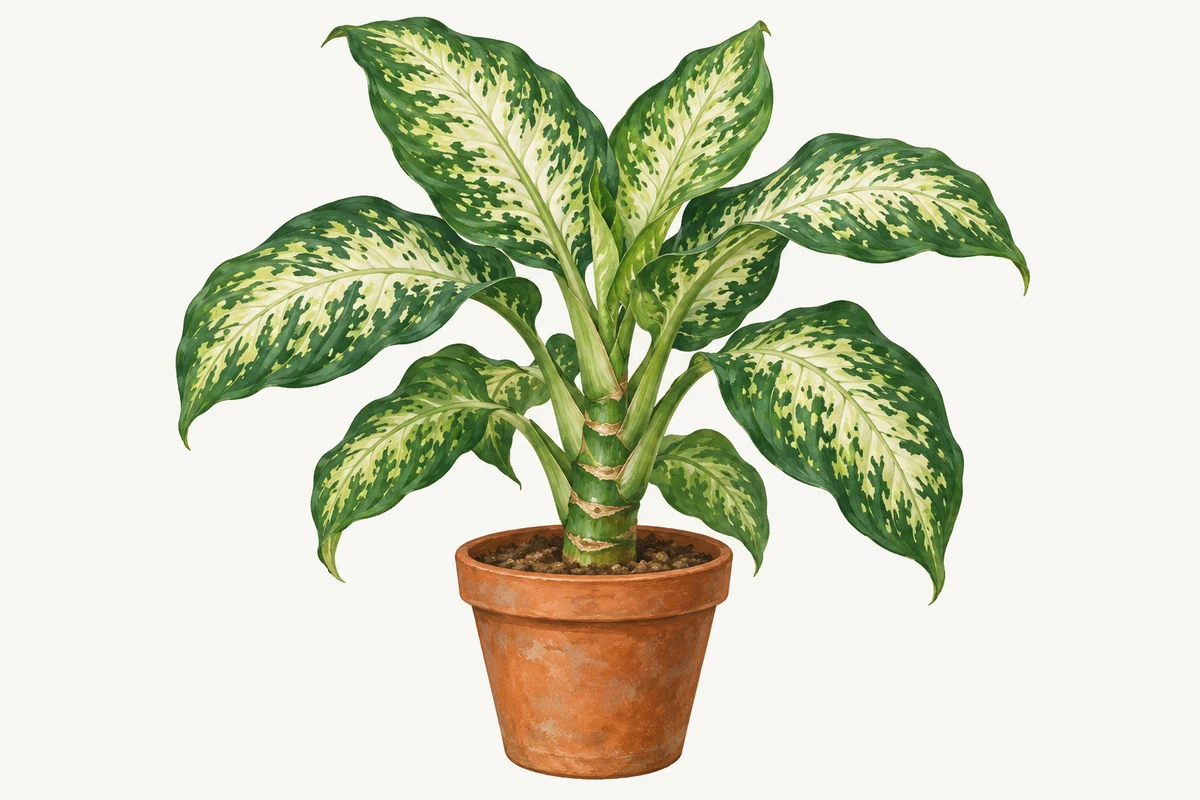
Dieffenbachia, or dumb cane (Dieffenbachia seguine), is an upright aroid with a stout, fleshy green stem ringed by leaf scars and large, glossy, oblong leaves blotched with cream, white or yellow. Count the side veins: dieffenbachia usually has 20 to 30, against 5 to 8 on Chinese evergreen. It grows 3 to 8 feet tall and rarely flowers indoors.
- A thick, cane-like stem plus large blotched leaves with 20 or more side veins point to Dieffenbachia.
- Only 5 to 8 main side veins suggest Chinese evergreen; no stem at all and a white spathe suggest peace lily.
- The ASPCA lists dieffenbachia as toxic to dogs and cats (insoluble calcium oxalates, proteolytic enzyme).
Field marks at a glance
- Scientific name
- Dieffenbachia seguine
- Family
- Araceae (arum family)
- Type
- Houseplant, perennial, evergreen
- Leaves
- Simple, alternate, large: oblong to oblong-lanceolate with a pointed tip, over 6 inches long and 3 to 6 inches wide (NC State).
- Leaf pattern
- Glossy green, mottled or blotched with cream, white or yellow; the pattern varies by cultivar (NC State).
- Veins
- More than 8 main side veins, usually 20 to 30 (NC State). Chinese evergreen usually has 5 to 8.
- Leaf stalk
- The stalk sheathes the stem at its base (NC State).
- Stem
- Stout, fleshy and green, encircled by leaf scars, with leaves toward the top and few or no branches (NC State); visible on older plants.
- Flower
- Rare indoors. A white spadix inside a pale green to white, boat-shaped spathe on a long stalk (NC State).
- Size
- 3 to 8 ft tall and 2 to 3 ft wide (NC State); UF/IFAS notes compact cultivars of about 12 inches.
- Native range
- Caribbean to tropical South America (NC State).
- Old names
- Plants once called D. amoena, D. maculata and D. picta are now placed in D. seguine (NC State).
Dieffenbachia, often sold as dumb cane, is a tropical aroid grown indoors for its large, patterned leaves. The NC State Plant Toolbox treats the common houseplant as Dieffenbachia seguine, which now includes plants once sold as D. amoena, D. maculata and D. picta. It is easy to confuse with other patterned aroids, so check it in the order below.
How to identify dieffenbachia in four checks
1. The stem. Look below the leaves. An older dieffenbachia has a stout, fleshy, green stem ringed with leaf scars, with the leaves bunched toward the top and few or no branches. NC State calls it cane-like; that cane gives the plant its common name.
2. The leaf. The leaves are large, simple and glossy: oblong to oblong-lanceolate with a pointed tip, over 6 inches long and 3 to 6 inches wide. They are mottled or blotched with cream, white or yellow, and the base of each stalk sheathes the stem.
3. The veins. Count the obvious side veins on one side of the midrib. NC State gives more than 8, usually 20 to 30, for dieffenbachia. This is the quickest way to separate it from Chinese evergreen.
4. The size. NC State gives 3 to 8 feet tall and 2 to 3 feet wide, scarcely branched. UF/IFAS Gardening Solutions adds that compact cultivars stay around 12 inches, while others reach 6 to 8 feet or more.
When a plant arrives without a tag, Plant Identifier can give a common and scientific name from one photo; include a whole leaf and, if you can, the stem. The app shows no confidence score and no list of alternatives, so compare its answer with the checks above.
Dieffenbachia cultivars
Most plants sold are named cultivars. NC State lists these, among others:
- 'Camille': up to 3 feet, pale yellow leaves with white margins.
- 'Exotica' or 'Arvida': heavily variegated creamy white, with narrow green margins and a creamy white midrib.
- 'Rudolph Roehrs': yellow leaves with creamy white blotches and a dark green midrib and margins.
- 'Tropic Snow': about 6 feet, heavily variegated cream and green.
- 'Perfection': heavily variegated leaves about 8 inches long.
Whatever the color, the cane, the leaf shape and the many side veins stay the same. UF/IFAS notes that its invasive-plant assessment predicted dieffenbachia to be invasive in Florida, and UF/IFAS Extension no longer recommends it there.
Dieffenbachia vs Chinese evergreen and peace lily
NC State lists Aglaonema and Spathiphyllum among the plants dieffenbachia is most often confused with.
| Feature | Dieffenbachia | Chinese evergreen | Peace lily |
|---|---|---|---|
| Main side veins | More than 8, usually 20 to 30 | 5 to 8 | Numerous, sunken |
| Stem | Stout cane ringed with leaf scars | Upright stem, often silver-gray blotches | None visible |
| Leaf pattern | Cream, white or yellow blotches | White, silver, pink or red | Plain dark green |
| Height | 3 to 8 ft | About 1.5 ft | 1 to 6 ft |
Sources: NC State on Aglaonema, Spathiphyllum and Dieffenbachia. See the full profiles of Chinese evergreen and peace lily, or work through the houseplant identification key.
Is dieffenbachia toxic to pets
The ASPCA lists dieffenbachia (also charming dieffenbachia, giant dumb cane, spotted dumb cane, Exotica and Tropic Snow) as toxic to dogs and cats. It names insoluble calcium oxalates and a proteolytic enzyme as the toxic principles and lists oral irritation, intense burning and irritation of the mouth, tongue and lips, excessive drooling, vomiting and difficulty swallowing. NC State rates the poison severity as high, lists the leaves, roots, sap and stems as the poisonous parts, and notes that the sap can irritate skin and harm the eyes, so wear gloves and wash your hands after handling it.
If a pet has chewed a leaf or stem, call your vet or the ASPCA Animal Poison Control Center at (888) 426-4435. For a person, call Poison Control at 1-800-222-1222 (poison.org). Plant Identifier's Toxicology tool gives AI-written notes for people, dogs and cats; treat them as a starting point, not as the answer. More houseplants on the ASPCA's lists are in plants toxic to cats and poisonous plants for dogs, and sap reactions are covered in plants that cause skin rashes.
A short care note
NC State recommends loose, fertile soil high in organic matter, indirect light, moderate temperatures and high humidity, watering thoroughly and letting the top inch of soil dry before watering again to help prevent root rot. UF/IFAS gives 60 to 75°F, notes that leaves dropping without yellowing first can mean the plant is too cold, and says the lowest leaves yellowing and drooping is part of normal growth. For other causes, see yellow leaves on plants.
Look-alikes and how to tell them apart
Chinese evergreen (Aglaonema)
Count the obvious side veins on one leaf. NC State gives 5 to 8 main veins for Aglaonema and more than 8, usually 20 to 30, for Dieffenbachia. Aglaonema is also smaller, to about 1.5 ft, with leaves 4 to 8 inches long.
Peace lily (Spathiphyllum)
Look for a stem. NC State separates the two by Dieffenbachia's aerial, cane-like stem; a peace lily has none, its leaves are plain dark green, and it often carries a white spathe above the leaves.
What a photo can't settle
- Dieffenbachia is sold as many named cultivars that differ mainly in leaf color and pattern; a photo can name the species but often not the cultivar.
- A young plant without a visible cane can look like a Chinese evergreen. Count the side veins on a mature leaf before deciding.
- Whether a pet or child that chewed a leaf needs treatment is for your vet or a poison control center to decide, not for this page or an app.
Questions people ask
Why is dieffenbachia called dumb cane?
NC State explains that the name refers to the numbing and paralyzing effect of the sap on the vocal cords of people and pets if it is ingested. The sap contains needle-like calcium oxalate crystals.
Is dieffenbachia the same as Chinese evergreen?
No. Both are aroids with patterned leaves, but they are different genera. NC State says Chinese evergreen usually has 5 to 8 main side veins and dieffenbachia more than 8, usually 20 to 30. Dieffenbachia is also taller, 3 to 8 feet.
Does dieffenbachia flower?
Rarely as a houseplant. NC State describes a white spadix in a pale green to white, boat-shaped spathe, and UF/IFAS says the blooms are not showy and seldom appear indoors.
Is dieffenbachia poisonous to cats and dogs?
The ASPCA lists dieffenbachia as toxic to dogs and cats, naming insoluble calcium oxalates and a proteolytic enzyme. If your pet chewed it, call your vet or the ASPCA Animal Poison Control Center at (888) 426-4435. For a person, call Poison Control at 1-800-222-1222.
Sources
- Dieffenbachia seguine — North Carolina Extension Gardener Plant Toolbox (NC State)
- Aglaonema — North Carolina Extension Gardener Plant Toolbox (NC State)
- Spathiphyllum — North Carolina Extension Gardener Plant Toolbox (NC State)
- Dieffenbachia — UF/IFAS Gardening Solutions
- Dieffenbachia — ASPCA Animal Poison Control Center
- Poison Control — National Capital Poison Center
Keep reading
- Houseplant profileAglaonema (Chinese evergreen): how to identify it
- Houseplant profilePeace lily (Spathiphyllum): how to identify it
- Houseplant profileCroton (Codiaeum variegatum): how to identify it
- Pet safety guidePoisonous plants for dogs, and what to do if your dog ate one
- Safety guidePlants that cause skin rashes, and how to tell which one