Houseplant profile
Aglaonema (Chinese evergreen): how to identify it
An upright, bushy aroid with glossy, lance-shaped leaves marked silver, cream, pink or red, on stems that turn cane-like with age. Here is what to check.
In short
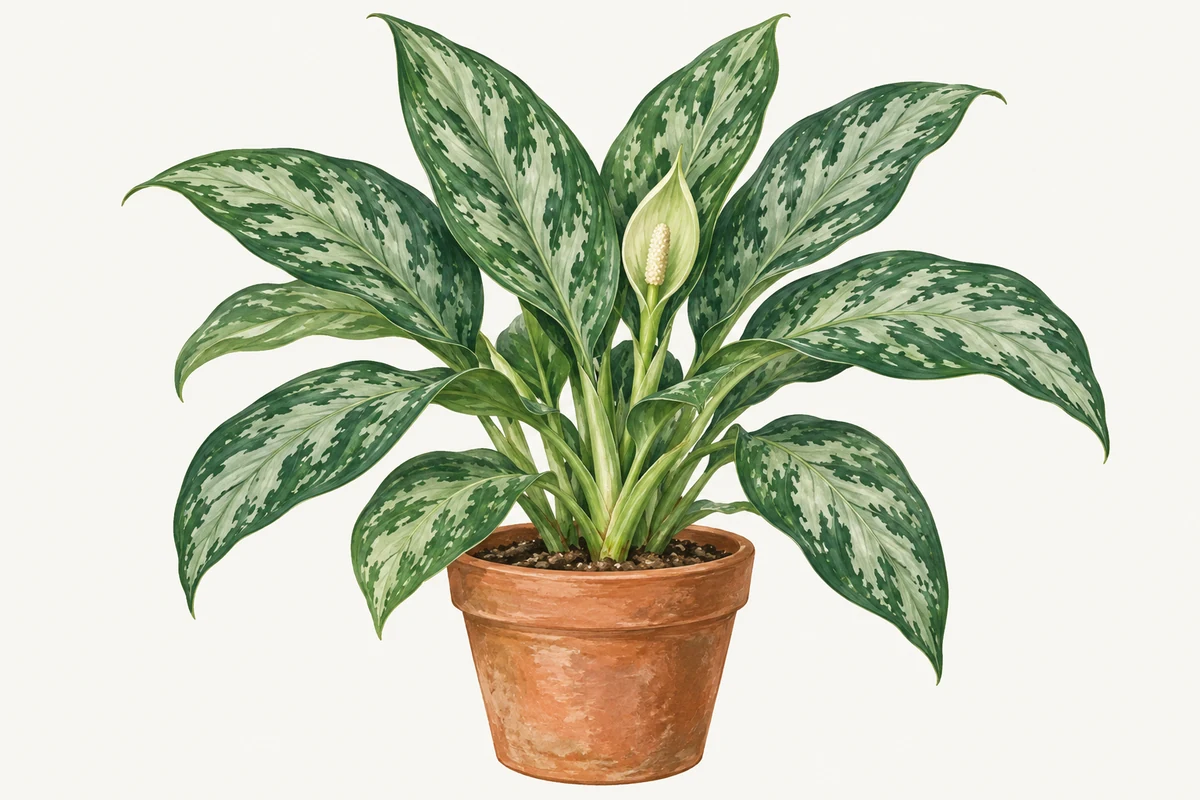
An aglaonema plant (Chinese evergreen) is an erect, bushy herbaceous perennial in the arum family, usually 1 to 1.5 feet tall. Its glossy, lance-shaped leaves are 4 to 8 inches long, often patterned with silver, cream, pink or red, and have only 5 to 8 main side veins. Older plants show an upright, cane-like stem; the rare flower is a small greenish-white spathe.
- Lance-shaped, patterned leaves with only 5 to 8 main side veins, on a short upright stem, point to Aglaonema.
- More than 8 side veins, usually 20 or more, on a taller cane mean dumb cane (Dieffenbachia); no stem at all means peace lily.
- The ASPCA lists Chinese evergreen as toxic to dogs, cats and horses (insoluble calcium oxalates).
Field marks at a glance
- Scientific name
- Aglaonema
- Family
- Araceae (arum family)
- Type
- Houseplant, perennial, evergreen
- Leaves
- Simple, lance-shaped to elliptic or oblong, with a pointed tip and a smooth edge; 4 to 8 inches long and 2 to 3 inches wide, up to 12 inches in some species (NC State).
- Leaf pattern
- Glossy, often banded or spotted along the veins in white, cream, silver-gray, pink or red (NC State). Hairless.
- Veins
- Only 5 to 8 main side veins, curved; the minor veins are not visible (NC State). This is the quickest way to tell it from dumb cane.
- Leaf stalk
- Shorter than the blade, sometimes white (NC State).
- Stem
- Upright, white or green, sometimes pink, with silver-gray blotches; it becomes cane-like with age and the plant can get leggy (NC State).
- Flower
- Rare indoors: a whitish-yellow spadix in a greenish to yellow spathe, 1 to 3 inches, in late summer or early fall, followed by red berries (NC State).
- Size
- 1 to 1.7 ft tall and 1 to 1.5 ft wide (NC State).
- Native range
- Tropical and subtropical Southeast Asia and New Guinea, from northeast India to Papua New Guinea (NC State).
- Genus
- 26 species and many cultivars (NC State), such as A. commutatum 'Maria' and 'Silver Bay'.
Aglaonema, the Chinese evergreen, is one of the most common office and home houseplants. Its patterned leaves come in many colours, so it is easy to confuse with other variegated aroids. Check the veins, the stem and the leaf shape in the order below.
How to identify an aglaonema plant in four checks
1. The leaf shape. Hold a leaf flat. It is lance-shaped to elliptic, with a pointed tip and a smooth edge. The NC State Plant Toolbox gives 4 to 8 inches long and 2 to 3 inches wide, and up to 12 inches in larger types such as A. commutatum.
2. The veins. Count the main side veins on one side of the midrib. An aglaonema usually has only 5 to 8, curving toward the tip, and the minor veins are not visible. This is NC State's quick test against dumb cane.
3. The pattern. Most plants sold are variegated: banded or spotted along the veins in white, cream, silver-gray, pink or red. Plain green forms exist, so treat colour as a clue, not proof.
4. The stem. Part the leaves at the base. There is an upright stem, white or green and sometimes pink, with silver-gray blotches; it lengthens and turns cane-like with age. A plant with no stem at all is more likely a peace lily.
When a plant arrives without a tag, Plant Identifier can give a common and scientific name from one photo; include a whole leaf and the base of the stem. The app shows no confidence score and no list of alternatives, so compare its answer with the checks above.
Aglaonema species and cultivars
NC State counts 26 species and many cultivars, native from northeast India to New Guinea. It lists these among the ones grown indoors:
- A. commutatum (Philippine evergreen): dark green, lance-shaped leaves 4 to 12 inches long.
- 'Maria': dark green leaves with silver stripes.
- 'Silver Bay': green leaves with silver in the centre.
- 'Crete': green leaves splashed and edged burgundy red, with pale pink stems.
- 'White Rajah': leaves with a large amount of white.
- A. modestum (Chinese evergreen): leaves up to 10 inches, often variegated.
A red-and-pink plant and a silver one can both be aglaonemas: the vein count and the upright, blotched stem stay the same.
Aglaonema vs dumb cane and peace lily
All three are aroids grown for their leaves, and NC State names both as plants aglaonema is often confused with.
| Feature | Aglaonema | Dumb cane | Peace lily |
|---|---|---|---|
| Main side veins | 5 to 8 | More than 8, usually 20 to 30 | Numerous, sunken |
| Leaf pattern | Silver, cream, pink or red | Cream, white or yellow blotches | Plain dark green |
| Visible stem | Yes, cane-like with age | Yes, stout, ringed with leaf scars | No |
| Height | 1 to 1.7 ft | 3 to 8 ft | Usually about 3 ft indoors |
Sources: NC State on Dieffenbachia seguine and NC State on Spathiphyllum. The peace lily has its own page: peace lily. For other upright, strap- or lance-leaved houseplants, see dracaena or try the houseplant identification key.
Is aglaonema toxic to pets
The ASPCA lists Chinese evergreen (Aglaonema modestum) as toxic to dogs, cats and horses. It names insoluble calcium oxalates as the toxic principle and lists oral irritation, pain and swelling of the mouth, tongue and lips, excessive drooling, vomiting and difficulty swallowing. NC State rates the plant as having low-severity poison characteristics.
If a pet has chewed a leaf or stem, call your vet or the ASPCA Animal Poison Control Center at (888) 426-4435. For a person, call Poison Control at 1-800-222-1222 (poison.org). Plant Identifier's Toxicology tool gives AI-written notes for people, dogs and cats; treat them as a starting point, not as the answer. More houseplants on the ASPCA's lists are in plants toxic to cats and poisonous plants for dogs.
A short care note
NC State recommends diffuse sun or good indirect light, high humidity if possible, and potting mix kept moist from spring to fall with less water in winter. It is intolerant of cold and prefers daytime temperatures of 70 to 80°F. Root rot can follow overwatering, so let the mix dry between waterings and avoid cold water; leaves may turn brown in very dry air or a draft. For yellowing leaves, see yellow leaves on plants.
Look-alikes and how to tell them apart
Dumb cane (Dieffenbachia seguine)
Count the main side veins. NC State says aglaonemas usually have 5 to 8, while dieffenbachias have more than 8, usually 20 to 30. Dumb cane is also bigger, 3 to 8 feet tall, with large leaves blotched cream, white or yellow on a stout, fleshy stem ringed with leaf scars.
Peace lily (Spathiphyllum)
Look for a stem. A peace lily has no visible stem above ground, its leaves are plain dark green with no variegation and numerous sunken side veins, and its white spathe is 4 to 12 inches (NC State). An aglaonema has an upright stem, usually patterned leaves and a small spathe.
What a photo can't settle
- Aglaonemas are sold mostly as named cultivars with many leaf patterns; a photo can name the genus but often not the cultivar.
- Young dumb canes and aglaonemas can look alike; count the main side veins on a mature leaf before deciding.
- Whether a pet that chewed a leaf needs treatment is for your vet or a poison control center to decide, not for this page or an app.
Questions people ask
Is aglaonema the same as Chinese evergreen?
Yes. Chinese evergreen is the usual common name for the genus Aglaonema. NC State also lists golden evergreen, Philippine evergreen and poison dart plant. Philippine evergreen usually means A. commutatum, and the ASPCA files Chinese evergreen under A. modestum.
Does aglaonema flower?
Sometimes. NC State says it blooms rarely as a houseplant, in late summer or early fall, with a whitish-yellow spadix in a greenish spathe 1 to 3 inches long, followed by clusters of red berries. In low light it may not flower at all.
Why is my aglaonema getting tall and bare at the base?
That is how it grows. NC State notes that the plant tends to get leggy with age as the stem lengthens and becomes cane-like, so older plants show bare stem below the leaves.
Is aglaonema poisonous to cats and dogs?
The ASPCA lists Chinese evergreen as toxic to dogs, cats and horses, naming insoluble calcium oxalates and signs such as mouth pain and swelling, drooling and vomiting. If your pet chewed it, call your vet or the ASPCA Animal Poison Control Center at (888) 426-4435. For a person, call Poison Control at 1-800-222-1222.
Sources
- Aglaonema — North Carolina Extension Gardener Plant Toolbox (NC State)
- Dieffenbachia seguine — North Carolina Extension Gardener Plant Toolbox (NC State)
- Spathiphyllum — North Carolina Extension Gardener Plant Toolbox (NC State)
- Chinese Evergreen — ASPCA Animal Poison Control Center
- Poison Control — National Capital Poison Center
Keep reading
- Houseplant profilePeace lily (Spathiphyllum): how to identify it
- Houseplant profileDracaena: how to identify corn plant, dragon tree and their relatives
- Houseplant profileBird of paradise (Strelitzia): how to identify it
- Pet safety guidePoisonous plants for dogs, and what to do if your dog ate one
- Plant healthYellow leaves on plants, and what each pattern means