Pet safety guide
Poisonous plants for dogs, and what to do if your dog ate one
The numbers to call first, how to put a name to the plant, then the garden plants behind the most serious cases and the houseplants dogs chew, as the ASPCA lists them.
In short
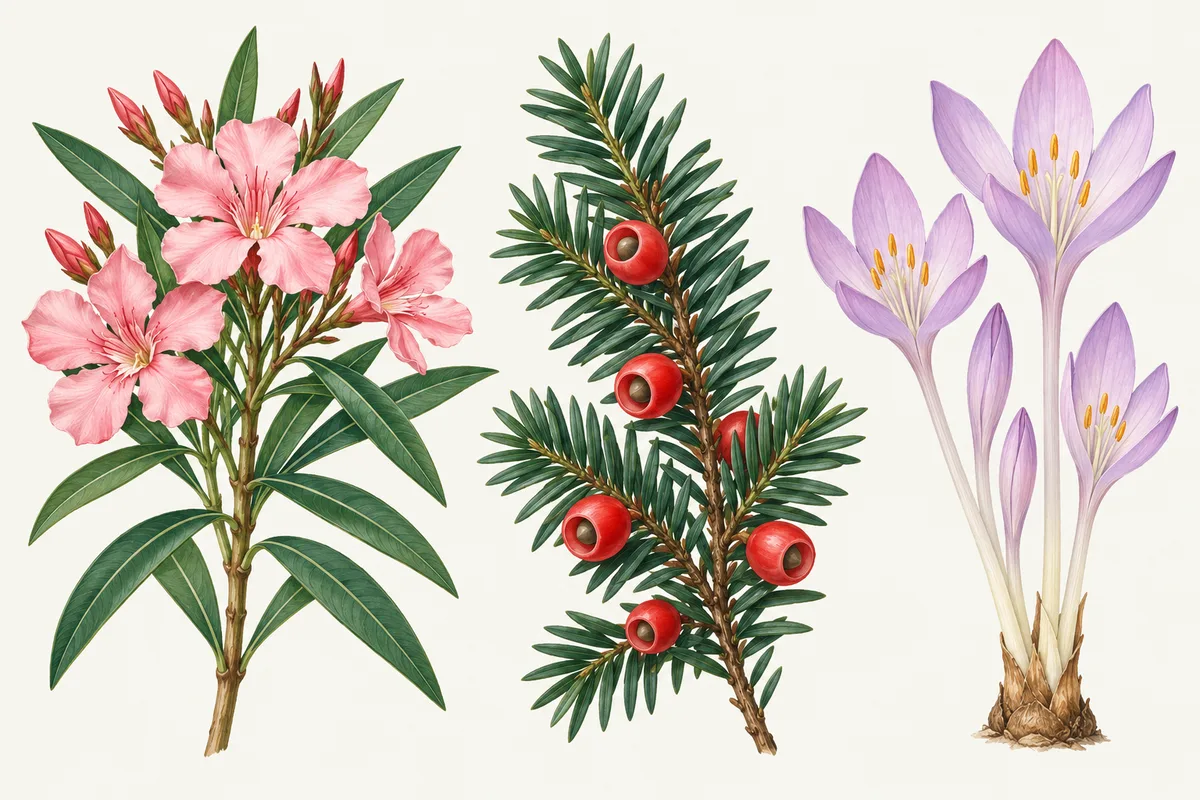
Poisonous plants for dogs include sago palm, oleander, yew, autumn crocus, foxglove, lily of the valley, azalea and rhododendron, castor bean, and tulip, daffodil and hyacinth bulbs, all listed as toxic to dogs by the ASPCA, which names liver failure, heart rhythm problems or death among the signs for several. If your dog ate a plant you can't name, call your vet or ASPCA Animal Poison Control at (888) 426-4435.
- Sago palm, oleander, yew, autumn crocus, foxglove and lily of the valley are ASPCA-listed garden plants whose entries name heart, liver or multi-organ effects, or death.
- Dogs dig: the ASPCA says tulip toxin is most concentrated in the bulb and that daffodil bulbs are the most poisonous part.
- True lilies don't cause kidney failure in dogs (FDA), but lily of the valley is listed as toxic to dogs and affects the heart.
If your dog has just eaten part of a plant, call before you search. This page puts the phone numbers first, then how to find the plant's name, then the garden plants behind the most serious ASPCA-listed signs, the bulbs dogs dig up, and the houseplants dogs chew, each linked to its ASPCA entry.
Your dog ate a plant: what to do now
- Call your vet or a poison line. In the US, call the ASPCA Animal Poison Control Center at (888) 426-4435, open 24 hours a day, 365 days a year; the ASPCA says a consultation fee may apply. Pet Poison Helpline is another 24-hour line at (855) 764-7661, with a $99 per-incident fee stated on its site (read October 21, 2026).
- In the UK, call your vet or Animal PoisonLine on 01202 509 000 (Veterinary Poisons Information Service): £35 per call 8am to 8pm Monday to Friday, £45 at other times. Its page says to go straight to your vet if your dog has collapsed, is having convulsions or has trouble breathing.
- Keep a piece of the plant, the label, and photos of the whole plant and the chewed part. The RHS says to seek veterinary advice and take samples of the plant with you.
- No home remedies. Pet Poison Helpline says not to give home antidotes and not to make your dog vomit without first talking to a vet or a poison line.
- Note what and when: which part (leaf, berry, bulb, seed), roughly how much, and the time. Poison lines ask for these.
If a child or adult ate part of the plant, call Poison Control at 1-800-222-1222 in the US, or NHS 111 in the UK (999 in an emergency).
How to find out what the plant is
The ASPCA list is sorted by plant name, and common names overlap, so the name is worth the effort:
- Look for a label in the pot or the garden bed, or check the receipt from the nursery.
- Photograph the whole plant where it grows, then a leaf, and any flower, berry, cone or bulb. Our guide to photographing a plant for identification shows what to frame. Fragments from a dog's mouth are much harder to name than the plant itself.
- Use an app for a first name. Plant Identifier names a plant from one photo and shows its scientific name, which is what to match against the ASPCA entry. Its Toxicology tool gives AI-written notes on toxic parts and on symptoms in people, dogs and cats, plus what to do.
Treat those notes as a pointer, never a verdict: an AI can misname a plant, and no app can judge how much your dog ate. Tell the poison line if you're unsure of the name.
Garden plants behind the most serious cases
These are the plants whose ASPCA entries name heart, liver or multi-organ effects, or death, in dogs. Several are common in yards, hedges and borders. "Toxic to dogs" is the ASPCA's classification, read October 21, 2026.
| Plant (scientific name) | ASPCA listing | Signs the ASPCA names |
|---|---|---|
| Sago palm (Cycas revoluta, other cycads) | Toxic to dogs, cats and horses | Vomiting, black stools, jaundice, increased thirst, bruising, liver damage and failure, death |
| Cardboard palm (Zamia) | Toxic to dogs, cats and horses | Vomiting (may be bloody), dark stools, jaundice, liver failure, death |
| Oleander (Nerium oleander) | Toxic to dogs, cats and horses | Drooling, abdominal pain, diarrhea, depression, death |
| Yew (Taxus, incl. Japanese and English yew) | Toxic to dogs, cats and horses | Sudden death from acute heart failure; early signs: tremors, difficulty breathing, seizures in dogs |
| Autumn crocus (Colchicum autumnale) | Toxic to dogs, cats and horses | Bloody vomiting, diarrhea, shock, multi-organ damage, bone marrow suppression |
| Foxglove (Digitalis purpurea) | Toxic to dogs, cats and horses | Abnormal heart rhythm, vomiting, diarrhea, weakness, heart failure, death |
| Lily of the valley (Convallaria majalis) | Toxic to dogs, cats and horses | Vomiting, irregular heartbeat, low blood pressure, disorientation, coma, seizures |
| Azalea and rhododendron (Rhododendron) | Toxic to dogs, cats and horses | Vomiting, diarrhea, drooling, weakness, coma, low blood pressure, cardiovascular collapse, death |
| Castor bean (Ricinus communis) | Toxic to dogs, cats and horses | Beans are very toxic: mouth and throat burning, thirst, vomiting, diarrhea, kidney failure, convulsions |
| Lantana (Lantana camara) | Toxic to dogs, cats and horses | Vomiting, diarrhea, labored breathing, weakness |
A few notes from the sources:
- Sago palm: Pet Poison Helpline says eating any part can cause severe stomach upset, nervous system signs, liver failure and death, especially the seed (the nut), and names coontie and cardboard palm as plants that cause the same poisoning.
- Rhododendron: the ASPCA entry says ingesting a few leaves can cause serious problems.
- Yew, oleander, foxglove, lily of the valley and autumn crocus are all in the RHS's category B of potentially harmful garden plants, each marked "poisonous if ingested" (category A, the most toxic, holds only poison ivy). The RHS advises not leaving prunings or uprooted plants where pets can reach them.
Bulbs, berries and seeds dogs dig up
Dogs dig, so bulbs in beds and in bags waiting to be planted matter more for dogs than for cats.
| Plant (scientific name) | ASPCA listing | Signs the ASPCA names |
|---|---|---|
| Tulip (Tulipa) | Toxic to dogs, cats and horses | Vomiting, depression, diarrhea, drooling; toxin most concentrated in the bulb |
| Daffodil (Narcissus) | Toxic to dogs, cats and horses | Vomiting, drooling, diarrhea; large amounts: convulsions, low blood pressure, tremors, heart rhythm problems. Bulbs are the most poisonous part |
| Hyacinth (Hyacinthus orientalis) | Toxic to dogs, cats and horses | Intense vomiting, diarrhea (sometimes with blood), depression, tremors |
| Amaryllis (Amaryllis) | Toxic to dogs, cats and horses | Vomiting, depression, diarrhea, abdominal pain, drooling, tremors |
| Cyclamen (Cyclamen) | Toxic to dogs, cats and horses | Drooling, vomiting, diarrhea; after large amounts of tuber, heart rhythm problems, seizures, death |
| Holly (Ilex) | Toxic to dogs, cats and horses | Vomiting, diarrhea, depression; the ASPCA rates leaves and berries as low toxicity |
| American mistletoe (Phoradendron) | Toxic to dogs, cats and horses | Vomiting, diarrhea, low blood pressure (rare), difficulty breathing, slow heart rate |
Bulb packets and pots of forced bulbs indoors count too. If a bulb is missing from a bag, call even before you find the chewed remains.
Houseplants dogs chew
Most of these cause mouth pain, drooling or vomiting rather than the effects above, according to the ASPCA entries, but they are still listed as toxic to dogs and still a reason to call.
| Plant (scientific name) | ASPCA listing | Signs the ASPCA names |
|---|---|---|
| Golden pothos (Epipremnum aureum) | Toxic to dogs and cats | Mouth irritation, drooling, vomiting, difficulty swallowing |
| Dieffenbachia (dumb cane) | Toxic to dogs and cats | Mouth irritation, drooling, vomiting, difficulty swallowing |
| Peace lily (Spathiphyllum) | Toxic to dogs and cats | Mouth irritation, drooling, vomiting, difficulty swallowing |
| Monstera (Monstera deliciosa) | Toxic to dogs and cats | Mouth irritation, drooling, vomiting, difficulty swallowing |
| Snake plant (Sansevieria trifasciata) | Toxic to dogs and cats | Nausea, vomiting, diarrhea |
| Aloe (Aloe vera) | Toxic to dogs, cats and horses | Vomiting, lethargy, diarrhea |
| Jade plant (Crassula) | Toxic to dogs, cats and horses | Vomiting, depression, incoordination |
| Kalanchoe (Kalanchoe) | Toxic to dogs and cats | Vomiting, diarrhea, abnormal heart rhythm (rare) |
| English ivy (Hedera helix) | Toxic to dogs, cats and horses | Vomiting, abdominal pain, drooling, diarrhea |
| Hydrangea (Hydrangea) | Toxic to dogs, cats and horses | Vomiting, depression, diarrhea |
Not sure which houseplant you have? Our houseplant identification key narrows it down by leaf, and Plant Identifier can name it from one photo.
Lilies and dogs, and what a list can't tell you
Lilies are the big danger for cats, not dogs. The ASPCA lists true lilies (Lilium) as non-toxic to dogs, and the FDA says dogs that eat them may have minor stomach upset but don't develop kidney failure. Two plants called lilies are exceptions: the FDA calls lily of the valley and gloriosa (flame) lily very dangerous to both cats and dogs. If you share your home with a cat as well, read our guide to plants toxic to cats.
Every list has limits, this one included:
- The ASPCA says its list is "not meant to be all-inclusive" and covers the most frequently encountered plants.
- It also says eating any plant material may cause vomiting and stomach upset in dogs, so a plant listed as non-toxic can still make your dog sick. A listing is not a guarantee.
- The RHS notes that the HTA guide to harmful plants it points to names a pet only where that pet has been affected, which does not mean other pets won't be.
- A plant missing from a list has not been cleared; it may simply not be there. Fertilizer, potting mix and pest sprays on a plant bring their own risks.
When in doubt, the answer is the same as at the top of this page: call your vet or a poison line, and bring the plant.
What a photo can't settle
- A photo app can't tell you how much your dog ate, whether it needs treatment, or how urgent it is. Only your vet or an animal poison line can.
- Bulbs, seeds and chewed fragments are hard to name from a photo. Photograph the whole plant where it grows, and bring the label or a piece of it.
- AI-written toxicity notes, ours included, can be wrong or incomplete. Check the plant against its ASPCA entry and your vet's advice.
Questions people ask
Are lilies poisonous to dogs?
The ASPCA lists true lilies (Lilium) as toxic to cats and non-toxic to dogs, and the FDA says dogs that eat them may get minor stomach upset but not kidney failure. Lily of the valley is different: the ASPCA lists it as toxic to dogs and the FDA calls it very dangerous, because it can cause abnormal heart rhythms.
Which part of a sago palm is most dangerous to dogs?
Pet Poison Helpline says eating any part of the sago palm can be harmful, especially the seed (the nut). The ASPCA names vomiting, jaundice, bruising, liver failure and death among the signs. Call your vet or a poison line at once, even if your dog seems fine.
Is a snake plant or pothos poisonous to dogs?
The ASPCA lists both as toxic to dogs. For snake plant it names nausea, vomiting and diarrhea; for golden pothos, mouth irritation, drooling, vomiting and difficulty swallowing. Call your vet or ASPCA Animal Poison Control at (888) 426-4435 if your dog chewed either.
What should I bring to the vet?
A piece of the plant, the pot label or florist card if you have one, and photos of the whole plant and the chewed part. The RHS advises taking samples of the plant to the vet, and a name or scientific name saves time on the phone.
Does ASPCA Animal Poison Control charge a fee?
The ASPCA says a consultation fee may apply and does not state the amount on its page. Pet Poison Helpline, (855) 764-7661, states a $99 per-incident fee. In the UK, Animal PoisonLine charges £35 to £45 per call. Fees as read on October 21, 2026.
Sources
- Toxic and Non-Toxic Plants List — ASPCA Animal Poison Control
- ASPCA Poison Control — ASPCA
- Sago Palm Is Toxic To Dogs — Pet Poison Helpline
- 24/7 Animal Poison Control Center — Pet Poison Helpline
- Lovely Lilies and Curious Cats: A Dangerous Combination — U.S. Food and Drug Administration
- Animal PoisonLine — Animal PoisonLine (Veterinary Poisons Information Service)
- Potentially harmful garden plants — Royal Horticultural Society (RHS)