Plant profile
Oleander (Nerium oleander): how to identify it
Long, narrow, leathery leaves in whorls of three, clusters of funnel-shaped flowers and slender seed pods in pairs. Every part is listed as poisonous, so learn to recognize it by eye.
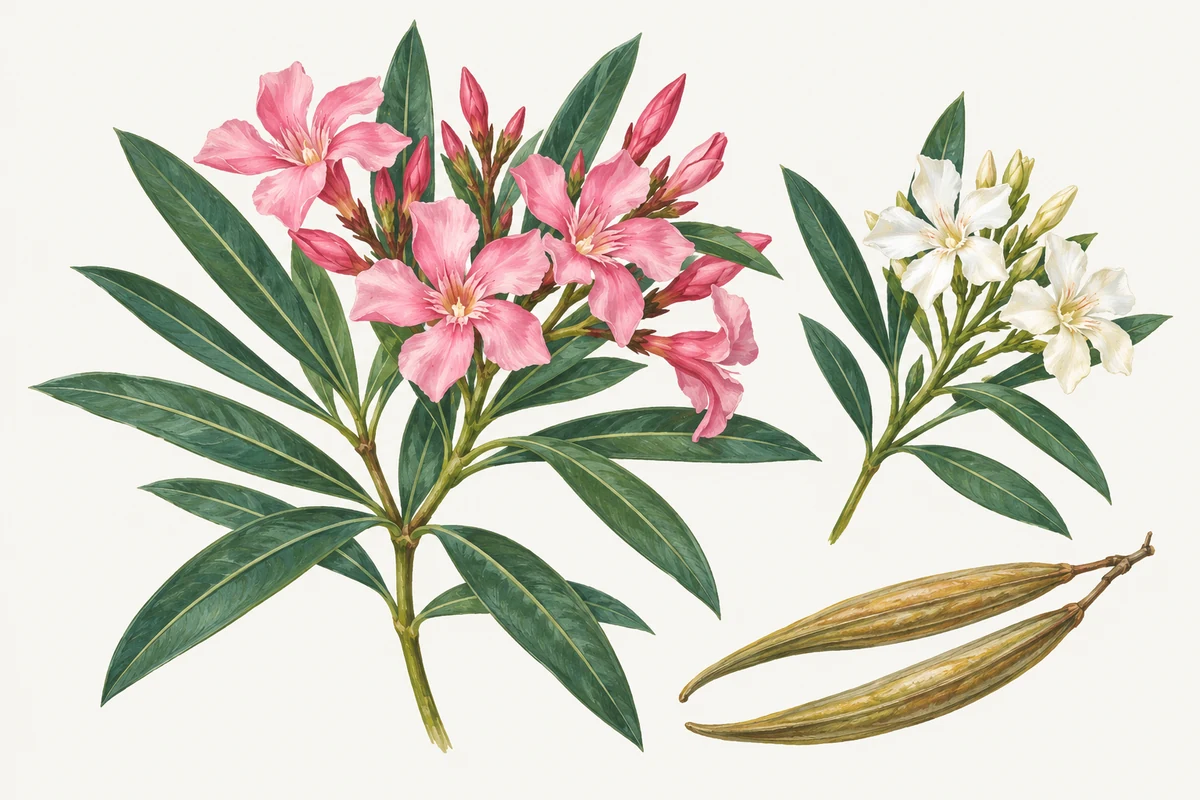
In short
Oleander (Nerium oleander) is an evergreen shrub with narrow, leathery leaves 4 to 7 inches long and under an inch wide, set in whorls of 3 or 4 or in pairs. Its 5-petaled flowers, 1 to 1½ inches across, come in white, pink, salmon, red or yellow, with a fringed corona at the mouth. Slender paired pods, 5 to 7 inches long, follow. Sources list all parts as toxic.
- Count the leaves at a node: three (or four) narrow leaves around the stem is the oleander pattern; mountain laurel, rhododendron and willow have leaves one at a time.
- ASPCA lists oleander as toxic to dogs, cats and horses; UF/IFAS says all parts are toxic if ingested and its sap can irritate skin and eyes.
- Never burn oleander prunings: NC State and UF/IFAS both warn that the smoke is harmful.
Field marks at a glance
- Scientific name
- Nerium oleander
- Family
- Apocynaceae (dogbane family)
- Type
- Shrub, perennial, evergreen
- Leaves
- In whorls of 3 or 4, or opposite; simple, linear-lanceolate (long and narrow), sharply pointed, 4 to 7 inches long and less than 1 inch wide, smooth-edged, on short stalks.
- Leaf texture
- Leathery and dark green, with a prominent midrib on the upper side. The name comes from the olive (Olea), whose leaves they resemble.
- Flowers
- 5-petaled, 1 to 1½ inches across, single or double, in clusters (cymes) at the branch tips. The petals open from a slender funnel-shaped tube with a fringed corona at its mouth.
- Flower color and season
- White, pink, red, salmon, apricot, coral or yellow. Late spring to late summer (NC State); in Florida through much of the year, especially the warm months (UF/IFAS).
- Fruit
- A pair of slender, green, pod-like follicles 5 to 7 inches long; each splits along one side to release small seeds with a tuft of fringe.
- Stems
- Strong, cane-like stems from the base; twigs stout and shiny green. Suckers sprout from the base of the plant (UF/IFAS).
- Size and form
- Rounded, fast-growing shrub, 5 to 19½ feet tall and 6 to 10 feet wide; it can be trained into a small tree of 10 to 18 feet. Dwarf cultivars stay near 4 feet.
- Where it grows
- Native from the Mediterranean region into Asia (NC State: Europe and Asia; UF/IFAS: northern Africa and the eastern Mediterranean). Planted outdoors in USDA zones 8 to 11, and in pots elsewhere.
- Other names
- Rosebay, rose-bay and rose laurel. Rosebay is also a name for rhododendron, so check the leaves rather than the label.
Oleander (Nerium oleander) is one of the most widely planted flowering shrubs in warm climates, along highways, beaches and pool fences, and one of the most poisonous: every source on this page lists it as toxic. That makes identifying it by sight worth getting right. Check the leaves first, then the flowers, then the pods.
What to check first: leaves, flowers, pods
1. The leaves. Pick a branch and count the leaves at one node (the point where leaves join the stem). The NC State Extension Plant Toolbox gives oleander leaves as opposite or in whorls of 3 or 4, 4 to 7 inches long and less than an inch wide, sharply pointed, smooth-edged, leathery and dark green, with a prominent midrib and short stalks. Three narrow leaves fanning out from the same point is the single most useful oleander mark. The species name refers to the olive tree, whose leaves they resemble.
2. The flowers. Oleander flowers come in terminal clusters. Each has 5 petals (or many, in double forms) spreading from a slender funnel-shaped tube, 1 to 1½ inches across. Look into the center: a fringed corona rings the mouth of the tube. NC State lists white, dark pink, salmon and apricot; UF/IFAS Gardening Solutions adds red, coral and yellow, and notes that double-flowered plants tend to be the fragrant ones.
3. The pods. After flowering, oleander forms a pair of slender green pods, 5 to 7 inches long, that split along one side to release small fringed seeds. Pods are a useful check on a shrub that has finished flowering.
Size helps less than you'd think. NC State gives 5 to 19½ feet tall and 6 to 10 feet wide, UF/IFAS says it can be trained into a small tree of 10 to 18 feet, and dwarf cultivars such as 'Petite Pink' stay near 4 feet.
Plant Identifier can put a name on an unknown shrub from one photo of a flowering branch or the whole plant. The app's answer comes without a confidence score or alternatives, so confirm it against the whorled leaves before you act on it.
Oleander toxicity: what the sources say
Oleander toxicity is the reason people look this plant up, so here is exactly how each source lists it.
- ASPCA. The ASPCA Animal Poison Control Center lists oleander (also rose-bay) as toxic to dogs, cats and horses. Toxic principle: cardiac glycosides. Clinical signs: drooling, abdominal pain, diarrhea, colic, depression and death.
- UF/IFAS. The University of Florida says all parts of the plant are toxic if ingested and that oleander contains cardenolide glycosides that, eaten in certain quantities, can be harmful, even fatal, to humans and pets. It advises planting it away from small children and curious pets, and keeping it out of reach of grazing animals.
- NC State Extension. NC State calls oleander highly poisonous: do not consume any part of it, and do not burn it, as the smoke is injurious. UF/IFAS gives the same warning about burning pruned branches.
On handling, UF/IFAS says oleander sap can cause skin and eye irritation, so wash your hands immediately after touching cuttings or, better, wear disposable gloves while pruning. That is all the handling advice its sources give; this page adds none of its own.
If someone may have eaten any part of an oleander, call Poison Control at 1-800-222-1222 (poison.org) right away, as UF/IFAS advises contacting a poison control center immediately. If a pet may have, call your veterinarian or the ASPCA Animal Poison Control Center at (888) 426-4435 (a consultation fee may apply). Other garden plants on the ASPCA lists are gathered in poisonous plants for dogs and plants toxic to cats.
Plant Identifier's Toxicology tool gives AI-written notes on toxic parts and symptoms. Treat them as background, never as a reason to wait before calling.
Oleander vs mountain laurel, rhododendron and willows
Three groups of plants get mistaken for oleander, each for a different reason: mountain laurel and rhododendrons for their leathery evergreen leaves and showy clusters, willows for their long, narrow leaves. The leaf count at a node settles almost every case.
| Feature | Oleander | Mountain laurel | Rhododendron (R. maximum) | Willow (weeping willow) |
|---|---|---|---|---|
| Leaves per node | 3–4 in a whorl, or 2 | 1 (alternate), occasionally more | 1 (alternate) | 1 (alternate) |
| Leaf shape | 4–7 in, under 1 in wide, smooth edge | 2–5 in, elliptic, smooth edge | 4–8 in, broad, rusty hairs below | 3–6 in, narrow, finely toothed |
| Flowers | Funnel tube, 5 petals, fringed corona | Cup-shaped, 10 anther pockets | Often spotted, to 2 in, no corona | Catkins, no petals |
| Fruit | Paired pods 5–7 in | Tiny 5-valved capsules | Oblong capsule | Small capsule with cottony seeds |
| Leaf habit | Evergreen | Evergreen | Evergreen | Deciduous |
Sources: NC State Extension pages for mountain laurel, rosebay rhododendron and weeping willow.
The name "rosebay" adds to the confusion: NC State lists it as a common name of oleander, and Rhododendron maximum is called rosebay rhododendron. Mountain laurel and rhododendrons are also listed as poisonous by NC State, so a mix-up between them doesn't make either one harmless. For the general method of narrowing down an unknown shrub, see how to identify plants.
Where you'll see oleander
Oleander is native from the Mediterranean region into Asia: NC State gives Europe and Asia, UF/IFAS northern Africa and the eastern Mediterranean. In the US it is planted outdoors in the warmest zones, which UF/IFAS gives as USDA zones 9a to 11 and NC State as 8 to 10; NC State notes it is damaged at or below 32°F. UF/IFAS describes it lining highways and interstates across Florida because it handles heat, car exhaust, poor soil, drought and sea spray. Farther north it is grown in containers that spend the winter indoors.
A short care note
UF/IFAS describes oleander as low maintenance: best in full sun, tolerant of partial shade (too little light makes it leggy and reduces flowering), drought tolerant once established, and flowering on new wood. NC State suggests light pruning after flowering and removing frost-damaged branches once winter passes. Its main pest in Florida, per UF/IFAS, is the oleander caterpillar, which can strip a plant within a week; UF/IFAS recommends cutting off the infested foliage. For any pruning, the gloves-and-handwashing advice above applies, and prunings should never be burned.
Look-alikes and how to tell them apart
Mountain laurel (Kalmia latifolia)
Mountain laurel leaves are shorter and wider (2 to 5 inches, elliptic) and usually alternate, one per node. Its flowers are cup-shaped and five-sided, rose to white with purple-red marks inside and 10 anthers tucked into pockets. Its fruits are tiny 5-valved capsules, never long paired pods.
Rosebay rhododendron (Rhododendron maximum) and other rhododendrons
Rhododendron leaves are alternate and broader (4 to 8 inches long), often with rusty hairs underneath. The flowers, up to 2 inches, come in umbel-like clusters, are often spotted olive green to orange and have no fringed corona, and the fruit is an oblong capsule rather than a pair of pods.
Willows (Salix), such as weeping willow
Willow leaves are also long and narrow, but they are alternate, finely toothed along the edge and grayish-green beneath. Willows lose their leaves in fall and flower in catkins with no petals.
What a photo can't settle
- Some oleander stems carry their leaves in opposite pairs rather than whorls of three. Check several nodes before deciding, and don't rule oleander out from one photo of one branch.
- Out of flower, a young oleander in a pot can be hard to separate from other narrow-leaved evergreens in a photo. Look for the whorled leaves, the prominent midrib and any old paired pods.
- A photo app, ours included, can name the plant but can't say how much of it a child or pet has eaten or how serious it is. That is a call for Poison Control or a vet, not an app.
Questions people ask
What does an oleander look like?
A dense, rounded evergreen shrub, often 5 to 20 feet tall, with long, narrow, leathery leaves in whorls of three. From late spring through summer it carries clusters of 5-petaled flowers, white, pink, red or yellow, about 1 to 1½ inches across, followed by slender pods in pairs.
Is oleander poisonous to dogs and cats?
The ASPCA lists oleander as toxic to dogs, cats and horses, naming cardiac glycosides as the toxic principle and signs including drooling, abdominal pain, diarrhea, depression and death. If a pet may have chewed any part, call your vet or the ASPCA Animal Poison Control Center at (888) 426-4435 at once. For a person, call Poison Control at 1-800-222-1222.
Is it dangerous to touch oleander?
UF/IFAS says oleander sap can cause skin and eye irritation, and advises washing your hands right after touching cuttings or, better, wearing disposable gloves while pruning. The serious danger its sources describe is from swallowing any part, or from smoke if prunings are burned.
How do I tell oleander from mountain laurel?
Count the leaves at one node and look at the flower. Oleander has three narrow leaves around the stem and funnel-shaped flowers with a fringed center. Mountain laurel usually has one shorter, wider leaf per node and cup-shaped flowers with 10 anthers tucked into little pockets.
Sources
- Nerium oleander — NC State Extension, North Carolina Extension Gardener Plant Toolbox
- Oleander — UF/IFAS Gardening Solutions, University of Florida
- Toxic and Non-toxic Plants: Oleander — ASPCA Animal Poison Control Center
- Poison Control — National Capital Poison Center
- Kalmia latifolia — NC State Extension, North Carolina Extension Gardener Plant Toolbox
- Rhododendron maximum — NC State Extension, North Carolina Extension Gardener Plant Toolbox
- Salix babylonica — NC State Extension, North Carolina Extension Gardener Plant Toolbox
Keep reading
- Pet safety guidePoisonous plants for dogs, and what to do if your dog ate one
- Garden shrub profileLavender (Lavandula): how to identify the plant and its types
- Field guideHow to identify a plant, step by step
- Free toolFlower identifier by description
- Plant profileHydrangea: how to identify it and tell the types apart