Garden shrub profile
Lavender (Lavandula): how to identify the plant and its types
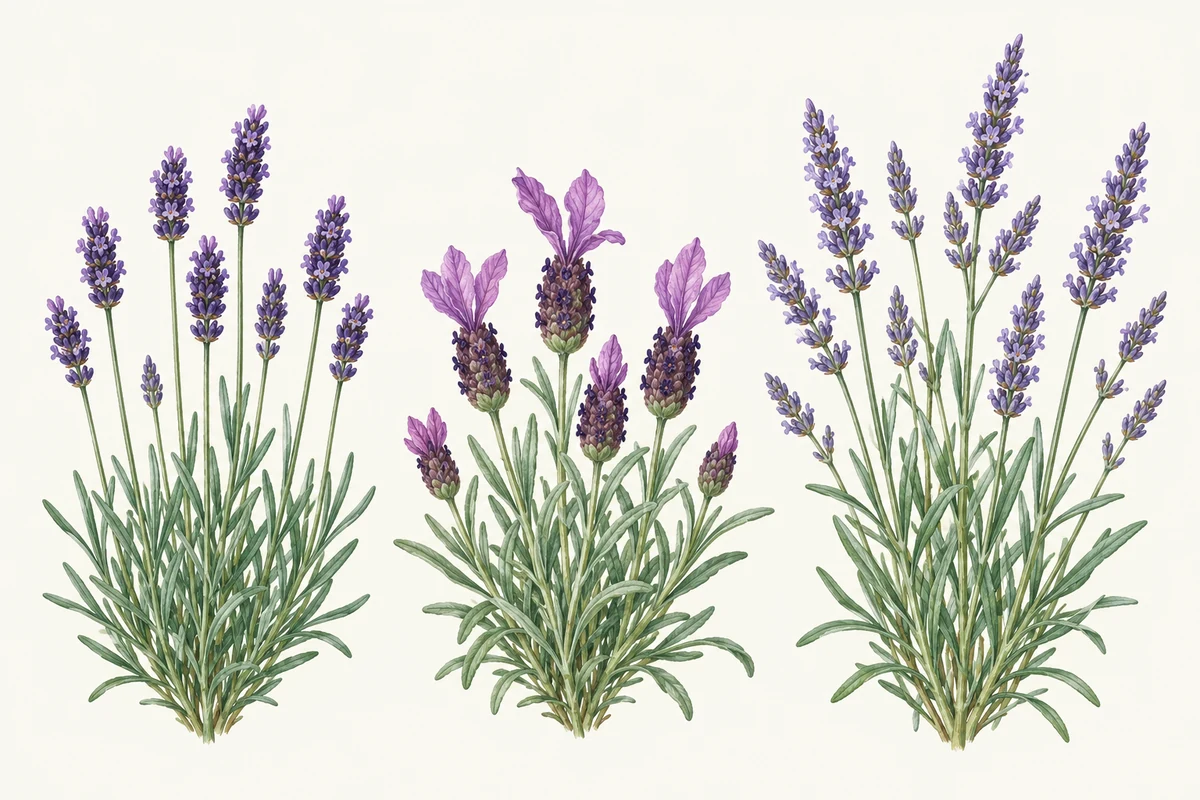
A low, woody, gray-green shrub with narrow aromatic leaves and slim purple spikes held well above the foliage. The top of the flower spike tells English lavender from French.
In short
To identify a lavender plant, look for a low, rounded, woody-based shrub with narrow, gray-green to silvery leaves that smell strongly when rubbed, and small purple, blue, pink or white flowers packed into slim spikes on long, leafless stalks above the foliage. English lavender (Lavandula angustifolia) has plain spikes; French or Spanish lavender (L. stoechas) carries petal-like bracts, or ears, on top.
- Narrow, gray-green, scented leaves plus flower spikes on long bare stalks point to lavender.
- Ears on top of a short, fat flower head mean Lavandula stoechas, called French lavender in the UK and Spanish lavender in the US.
- Russian sage and catmint share the color and scent; their leaves are toothed or deeply cut, lavender's are smooth-edged.
Field marks at a glance
- Scientific name
- Lavandula angustifolia
- Family
- Lamiaceae (mint family)
- Type
- Shrub, perennial, evergreen
- Habit
- A low, rounded evergreen shrub with a woody base; English lavender 1 to 2 ft tall and 2 to 3 ft wide (NC State), 30 to 90 cm in RHS figures.
- Leaves
- Opposite, narrow (linear to lance-shaped), smooth-edged with the margins rolled under, gray-green to bluish-green, about 0.4 to 1 in long (NC State).
- Leaf surface
- Covered in fine white hairs, which give the silvery look; the RHS describes silver-grey leaves.
- Scent
- Leaves and flower calyces are aromatic when bruised; rub a leaf between your fingers.
- Flower spike
- Small two-lipped flowers in whorls on a slim terminal spike 0.7 to 3 in long, on a long, leafless stalk 2 to 6 in above the leaves (NC State).
- Flower color
- Usually lavender-purple or purple-blue; mauve, pink and white cultivars exist (NC State, RHS).
- Bloom time
- Summer; lavandin blooms later, July to September (NC State).
- Top of the spike
- Plain in English lavender and lavandin; topped with 'ears' (large colored bracts) in French or Spanish lavender, L. stoechas.
- Native range
- The Mediterranean region; L. stoechas from coastal France, Spain, Portugal and nearby islands (NC State).
- Where it grows
- Sunny, fast-draining spots: borders, low hedges, gravel and containers. The RHS notes it will not survive long in shade or wet soil.
Lavender is one of the easiest garden shrubs to recognise in flower and one of the easiest to confuse with its neighbours out of it, because several mint family plants share its gray leaves, its scent and its purple color. Check the leaves first, then the flower stalk, then the top of the spike.
How to identify a lavender plant in four checks
1. The leaves. Pick a leaf. English lavender leaves are narrow, linear to lance-shaped, about 0.4 to 1 inch long, gray-green to bluish-green, smooth-edged with the margins rolled under, and covered in fine white hairs, according to the NC State Plant Toolbox. They grow in opposite pairs along the stem. A toothed or broad leaf rules lavender out.
2. The scent. Rub the leaf between your fingers. Lavender leaves are aromatic when bruised, and the flower calyces are too. Russian sage and catmint smell strong as well, so scent confirms the family more than the plant; the leaf shape does the rest.
3. The flower stalk. Look at how the flowers are held. Lavender flowers grow in whorls on a slim spike at the end of a long, leafless stalk; NC State gives spikes of 0.7 to 3 inches on stalks of 2 to 6 inches, standing well clear of the foliage. Each small flower is two-lipped, usually lavender-purple, sometimes pink or white.
4. The top of the spike. This separates the two main groups. English lavender and lavandin have plain spikes. French lavender, called Spanish lavender in the US, ends in a tuft of large, colored bracts, the "ears" described below.
If you find a gray-leaved shrub with no label, one photo of a flowering stem lets Plant Identifier suggest a name, and the Plant Map can keep a note of where it grows. The app shows no confidence score and no list of alternatives, so check the leaf edge and the top of the spike yourself.
English, French and lavandin: the three you will meet
The RHS sorts garden lavenders into English lavender and its hybrids, which are usually hardy, and French and tender lavenders, which are not.
English lavender (Lavandula angustifolia) is the classic: a compact, rounded shrub 1 to 2 feet tall and 2 to 3 feet wide in NC State's figures (the RHS gives 30 to 90 cm), with silver-grey leaves and abundant purple or purple-blue spikes in summer. Mauve, pink and white cultivars exist. World Flora Online lists Lavandula angustifolia Mill. as the accepted name; the ASPCA spells it Lavendula.
French or Spanish lavender (Lavandula stoechas) has a short, plump flower head about 0.75 inch long topped by four petal-like bracts 0.5 to 1 inch long, which NC State compares to flags or rabbit ears. Its silvery-green leaves are 0.5 to 1.5 inches long with downturned margins, and NC State says they resemble rosemary. The RHS adds a camphor-like scent and notes these types are less hardy than English lavender. UK readers will see it labeled French lavender; US labels usually say Spanish lavender. The name on the label differs, the plant is the same.
Lavandin (Lavandula × intermedia) is a hybrid of English and Portuguese lavender. NC State describes a larger plant, a 2 to 4 foot mound, with leaves 1 to 1.7 inches long and spikes of 1.5 to 2.5 inches, blooming later than other lavenders, from July to September. 'Grosso', 'Provence' and 'Phenomenal' are cultivars you will see. Without the label, a lavandin looks like an oversized English lavender; size and the late bloom are the clues.
Lavender vs Russian sage and catmint
Both look-alikes are sold beside lavender in the same sunny borders, and both belong to the mint family.
| Feature | English lavender | Russian sage | Catmint |
|---|---|---|---|
| Scientific name | Lavandula angustifolia | Salvia yangii (formerly Perovskia atriplicifolia) | Nepeta × faassenii |
| Leaf | Narrow, smooth-edged, 0.4 to 1 in | Deeply cut, toothed, 1 to 2 in | Oblong to oval, rounded teeth, 1 to 2 in |
| Flowers | Dense spike on a bare stalk | Tall, branched, airy sprays | Spikes of violet-blue flowers |
| Height | 1 to 2 ft | 2 to 4 ft | 1.5 to 2 ft, spreading to 3 ft |
| Bloom | Summer | June to October | Spring into summer |
Russian sage is the plant most often mistaken for lavender at a distance: a haze of blue-purple above silvery stems. Up close, its leaves are lance-shaped but strongly cut into lobes with toothed margins, and its stems are stiff and square. Catmint forms a looser mound with broad, gray-green, scalloped leaves. For other purple garden flowers, the flower identifier narrows the choice by color and flower shape, and identify a plant by its leaf explains how to read leaf edges and arrangement.
Is lavender toxic to pets
The ASPCA lists lavender (Lavendula angustifolia, also called common or English lavender) as toxic to dogs, cats and horses. It names linalool and linalyl acetate as the toxic principles and lists nausea, vomiting (not in horses) and loss of appetite as clinical signs.
If a pet has chewed lavender, call your vet or the ASPCA Animal Poison Control Center at (888) 426-4435 (a consultation fee may apply). If a person has eaten part of the plant and seems unwell, call Poison Control at 1-800-222-1222 in the US, or NHS 111 in the UK. Plant Identifier's Toxicology tool gives AI-written notes for people, dogs and cats, but it does not replace that call. Other garden and house plants on the ASPCA's lists are in poisonous plants for dogs.
A short note on where lavender grows
The RHS calls lavender a Mediterranean plant in its needs: it wants full sun and fast-draining, poor to moderately fertile soil, including chalky and alkaline ground, and it will not survive long in shade, heavy clay or waterlogged soil. English lavender and its hybrids are the hardiest; the RHS describes the French and tender types as less hardy and short-lived, best grown in containers kept frost-free over winter. So a lavender-like shrub thriving in a damp, shady corner deserves a second look. NC State notes that root rot from overwatering and leaf spot are the main problems.
Look-alikes and how to tell them apart
Russian sage (Salvia yangii, formerly Perovskia atriplicifolia)
Check the leaf edge and the flower stalk. Russian sage leaves are deeply cut (pinnately dissected) with toothed margins, 1 to 2 in long, on stiff, square stems 2 to 4 ft tall, and its flowers sit on tall, branched, airy sprays (NC State). Lavender leaves are narrow and smooth-edged, with one dense spike per stalk.
Catmint (Nepeta × faassenii)
Look at the leaf shape. Catmint leaves are oblong to oval, 1 to 2 in long, with rounded teeth (NC State), much broader than lavender's needle-like leaves, and the plant sprawls into a soft mound. Lavender leaves are narrow and untoothed on a woody-based shrub.
French or Spanish lavender (Lavandula stoechas)
A different lavender. Look at the top of the flower head: L. stoechas has a short, plump head about 0.75 in long topped by four petal-like bracts 0.5 to 1 in long, like rabbit ears (NC State). English lavender has a longer, slimmer spike with no ears.
Lavandin (Lavandula × intermedia)
Also lavender: a hybrid of English and Portuguese lavender that grows into a bigger mound, 2 to 4 ft, with longer leaves, 1 to 1.7 in, and spikes 1.5 to 2.5 in, blooming later, July to September (NC State). Size and bloom time, not the flower, separate it from English lavender.
What a photo can't settle
- Lavender cultivars, and English lavender versus lavandin, differ mostly in size, color shade and bloom time; a photo may confirm Lavandula but not always the species or cultivar.
- Out of flower, a young lavender can look like other gray-leaved shrubs in a photo; rub a leaf and check the edge before you rely on the name.
- A photo cannot tell whether a pet ate enough to matter; that is a question for your vet or the ASPCA Animal Poison Control Center.
Questions people ask
How can you tell English lavender from French lavender?
Look at the top of the flower head. French lavender, Lavandula stoechas, has a short, plump head topped with petal-like bracts that look like rabbit ears (NC State); the RHS describes a distinctive tuft or ears and a camphor-like scent. English lavender has a slim spike with no ears. In the US, L. stoechas is usually called Spanish lavender.
What plant looks like lavender but isn't?
Russian sage and catmint are the usual suspects: both are mint family plants with gray-green, scented leaves and lavender-blue flowers. Russian sage has deeply cut, toothed leaves on tall, airy, branched sprays; catmint has broad, oval leaves with rounded teeth. True lavender has narrow, smooth-edged leaves and dense spikes.
Is lavender a shrub or a perennial?
Both descriptions fit. NC State calls English lavender an evergreen perennial shrub and Spanish lavender a woody evergreen subshrub; the RHS calls lavender a shrub. The base turns woody with age, and the RHS notes older plants can become straggly and very woody.
Is lavender poisonous to cats and dogs?
The ASPCA lists lavender (Lavandula angustifolia) as toxic to dogs, cats and horses, naming linalool and linalyl acetate and listing nausea, vomiting and loss of appetite. If a pet chewed the plant, call your vet or the ASPCA Animal Poison Control Center at (888) 426-4435; in the UK, call your vet.
Sources
- Lavandula angustifolia — North Carolina Extension Gardener Plant Toolbox (NC State)
- Lavandula stoechas — North Carolina Extension Gardener Plant Toolbox (NC State)
- Lavandula x intermedia — North Carolina Extension Gardener Plant Toolbox (NC State)
- Salvia yangii — North Carolina Extension Gardener Plant Toolbox (NC State)
- Nepeta x faassenii — North Carolina Extension Gardener Plant Toolbox (NC State)
- How to grow lavender — Royal Horticultural Society (RHS)
- Lavandula angustifolia Mill. — World Flora Online
- Lavender — ASPCA Animal Poison Control Center