Garden shrub profile
Lantana (Lantana camara): how to identify it
A sprawling, woody shrub with rough, toothed, aromatic leaves and flat-topped clusters of tiny tubular flowers that often change color as they age. Here is what to check.
In short
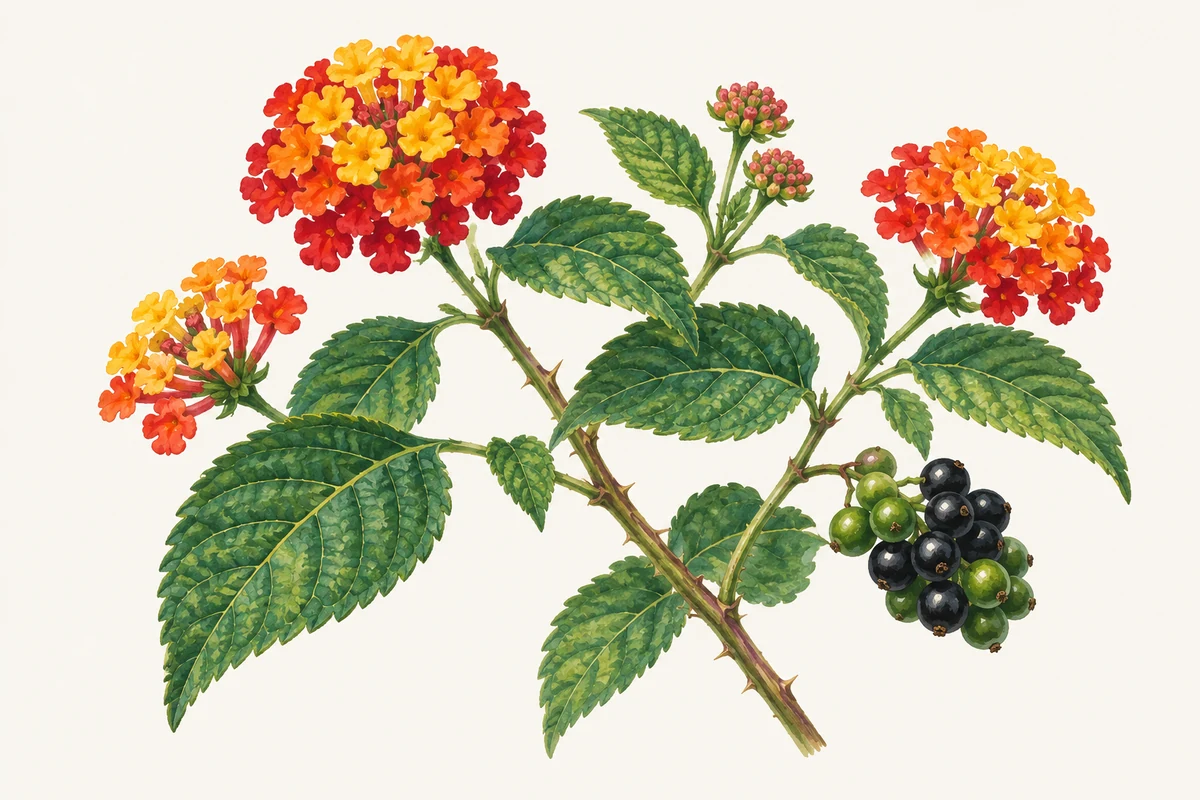
What plant is lantana? Lantana is a small, sprawling woody shrub in the verbena family (Verbenaceae). Lantana camara has rough, toothed, ovate leaves 3 to 6 inches long that smell when crushed, square and often prickly stems, and domed clusters of small tubular flowers that shift from yellow to orange, pink or red. Trailing lantana (L. montevidensis) is low, with lilac flowers.
- Domed clusters of tiny tubular flowers in mixed colors, on a shrub with rough, toothed, scented leaves, point to Lantana camara.
- A low, trailing plant with lilac or purple-pink clusters and yellow throats is trailing lantana, L. montevidensis.
- The ASPCA lists lantana as toxic to dogs, cats and horses (pentacyclic triterpenoids).
Field marks at a glance
- Scientific name
- Lantana camara
- Family
- Verbenaceae (verbena family)
- Type
- Shrub, perennial, evergreen
- Leaves
- Simple, opposite or whorled, ovate, with a serrate (toothed) margin; 3 to 6 inches long and 1 to 3 inches wide (NC State).
- Leaf feel and scent
- Rough to the touch and fragrant when crushed (NC State); hairless, according to NC State's attribute list.
- Stem
- Square in cross-section, green, often with small spines or prickles (NC State); woody at the base.
- Flowers
- Tiny tubular flowers, under 1 inch, with five lobes, in hemispherical clusters on long stalks; flowers in one cluster often change color as they age (NC State).
- Flower colors
- White, yellow, orange, pink or red, often two or three colors in one cluster (NC State). Blooms from midsummer until the first frost.
- Fruit
- Small, berry-like drupes under 1 inch, green at first and turning metallic blue or purple-black (NC State).
- Size and habit
- 1 to 6 ft tall and 3 to 5 ft wide, growing wider than tall; arching, upright or prostrate (NC State).
- Native range
- The West Indies and Mexico to tropical America (NC State).
- Trailing lantana
- Lantana montevidensis: 1 to 1.5 ft tall and 3 to 5 ft wide, thin, drooping, hairy stems and light purple to purplish-pink flowers with yellow throats; native to Bolivia, Brazil and northern Argentina (NC State).
Lantana is a fast-growing, sprawling shrub from tropical America, sold across the US, Canada and the UK as a summer bedding plant, a patio pot or a hanging basket. Its flower heads are easy to spot, but verbenas and pentas carry similar clusters, so check the leaf, the stem and the flower in the order below.
How to identify lantana in four checks
1. The flower cluster. Look at one head from above. Lantana flowers are tiny, under 1 inch, tubular with five spreading lobes, and packed into a domed, hemispherical cluster on a long stalk. The NC State Plant Toolbox notes that the flowers within a cluster often change color as they age, so one head can show yellow in the middle and orange, pink or red around the edge. That mixed-color dome is the strongest single clue.
2. The leaf. Pick a leaf and rub it. Lantana camara leaves are simple, ovate, 3 to 6 inches long and 1 to 3 inches wide, with a toothed edge and a rough, sandpapery surface. They sit opposite each other or in whorls, and they are fragrant when crushed.
3. The stem. Roll a young shoot between your fingers. NC State describes the stems as square in cross-section and spiny, so you may feel small prickles. Older stems at the base turn woody, which separates lantana from soft-stemmed bedding plants.
4. The fruit. After flowering, look in the center of old heads. Lantana sets small, berry-like drupes that start green and turn metallic blue or purple-black. Sterile cultivars set few or none, so a plant without berries can still be lantana.
If you photograph a plant at a garden center or in a neighbor's border and want a name, Plant Identifier can give a common and scientific name from one photo; frame a whole flower cluster with a few leaves. The app shows no confidence score and no list of alternatives, so compare its answer with the four checks above.
Lantana camara and trailing lantana
Two species account for most garden lantanas. Lantana camara is the bushy one: NC State gives 1 to 6 feet tall and 3 to 5 feet wide, growing wider than tall, with an arching, upright or prostrate habit, and flowers from midsummer until the first frost. It is native to the West Indies and Mexico to tropical America. Named cultivars NC State lists include 'Anne Marie' (yellow through orange to pink and red-fuchsia), 'Dallas Red' (red with orange overtones and yellow centers), 'Chapel Hill Yellow' (pale yellow), 'New Gold' (golden yellow, low, up to 6 feet wide) and 'Radiation' (red-orange and yellow, 4 to 6 feet tall and wide).
Trailing lantana, Lantana montevidensis, is the low one. The NC State page on trailing lantana describes it as 1 to 1.5 feet tall and 3 to 5 feet wide, with dark green, ovate, toothed leaves, thin, drooping, hairy stems, and clusters of tiny, scented, light purple to purplish-pink flowers with yellow throats from June until the first frost. It is native to Bolivia, Brazil and northern Argentina. 'Alba' has white flowers with yellow eyes, and 'New Gold' is a cross between the two species.
Lantana vs verbena and pentas
All three are sold as summer pollinator plants with clusters of small flowers. The leaf edge and the stem usually settle it.
| Feature | Lantana camara | Rose verbena | Pentas |
|---|---|---|---|
| Leaf | Ovate, toothed, rough, scented | Divided into 3 lobes, coarsely toothed | Elliptic to lance-shaped, smooth edge |
| Stem | Square, often prickly, woody at base | Creeping, turned up at the tips | Soft, finely hairy |
| Cluster | Domed, often several colors | Dome of 10 to 25 flowers, up to 2.5 in | Star-shaped tubular flowers |
| Height | 1 to 6 ft | 8 in to 1.5 ft | 1 to 2 ft |
Sources: NC State on rose verbena and NC State on pentas. If you are not sure where to start with an unknown shrub, the houseplant identification key walks through leaf and stem checks step by step.
Where lantana is listed as invasive
NC State notes that in parts of the world with more tropical climates, lantana is a weedy pest, and that trailing lantana has naturalized in the southern United States, including California, Texas, Louisiana, Alabama, Georgia and Florida. UF/IFAS Gardening Solutions states that the UF/IFAS Assessment of Non-Native Plants lists the common nursery lantana, which it names Lantana strigocamara, as invasive, and that UF/IFAS does not recommend it for North, Central or South Florida. UF/IFAS points to sterile cultivars such as 'Bloomify Red', 'Bloomify Rose' and 'Luscious Royale Red Zone', and to the rare Florida natives Lantana involucrata and Lantana depressa. Rules differ by state, province and country; check your local invasive plant list before planting, and if you remove plants with a herbicide, follow the label and local rules. For other plants that escape gardens, see how to identify invasive plants.
Is lantana toxic to pets
The ASPCA lists lantana (Lantana camara, also shrub verbena, yellow sage and red sage) as toxic to dogs, cats and horses. It names pentacyclic triterpenoids as the toxic principle and lists vomiting, diarrhea, labored breathing and weakness, with liver failure more common in livestock. NC State lists the flowers, fruits and leaves as the poisonous parts and notes that the leaves may cause skin irritation in sensitive people; it advises gloves when handling trailing lantana.
If a pet has chewed a leaf or flower, call your vet or the ASPCA Animal Poison Control Center at (888) 426-4435. For a person, call Poison Control at 1-800-222-1222 (poison.org). Plant Identifier's Toxicology tool gives AI-written notes for people, dogs and cats; treat them as a starting point, not as the answer. More plants on the ASPCA's lists are in poisonous plants for dogs and plants toxic to cats.
Look-alikes and how to tell them apart
Rose verbena (Glandularia canadensis)
Check the leaves and the stem base. Rose verbena leaves are deeply divided into 3 main lobes with coarse teeth, and its stems creep along the ground and turn up at the ends (NC State). Lantana leaves are undivided ovals with even teeth on a woody, square, often prickly stem.
Pentas, Egyptian star cluster (Pentas lanceolata)
Feel the leaf edge. Pentas leaves are elliptic to lance-shaped with a smooth, untoothed margin and fine hairs underneath, and the plant is soft-stemmed, 1 to 2 ft tall (NC State). Lantana leaves are toothed and rough, the stems turn woody, and the clusters mix colors.
Trailing lantana (Lantana montevidensis)
Look at the habit and color. Trailing lantana stays 1 to 1.5 ft tall with thin, drooping, hairy stems and lilac to purplish-pink clusters (white in 'Alba'), all one color (NC State). Lantana camara is a taller, bushier shrub whose clusters often mix yellow, orange and pink.
What a photo can't settle
- Garden lantanas are mostly hybrids and named cultivars, and many are sold simply as Lantana camara; a photo can name the genus but often not the exact cultivar or whether it is a sterile variety.
- Whether a lantana is listed as invasive depends on where you live; check your state, provincial or local invasive plant list rather than relying on a photo app.
- Whether a pet that chewed a leaf or berry needs treatment is for your vet or a poison control center to decide, not for this page or an app.
Questions people ask
Why does lantana change color?
Each cluster opens from the outside in, and NC State notes that the flowers within a cluster often change color as they age. That is why one head can show yellow centers with orange, pink or red outer flowers. Cultivars such as 'Anne Marie' go from yellow through orange to pink and fuchsia.
Is lantana invasive?
In parts of the US, yes, according to official assessments. The UF/IFAS Assessment of Non-Native Plants lists the common nursery lantana, Lantana strigocamara, as invasive and does not recommend it for North, Central or South Florida. UF/IFAS points to sterile cultivars and the Florida natives Lantana involucrata and L. depressa as alternatives.
Is lantana an annual or a perennial?
Both, depending on climate. NC State describes Lantana camara as an annual or perennial shrub; it is evergreen where winters are mild and grown as a summer annual where frost kills it. Trailing lantana is root hardy in zone 8 and grown as an annual in colder areas (NC State).
Is lantana poisonous to dogs and cats?
The ASPCA lists lantana as toxic to dogs, cats and horses, naming pentacyclic triterpenoids and signs such as vomiting, diarrhea, labored breathing and weakness. If your pet chewed it, call your vet or the ASPCA Animal Poison Control Center at (888) 426-4435. For a person, call Poison Control at 1-800-222-1222.
Sources
- Lantana camara — North Carolina Extension Gardener Plant Toolbox (NC State)
- Lantana montevidensis — North Carolina Extension Gardener Plant Toolbox (NC State)
- Lantana — UF/IFAS Gardening Solutions
- Lantana — ASPCA Animal Poison Control Center
- Glandularia canadensis — North Carolina Extension Gardener Plant Toolbox (NC State)
- Pentas lanceolata — North Carolina Extension Gardener Plant Toolbox (NC State)
- Poison Control — National Capital Poison Center
Keep reading
- Invasive plants IDHow to identify invasive plants
- Pet safety guidePoisonous plants for dogs, and what to do if your dog ate one
- Pet safety guidePlants toxic to cats, and what to do if your cat chewed one
- Plant profileOleander (Nerium oleander): how to identify it
- Shrub profileHow to identify a hibiscus plant