Shrub profile
How to identify a hibiscus plant
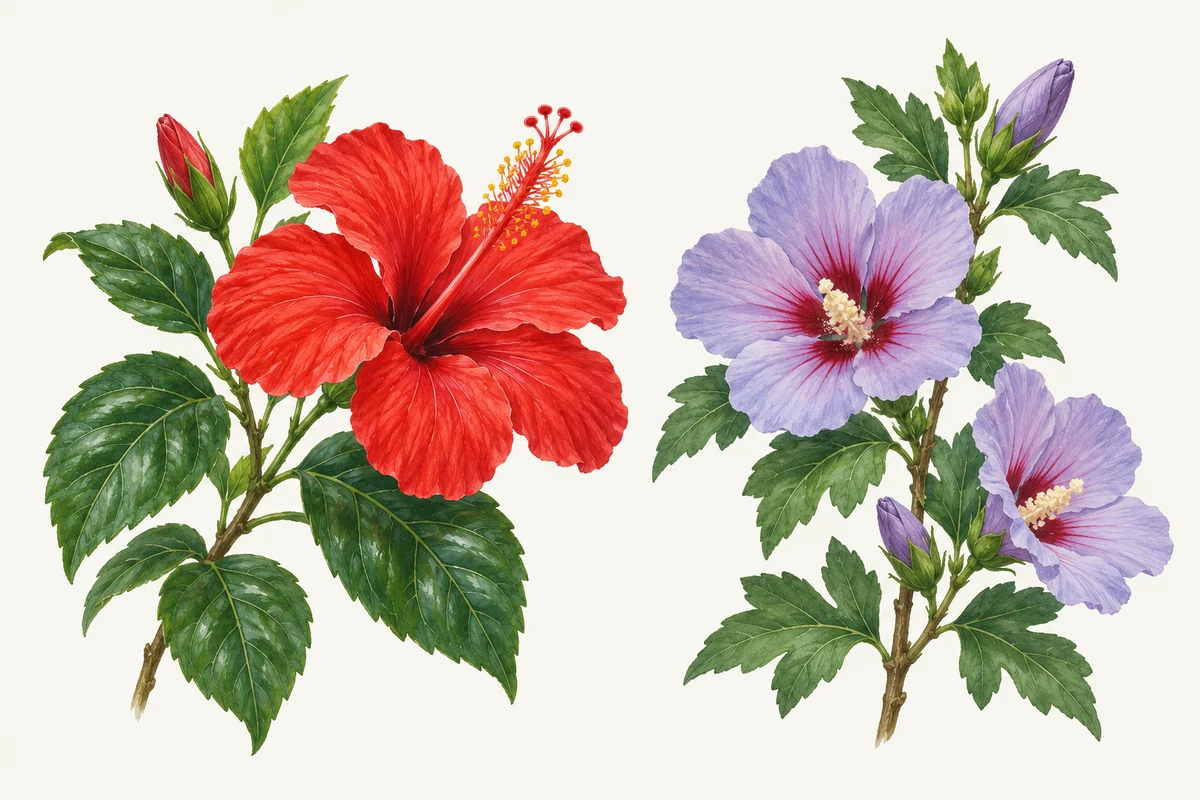
Big funnel- or saucer-shaped flowers with five petals and a column of fused stamens in the center. How to tell tropical Chinese hibiscus from hardy rose of Sharon and rose mallow.
In short
To identify a hibiscus plant, look at the flower: five broad petals around a long central column where the stamens are fused around the pistil. The leaves are simple and alternate, often toothed or lobed. Glossy evergreen leaves point to tropical Chinese hibiscus, small three-lobed leaves on a deciduous shrub to rose of Sharon, and dinner-plate flowers on 2- to 6-foot stems to hardy rose mallow.
- Hibiscus flowers have five petals and a showy central column of fused stamens; each flower usually lasts one day.
- Chinese hibiscus is a tropical evergreen shrub, rose of Sharon a hardy deciduous shrub with 3-lobed leaves, and rose mallow a native perennial that dies back each winter.
- The ASPCA lists Hibiscus syriacus (rose of Sharon) as non-toxic to dogs and cats; that is the ASPCA's classification, not a guarantee.
Field marks at a glance
- Scientific name
- Hibiscus rosa-sinensis, Hibiscus syriacus, Hibiscus moscheutos
- Family
- Malvaceae (mallow family)
- Type
- Shrub, perennial
- Flowers
- Five broad petals in a funnel or saucer shape, single or double, in red, pink, white, yellow, purple or two-toned.
- Central column
- Stamens fused into a long tube around the pistil, sticking out of the center of the flower; the clearest hibiscus trait.
- Flower size
- 2 to 4 inches in rose of Sharon, up to 6 inches in Chinese hibiscus, 6 to 8 inches or more in rose mallow, per NC State.
- Leaves
- Simple and alternate, toothed: glossy dark green in Chinese hibiscus, 3-lobed in rose of Sharon, white and hairy underneath in rose mallow.
- Fruit
- A dry capsule that splits open: 5-valved and persisting through winter in rose of Sharon, oval and short-beaked in rose mallow.
- Habit
- Chinese hibiscus 4 to 10 ft, rose of Sharon 8 to 12 ft, rose mallow 2 to 6 ft with stems that die back in winter.
- Native range
- Chinese hibiscus from Asia, rose of Sharon from south China and Taiwan, rose mallow from southeastern Canada and the central and eastern US.
Hibiscus is the shrub behind the big, single-day flowers with a long column sticking out of the center: on patio pots, along suburban fences in late summer and in wet ditches where the native rose mallow grows. Three species are the ones most gardeners meet: tropical Chinese hibiscus, hardy rose of Sharon and hardy rose mallow. The ASPCA lists rose of Sharon as non-toxic, which is its classification, not a guarantee.
How to identify a hibiscus plant: flower, column, leaves and capsules
1. Five petals around a central column. The flower decides it. NC State's Chinese hibiscus page describes flowers up to 6 inches across in which the pistil and stamens are fused together in a showy central tube. Look for that column first; double forms can hide it among extra petals.
2. One-day flowers. NC State says the flowers of both Chinese hibiscus and rose of Sharon last only one day, with new ones opening through the season. A shrub with fresh blooms every morning and limp, rolled-up ones below is a good sign.
3. Simple, alternate, toothed leaves. Hibiscus leaves are never divided into leaflets. Chinese hibiscus leaves are glossy and dark green with toothed edges and veins radiating from the base. Rose of Sharon leaves are 3-lobed and 2 to 4 inches long. Rose mallow leaves are ovate to lance-shaped, green to grayish-green, and white and hairy underneath.
4. Dry, splitting capsules. After bloom, the hardy species carry capsules that split into sections. Rose of Sharon's are brown, 5-valved and about 3/4 inch, and stay on the shrub through winter.
One photo of an open flower in Plant Identifier gives a name when you are not sure which hibiscus you have, or whether it is one; the app shows no confidence score and no list of alternatives, so check the column and the leaves yourself. The flower identifier covers more garden flowers, and the hydrangea page covers the other big-flowered shrub of summer borders.
What the ASPCA lists for cats and dogs
The ASPCA's hibiscus entry lists Hibiscus syriacus, also called rose of Sharon and rose of China, in the family Malvaceae, as non-toxic to dogs, cats and horses. The ASPCA's separate rose of Sharon entry gives the same classification for the same species.
That listing is the ASPCA's classification for one species, not a guarantee. Both entries name Hibiscus syriacus, not tropical Chinese hibiscus or rose mallow,.
What to do:
- Cat or dog chewed hibiscus: call your vet or the ASPCA Animal Poison Control Center at (888) 426-4435 (the ASPCA says a consultation fee may apply).
- A person swallowed leaves or other parts: call Poison Control at 1-800-222-1222 in the US, or NHS 111 in the UK; in an emergency, 911 or 999.
Plant Identifier's Toxicology tool gives AI-written notes for people, dogs and cats once the plant is named, but it does not replace the vet or poison-control call. The poisonous plants for dogs guide lists common plants that are on the ASPCA's toxic list.
Tropical vs hardy hibiscus: Chinese hibiscus, rose of Sharon and rose mallow
| Feature | Chinese hibiscus | Rose of Sharon | Rose mallow |
|---|---|---|---|
| Scientific name | Hibiscus rosa-sinensis | Hibiscus syriacus | Hibiscus moscheutos |
| Type | Tropical evergreen shrub | Hardy deciduous shrub | Hardy perennial, woody at the base |
| Leaves | Glossy, dark green, toothed | 3-lobed, 2 to 4 in, coarsely toothed | Ovate, white and hairy underneath |
| Flowers | Up to 6 in, funnel-shaped | 2 to 4 in, crepe-like petals | 6 to 8 in, dark central eye |
| Bloom | Summer, also spring and fall | Summer | June to September |
| Height | 4 to 10 ft | 8 to 12 ft | 2 to 6 ft |
| Hardiness (USDA) | Zones 9 to 11 | Zones 5 to 9 | Zones 4 to 9 |
Chinese hibiscus. NC State describes a tropical, evergreen shrub native to Asia, 4 to 10 feet high, that needs protection from wind and frost. Outside frost-free areas it is grown in a large container or as a houseplant in bright light. NC State notes it is sensitive to change, and moving the plant can cause leaves and buds to drop.
Rose of Sharon. NC State's rose of Sharon page describes a rapidly growing, large deciduous shrub or small tree native to south China and Taiwan, 8 to 12 feet tall, with an erect, spreading habit and upright branches. Its quick ID hints are large, tropical-looking, 5-petaled flowers, 3-lobed coarsely toothed leaves and a 5-valved capsule that persists through winter. NC State says spring pruning encourages flowers on new growth.
Rose mallow. NC State's rose mallow page describes a tall, shrub-like perennial native to wetlands and creek edges, ranging from southeastern Canada through the central and eastern US to northeastern Mexico. Flowers of 6 to 8 inches in white, pink, red or burgundy carry a contrasting red or burgundy eye and a creamy white to pale yellow column. Stems are cut back nearly to the ground in fall and regrow in spring, which is why the plant vanishes in winter. NC State now files it under the genus name Muenchhusia in its attributes.
Hibiscus vs flowering maple (Abutilon)
Flowering maple is the shrub most often mistaken for a small hibiscus, and the two are related. NC State's Abutilon page describes tropical, frost-tender shrubs in the mallow family whose flowers also have five petals and stamens fused into a tubular column.
The difference is in the posture and the leaves:
- Flowers. Abutilon flowers hang down singly from the leaf axils, bell- or cup-shaped, with petals about 2 inches long. Hibiscus flowers face outward or upward and open wide.
- Leaves. Abutilon leaves are maple-like and lobed, often variegated with gold, which gives the plant its common name. Chinese hibiscus leaves are glossy and unlobed; rose of Sharon leaves are 3-lobed but small and dark green.
- Size. NC State says flowering maple grows 8 to 10 feet in tropical areas but 2 to 4 feet in colder places, where it is grown in containers and brought indoors for winter.
Invasive status. NC State says rose of Sharon has been reported to be invasive in some states, including Virginia and Kentucky. Rules differ by state, province and country, so check your local agency before planting it near woodland or wetland edges.
Look-alikes and how to tell them apart
Flowering maple (Abutilon)
Also in the mallow family with a stamen column, but its 5-petaled flowers hang down like bells or cups, and its leaves are maple-like and lobed, often variegated.
Rose of Sharon (Hibiscus syriacus)
A hardy, deciduous hibiscus with small 3-lobed leaves 2 to 4 inches long, flowers of 2 to 4 inches, and brown 5-valved capsules that stay on the shrub through winter.
Rose mallow (Hibiscus moscheutos)
Hardy perennial, not a woody shrub: stems die back each fall, leaves are white and hairy underneath, and flowers reach 6 to 8 inches with a dark central eye.
Chinese hibiscus (Hibiscus rosa-sinensis)
Tropical evergreen with glossy dark green leaves; grown outdoors only in frost-free areas and as a houseplant elsewhere. Flowers up to 6 inches, often with a long central column.
What a photo can't settle
- Hibiscus comes in many cultivars, single and double; a photo can name the species or a group, but rarely a cultivar.
- Out of bloom, a hibiscus is a shrub with simple toothed leaves like many others; a photo of an open flower with its central column gives a far better result.
- Whether rose of Sharon is regulated where you live depends on your state, province or country; a photo app cannot tell you the local rules.
Questions people ask
Is hibiscus poisonous to cats and dogs?
The ASPCA lists Hibiscus syriacus (rose of Sharon, also called hibiscus) as non-toxic to dogs, cats and horses. That is the ASPCA's classification, not a guarantee, and it names one species. If your pet chewed a hibiscus and seems unwell, call your vet or the ASPCA Animal Poison Control Center at (888) 426-4435; a fee may apply.
How do I tell tropical hibiscus from hardy hibiscus?
Check the leaves and the winter. NC State describes Chinese hibiscus as a tropical evergreen with glossy leaves that needs protection from frost. Rose of Sharon is a hardy deciduous shrub with 3-lobed leaves, and rose mallow is a hardy perennial whose stems are cut back to the ground in fall.
Is rose of Sharon a hibiscus?
Yes. Rose of Sharon is Hibiscus syriacus, a deciduous shrub in the mallow family native to south China and Taiwan, according to NC State. Its flowers are smaller than those of tropical hibiscus, 2 to 4 inches, with five crepe-like petals.
Is rose of Sharon invasive?
NC State says rose of Sharon has been reported to be invasive in some states, including Virginia and Kentucky. Rules differ by state, province and country, so check your local agency's list before planting it near natural areas.
Sources
- Hibiscus — ASPCA Poison Control
- Rose of Sharon — ASPCA Poison Control
- Hibiscus rosa-sinensis — NC State Extension Gardener Plant Toolbox
- Hibiscus syriacus — NC State Extension Gardener Plant Toolbox
- Hibiscus moscheutos — NC State Extension Gardener Plant Toolbox
- Abutilon — NC State Extension Gardener Plant Toolbox
Keep reading
- Plant profileHydrangea: how to identify it and tell the types apart
- Plant profileOleander (Nerium oleander): how to identify it
- Pet safety guidePoisonous plants for dogs, and what to do if your dog ate one
- Free toolFlower identifier by description
- Plant profileCamellia (Camellia japonica and C. sasanqua): how to identify it