Plant profile
Camellia (Camellia japonica and C. sasanqua): how to identify it
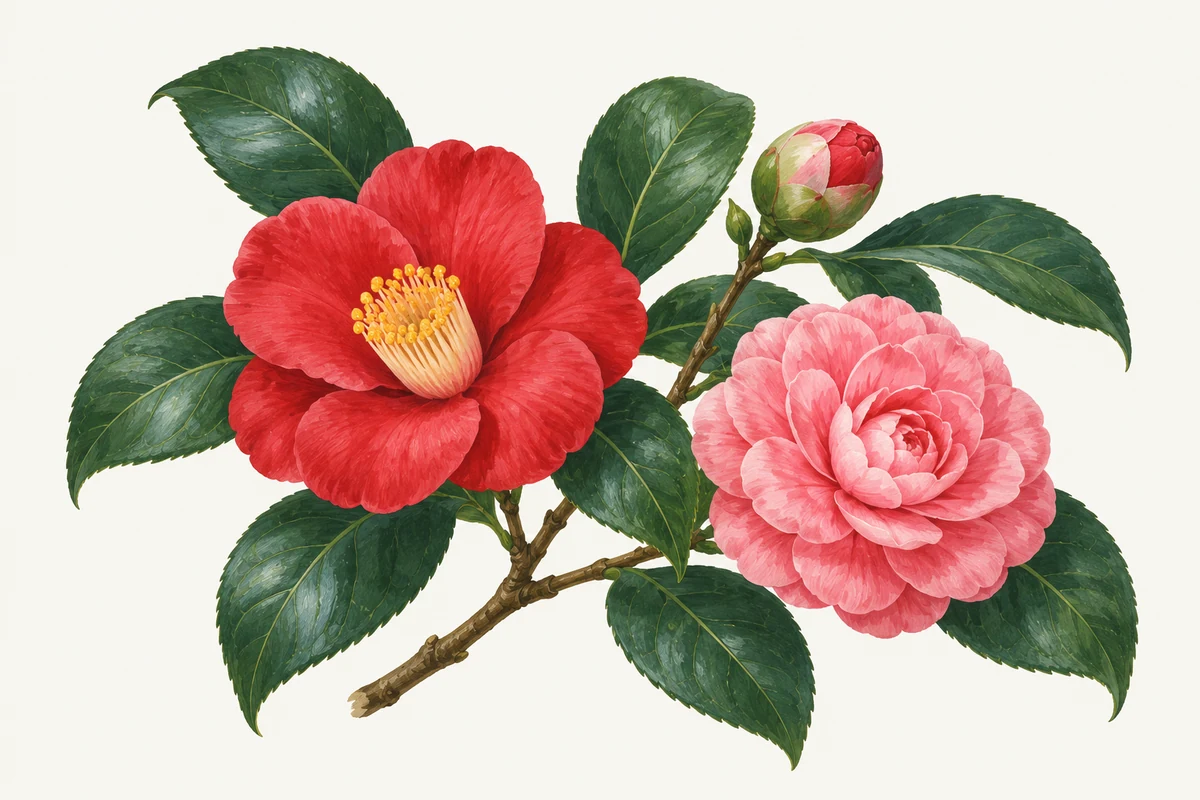
Thick, glossy, finely toothed evergreen leaves set one at a time along the stem, and large rose-like flowers in white, pink or red from late fall to spring. Two species cover most garden camellias.
In short
Camellia is an evergreen shrub or small tree in the tea family with glossy, leathery, finely toothed leaves 1½ to 4 inches long, set alternately. Japanese camellia (Camellia japonica) bears flowers 2 to 5 inches across, often double, from late winter to spring; sasanqua camellia (C. sasanqua) has smaller, usually single, fragrant flowers in late fall and winter. A woody capsule about 1 inch long follows.
- Look at the leaf edge and arrangement: camellia leaves are toothed and come one per node; gardenia leaves are smooth-edged and set in pairs or whorls.
- Season separates the two main species: sasanqua flowers from late fall into winter, Japanese camellia from late winter into spring (NC State).
- ASPCA lists Camellia japonica as non-toxic to dogs, cats and horses. That is its classification, not a guarantee.
Field marks at a glance
- Scientific name
- Camellia japonica
- Family
- Theaceae (tea family)
- Type
- Shrub, perennial, evergreen
- Leaves
- Alternate (one per node), simple, ovate to elliptic, with a serrated edge. Japanese camellia: 2 to 4 inches long. Sasanqua: 1½ to 3 inches long, with a pointed tip.
- Leaf texture
- Lustrous, dark green and leathery. NC State calls sasanqua leaves so thick and leathery they almost feel fake; its new growth sometimes emerges bronze.
- Flowers
- Borne in the leaf axils, with 7 to 20 petals. Japanese camellia: 2 to 5 inches across, usually semi-double to double. Sasanqua: 2 to 3 inches, usually single, fragrant, with ruffled petals around yellow stamens.
- Flower color and season
- White, pink, red, rose or variegated. Sasanqua blooms late fall to early winter. Japanese camellia can start in October and finish by mid-March depending on variety; NC State's quick ID gives February to April.
- Fruit
- A woody capsule about 1 inch long.
- Size and form
- Dense evergreen shrub or small tree. NC State gives Japanese camellia 10 to 13 feet tall and 5 to 10 feet wide, sasanqua 6 to 14 feet tall and 5 to 7 feet wide. Slow-growing (japonica) to fast-growing (sasanqua).
- Where it grows
- Japanese camellia is native to China, Korea and parts of Japan; sasanqua to Japan. NC State lists both for USDA zones 7a to 9b, in shade to part sun and acidic soil.
- Other names
- ASPCA gives common camellia and peony camellia for Camellia japonica; sasanqua is often just called sasanqua.
Camellias are among the most familiar winter-flowering shrubs in the American South, the Pacific Northwest and mild parts of the UK, and two species account for most of them: Japanese camellia (Camellia japonica) and sasanqua camellia (Camellia sasanqua). Both belong to the tea family. Check the leaves first, then the flowers, then the season.
What to check first: leaves, flowers, season
1. The leaves. Follow one stem and see how the leaves are arranged. The NC State Extension Plant Toolbox describes Japanese camellia leaves as alternate, simple, lustrous, leathery and dark green, 2 to 4 inches long, ovate to elliptic with serrated margins. Run a finger along the edge: the fine teeth are easy to feel. Sasanqua leaves are smaller, 1½ to 3 inches, and NC State says they are so thick and leathery they almost feel fake; new growth sometimes comes in bronze.
2. The flowers. Camellia flowers sit in the leaf axils, close to the stem, and have 7 to 20 petals. NC State gives Japanese camellia flowers 2 to 5 inches across, usually semi-double to double, in white, pink, red, rose or variegated forms. Sasanqua flowers are 2 to 3 inches across, fragrant and usually single, with ruffled, fluted petals around a center of yellow stamens.
3. The season. Bloom time is often the quickest way to tell the two apart. NC State says sasanqua blooms during late fall and winter, in a different season from C. japonica. Japanese camellia can start as early as October and finish as late as mid-March depending on the variety, and NC State's quick ID gives February to April as its main season. Each plant flowers for three to six weeks.
After flowering, camellias form a woody capsule about an inch long.
Plant Identifier can put a name on an unknown shrub from one photo of a flowering branch or the whole plant. The app's answer comes without a confidence score or alternatives, so confirm it against the toothed, alternate leaves before you act on it.
Camellia and pets: what the sources say
- ASPCA. The ASPCA Animal Poison Control Center lists camellia (Camellia japonica, also common camellia and peony camellia) as non-toxic to dogs, cats and horses. That is the ASPCA's classification, not a guarantee that a pet will have no reaction after chewing a plant. The ASPCA entry covers C. japonica; it does not list sasanqua separately.
If someone may have eaten any part of a plant and is unwell, call Poison Control at 1-800-222-1222 (poison.org). If a pet may have, call your veterinarian or the ASPCA Animal Poison Control Center at (888) 426-4435 (a consultation fee may apply). Garden plants the ASPCA does list as toxic are gathered in poisonous plants for dogs and plants toxic to cats.
Plant Identifier's Toxicology tool gives AI-written notes on toxic parts and symptoms. Treat them as background, never as a reason to wait before calling.
Camellia vs gardenia, and japonica vs sasanqua
Gardenia is the shrub most often confused with camellia: both are glossy evergreens with large, rose-like flowers, and they are often sold side by side. The leaves settle it.
| Feature | Japanese camellia | Sasanqua camellia | Gardenia |
|---|---|---|---|
| Leaves per node | 1 (alternate) | 1 (alternate) | 2 (opposite) or a whorl |
| Leaf edge | Serrated | Serrated | Smooth |
| Leaf length | 2–4 in | 1½–3 in | 2–4 in |
| Flowers | 2–5 in, usually double | 2–3 in, usually single, fragrant | 2–3 in, waxy, white aging to yellow |
| Colors | White, pink, red, variegated | White, pink, red | White to cream |
| Main bloom | Late winter to spring | Late fall to early winter | Spring and summer |
| Fruit | Woody capsule, about 1 in | Woody capsule, about 1 in | Orange berry |
Sources: NC State Extension pages for Japanese camellia, sasanqua camellia and gardenia. The full gardenia profile is at gardenia.
Unlike camellia, gardenia is listed as toxic to dogs, cats and horses by the ASPCA, so a mix-up matters if you have pets. Azaleas are another glossy-leaved shrub in the same shady beds; see azalea. For the general method of narrowing down an unknown shrub, see how to identify plants.
Where you'll see camellias
Japanese camellia is native to China, Korea and parts of Japan; sasanqua is native to Japan. NC State lists both for USDA zones 7a to 9b. Japanese camellia prefers shade to part shade with protection from drying winter winds, in well-drained, slightly acidic soil (pH 5.5 to 6.5). Sasanqua takes full sun to partial shade, tolerates drought once established and is slightly salt-tolerant, so it turns up as hedges and foundation plantings.
A short care note
NC State describes camellias as slow to establish but long-lived. Next year's flowers form on old growth, so prune right after flowering or in early summer; later pruning can cost the following year's blooms. Drought in August and September can reduce flowering the next spring, and yellow leaves with green veins may point to soil that isn't acidic enough. Scale is the main insect pest, and petal blight (browning that runs from the petal edges to the center) is best handled by removing infected flowers promptly.
Look-alikes and how to tell them apart
Gardenia (Gardenia jasminoides)
Gardenia leaves are opposite or whorled and smooth-edged, with deeply pressed-in veins, while camellia leaves are alternate and toothed. Gardenia flowers are waxy white aging to yellow, strongly scented, open from pinwheel-twisted buds, and are followed by orange berries rather than woody capsules.
Japanese camellia vs sasanqua camellia
Japanese camellia has larger leaves (2 to 4 inches) and larger flowers (2 to 5 inches), usually double, from late winter to spring. Sasanqua has smaller leaves (1½ to 3 inches) and flowers (2 to 3 inches), usually single and fragrant, from late fall into winter.
What a photo can't settle
- Hundreds of camellia cultivars exist, plus hybrids between the species, so flower form and size vary widely. Use leaves and bloom season together, not flower shape alone.
- Out of flower, a camellia in a photo can be hard to separate from other glossy evergreens. Check the toothed edge and the alternate leaf arrangement on several stems.
- A photo app, ours included, can name the plant but can't say how much of it a child or pet has eaten or how serious it is. That is a call for Poison Control or a vet, not an app.
Questions people ask
What does a camellia look like?
A dense evergreen shrub or small tree, often 6 to 14 feet tall, with glossy, dark green, leathery leaves that have finely toothed edges and sit one per node. From late fall to spring it carries large, rose-like flowers in white, pink, red or variegated forms, 2 to 5 inches across.
How do I tell Camellia japonica from Camellia sasanqua?
Check the season and the size. Sasanqua blooms from late fall into winter, with smaller leaves and 2- to 3-inch flowers that are usually single and fragrant. Japanese camellia blooms from late winter into spring, with larger leaves and 2- to 5-inch flowers that are usually double.
Is camellia poisonous to dogs and cats?
The ASPCA lists Camellia japonica as non-toxic to dogs, cats and horses. That is the ASPCA's classification, not a guarantee: if a pet is unwell after chewing any plant, call your vet or the ASPCA Animal Poison Control Center at (888) 426-4435. For a person, call Poison Control at 1-800-222-1222.
How do I tell camellia from gardenia?
Look at one leaf and its neighbours. Camellia leaves have a toothed edge and grow one at a time along the stem. Gardenia leaves are smooth-edged with deeply sunken veins and grow in pairs or whorls. Gardenia flowers are white aging to yellow; camellias also come in pink and red.
Sources
- Camellia japonica — NC State Extension, North Carolina Extension Gardener Plant Toolbox
- Camellia sasanqua — NC State Extension, North Carolina Extension Gardener Plant Toolbox
- Toxic and Non-toxic Plants: Camellia — ASPCA Animal Poison Control Center
- Poison Control — National Capital Poison Center
- Gardenia jasminoides — NC State Extension, North Carolina Extension Gardener Plant Toolbox
Keep reading
- Plant profileGardenia (Gardenia jasminoides): how to identify it
- Plant profileAzalea: how to identify it, and how to tell it from a rhododendron
- Field guideHow to identify a plant, step by step
- Free toolFlower identifier by description
- Plant profilePoison sumac (Toxicodendron vernix): how to identify it