Plant profile
Poison sumac (Toxicodendron vernix): how to identify it
A swamp shrub or small tree of eastern North America with the same rash-causing oil as poison ivy. Its pale fruit and wet feet set it apart from red-fruited sumacs.
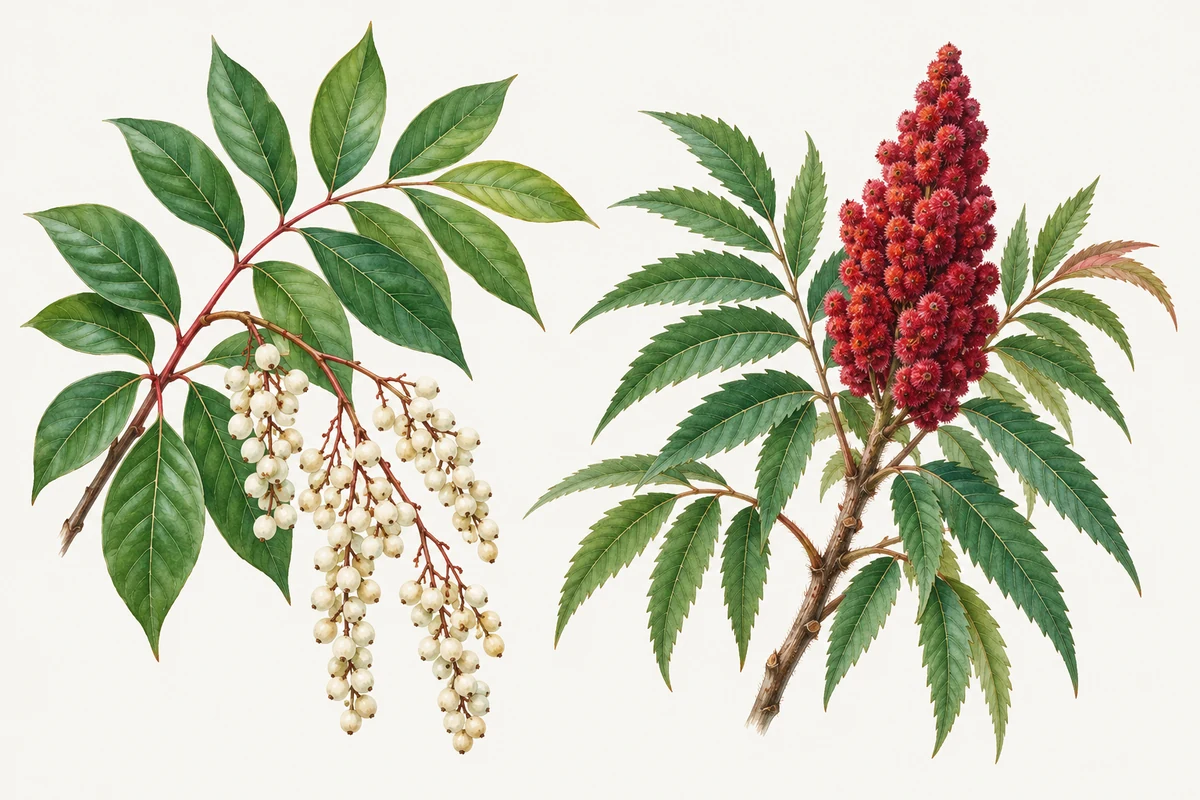
In short
Poison sumac is identified by its leaves and its habitat: each leaf has 7 to 13 smooth-edged, pointed leaflets on a red stalk, set alternately along the stem, and the plant grows as a shrub or small tree up to 20 to 25 feet in bogs, swamps and wet thickets. Its fruit is pale, yellowish-white or greenish-white, never red. Every part carries urushiol.
- Seven to 13 smooth-edged leaflets (Alabama Extension counts up to 15) on red stems, in wet ground: that combination points to poison sumac.
- Staghorn and smooth sumac have red fruit clusters and grow on dry, well-drained ground; poison sumac's fruit is pale and it grows in swamps.
- Ash trees look similar, but their leaves are opposite and their fruits are winged (NC State).
- Never burn it: NC State says inhaling the smoke can inflame the lungs and can be fatal.
Field marks at a glance
- Scientific name
- Toxicodendron vernix
- Family
- Anacardiaceae (cashew or sumac family)
- Type
- Shrub, perennial, deciduous
- Leaves
- Compound, dark green and alternate, with 7 to 13 leaflets (NC State); Alabama Extension counts seven to fifteen. Leaflets sit in pairs along the stalk with one at the tip.
- Leaflets
- Oblong with sharply pointed tips and smooth or slightly wavy edges, never toothed, commonly 2 to 4 inches long and ¾ to 2 inches wide (Alabama Extension).
- Stems
- Stems and leaf stalks are often bright red (Alabama Extension). The bark is smooth and grayish brown with lenticels; NC State notes black sap from the trunk.
- Size and form
- A shrub or small tree with an open crown: up to 20 feet (Alabama Extension) or 25 feet with a trunk 6 inches across (NC State), often sprouting at the base.
- Flowers
- Small greenish-yellow flowers with 5 petals in dangling panicles (NC State).
- Fruit
- Smooth, greenish-white or yellowish-white drupes from late summer that may stay through fall and winter (Alabama Extension, NC State). Not red.
- Fall color
- Leaves turn a brilliant orange-red in fall (NC State), the season when it is easiest to confuse with other sumacs.
- Where it grows
- Bogs, marshes, swamps and wet thickets along rivers, in acidic soil (NC State). Native to eastern Canada and the east-central and eastern United States.
Poison sumac (Toxicodendron vernix) is a shrub or small tree of wet ground in eastern North America, a close relative of poison ivy and poison oak that looks nothing like them. It has no leaves of three: each leaf carries a row of smooth, pointed leaflets on a red stalk. It carries the same oil, urushiol, so the aim of this page is to help you recognize it from the edge of the swamp and tell it from the common red-fruited sumacs that are often in the same view. For poison ivy, see the poison ivy identification guide.
How to identify poison sumac: four checks
The marks come from NC State Extension's poison sumac profile and Alabama Extension's Touch-Me-Nots. Use them together.
1. A row of smooth-edged leaflets. Each compound leaf has 7 to 13 leaflets (NC State; Alabama Extension counts seven to fifteen), arranged in pairs along the leaf stalk with one at the tip. They are oblong, 2 to 4 inches long and ¾ to 2 inches wide, with sharply pointed tips and smooth or somewhat wavy edges, never toothed.
2. Red stems and leaf stalks. Alabama Extension says the stems and leaf stalks are often bright red. NC State lists the red stems, or the red central stalk carrying the leaflets, among its quick identification features, along with leaves that alternate along the branch.
3. Pale fruit. Small greenish-yellow flowers hang in loose panicles, followed by smooth, greenish-white to yellowish-white fruit in late summer that may stay on the plant through fall and winter. Poison sumac fruit is never red.
4. Wet ground. NC State says poison sumac grows mainly in bogs, marshes, swamps and thickets along river banks, in acidic soil, in full sun to part shade. Alabama Extension says it is typically found only in open or wooded swampy areas. A sumac-like shrub on a dry roadside bank is far more likely to be staghorn or smooth sumac.
Size and bark. Poison sumac grows as a shrub or small tree with an open crown, up to 20 feet (Alabama Extension) or 25 feet with a trunk 6 inches across (NC State), and often sprouts from its base. The bark is smooth and grayish brown with lenticels; NC State mentions black sap from the trunk. In fall the leaves turn a brilliant orange-red.
When you don't know where to start, one photo in Plant Identifier gives you a name to compare with these four checks. Take it from a distance; the app shows no confidence score and no list of alternatives, so check the leaflets, stems, fruit and site yourself before going closer.
Poison sumac vs staghorn sumac and smooth sumac
The common sumacs of North America share the compound leaves and the orange-red fall color, which is why poison sumac gets confused with them. The fruit and the ground settle it.
| Plant | Fruit | Leaflet edges | Twigs | Where it grows |
|---|---|---|---|---|
| Poison sumac | Greenish-white to yellowish-white | Smooth or wavy | Red leaf stalks, smooth bark | Bogs, swamps, wet thickets |
| Staghorn sumac | Showy red berries | Compound leaves | Reddish-brown velvety hairs on young branches | Woodland edges, roadsides, embankments; well-drained soil |
| Smooth sumac | Clusters of red drupes, summer to winter | Compound leaves | Male and female flowers on separate shrubs | Dry, disturbed or rocky ground; not wet soils |
| Ash sapling | Winged fruits | Compound leaves | Leaves opposite | Varies |
NC State's staghorn sumac profile names the velvet-like reddish-brown hairs on young branchlets that gave it its name, and red berries after white summer flowers; it grows from Quebec and Ontario to Minnesota and south to Georgia, in any soil that drains well. Its smooth sumac profile describes a 9- to 15-foot shrub found in every state and parts of Canada, with clusters of red drupes that persist into winter, adaptable to most soils except wet ones. Both form colonies by suckering, so you often see a whole thicket of one kind.
Ash is the other trap. NC State says poison sumac resembles a young ash tree, but ash leaves are opposite, in pairs on the twig, and its fruits are winged samaras rather than round drupes.
Why you shouldn't touch it: urushiol
These lines are as the health and extension sources state them. They are not medical advice.
- Every part, every season. NC State says all parts of poison sumac are poisonous and cause skin redness, itching, blistering and swelling. The American Academy of Dermatology says these plants are poisonous year-round and that touching any part, including the roots, can cause a rash, even in winter.
- Never burn it. NC State says inflammation and fluid can build up in the lungs from inhaling the smoke of burning poison sumac, which can be fatal. Poison Control says dead leaves and stems should never be handled or used as kindling, because the smoke can cause very severe breathing problems.
- Not contagious, but the oil travels. Poison Control says the rash itself does not spread from person to person, but oil left on skin or clothes can cause another rash. NC State says to wear protective clothing and wash hands, clothing and tools with soap and water after exposure.
- Timing. Poison Control says the rash often starts 1 to 2 days after contact, sometimes up to a week, and typically lasts 1 to 2 weeks.
If you touched poison sumac: first steps and when to get help
First steps. Poison Control says to rinse your skin with lukewarm, soapy water as soon as possible; the sooner you rinse, the more likely you are to remove the oil before it is absorbed. Then wash, separately, all the clothes you were wearing, along with any tools, backpacks and pets that may have been exposed.
See a doctor, according to Poison Control, if the rash covers a large area or if you can't control the itching. In the US, Poison Control answers at 1-800-222-1222, online or by phone, 24 hours a day.
Where poison sumac grows in the US and Canada
NC State describes poison sumac as native to eastern Canada and the east-central and eastern United States; in North Carolina it is typical of the coastal plain and rare in the piedmont and mountains. Poison Control says poison ivy and poison sumac are typically met in the Midwest and Eastern states, while poison oak is a plant of the West; see the poison oak profile for the western and Atlantic species.
Because it needs wet, acidic ground, poison sumac turns up along boardwalks, pond and bog edges, and the wet margins of trails, which is where hikers and anglers brush against it. To remember where a stand grows, Plant Identifier's Plant Map records where each located identification was made. For other plants that irritate skin, see plants that cause skin rashes. If poison sumac must be removed from a yard, ask your county extension office first, wear long sleeves, gloves and long pants, wash everything afterwards, and don't burn it.
Look-alikes and how to tell them apart
Staghorn sumac (Rhus typhina)
Look at the fruit and the twigs. NC State describes staghorn sumac's showy red berries and young branches covered in reddish-brown velvety hairs, on well-drained ground. Poison sumac has pale fruit, smooth reddish stems and wet feet.
Smooth sumac (Rhus glabra)
NC State says smooth sumac bears clusters of red drupes from summer to fall and grows on dry, disturbed or rocky ground, not in wet soils. Poison sumac's fruit is greenish-white, and it grows in swamps.
Ash saplings (Fraxinus)
Check the leaf arrangement. NC State says ash trees have opposite leaves, in pairs on the twig, and winged fruits; poison sumac's leaves alternate along the stem and its fruit is a round drupe.
What a photo can't settle
- Out of fruit, a young poison sumac can look like an ash sapling or a sumac in a photo: the deciding marks are alternate leaves, smooth leaflet edges, red stalks and wet ground, so photograph the whole shoot and note the site.
- Fall color is no help: poison sumac, staghorn sumac and smooth sumac all turn orange-red.
- No identification, by app or by eye, tells you what caused a rash; a doctor decides that.
Questions people ask
How do you tell poison sumac from regular sumac?
Look at the fruit and the ground. Staghorn and smooth sumac carry upright clusters of red fruit and grow on dry, well-drained sites (NC State). Poison sumac has pale greenish-white or yellowish-white fruit, smooth-edged leaflets on red stalks, and grows in bogs and swamps.
Does poison sumac grow in Canada?
Yes. NC State Extension describes poison sumac as native to eastern Canada as well as the east-central and eastern United States. Look for it in bogs, marshes, swamps and wet thickets along rivers.
Is poison sumac worse than poison ivy?
The sources here describe the same oil, urushiol, in poison ivy, poison oak and poison sumac, and the same kind of rash: redness, itching, blistering and swelling (NC State). Poison Control says the rash may blister and itch for days or weeks.
What should I do if I touched poison sumac?
Poison Control says to rinse your skin with lukewarm, soapy water as soon as possible, then wash your clothes, tools and any pets that were exposed. See a doctor if the rash covers a large area or you can't control the itching. In the US, call Poison Control at 1-800-222-1222.
Sources
- Toxicodendron vernix (Poison Sumac) — NC State Extension, North Carolina Extension Gardener Plant Toolbox
- Touch-Me-Nots: Poison Ivy, Poison Oak, and Poison Sumac — Alabama Cooperative Extension System
- Rhus typhina (Staghorn Sumac) — NC State Extension, North Carolina Extension Gardener Plant Toolbox
- Rhus glabra (Smooth Sumac) — NC State Extension, North Carolina Extension Gardener Plant Toolbox
- Poison ivy, poison oak, and poison sumac — Poison Control, National Capital Poison Center
- Poison ivy, oak, and sumac: Who gets a rash, and is it contagious? — American Academy of Dermatology
Keep reading
- Safety guidePoison ivy identification: leaves, vines, berries and look-alikes
- Plant profilePoison oak (Toxicodendron diversilobum and T. pubescens): how to identify it
- Safety guidePlants that cause skin rashes, and how to tell which one
- Weed profileGiant hogweed (Heracleum mantegazzianum): how to identify it
- Field guideHow to identify a plant, step by step