Safety guide
Poison ivy identification: leaves, vines, berries and look-alikes
Three leaflets with a long-stalked middle one, leaves that alternate up the stem, hairy vines and waxy white berries, plus the one test that rules out each look-alike.
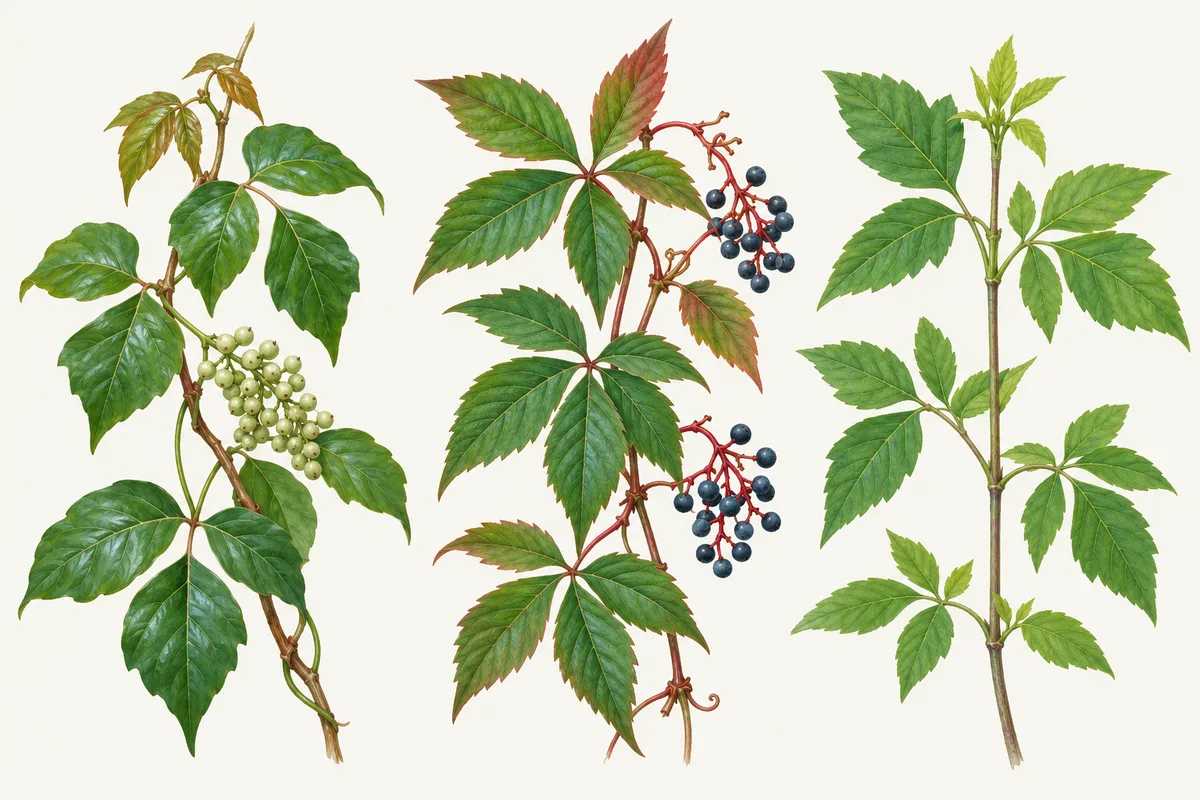
In short
Poison ivy identification starts with the leaf: three leaflets, the middle one on a noticeably longer stalk (½ to 1¾ inches, says the Missouri Department of Conservation), and leaves that alternate along the stem. Edges can be smooth, toothed or lobed. Climbing vines look hairy from aerial roots, and clusters of waxy, creamy-white berries ripen from late summer. Every part can cause a rash, in every season.
- Check three things together: three leaflets, a longer stalk on the middle leaflet, and leaves that alternate along the stem rather than sitting in pairs.
- Virginia creeper usually has five leaflets, boxelder has opposite leaves, fragrant sumac's middle leaflet has no long stalk, and brambles have prickles.
- AAD: touching any part of these plants, roots included, can cause a rash, even in winter. CDC/NIOSH: never burn them.
Poison ivy grows in woodlands, thickets, fence rows, roadsides and yards across most of the United States and southern Canada, and it is easy to misjudge. "Leaves of three, let it be" catches it, but it also catches boxelder seedlings, wild strawberry and hog peanut, and it misses the bare, hairy vine in winter. This guide shows how to identify poison ivy with four marks you can check without touching it, how to tell poison ivy vs poison oak and poison sumac, and the one field test that rules out each common look-alike.
How to identify poison ivy: four marks
Use these together. Any one alone fits other plants. The descriptions come from the Missouri Department of Conservation's poison ivy field guide, NC State Extension's Plant Toolbox and Alabama Extension's Touch-Me-Nots.
1. Three leaflets, the middle one on a longer stalk. Each leaf is compound, made of three leaflets. The middle (end) leaflet sits on a stalk ½ to 1¾ inches long, clearly longer than the very short stalks of the two side leaflets, and the side leaflets have unequal sides (MDC). NC State adds that the middle leaflet is longer than the outer two. Alabama Extension notes there is often a red spot where the two side leaflets join.
2. Leaves alternate along the stem. Follow the stem: one leaf, then the next on the other side a little higher. The leaves are not set in opposite pairs. This single check rules out boxelder.
3. The edges and colors change; the pattern doesn't. NC State describes leaflets ranging from smooth, rounded edges to serrated or shallowly lobed ones, sometimes on the same plant; Alabama Extension notes leaflets with a few jagged teeth or one larger tooth that gives a mitten shape. Leaves come out with a shiny reddish tinge in spring, turn green in summer and red, orange or yellow in fall (MDC, NC State). Don't rely on shine or color.
4. Hairy vines and pale berries. Poison ivy grows as a ground cover, a shrub up to about 6 feet, or a vine that NC State says can climb 60 to 150 feet. Climbing stems are covered in aerial rootlets that make older vines look like hairy rope; Alabama Extension notes vines thicker than 2 inches, with new stems less hairy. Small greenish-white flowers appear in May and June, and loose clusters of waxy, smooth, creamy-white berries about ¼ inch across ripen from August to November and often stay through winter (MDC). CDC/NIOSH describes the berries as white to green-yellow or amber.
If you aren't sure, take a photo from where you stand. Plant Identifier names a plant from one photo, with its scientific name, which you can then check against these four marks. It shows no confidence score and no list of alternatives, so the marks above stay the final test.
Eastern vs western poison ivy, poison oak and poison sumac
All of these are Toxicodendron species, and all carry urushiol, the oil behind the rash. Names below follow the USDA PLANTS Database and NC State Extension.
- Eastern poison ivy (Toxicodendron radicans): the climbing, hairy-vined plant described above. CDC/NIOSH calls it typically a hairy, ropelike vine with three shiny green leaves budding from one small stem.
- Western poison ivy (Toxicodendron rydbergii): CDC/NIOSH describes it as a low shrub that does not form a climbing vine. Use the leaflet and arrangement checks; there is no hairy vine to find.
- Atlantic poison oak (Toxicodendron pubescens): the FDA describes a low shrub of the Eastern and Southern United States with fuzzy green leaves in clusters of three, lobed or deeply toothed with rounded tips. Alabama Extension gives upright stems to about 3 feet on dry sites; MDC says it does not climb, makes no aerial roots and has berries with inconspicuous hairs.
- Pacific poison oak (Toxicodendron diversilobum): the FDA says it grows in tall clumps or long vines on the Pacific Coast.
- Poison sumac (Toxicodendron vernix): a shrub or small tree with 7 to 13 smooth-edged leaflets per leaf (FDA; Alabama Extension counts up to 15), stems and leaf stalks that are often bright red (Alabama Extension), and glossy, pale yellow or cream-colored berries (CDC/NIOSH). It grows in wet ground: bogs and swamps in the Northeast, Midwest and parts of the Southeast (FDA).
Poison ivy vs poison oak, in one line: poison ivy climbs or trails with hairy aerial roots and has glossy leaflets; poison oak stands as a low, upright shrub (on the Atlantic side) with fuzzy, round-lobed leaflets (FDA) crowded near the tips of its stems (Alabama Extension). In a photo they can look alike; the habit and the hairs usually decide it.
Poison ivy look-alikes and the test for each
Brandywine Conservancy and Alabama Extension both note how often harmless plants get blamed. Alabama Extension's rule is the one to keep: if you're not sure, don't touch it.
| Look-alike | Leaflets | Field test |
|---|---|---|
| Virginia creeper (Parthenocissus quinquefolia) | Usually 5 | Count leaflets. Seedlings may show 3, but the vine is much less hairy, with fewer rootlets, some ending in small attachment disks (Alabama Extension), and the berries are blue, not white (MDC) |
| Boxelder seedlings (Acer negundo) | 3 to 7 | Opposite leaves, in pairs on the stem; poison ivy alternates (MDC). Young boxelder leaves are light yellow-green, young poison ivy reddish (Brandywine) |
| Fragrant sumac (Rhus aromatica) | 3 | The middle leaflet lacks poison ivy's distinct stalk, and the berries are reddish and fuzzy (MDC); Alabama Extension says its leaflets attach at a single point |
| Brambles: blackberry, raspberry (Rubus) | Compound, toothed | Look for prickles. NC State describes black raspberry canes with short, curved prickles; poison ivy stems carry hairs and aerial roots, never prickles |
| Hog peanut (Amphicarpaea bracteata) | 3, egg-shaped | Thin, fragile, twining stems of a non-woody vine 2 to 8 feet long, with fewer leaf veins and white to lavender pea flowers (Brandywine) |
| Wild strawberry (Fragaria virginiana) | 3, toothed | A ground-hugging plant about 6 inches tall that roots from runners, leaves on hairy stalks, white five-petal flowers and a red fruit (Missouri Department of Conservation). Never woody |
Two more that catch people: climbing hydrangea (Decumaria barbara) has a hairy vine much like poison ivy, but its leaves are simple and opposite (Alabama Extension); and mock strawberry (Duchesnea indica), a lawn weed with yellow flowers, has three leaflets that join at one point, without the long middle stalk (Brandywine). For the low three-leaflet plants in turf, such as clover, wood sorrel and black medic, see the lawn weed identification guide.
Urushiol: what the health agencies say
These lines are as CDC/NIOSH, the FDA and the AAD state them. They are not medical advice.
- Every part, every season. The American Academy of Dermatology says touching any part of these plants, including the roots, can cause a rash, even during the winter, and that the plants are poisonous year-round.
- Never burn it. CDC/NIOSH says not to burn plants that may be poison ivy, poison oak or poison sumac, because inhaling the smoke can cause severe allergic respiratory problems.
- It lingers on things. CDC/NIOSH says urushiol can stay active on the surface of objects for up to 5 years. The FDA notes the oil can stick to pets' fur and cause a reaction in whoever pets them; the AAD suggests bathing a pet you suspect has been near these plants, wearing rubber gloves. For plants dogs might chew, see plants poisonous to dogs.
- The rash itself isn't contagious. The FDA says these rashes can't be spread from person to person; the oil, while still on skin, clothes or tools, can.
If you touched it: first steps and when to get help
First steps. The FDA says to wash your skin in soap and cool water as soon as possible. CDC/NIOSH says to rinse skin immediately with rubbing alcohol, poison plant wash or dishwashing soap and lots of water, and to scrub under your nails with a brush. Wash the clothes, gloves and tools that touched the plant.
See a doctor, according to the FDA, if you have a temperature over 100°F; there is pus, soft yellow scabs or tenderness on the rash; the itching gets worse or keeps you awake; the rash spreads to your eyes, mouth or genital area, or covers more than one-fourth of your skin; the rash is not improving within a few weeks; or the rash is widespread and severe. CDC/NIOSH adds: get medical help in severe cases or if the rash is on the face or genitals.
Emergency care. CDC/NIOSH says to call 911 or go to a hospital emergency room for a severe allergic reaction, like swelling or difficulty breathing, or if the person has had a severe reaction to poisonous plants in the past. The FDA also lists difficulty breathing as a reason to see a doctor.
Removing it, and where it grows
If poison ivy has to go, follow the label and local rules for any product, or ask your county extension office. Don't burn it, and keep in mind that Alabama Extension warns trimming or mowing patches can make particles of the allergen airborne. Wear long sleeves, gloves and closed shoes, and wash everything afterwards.
Poison ivy is native to North America: NC State says throughout the United States and much of southern Canada, and USDA PLANTS lists eastern and western poison ivy as native to the lower 48 states and Canada. The FDA says poison ivy is absent from Alaska, Hawaii and parts of the West Coast. The sources here describe no wild populations in Britain or continental Europe; in the UK the RHS lists Toxicodendron as the only plant in category A, its most toxic group, of potentially harmful garden plants. What most British readers call ivy is English ivy, a different plant with simple, lobed leaves.
To keep track of a patch you want to avoid next season, Plant Identifier's Plant Map records where each located identification was made. For unknown plants in general, start with how to identify plants.
What a photo can't settle
- A photo of a seedling or a single leaf can't always separate poison ivy from boxelder, fragrant sumac or poison oak: the deciding marks (leaf arrangement, the middle leaflet's stalk, hairs on both leaf surfaces) need the whole shoot in view.
- No identification, by app or by eye, tells you whether a rash came from poison ivy. A doctor or dermatologist decides that.
- Plant Identifier gives one name with no confidence score or list of alternatives, so check the field tests on this page before you trust a result near skin.
Questions people ask
How do you identify poison ivy for sure?
Check three marks together: three leaflets per leaf, a middle leaflet on a clearly longer stalk than the side leaflets, and leaves that alternate along the stem. On a vine, add the hairy aerial roots and, from late summer, waxy creamy-white berries. If one mark is missing, treat it as unconfirmed and don't touch it.
What is the difference between poison ivy and poison oak?
Poison ivy climbs or trails with hairy aerial roots and has glossy leaflets with smooth, toothed or lobed edges. Atlantic poison oak is a low shrub that doesn't climb, with fuzzy leaflets in threes cut into rounded, oak-like lobes. Pacific poison oak, on the West Coast, can form tall clumps or long vines. All three contain urushiol.
Can you get poison ivy in winter?
Yes. The American Academy of Dermatology says touching any part of these plants, including the roots, can cause a rash even during the winter, and that the plants are poisonous year-round. Bare winter vines are still hairy with aerial roots, and the white berries can hang on through winter.
Does Virginia creeper cause a rash like poison ivy?
Alabama Extension says contact with Virginia creeper leaves or stems only rarely causes an allergic reaction in sensitive people and that its fruit can be harmful if eaten. Count the leaflets: Virginia creeper usually has five, though seedlings and new growth can show three.
Does poison ivy grow in the UK or Europe?
Poison ivy is native to North America, where USDA lists it as native to the lower 48 states and Canada. The sources here describe no wild populations in Britain. The RHS lists it, alone in its most toxic category, among potentially harmful garden plants. The plant most British readers call ivy is English ivy, Hedera helix.
Sources
- Poisonous Plants and Work — CDC, National Institute for Occupational Safety and Health (NIOSH)
- Outsmarting Poison Ivy and Other Poisonous Plants — U.S. Food and Drug Administration (FDA), Consumer Updates
- Poison ivy, oak, and sumac: Who gets a rash, and is it contagious? — American Academy of Dermatology (AAD)
- Poison Ivy (Toxicodendron radicans) — Missouri Department of Conservation, Field Guide
- Toxicodendron radicans (Eastern Poison Ivy, Poison Ivy, Poison Oak) — NC State Extension, North Carolina Extension Gardener Plant Toolbox
- Touch-Me-Nots: Poison Ivy, Poison Oak, and Poison Sumac (ANR-1460) — Alabama Cooperative Extension System (Auburn University)
- Plant profile: Toxicodendron radicans (L.) Kuntze, eastern poison ivy — USDA NRCS PLANTS Database
- Poison Ivy vs. Look-alike Species — Brandywine Conservancy
Keep reading
- Lawn and gardenHow to identify weeds in your lawn
- Pet safety guidePoisonous plants for dogs, and what to do if your dog ate one
- Pet safety guidePlants toxic to cats, and what to do if your cat chewed one
- Field guideHow to identify a plant, step by step
- Weed profileCreeping Charlie (Glechoma hederacea): how to identify ground ivy