Lawn and garden
How to identify weeds in your lawn
Fifteen common lawn weeds sorted into five groups by leaf shape, flower and growth habit, the test that separates each look-alike pair, and what the weeds say about your soil.
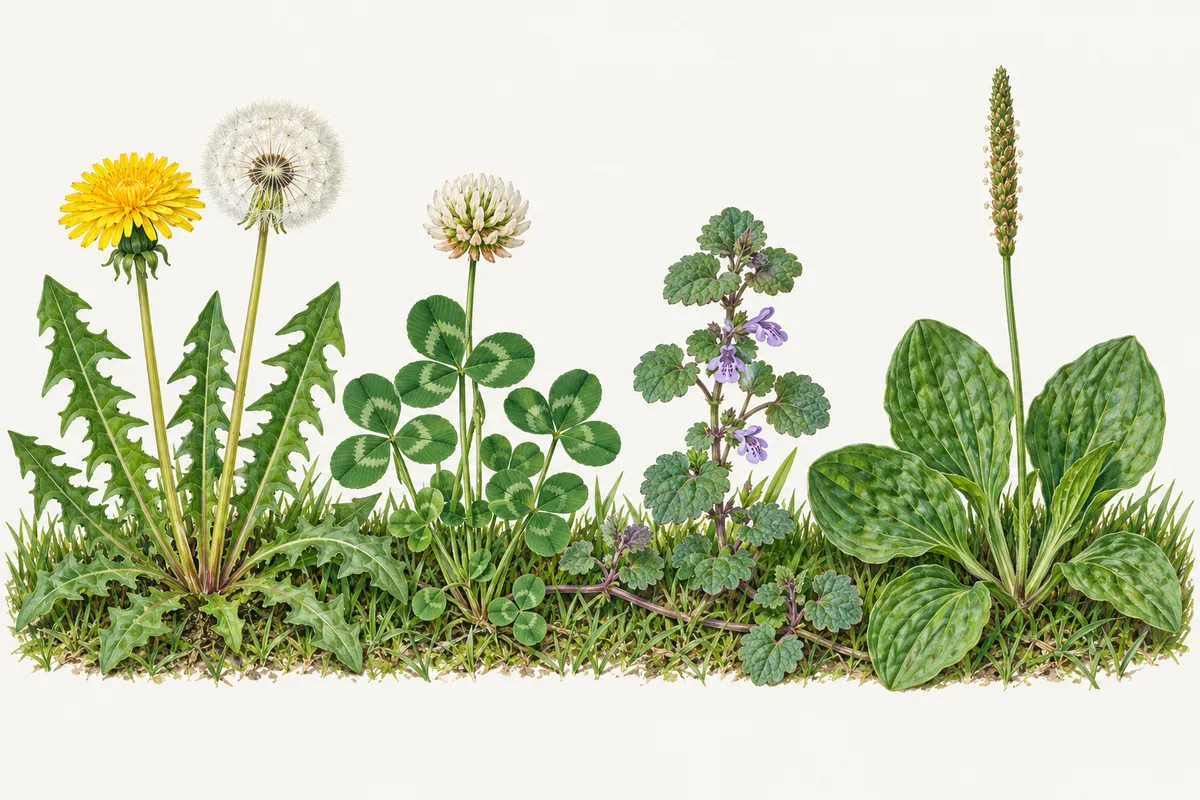
In short
To identify weeds in a lawn, sort each one by growth habit first: a flat rosette, three clover-like leaflets, a creeping runner or a grass blade. Then check one detail per pair. Dandelion stalks are hollow and unbranched, cat's ear stalks branch. Black medic has a tiny point on each leaflet, white clover does not. Nutsedge has a triangular stem, true grasses a round one.
- Leaf arrangement and growth habit narrow a lawn weed to one of five groups before you look at a single flower.
- Most look-alike pairs split on one detail you can check with your fingers: a hollow stalk, a triangular stem, a hairy leaf or a leaflet tip.
- Extension services read weeds as clues: clover and plantain often point to low fertility, chickweed and nutsedge to wet soil, annual bluegrass to compaction and short mowing.
A lawn weed is easiest to name when you stop looking at it as "a weed" and start looking at how it grows. Kneel down, find a whole plant and ask four questions in order: does it grow as a flat rosette, as three leaflets on a stalk, as a creeping stem, or as a grass blade? The chart below groups 15 common lawn weeds that way, then gives the one test that separates each look-alike pair, and finishes with what the extension services say each weed tells you about the lawn.
Lawn weed identification chart: five groups
Descriptions follow Virginia Cooperative Extension's Common Turf Weeds sheet, the RHS and the NC State Extension Plant Toolbox, as noted in each section below.
| Group | Weed | Leaves | Flowers | Habit and the quickest tell |
|---|---|---|---|---|
| Broadleaf rosettes | Dandelion (Taraxacum officinale) | Deeply toothed, teeth pointing back toward the center | Yellow heads, then a puffball | Hollow, leafless, unbranched stalks with milky sap; deep taproot |
| Broadleaf rosettes | Broadleaf plantain (Plantago major) | Wide, in a flat rosette | Flowers along the upper half of an upright stalk | Rosette; often a sign of low fertility |
| Broadleaf rosettes | Cat's ear (Hypochaeris radicata) | Densely hairy, up to 6 inches long | Yellow, dandelion-like | Flower stalks usually branched |
| Clover-like | White clover (Trifolium repens) | Three rounded leaflets, often with a pale mark | Creamy-white heads, May to October | Creeping stems that root as they go |
| Clover-like | Yellow wood sorrel (Oxalis) | Three folded leaflets | Yellow, one by one | Short stems, sometimes runners |
| Clover-like | Black medic (Medicago lupulina) | Three creased leaflets, a tiny point at each tip | Small yellow balls, then black pods | Low mat |
| Creeping | Ground ivy, creeping charlie (Glechoma hederacea) | Rounded, scalloped edges | Small bluish-purple tubes, April to June | Square stems rooting at every node; aromatic |
| Creeping | Speedwell (Veronica) | Small, rounded and toothed low down | Tiny bright blue | Low, sprawling, often hairy |
| Creeping | Creeping buttercup (Ranunculus repens) | Three deeply lobed, toothed leaflets, often pale-marked | Glossy yellow, five petals | Runners rooting from the parent plant |
| Grassy | Crabgrass (Digitaria) | Light green blades ½ to ¾ inch wide | Three to five finger-like spikes | Stems spread flat from one center; summer annual |
| Grassy | Nutsedge (Cyperus) | Grass-like, lighter than the turf | Yellowish or purplish spikelets | Triangular stem |
| Grassy | Annual bluegrass (Poa annua) | Light green, boat-shaped tips | Seed heads that stand out against the turf | Low bunch grass; thrives when cut short |
| Others | Common chickweed (Stellaria media) | Light green, little or no hair | Small | Cool-season annual |
| Others | Wild violet (Viola) | Heart-shaped | Not the main clue | Clumps from rhizomes, in shade |
| Others | Henbit (Lamium amplexicaule) | Upper leaves without stalks | Spring | Square stems; winter annual |
Two habits to check before you trust any row: whether the plant comes back from the same crown every year (dandelion, plantain, violet) or appears in a flush and dies (crabgrass, annual bluegrass, chickweed, henbit), and whether it roots along its stems. A weed that roots at every node will be back if you pull only the top.
Field tests for each look-alike pair
Dandelion vs cat's ear. Both make yellow flower heads, milky sap and wind-blown seed. Pick a flower stalk. The NC State Plant Toolbox describes dandelion stalks as hollow, leafless and unbranched, with leaves deeply toothed and pointing backward. Cat's ear has densely hairy leaves and flower stalks that are typically branched. Hairy leaf plus branched stalk means cat's ear. Virginia Cooperative Extension adds a third look-alike: sow thistle carries several flowers per upright stem.
Broadleaf plantain vs buckthorn plantain. Both are rosettes. Broadleaf plantain has much wider leaves and flowers along the upper half of its stalk; buckthorn (narrowleaf) plantain has narrow leaves and a fuzzy white flower head at the top of the spike (Virginia Cooperative Extension).
White clover vs wood sorrel vs black medic. All three show three leaflets. Flowers settle it fastest: white clover has white globe-shaped clusters, wood sorrel single yellow flowers, black medic yellow globe-shaped clusters. Without flowers, look at the leaflets. Wood sorrel's three leaflets are folded. The RHS clover guide notes white clover's rounded leaflet tips, often with a white mark, and a tiny point at the tip of each black medic leaflet, which are followed by black seed pods.
Creeping charlie vs wild violet. Both like shade and both resist easy removal. Virginia Cooperative Extension says growth habit and leaf shape separate them: ground ivy has rounded, scalloped leaves and runners that root at the nodes; wild violets grow in clumps from rhizomes and have heart-shaped leaves. Crush a leaf as well: the NC State ground ivy page describes an aromatic mint-family plant with square stems. The full profile is on the creeping charlie page.
Creeping buttercup vs creeping charlie. Both creep and root along runners. The leaf is the test: creeping buttercup leaves are divided into three deeply lobed, toothed leaflets covered in small hairs, while ground ivy leaves are single and rounded. The flowers differ too: glossy five-petaled yellow against small purple tubes. The RHS notes that buttercups are harmful if eaten and can irritate skin, so wear gloves when you dig them out.
Speedwell vs chickweed. Both are small and sprawling in cool weather. Corn speedwell has bright blue flowers, rounded toothed lower leaves and soft white hairs over the whole plant. Common chickweed has light green leaves with little or no hair; its relative mouse-ear chickweed has small, cupped, hairy leaves that turn darker green (Virginia Cooperative Extension).
Henbit vs purple deadnettle. Both are square-stemmed winter annuals that flower in spring. Deadnettle's upper leaves have short stalks and often a reddish-purple tint; henbit's upper leaves have no stalks.
Crabgrass vs goosegrass. Crabgrass sprawls and its stems root at the nodes; goosegrass sends stems out like the spokes of a wheel and doesn't root. Crabgrass centers turn purplish, goosegrass centers whitish (Virginia Cooperative Extension). Penn State Extension's crabgrass page adds the hairs: large crabgrass has long sparse hairs on both leaf surfaces and the sheaths, smooth crabgrass only a few at the base of the blade.
Nutsedge vs grass. Roll the stem between finger and thumb. A triangular stem means a sedge. Yellow nutsedge has yellowish flowers and stems as long as or shorter than the basal leaves; purple nutsedge has purplish flowers and stems longer than the leaves.
What the weeds say about your lawn
Weeds move in where grass is struggling, so a patch of one species is a clue to the site. The links below come from Virginia Cooperative Extension unless stated; treat them as reasons to test the soil, not as a diagnosis.
- Wet or poorly drained soil: nutsedge (also overwatered lawns), common and mouse-ear chickweed, ground ivy, buttercups, wild onion and wild garlic. The RHS says wet or waterlogged lawns favor creeping buttercup, and that waterlogging is common when heavy soil is compacted.
- Compaction, low pH and short mowing: annual bluegrass likes low pH, compaction, poor drainage, shade and lawns cut short. Moss points to low pH, wet or compacted soil, shade and low fertility.
- Low fertility: clover and wood sorrel, and plantains. Clovers fix their own nitrogen, which is why they stay green where grass is pale; the RHS adds that they cope with poor, dry soils. Speedwell turns up in dry areas with low fertility.
- High fertility: henbit and deadnettle, and buttercups.
- Shade: wild violet, ground ivy, chickweed and annual bluegrass.
- Mowing too short and thin turf: crabgrass and goosegrass do well in close-cut turf. Penn State notes crabgrass is most common in sunny sites with thinning turf and tolerates mowing at half an inch or less.
Cultural control: what extension services recommend first
The sources agree that a dense lawn is the main defence, because most weeds need light and bare soil to start.
- Test the soil and adjust pH and fertilizer to the result, rather than guessing (Virginia Cooperative Extension). Purdue's 7 Simple Steps to a Better Home Lawn puts most fertilizing in the fall for cool-season grass; your local extension office has the timing for warm-season lawns.
- Mow high and often. Purdue sets cool-season lawns at 3 inches or more and never removes more than a third of the blade at once. Penn State says about 3 inches with regular mowing deprives young crabgrass of light; Virginia Cooperative Extension suggests 3.5 to 4 inches against crabgrass and goosegrass.
- Fix drainage and compaction by aerating and top-dressing with compost, which works against chickweed, buttercups and ground ivy.
- Overseed thin areas so that new grass, not weeds, fills the gaps.
- Let in light where trees and shrubs shade the turf; ground ivy, violets and chickweed lose their edge in brighter spots.
- Hand-pull at the right moment. Chickweed before it flowers, young plantains, nutsedge while it has fewer than five leaves (older plants can resprout from their nutlets), dandelions while small and after rain when the soil is loose. Get the whole plant: ground ivy and creeping buttercup root along their stems, so lift those sections too. The RHS suggests raking creeping buttercup before mowing so the mower catches the runners.
Some of these "weeds" are worth keeping. The RHS describes clovers as drought-tolerant wildflowers valuable to bees, and creeping buttercup as a good plant for pollinators in a flower-rich lawn. If you'd rather have a wildflower lawn, the wildflower identification guide covers what you might be encouraging.
If you decide to use a herbicide, follow the label and local rules. Identification matters here: Virginia Cooperative Extension notes that ground ivy and violets resist many broadleaf products and that not every product that controls yellow nutsedge works on purple nutsedge, so check that the label names your weed.
When a photo helps
Most lawn weeds are easy once flowering and hard as mown leaves. A sharp photo of the whole plant, with a flower or seed head if there is one, is the best starting point. Plant Identifier names the plant from one photo and gives its scientific name, which you can then check against the chart above. The app shows no confidence score and no list of alternative species, so run the matching field test yourself: hollow stalk, triangular stem, leaflet tip. If the answer surprises you, the follow-up chat under the result in Plant Identifier lets you ask how that weed differs from the one you suspected. For pets that graze the lawn, see plants that are poisonous to dogs, and call your vet or the ASPCA Animal Poison Control Center at (888) 426-4435 if your dog has eaten something you can't name.
What a photo can't settle
- A photo can't measure your soil. Weeds only hint at compaction, drainage, pH or low fertility; a soil test from your extension service or a lab gives the answer.
- Seedlings and mown, flowerless plants are hard to name from a picture. Yellow and purple nutsedge, for example, are told apart partly by flower color and stem length.
- No identification, by app or by eye, tells you which herbicide is right or legal where you live. Read the product label and follow local rules, or ask your extension office.
Questions people ask
What is the weed in my lawn that looks like clover with yellow flowers?
Usually yellow wood sorrel (oxalis) or black medic. Wood sorrel has three folded leaflets and single yellow flowers. Black medic has a small point at the tip of each leaflet, ball-shaped yellow flower heads and black seed pods afterwards. White clover itself has white flower heads.
What lawn weed looks like grass but grows faster?
Often nutsedge. In summer it stands above the turf, looks lighter than the grass, and its stem is triangular: roll it between your fingers and you feel three edges. Grass stems are round. Virginia Cooperative Extension links nutsedge with wet or overwatered lawns.
Is clover a weed?
Only if you don't want it. The RHS calls clovers, trefoils and medicks wildflowers that feed bees, stay green in drought and make their own nitrogen. Lawn owners who want grass alone treat them as weeds; extension services read heavy clover as a sign of low fertility.
How do I tell creeping charlie from wild violet?
Look at the habit. Creeping charlie (ground ivy) runs along the ground on square stems that root at each node and is aromatic when crushed. Wild violet grows in separate clumps from rhizomes and has heart-shaped leaves.
Sources
- Common Turf Weeds — Virginia Cooperative Extension (Virginia Tech and Virginia State University), Prince William County office
- Smooth Crabgrass and Large Crabgrass — Penn State Extension
- AY-32: 7 Simple Steps to a Better Home Lawn — Purdue University Extension, Turfgrass Science
- Clover in lawns — Royal Horticultural Society (RHS)
- Creeping buttercup — Royal Horticultural Society (RHS)
- Glechoma hederacea (ground ivy, creeping Charlie) — NC State Extension Gardener Plant Toolbox
- Hypochaeris radicata (cat's ear) — NC State Extension Gardener Plant Toolbox
- Taraxacum officinale (dandelion) — NC State Extension Gardener Plant Toolbox