Field guide
How to identify wildflowers in the field
Seven flower shapes get most wildflowers to the right family. Color, leaf arrangement, habitat and the month then narrow the family to a name, in North America and in Britain alike.
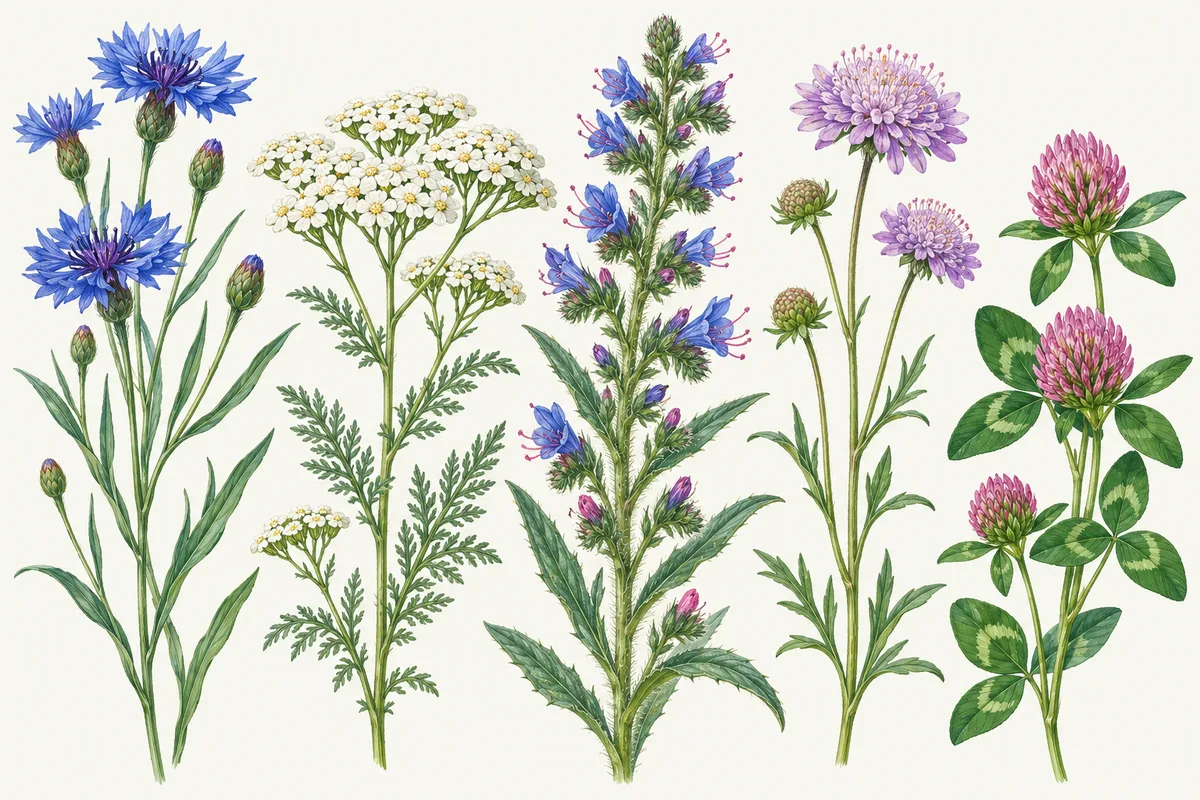
In short
To identify wildflowers, read the flower's shape before its color. A head of many tiny florets means the daisy family; a banner, two wings and a keel mean a pea; flat umbrellas of small flowers mean the carrot family; a square stem with opposite leaves and two-lipped flowers means a mint; four petals in a cross mean a mustard. Then check leaves, habitat and month.
- Shape first: seven flower builds (daisy heads, pea flowers, umbels, mints, mustards, buttercups, bells) place many common wildflowers in their family before you look at color.
- Leaf arrangement splits families fast: mints carry opposite leaves on a square stem, while mustards, peas and the carrot family carry alternate leaves.
- White umbels are the group to leave alone: poison hemlock and water hemlock are deadly, and giant hogweed sap burns skin in sunlight.
- In Great Britain uprooting any wild plant without the landowner's permission is an offence, and Schedule 8 plants may not be picked at all.
Most people try to identify wildflowers by color, and color is the weakest clue on a wildflower. One family can carry white, yellow and pink flowers on plants that grow side by side. What stays constant is the build of the flower: how many petals, whether they are joined, how the flowers are grouped, and what the stem and leaves underneath look like. Read the shape first, then color, leaves, habitat and the month, and most roadside plants come down to a short list. This method works the same way in North America and in Britain, because the big wildflower families are shared across the temperate world.
Start with the flower's shape: seven families to know
These seven builds come from Lena Struwe's field guide to the 50 most common temperate plant families (Rutgers University), which lists the traits below and the examples named in each.
1. Daisy-like heads (aster and sunflower family, Asteraceae). What looks like one flower is a head of many small flowers packed together, ringed underneath by small green bracts. The tiny flowers are either tubular or tongue-shaped, and a daisy carries both: tongues around the edge, tubes in the center. Dandelion, ox-eye daisy, thistles, knapweed, asters, coneflowers (Echinacea), sunflowers and ragwort all belong here.
2. Pea flowers (bean family, Fabaceae). Five petals in a "butterfly-type" build: a broad banner at the back, two wings at the sides and a keel between them that hides the stamens. The leaves are usually compound, with many small leaflets, a pair of stipules at the base and sometimes tendrils. The fruit is a pod. Clovers, vetches (Vicia) and wild peas (Lathyrus) are the common wild examples.
3. Umbels (carrot family, Apiaceae). Many small white or yellow five-petaled flowers held in umbrella-like clusters, usually umbrellas of umbrellas. Stems are hollow, leaves are often finely divided and wrap the stem at their base, and the plants are aromatic. Struwe notes that some are very poisonous; Queen Anne's lace and poison hemlock are both in this family. Treat this group with care (see the section on look-alikes below).
4. Mints and dead-nettles (mint family, Lamiaceae). A stem that is usually square, leaves in opposite pairs, and flowers with an upper and a lower lip, set in rings around the stem or in spikes at the tip. Many are aromatic. Dead-nettles, catnip, bee balm (Monarda), wild thyme and wild mints belong here.
5. Four petals in a cross (mustard family, Brassicaceae). Four separate petals that form a cross when seen from above, in white, yellow or pink. Look inside for six stamens, four long and two short, and below for slender pods. Garlic mustard, yellow rocket (Barbarea) and watercress are examples.
6. Buttercups and relatives (buttercup family, Ranunculaceae). Separate petals, from few to many, around a crowded center of many stamens and a cluster of separate small carpels. Sepals are often colored like petals. Buttercups, anemones, marsh marigold, columbine, hepatica and larkspur are in this family.
7. Bells (bellflower family, Campanulaceae). Five petals fused into a bell, or in the lobelias into a two-lipped tube, on plants with milky sap and usually alternate leaves. Bellflowers and harebells (Campanula) and cardinal flower (Lobelia) are examples.
If you can't place a flower in any of these, it is not a failure: lilies, orchids, roses, borages and many other families have their own builds. The flower identifier tool filters wild and garden flowers by color, shape, petal count, height, leaves and where the plant grows, if you would rather answer a few questions than read a key.
Then color, leaves, habitat and month
Once you know the family, the other clues do the narrowing.
Color, now that it means something. Within a family, color separates candidates: in the mustards, a white cross-shaped flower and a yellow one are usually different species. Note the color of the flower when it is freshly open, in shade if you can, because strong sun bleaches blues and pinks in photos.
Leaf arrangement and the stem. Roll the stem between finger and thumb. Four corners plus opposite leaves suggests a mint. The mustards, the pea family and the carrot family carry alternate leaves, one per node, according to Struwe. Then look at the leaf itself: undivided, lobed, compound with leaflets, or cut into fine fern-like segments.
Habitat. Write down where the plant is growing: a wet ditch, a dry meadow, a wood edge, a roadside verge, a lawn. It matters most for the dangerous umbels. The Delaware Department of Agriculture found both poison hemlock and spotted water hemlock in wetland areas, and lists ditches, meadows, pastures and field edges for poison hemlock. In Britain, Plantlife describes cow parsley along roadsides, hedgerows and woodland edges.
Month. Wildflowers flower in a predictable order. Plantlife gives cow parsley's season as April to June; the Delaware Department of Agriculture says both hemlocks bloom from June through August. A white umbel in July or August is outside cow parsley's usual season and inside the hemlocks', which is one more reason to keep your hands off it.
North America and Britain, side by side
The same families turn up on both sides of the Atlantic, often with the same species, because many European wildflowers have spread into North America. The examples below are common names from the families above; check a regional field guide for what grows where you are.
| Flower shape | Often met in North America | Often met in Britain and Europe |
|---|---|---|
| Daisy-like head | Asters, coneflowers, sunflowers, dandelion | Ox-eye daisy, knapweed, ragwort, dandelion |
| Pea flower | Clovers, vetches, wild peas | Clovers, vetches, wild peas |
| Umbel | Queen Anne's lace, poison hemlock, water hemlock | Cow parsley, hemlock, hogweed, giant hogweed |
| Two-lipped mint | Bee balm, catnip, wild mints | Dead-nettles, wild thyme, wild mints |
| Four petals in a cross | Garlic mustard, yellow rocket, watercress | Garlic mustard, watercress |
| Buttercup | Buttercups, marsh marigold, columbine, hepatica | Buttercups, marsh marigold, anemones |
| Bell | Harebell, cardinal flower | Harebell, bellflowers |
UK readers searching "wild flowers identification" will find the method identical; only the field guide changes. In Britain the BSBI runs recording schemes and publishes the code of conduct described below.
Dangerous look-alikes: the white umbels
The carrot family is where wildflower identification stops being a hobby question. Several white umbels look alike from a few steps away, and some of them are deadly or burn skin.
Queen Anne's lace versus poison hemlock. N.C. Cooperative Extension gives the field tests: Queen Anne's lace has hairy, green stems and often a dark purple flower in the middle of its flat cluster, and rarely grows above 3 feet. Poison hemlock has smooth, hollow stems with purplish spots and streaks, never that central purple flower, and can reach 10 feet. Its sap can cause rashes similar to poison ivy, so the same page recommends gloves for anyone who cuts it.
Water hemlock. The Delaware Department of Agriculture describes spotted water hemlock as a native plant up to six feet tall, with stems from solid green or purple to green with purple spots or stripes, and lacy, fern-like leaves whose veins end at the base of the notch on the leaf edge. It says all parts of both hemlocks are poisonous to humans and animals, that people should not crush any part of the plant to smell it, and that residents should not try to remove the plants themselves.
Cow parsley and hemlock in Britain. Plantlife warns that cow parsley "can be confused with hemlock", which is very poisonous, and with hogweed, whose sap burns in sunlight. Cow parsley's stems are hollow and without spots.
Giant hogweed: look, never handle. The RHS describes a plant that can reach 5 m (16 ft) or more, with thick, bristly, purple-blotched hollow stems and upward-facing white umbels. It is phototoxic: touching it with bare skin can cause severe photodermatitis, burning, blistering and long-lasting scarring, and cut plant material can still damage skin hours later. The RHS says it is listed on Schedule 9 of the Wildlife and Countryside Act, so you must not plant it or cause it to spread. Our giant hogweed page covers its field marks and look-alikes in detail.
If skin touches giant hogweed, the RHS advises washing it at once, keeping it out of sunlight and seeking medical advice (in the UK, NHS 111). If anyone may have swallowed part of a hemlock, call Poison Control at 1-800-222-1222 or 911 in the US, as the Delaware Department of Agriculture advises, or NHS 111 in the UK.
Protected wildflowers: leave them where they grow
A photograph records a wildflower better than a picked stem, which wilts before you get home. The BSBI's code of conduct says most specimens can be identified reliably from good photos of the flowers and the leaves and stems.
The rules differ by country, so check them where you walk. In Great Britain, the BSBI explains that under the Wildlife and Countryside Act it is illegal to uproot any wild plant without permission from the landowner or occupier, and that plants on Schedule 8 are specially protected against intentional picking, uprooting and destruction, so they cannot be picked or disturbed without a licence. The BSBI adds that you can usually pick a few wild flowers for study or enjoyment, taking them only from large patches of plants you know are widespread and plentiful in the area. It also notes that its guidance is not a definitive statement of the law. In North America, rules depend on the park, the state or province, and the landowner, so read the rules of a park or reserve before you pick anything.
Free tools for wild plants, named honestly
Several free apps were built for wild plants by research groups and charities, and they are worth knowing before any paid app.
- Seek and iNaturalist (North America and worldwide). Plantlife describes iNaturalist as free, with observations shared so other users can help identify them; it found iNaturalist very accurate to genus and sometimes to species when several photos were added, and its simpler sister app Seek less accurate in the field.
- Flora Incognita (Europe). Plantlife describes it as free to download, with no intrusive adverts or other costs, combining traditional identification with AI and recording plant locations for biodiversity mapping.
- Pl@ntNet (Europe and worldwide). Pl@ntNet is a citizen-science project whose trademark is owned by four French research institutes (CIRAD, INRAE, Inria and IRD). It identifies plants from photos and asks for donations to stay open and free to everyone.
Plantlife's advice applies to every app: treat it as a training tool, take the name to genus, and confirm with a field guide. Our free plant identification apps comparison sets out what "free" means for each.
Where a photo app fits in the field
Plant Identifier, our iPhone app, identifies a plant from one photo, taken with its camera or picked from your library, and returns the common and scientific names with origin and key traits. It sends the photo to a cloud AI model, so it needs a phone signal or Wi-Fi, which is not a given on a mountain path. It shows one name, with no confidence score and no list of similar species, so use the shape, leaves and month above to check whether the answer fits.
For a wildflower, photograph one open flower straight on, then the stem and a leaf, as the photo checklist explains, and identify from the flower photo first. If Plant Identifier names a member of the carrot family, treat it as a reason to stay hands-off, not as clearance to touch. With location allowed, Plant Identifier's Plant Map pins each find, which helps you come back in a later month to see the plant in seed.
What a photo can't settle
- A photo rarely shows the hairs, stem corners or smell that separate some look-alikes, so white umbels in particular need a check in person by someone who knows them, without touching.
- Many wildflower groups (dandelion-like yellow composites, small white mustards, vetches) hold several similar species that a photo app or a beginner can only take to the genus.
- No app or page can tell you whether a wild plant is protected on a particular site or whether you may pick it there; that depends on the law where you are and on the landowner.
Questions people ask
What is the easiest way to identify wildflowers?
Start with the flower's shape, not its color. A daisy-like head, a pea flower, a flat umbel, a two-lipped flower on a square stem, four petals in a cross, a buttercup or a bell each point to a family. Leaves, habitat and month then narrow the family to a short list.
How do I tell Queen Anne's lace from poison hemlock?
N.C. Cooperative Extension gives three checks: Queen Anne's lace has hairy green stems, often a dark purple floret in the middle of its flat cluster, and rarely tops 3 feet. Poison hemlock has smooth, hollow stems with purplish spots and streaks, no purple center, and can reach 10 feet. Look without touching or crushing.
Is it illegal to pick wildflowers in the UK?
Not in general. The BSBI says you can usually pick a few wild flowers from large patches of common plants. Uprooting any wild plant without the landowner's or occupier's permission is illegal, and plants on Schedule 8 of the Wildlife and Countryside Act are protected against picking, uprooting and destruction.
Which free apps identify wildflowers?
Plantlife names Flora Incognita, free to download without intrusive adverts, and iNaturalist, free, where other users help confirm your records; its simpler sister app Seek was less accurate in Plantlife's field use. Pl@ntNet is a free citizen-science app from French research institutes. Plantlife advises treating any app as a training tool.
Why does the same wildflower look different in two field guides?
Color varies between plants and fades with age and light, and one family often covers white, yellow and pink flowers. The structure of the flower, the stem and the leaf arrangement change far less, which is why keys and field guides lean on shape before color.
Sources
- Field identification of the 50 most common plant families in temperate regions — Lena Struwe, Rutgers University (PDF hosted by San Diego State University)
- Poison Hemlock in the High Country…What to Know — N.C. Cooperative Extension, Watauga County Center
- Deadly Poison Hemlock and Spotted Water Hemlock Found in Delaware — Delaware Department of Agriculture
- Giant hogweed — Royal Horticultural Society (RHS)
- Cow parsley — Plantlife
- 3 mobile apps to identify wildflowers on your phone — Plantlife
- Code of Conduct — Botanical Society of Britain and Ireland (BSBI)
- Pl@ntNet — Pl@ntNet (CIRAD, INRAE, Inria, IRD)
Keep reading
- Free toolFlower identifier by description
- Weed profileGiant hogweed (Heracleum mantegazzianum): how to identify it
- Photo checklistHow to photograph a plant for identification
- Field guideHow to identify a plant, step by step
- Compared by Plant Identifier's makersFree plant identification apps, and what "free" means in each