Weed profile
Giant hogweed (Heracleum mantegazzianum): how to identify it
A white-flowered giant of the carrot family whose sap, with sunlight, can burn skin. Identify it from a distance, then report it; don't touch it.
In short
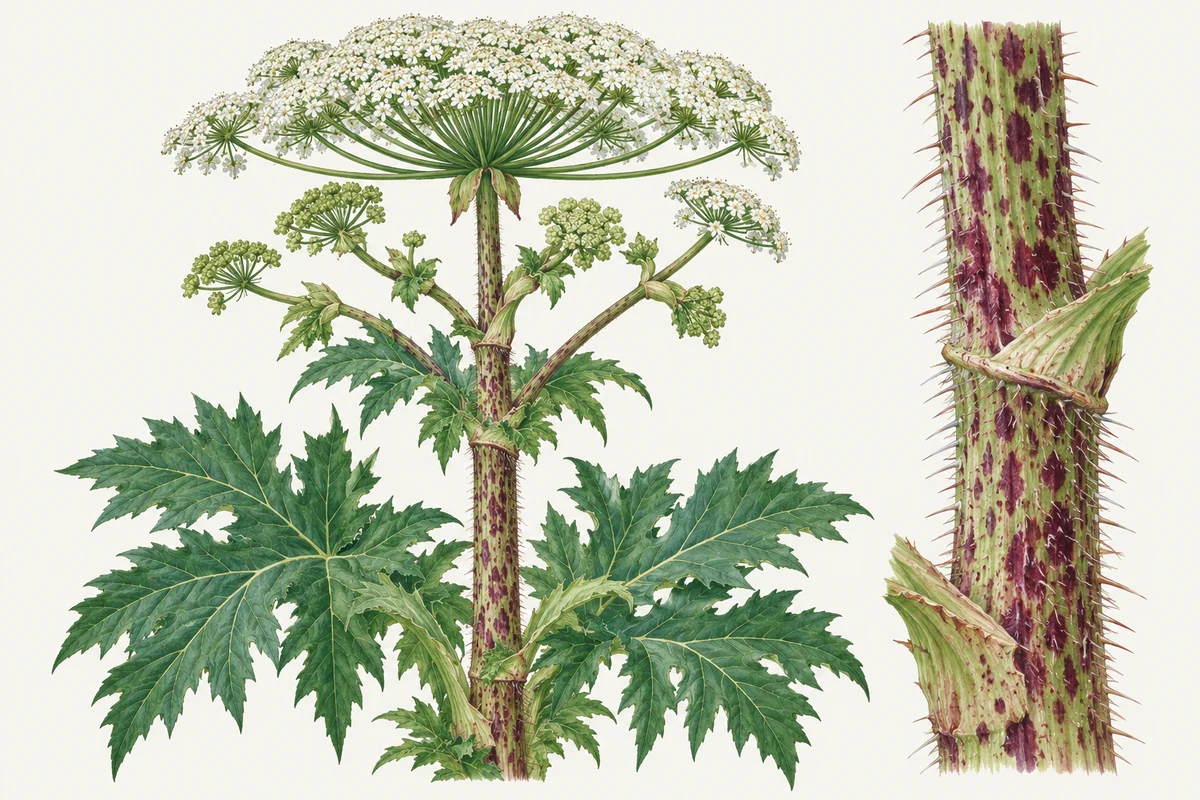
Giant hogweed is identified by its size and its stem: plants stand 7 to 14 feet tall in flower, with white umbrella-shaped flower heads up to 2.5 feet across and deeply cut leaves up to 5 feet wide. The hollow stem, 2 to 4 inches thick, has purple blotches and coarse white hairs. Its sap with sunlight can cause severe burns, so look but don't touch.
- Purple blotches plus coarse white hairs on a stem 2 to 4 inches thick: that combination points to giant hogweed (NY DEC).
- Cow parsnip, its most common look-alike, rarely tops 8 feet and has flower heads only up to 1 foot wide.
- Sap on skin plus sunlight can cause painful burns and scarring: wash with soap and water and keep the skin out of the sun for 48 hours.
- In New York, report it to DEC with photos; elsewhere, follow your state or national authority's instructions.
Field marks at a glance
- Scientific name
- Heracleum mantegazzianum
- Family
- Apiaceae (carrot family)
- Type
- Weed
- Height
- 7 to 14 feet tall in flower (NY DEC), sometimes more; the RHS gives 5 m (16 ft) or more for second-year flowering stems.
- Stem
- Hollow and ridged, 2 to 4 inches across, green with dark reddish-purple blotches and coarse white hairs, thickest at the base of the leaf stalks.
- Leaves
- Compound and deeply cut, usually in three lobed leaflets with toothed edges, up to 5 feet wide; first-year rosette leaves can reach 3 m (10 ft) long (RHS).
- Flowers
- Many small white flowers in a flat-topped umbrella (umbel) up to 2.5 feet across, with 50 or more rays per head.
- Flowering time
- Late June to mid-July in New York (NY DEC); the flowers face upward.
- Seeds
- Penny-sized, flat, paper-thin seeds with dark brown stripes; the RHS gives up to 50,000 seeds per plant.
- Life cycle
- Usually a biennial: a leaf rosette the first year, a flowering stem the second; NC State notes it can take several years to flower and dies after setting seed.
- Where it grows
- Stream and river banks, roadsides, fields, yards and woods. Introduced: established in New England, the Mid-Atlantic and the Northwest (NY DEC), in Canada (USDA) and across the British Isles, where it came from the Caucasus (RHS).
Giant hogweed (Heracleum mantegazzianum) is a huge, white-flowered member of the carrot family, introduced from the Caucasus as a garden curiosity and now loose along rivers and roadsides in North America and the UK. It matters because of its sap: on skin, with sunlight, it can cause severe burns. Identify it from a distance, photograph it, and report it where your authority asks. Don't touch it, cut it or mow it.
How to identify giant hogweed without touching it
Use four checks, all from a step or two away. The figures come from the New York State Department of Environmental Conservation's giant hogweed page and its look-alike fact sheet.
1. Height. A flowering giant hogweed stands 7 to 14 feet tall, and NY DEC notes it can pass 14 feet. Its closest look-alike, cow parsnip, reaches 5 to 8 feet.
2. The stem. This is the most reliable mark. The stem is hollow and ridged, 2 to 4 inches across, green with dark reddish-purple blotches and coarse white hairs that are thickest where the leaf stalks join it. You can read all of this from a photo; there is no need to get close.
3. The flower heads. In flower, each stem carries a flat-topped white umbrella up to 2.5 feet across, with 50 or more rays (flower stalks) radiating from the center. NY DEC gives late June to mid-July as flowering time in New York.
4. The leaves. The leaves are compound, usually in three lobed leaflets, deeply cut and toothed, and up to 5 feet wide. The RHS adds that first-year rosette leaves can reach 1.5 m (5 ft) wide and 3 m (10 ft) long.
If you aren't sure what you are looking at, a photo taken from a distance in Plant Identifier gives you a name to compare against these four checks. The app shows no confidence score and no list of alternatives, and it can't stand in for an official confirmation, so use the measurements above and the reporting steps below either way.
Why you shouldn't touch it: sap and sunlight
The RHS explains that giant hogweed contains high levels of furanocoumarins, chemicals that make skin very sensitive to sunlight, and that contact can lead to severe photodermatitis with burning, blistering, pigmentation and long-lasting scarring. NY DEC says the sap, combined with sunlight and moisture, can cause a severe burn within 24 to 48 hours, that reactions can begin as soon as 15 minutes after contact, and that scars typically last a few months but can last up to six years. DEC's Beware of Giant Hogweed poster puts it plainly: don't touch this plant.
If sap gets on your skin, NY DEC's first-aid steps are:
- Wash the area thoroughly with soap and water as soon as possible.
- Keep it covered and out of sunlight for 48 hours.
- See a doctor if a reaction develops.
- If sap gets in your eyes, rinse them with water, wear sunglasses or cover them, and get medical care.
In the UK, the RHS gives the same advice (wash, keep out of sunlight, seek medical advice); NHS 111 can tell you where to go. In the US, Poison Control answers at 1-800-222-1222. NY DEC also warns against using weed trimmers or brush cutters near the plant, which spray sap, and the RHS notes that cut plant material can still damage skin hours later and that sap on clothes and tools needs careful washing. Keep children and pets away from it.
Giant hogweed vs cow parsnip, Queen Anne's lace and angelica
NY DEC lists several plants that are often mistaken for giant hogweed, most of them smaller relatives in the same family. Its fact sheet compares them on mature plants:
| Plant | Height | Flower head | Stem |
|---|---|---|---|
| Giant hogweed | 7 to 14 ft | White, flat umbrella up to 2.5 ft, 50+ rays | 2 to 4 in, purple blotches, coarse white hairs |
| Cow parsnip | 5 to 8 ft | White, flat-topped, up to 1 ft, 15 to 30 rays | 1 to 2 in, lines of fine white hairs |
| Angelica | 4 to 9 ft | Greenish-white globes, 4 to 8 in | 1 to 2.5 in, smooth, waxy, purple, no hairs |
| Queen Anne's lace | 1 to 3 ft | White, 2 to 4 in, often a purple center flower | Under 0.5 in, bristly |
| Wild parsnip | Up to 5 ft | Yellow, flat-topped, 4 to 8 in | Up to 1.5 in, grooved, no hairs |
| Poison hemlock | 4 to 9 ft | Small white clusters, 1.5 to 2.5 in | 1 to 2 in, smooth, waxy, purple blotches, no hairs |
Two lessons from that table. First, purple blotches alone don't make a giant hogweed: poison hemlock has them too, but its stem is smooth and hairless. Look for blotches and coarse hairs together on a stem 2 to 4 inches thick. Second, several look-alikes are hazards in their own right: NY DEC says cow parsnip and angelica may cause burns, wild parsnip can cause burns, and poison hemlock is very poisonous in all parts. Treat any big white or yellow umbel as hands-off until you know what it is.
In the UK, the RHS names cow parsley and common hogweed as the usual confusions with young or stunted plants: cow parsley has fern-like foliage and flowers earlier in the year; common hogweed has more rounded leaves, no purple blotching and grows only to about 2 m (6 ft). For other roadside flowers, see the wildflower identification guide.
How to report giant hogweed
In New York State, NY DEC asks you to:
- Photograph the whole plant, the stem, the leaves and the flowers or seeds, from a safe distance.
- Note the approximate number of plants or size of the patch, and the location (GPS if you can).
- Email the photos and details to ghogweed@dec.ny.gov, call the Invasive Plant Information Line at 845-256-3111, or submit a report through iMapInvasives. The DEC page also gives a number for texting photos (518-320-0309) and suggests your local PRISM.
DEC can then confirm whether it is giant hogweed and give management recommendations. Our guide to photographing a plant for identification covers getting a usable stem and flower shot, but for this plant, use zoom and stay back.
Elsewhere in the US, giant hogweed is a federal noxious weed, according to NC State Extension, which asks people in North Carolina to report sightings to the NC Department of Agriculture or the NC Invasive Plant Council. The USDA PLANTS Database lists it as introduced in the lower 48 states and Canada. In other states, contact your state department of agriculture or invasive species program and follow its instructions.
In the UK, the RHS notes that giant hogweed is listed on Schedule 9 of the Wildlife and Countryside Act 1981 and as a Species of Special Concern by the GB Non-Native Species Secretariat. It is not an offence to have it in your garden, but you must not plant it or cause it to spread, and an environmental authority can require its control. GOV.UK guidance adds that if invasive non-native plants are on your land, you must stop them spreading, and that in most cases you will need a specialist contractor. The RHS also classes cut giant hogweed as controlled waste that must go to an authorized site.
Where it grows and how it spreads
Giant hogweed favors moist ground, especially stream banks, where NC State says it can lead to soil erosion and carry its seeds downstream. NY DEC lists streams and rivers, fields, forests, yards and roadsides, and says the plant is established in New England, the Mid-Atlantic and the Northwest. The RHS says it was introduced to Britain from the Caucasus Mountains in the early 1800s, escaped gardens within about ten years, and is now found in every part of the British Isles.
Each plant can shed up to 50,000 seeds, spread by wind over short distances and by water much farther (RHS). That is why a single flowering plant by a stream matters, and why reports with an exact location help. If you want to keep track of where you saw one while you wait for an answer from the authority, Plant Identifier's Plant Map records each located identification. For the general method on any unknown plant, see how to identify plants.
Look-alikes and how to tell them apart
Cow parsnip (Heracleum maximum)
Native to North America and much smaller: 5 to 8 feet tall, flower heads up to 1 foot wide with 15 to 30 rays, flowering late May to late June. Its stem is 1 to 2 inches thick with lines of fine white hairs, not purple blotches. NY DEC says it may also cause burns.
Queen Anne's lace (Daucus carota)
Only 1 to 3 feet tall, with lacy flower heads 2 to 4 inches across that often have one deep purple flower in the center and curl into a bird's nest as they age. The stem is under half an inch thick and bristly, with no purple blotches.
Angelica (Angelica atropurpurea)
Look at the stem and flower shape: angelica's stem is smooth, waxy and purple all over with no hairs or bristles, and its greenish-white flower clusters are globe-shaped, 4 to 8 inches wide. It flowers mid-May to mid-June. NY DEC says handle with care, it may cause burns.
Cow parsley (Anthriscus sylvestris)
A UK roadside plant with soft, fern-like leaves and small white flower heads that open in spring, earlier than giant hogweed (RHS). Its leaves are finely divided like a fern, nothing like giant hogweed's huge, coarse, deeply cut leaves.
Common hogweed (UK)
The RHS says common hogweed grows only up to 2 m (6 ft), has more rounded leaves and no purple blotching on the stem. A giant hogweed in flower stands well over head height, so size alone usually settles it.
What a photo can't settle
- A first-year rosette, or a stunted plant, can look like cow parsnip, common hogweed or cow parsley in a photo (the RHS warns of this): measure the stem and look for purple blotches with coarse hairs before deciding.
- Only an inspection by the authority can confirm a giant hogweed record; NY DEC asks for photos of the whole plant, stem, leaves and flowers or seeds so it can confirm the species.
- The RHS notes four closely related giant hogweed species naturalized in Britain, usually all called Heracleum mantegazzianum; a photo will not separate them.
Questions people ask
What happens if you touch giant hogweed?
NY DEC says the sap, combined with sunlight and moisture, can cause a severe burn within 24 to 48 hours, with painful blisters and scars that can last up to six years. Wash the skin with soap and water at once, keep it covered from sunlight for 48 hours, and see a doctor if it reacts.
How do I tell giant hogweed from cow parsnip?
Measure and look at the stem. Giant hogweed is 7 to 14 feet tall with flower heads up to 2.5 feet wide and a 2- to 4-inch stem with purple blotches and coarse hairs. Cow parsnip is 5 to 8 feet tall, its heads up to 1 foot wide, its stem 1 to 2 inches with fine hairs.
Who do I report giant hogweed to?
In New York, email photos and the location to ghogweed@dec.ny.gov, call DEC's Invasive Plant Information Line at 845-256-3111, or submit a report through iMapInvasives. In North Carolina, NC State Extension says to report it to the NC Department of Agriculture. Elsewhere, contact your state or national invasive species authority.
Is it illegal to have giant hogweed in your garden in the UK?
The RHS says it is not an offence to have it growing in your garden, but you must not plant it or cause it to spread, and an environmental authority can order its control. It is listed on Schedule 9 of the Wildlife and Countryside Act 1981. GOV.UK says that in most cases you will need a specialist contractor.
When does giant hogweed flower?
NY DEC gives late June to mid-July for New York. Plants usually flower in their second year or later, on a stem that can pass 14 feet, then die after setting seed. Before that, a giant hogweed is only a large rosette of deeply cut leaves, which is harder to recognize.
Sources
- Giant Hogweed — New York State Department of Environmental Conservation
- How to Identify Giant Hogweed from Common Lookalike Plants — New York State Department of Environmental Conservation
- Beware of Giant Hogweed (poster) — New York State Department of Environmental Conservation
- Giant hogweed — Royal Horticultural Society (RHS)
- Heracleum mantegazzianum (giant hogweed) — NC State Extension, North Carolina Extension Gardener Plant Toolbox
- Plant profile: Heracleum mantegazzianum Sommier & Levier, giant hogweed — USDA NRCS PLANTS Database
- How to stop invasive non-native plants from spreading — GOV.UK (Environment Agency and Defra)
- When to use NHS 111 online or call 111 — NHS