Weed profile
Common ragweed (Ambrosia artemisiifolia): how to identify it
Finely cut hairy leaves, a pinkish-red hairy stem and spikes of tiny green flowers with no petals. The plant behind late-summer hay fever, and how to pick it out from its look-alikes.
In short
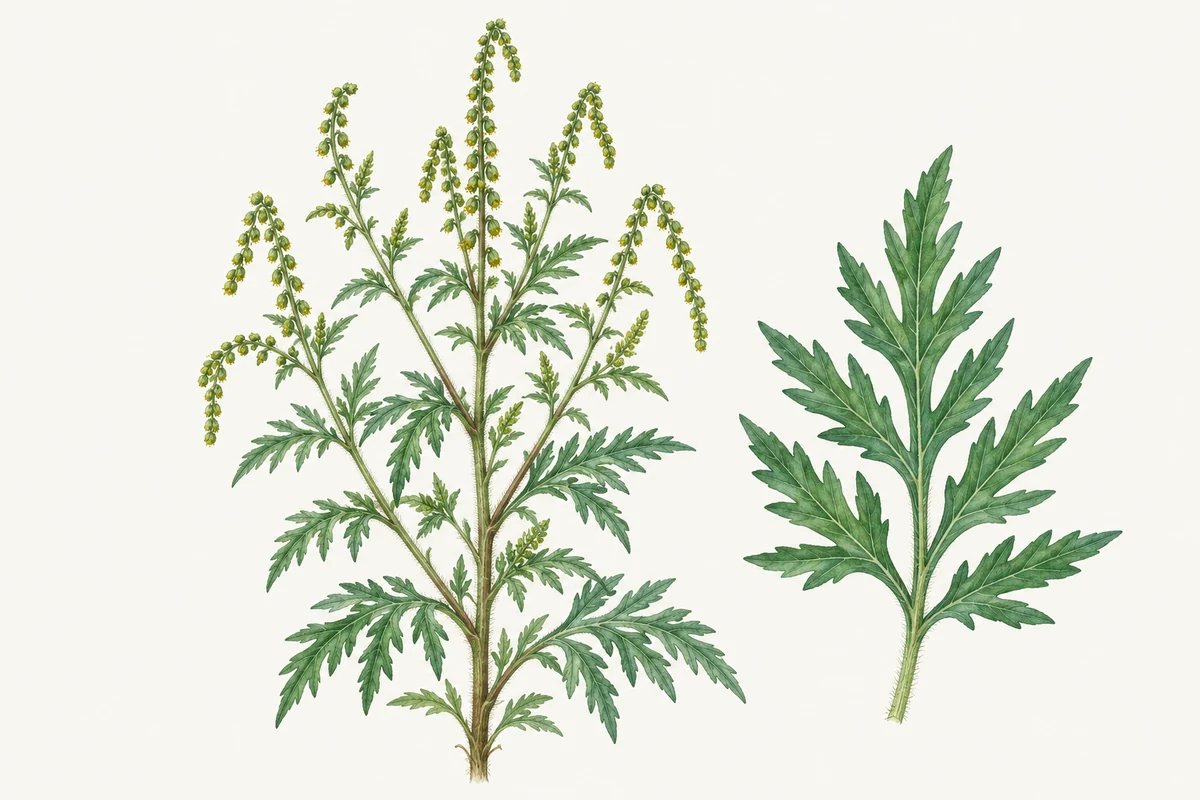
To identify ragweed plants, start with the leaves: common ragweed's are deeply cut and fern-like, 3 to 6 inches long and hairy, opposite low on the stem and alternate higher up. The stem is pinkish red, grooved and hairy. From late summer, slender spikes of tiny green flowers with no petals top each stem; these male flowers shed wind-blown pollen into fall.
- No petals, no color: ragweed flowers are tiny, green and packed into spikes 1 to 4 inches long at the stem tips.
- A hairy pinkish-red stem and finely cut, hairy leaves separate it from mugwort and from marigold seedlings.
- Giant ragweed is a different species, with rough leaves cut into 3 to 5 big lobes and plants up to 12 feet tall.
Field marks at a glance
- Scientific name
- Ambrosia artemisiifolia
- Family
- Asteraceae (daisy family)
- Type
- Weed, annual
- Leaves
- Deeply lobed and fern-like, up to 6 inches long and 4 inches wide, broadest at the base, hairy; the first leaves are opposite, later ones alternate.
- Stem
- Upright, often branched, pinkish red, grooved and hairy.
- Flowers
- No petals. Male flowers in slender spikes (racemes) 1 to 4 inches long at the stem tips, each flower about 1/8 inch, green turning yellow-green then brown; female flowers in small clusters in the leaf axils below.
- Flowering and pollen
- Flowers in summer and fall; the male flowers release pollen from late summer into fall, carried by the wind (NC State Extension).
- Seeds
- A woody achene with 4 to 7 spine-like points around the top, like a small crown; seeds can stay viable for up to 5 years.
- Size
- Usually 1 to 3 feet tall, up to 6 feet, with a spread of 3 to 4 feet.
- Life cycle
- Summer annual: it grows from seed each spring and dies in fall.
- Where it grows
- Crop fields, roadsides, waste ground and disturbed soil in full sun; tolerates drought and poor soil. Native to North America; naturalized in Europe and elsewhere.
Common ragweed (Ambrosia artemisiifolia) is the plant most people mean when they say ragweed: a weedy annual of fields, roadsides and bare yard soil, and, in the words of Iowa State Extension, a major cause of hay fever. It has no showy flowers, which is why so many people walk past it. Check the leaves first, then the stem, then the flower spikes.
How to identify common ragweed in three checks
1. The leaves. Common ragweed leaves are deeply lobed and fern-like, 3 to 6 inches long and up to about 4 inches wide, with the base much wider than the tip, according to the NC State Extension Plant Toolbox. Iowa State describes the outline as triangular and finely divided, with hairy leaves. The first leaves on the stem are opposite (in pairs); the later ones are alternate, one per node, as Iowa State Extension notes. Rub a leaf between two fingers: the hairs on young leaves are easy to feel on the underside.
2. The stem. NC State describes the stem as pinkish red, grooved and hairy. A plant in a sunny spot branches into several upright stems and usually stands 1 to 3 feet tall, sometimes up to 6 feet, and 3 to 4 feet across.
3. The flowers. From summer on, each stem ends in slender spikes 1 to 4 inches long, crowded with tiny flowers about 1/8 inch across. They have no petals: they start green, turn yellow-green, then brown. These are the male flowers, the ones that shed pollen. The female flowers sit in small clusters in the leaf axils just below, and later become hard seeds ringed with 4 to 7 short spines, like a tiny crown.
If you have a photo but no idea where to start, one picture of the leaves and stem in Plant Identifier gives you a name to check against these three marks. The app shows no confidence score and no list of alternatives, so confirm the hairs on the stem and the flower spikes yourself before you rely on the answer.
When ragweed flowers and sheds pollen
Common ragweed is a summer annual. It sprouts from seed in spring, grows through summer and dies in fall, and NC State lists its bloom time as summer and fall. The male flowers release copious pollen from late summer into fall, and the wind carries it. The seeds that follow are rich in oil, and birds eat them. Seeds left in the soil can stay viable for up to five years, which is why a patch comes back year after year even though each plant lives only one season.
What this means for spotting it:
- Spring to early summer: low, leafy plants with fern-like hairy leaves and no flowers. This is the stage where it is most often confused with marigolds, wild carrot and other cut-leaved seedlings.
- Mid to late summer: the green flower spikes appear at every stem tip; this is the easiest stage to identify.
- Fall: spikes turn brown, pollen release ends, and the plant dies at the end of the season, leaving its spiny seeds.
Hay fever is the reason most people look this plant up. Iowa State calls common ragweed a major cause of hay fever and says the same of giant ragweed. NC State also lists contact dermatitis as a problem with this plant. We don't give medical advice: if you think ragweed is behind your symptoms, see a doctor about allergy. In the UK, the NHS says hay fever symptoms are usually worse from late March to September and suggests speaking to a pharmacist, then a GP if symptoms get worse.
Common ragweed vs mugwort, giant ragweed and marigolds
| Feature | Common ragweed | Mugwort | Giant ragweed |
|---|---|---|---|
| Life cycle | Annual | Perennial, spreads by rhizomes | Annual |
| Leaves | Fern-like, finely divided, hairy | Lobed, pale and woolly underneath, fragrant | Rough, 3 to 5 large lobes |
| Stem | Pinkish red, grooved, hairy | Purple-brown, angular, largely hairless | Rough |
| Height | 1 to 3 ft, up to 6 ft | 2 to 4 ft | Up to 12 ft |
| Flowers | Green spikes, no petals | Greenish-yellow to reddish-brown panicles | Green spikes, no petals |
Mugwort is the look-alike that confuses gardeners most, because the young leaves of both are deeply lobed. The NC State mugwort page gives the decisive points: mugwort leaves are paler and hairy underneath, mugwort is fragrant, and it is a perennial that spreads by rhizomes. If the patch was in the same place last year and the leaf undersides are silvery-white, think mugwort.
Giant ragweed (Ambrosia trifida) is a separate species, not a big common ragweed. Iowa State describes rough stems and leaves, leaves in opposite pairs with 3 to 5 deep lobes, and plants up to 12 feet tall in crop fields, flood plains and field edges. The first leaves can be unlobed, which makes seedlings look like sunflower or cocklebur.
Marigold seedlings turn up where marigolds were grown the year before, and their cut leaves resemble young ragweed. The NC State marigold page describes marigold leaves as gland-dotted and aromatic, without hairs, on a green stem that smells when squeezed. A strong marigold smell and a hairless leaf settle it.
For other weeds in a lawn, see the lawn weed identification guide; for plants in flower along roadsides and field edges, the wildflower identification guide.
Where common ragweed grows, and its status
The USDA PLANTS Database lists Ambrosia artemisiifolia (there called annual ragweed) as native to Canada and the lower 48 states (where it also records introduced populations) and introduced in Hawaii. Iowa State lists crop fields and waste areas as its habitat; NC State adds that it prefers dry conditions in full sun to part shade and tolerates drought and poor soil. In practice, look along roadsides, field margins, new construction sites and any yard soil left bare over summer.
Outside North America it is an introduced plant. The EPPO Global Database describes it as native to North America, invasive and allergenic, and has listed it on the EPPO List of Invasive Alien Plants since 2004; Switzerland (2008) and Spain (2011) regulate it as an invasive alien plant. EPPO also records the old name Ambrosia elatior as a synonym. If you find ragweed in Europe, check what your national or regional authority asks of you before you do anything else.
What to do about it
Control advice here comes only from the extension services we cite. NC State says control is best done by hoeing and hand pulling, and that glyphosate-resistant strains now exist in the United States. Because NC State also lists contact dermatitis, wear gloves and long sleeves when you pull it, and pull before the flower spikes open so the plant doesn't shed pollen or set seed. If you use any weed killer, follow the label and local rules.
To come back to a patch next summer, before it flowers, the Plant Map in Plant Identifier keeps each located identification so you can find the spot again. For the general method that works on any unknown plant, see how to identify plants.
Look-alikes and how to tell them apart
Mugwort (Artemisia vulgaris)
Turn a leaf over: mugwort's underside is pale and hairy, almost woolly, and the leaf is fragrant when crushed. Its stems are purple-brown and largely hairless. Mugwort is a perennial that spreads by underground rhizomes, so it comes back in the same patch every year.
Giant ragweed (Ambrosia trifida)
Giant ragweed's leaves are rough, opposite and cut into 3 to 5 large lobes like a hand, not finely divided like a fern. The plant is far bigger, up to 12 feet (Iowa State). The flowers are the same green spikes, and it is also a major hay fever plant.
Marigold seedlings (Tagetes)
Crush a leaf: marigold leaves are dotted with oil glands and smell strongly, and the green stem is aromatic when squeezed. Marigold leaves are hairless (NC State), while young ragweed leaves are hairy and its stem is pinkish and hairy.
Wild carrot or poison hemlock seedlings
Iowa State notes that ragweed leaves look somewhat like these, but wild carrot and poison hemlock are biennials whose first-year leaves sit in a flat basal rosette. Ragweed puts its leaves on an upright, branching stem from the start. Do not handle or taste any of them.
What a photo can't settle
- Seedlings with only a few leaves are hard to tell from marigold, wild carrot and other cut-leaved seedlings in a photo: wait for the stem to show its pinkish hairs or check the scent.
- A photo can't tell you whether the plant is shedding pollen right now, or whether ragweed is what you are allergic to: only an allergy test and a doctor can settle that.
- Close relatives such as western ragweed, a perennial with less deeply divided leaves (Iowa State), can look alike in a single leaf photo; check the whole plant and whether it returns from the same roots.
Questions people ask
What does ragweed look like?
Common ragweed is an upright annual, usually 1 to 3 feet tall, with deeply cut, fern-like hairy leaves and a pinkish-red hairy stem. From summer it carries slender spikes of tiny green flowers with no petals at the stem tips. Giant ragweed, its relative, has big 3- to 5-lobed leaves and grows much taller.
When does ragweed release pollen?
NC State Extension says the male flowers release pollen from late summer into fall, and the wind carries it. The plant flowers in summer and fall, then dies at the end of the season, since it is an annual. Local timing shifts with latitude and weather, so a local pollen forecast is the best guide for a given week.
Is mugwort the same as ragweed?
No. Both are in the daisy family and both have deeply lobed leaves, but mugwort (Artemisia vulgaris) is a perennial with fragrant leaves that are pale and woolly underneath. Common ragweed (Ambrosia artemisiifolia) is an annual with hairy green leaves on both sides and a pinkish-red hairy stem.
Should I pull ragweed out of my yard?
NC State Extension says control is best done by hoeing and hand pulling, before the flowers shed pollen. It also lists ragweed as a cause of contact dermatitis, so cover your skin. For any weed killer, follow the label and local rules.
Can ragweed cause hay fever?
Yes. Iowa State Extension calls common ragweed a major cause of hay fever, and NC State calls it the culprit for allergies and hay fever. If you think ragweed pollen is behind your symptoms, see a doctor, or in the UK a pharmacist or GP, about allergy.
Sources
- Ambrosia artemisiifolia (common ragweed) — NC State Extension, North Carolina Extension Gardener Plant Toolbox
- Common ragweed — Iowa State University Extension and Outreach, Integrated Crop Management
- Giant ragweed — Iowa State University Extension and Outreach, Integrated Crop Management
- Artemisia vulgaris (mugwort) — NC State Extension, North Carolina Extension Gardener Plant Toolbox
- Tagetes erecta (African marigold) — NC State Extension, North Carolina Extension Gardener Plant Toolbox
- Plant profile: Ambrosia artemisiifolia L., annual ragweed — USDA NRCS PLANTS Database
- Ambrosia artemisiifolia (AMBEL): overview and categorization — EPPO Global Database
- Hay fever — NHS
Keep reading
- Lawn and gardenHow to identify weeds in your lawn
- Field guideHow to identify wildflowers in the field
- Weed profileWhite clover (Trifolium repens): how to identify clover in a lawn
- Weed profileGiant hogweed (Heracleum mantegazzianum): how to identify it
- Weed profileCreeping Charlie (Glechoma hederacea): how to identify ground ivy