Weed profile
White clover (Trifolium repens): how to identify clover in a lawn
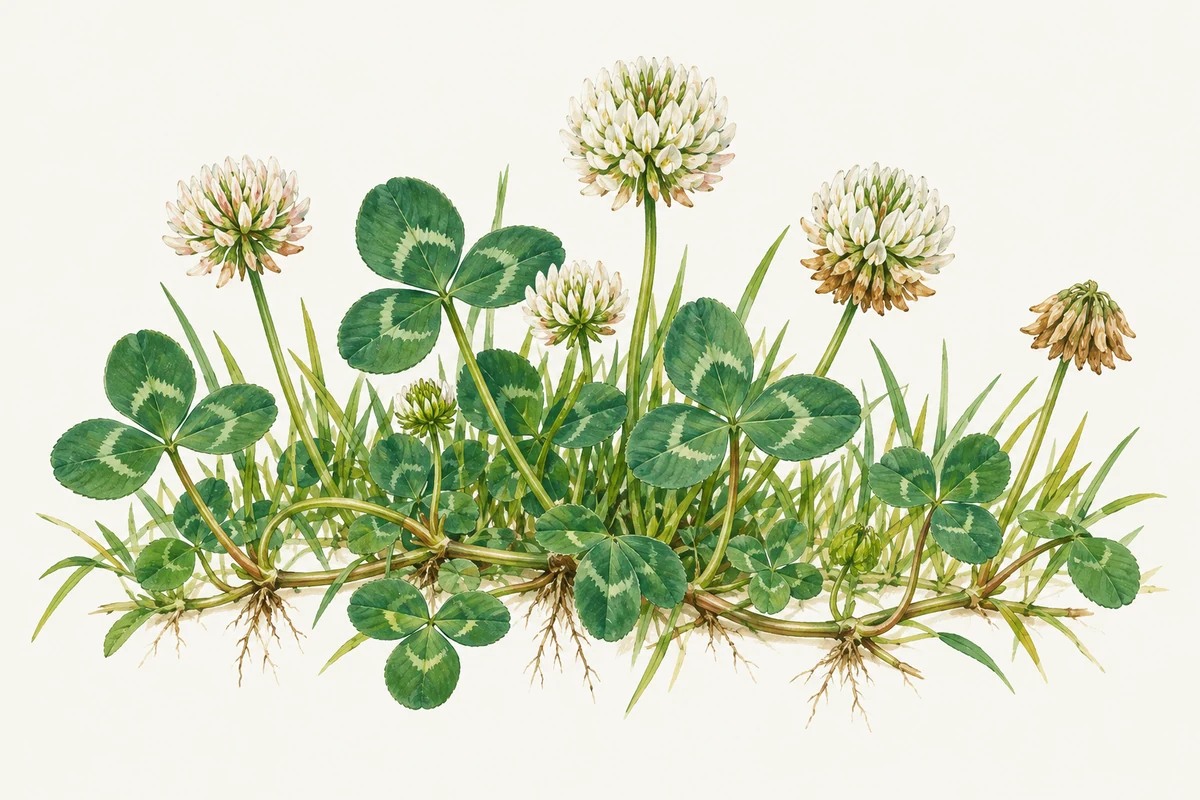
Creeping stems that root as they spread, leaves of three rounded leaflets often marked with a pale crescent, and round white flower heads on long stalks from May to October.
In short
White clover is a low, creeping perennial of the pea family whose stems run along the ground and root at the nodes. Each leaf has three hairless, oval leaflets with finely toothed edges, usually marked with a pale crescent near the base. From May to October, round white heads ½ to 1½ inches across, sometimes tinged pink, rise on long stalks above the leaves.
- Look for the pale crescent or chevron on each leaflet: white clover usually has one, while oxalis and black medic do not.
- Oxalis leaflets are heart-shaped and fold along the middle; white clover leaflets are oval with rounded tips.
- Black medic also has three leaflets, but each ends in a tiny point and its small flower heads are yellow, followed by black seed pods.
Field marks at a glance
- Scientific name
- Trifolium repens
- Family
- Fabaceae (pea family)
- Type
- Weed, perennial
- Leaves
- Three leaflets (sometimes four) on a long, upright stalk; leaflets oval to egg-shaped with rounded tips, slightly toothed edges and no hairs. A membranous sheath wraps the base of each leaf stalk.
- Leaf marking
- Usually a white or pale crescent-shaped mark near the base of the upper surface of each leaflet (NC State); the RHS describes rounded leaflet tips, often with a white mark.
- Stems
- Creeping stems that lie along the ground and root at some nodes, so a plant spreads into a patch.
- Flowers
- Round heads ½ to 1½ inches across of small creamy-white flowers, occasionally tinged pink, on long stalks that usually rise above the leaves.
- Flowering time
- May to October in the UK (RHS).
- Height
- Can reach 45 cm (18 in) in long grass but is often much shorter in a mown lawn (RHS); it also survives close mowing (NC State).
- Roots
- Fibrous roots that usually carry small round nodules, where soil bacteria fix nitrogen from the air.
- Where it grows
- Lawns, especially thin ones and those low in nitrogen; it can also spread by seed onto bare soil.
White clover (Trifolium repens) is a creeping perennial of the pea family found in lawns in North America and the UK. NC State Extension lists it among turf weeds; the RHS says there is no need to remove it from a regularly mown lawn, because it stays green and low, and that its flowers provide nectar for bees and butterflies. Either way, the first step is to make sure the plant is white clover and not one of the trefoils, medics or sorrels that share its three-leaflet leaves.
How to identify white clover in four checks
1. The leaflets. Each leaf has three leaflets, occasionally four, on a long upright stalk. NC State's white clover page describes them as oval to egg-shaped, hairless and slightly toothed along the edges. The RHS adds that the tips are rounded, with no notch and no point.
2. The pale mark. Look at the upper surface of a leaflet. White clover usually carries a white, crescent-shaped mark near the base of each one,. The mark varies from plant to plant and can be faint, so use it alongside the leaflet shape.
3. The runners. Lift the edge of a patch. White clover stems creep along the soil surface and root at some of the nodes, which is how a single plant becomes a patch. At the base of each leaf stalk you will find a thin, papery sheath wrapping the stem.
4. The flowers. From May to October, according to the RHS page on clover in lawns, white clover raises round heads of small creamy-white flowers, sometimes tinged pale pink, on long stalks that usually stand above the leaves. NC State gives ½ to 1½ inches for the diameter of a head.
If you dig up a plant, you will usually see small round nodules on the fibrous roots. NC State notes that they fix atmospheric nitrogen; the RHS says this nitrogen supports healthy green growth.
If you'd like a second opinion, one photo of a patch with a flower head in Plant Identifier gives you a name to check against these four points. The app shows no confidence score and no list of alternatives, so check the leaflet tips and the pale mark yourself.
White clover vs oxalis, black medic and lesser celandine
| Feature | White clover | Oxalis (yellow wood sorrel) | Black medic | Lesser celandine |
|---|---|---|---|---|
| Leaf | 3 oval leaflets, rounded tips | 3 heart-shaped leaflets, folded | 3 leaflets, tiny point at tip | Single kidney- to heart-shaped leaf |
| Mark on leaf | Pale crescent, usually | None | None | None, dark and glossy |
| Flower | White ball, ½–1½ in | Single, yellow, 5 petals | Small yellow ball, 15–50 flowers | Single, yellow, about 8 petals |
| Life cycle | Perennial | Perennial | Annual or short-lived perennial | Perennial, dies back by early summer |
| Root | Fibrous, runners root at nodes | Shallow taproot, rhizomes | Branched taproot | Fig-shaped tubers |
The table draws on NC State's pages for yellow woodsorrel, black medick and lesser celandine, and on the RHS.
Oxalis, or yellow wood sorrel, is the plant most often mistaken for clover. NC State says its leaflets are heart-shaped and partly folded, with smooth edges, on hairy stems 4 to 10 inches tall. Its flowers are bright yellow with five separate petals, and the seed pod is a narrow capsule ½ to 1 inch long.
Black medic (black medick in the UK) is the closest match in leaf. The RHS gives the field test: a tiny point at the tip of each leaflet. Its round yellow flower heads appear from April to October and are followed by black seed pods. NC State's Plant Toolbox adds that the centre leaflet sits on a short stalk while the outer two attach directly, and that it grows from a coarse branched taproot.
Lesser celandine is a spring plant of moist, shady ground. Its leaves are single, not divided, dark, glossy and kidney- to heart-shaped, and its bright yellow flowers usually have about eight petals. NC State says it flowers in early spring and dies back by early summer, spreading by tubers and small bulbils.
The RHS lists other clover-like lawn plants too: lesser trefoil and slender trefoil with small yellow flowers, hare's foot clover with soft pink, hairy heads, and bird's foot trefoil with five leaflets per leaf. For other lawn weeds, see the lawn weed identification guide.
Where white clover grows, and why lawns get it
The RHS says clovers, trefoils and medics spread by seed that sprouts readily on bare soil, and perennial species such as white clover also spread by creeping stems. Given the right conditions, they form large patches. White clover can reach 45 cm (18 in) in long grass but stays much shorter in a mown lawn, and NC State notes it persists under close mowing.
Clover's root nodules let it make use of nitrogen from the air, so it holds its own where grass is short of fertilizer. NC State says keeping soil phosphorus at medium levels and nitrogen at the proper level for your grass reduces white clover's ability to compete. The RHS puts it the other way round: clover does not compete well with dense, healthy grass.
Controlling clover in a lawn
Start by deciding whether to control it at all. The RHS says there is no need to remove clover from a lawn you mow regularly, because it stays green and low, and that a species-rich lawn with clover supports pollinators. If you want a uniform grass lawn, it recommends:
- Improve the lawn. Clover, trefoils and medics establish less easily in dense, healthy grass, so follow a programme of lawn care in spring, summer and autumn.
- Pull or fork out plants. Gather the sprawling stems and pull to bring up the roots, or slide a hand fork under the rooted sections. Re-seed any bare patches in spring or autumn.
- Rake before mowing. Raking lifts the stems so the mower removes more growth, and collecting the clippings stops seed shedding and stems re-rooting.
The RHS adds that clovers resist many selective lawn weedkillers. If you use any herbicide, follow the label and local rules, and ask your local extension office about your grass type and region.
NC State's Plant Toolbox flags lesser celandine, one of the look-alikes here, as a problem for cats, dogs and horses. If you think a pet or other animal has eaten a lot of it, call your vet or the ASPCA Animal Poison Control Center at (888) 426-4435 (a consultation fee may apply). In the UK, call your vet.
For the grass weed that often fills the same thin lawn in summer, see crabgrass, and for creeping broadleaf weeds in shade, see creeping Charlie.
Look-alikes and how to tell them apart
Yellow wood sorrel, or oxalis (Oxalis stricta)
Look at the leaflet shape: oxalis leaflets are heart-shaped, with a notch at the tip, and partly folded along the middle, with smooth edges and no pale mark. Its flowers are single, bright yellow and five-petalled, not white heads, and its seed pods are narrow upright capsules.
Black medic (Medicago lupulina)
Check the tip of each leaflet: black medic has a tiny point there and white clover does not. Its flower heads are small, round and yellow, made of 15 to 50 tiny flowers, and they turn into clusters of black seed pods. It grows from a branched taproot, not rooting runners.
Lesser celandine (Ficaria verna)
Lesser celandine has single, dark, glossy, kidney- to heart-shaped leaves, not leaves split into three leaflets. Its bright yellow flowers have about eight petals and appear in early spring, and the whole plant dies back by early summer, when white clover is in full flower.
Red clover (Trifolium pratense)
Red clover has a pale V-shaped mark on oval leaflets and pinkish-red flower heads. It grows up to 60 cm tall and does well in long grass and meadows, but the RHS says it is not common in closely mown lawns.
What a photo can't settle
- Before it flowers, a photo of one leaf may not separate white clover from black medic or other trefoils: get close enough to show the leaflet tips and any pale marking.
- White clover, lesser trefoil and slender trefoil are easier to tell apart in flower; a photo of leaves alone may only get you to the clover group.
- A photo can't tell you why clover is spreading in your lawn (thin turf, low nitrogen); a soil test or local extension office can.
Questions people ask
What does white clover look like?
A low, creeping plant with leaves of three oval leaflets, usually marked with a pale crescent near the base, on long upright stalks. Its stems run along the ground and root at the nodes. From May to October it carries round, creamy-white flower heads, sometimes tinged pink, on stalks above the leaves.
How do I tell white clover from oxalis?
Look at the leaflets and flowers. Oxalis, or yellow wood sorrel, has heart-shaped leaflets that fold along the middle and single yellow five-petalled flowers. White clover has oval leaflets with rounded tips, often with a pale mark, and round white flower heads.
What is the clover-like weed with yellow flowers in my lawn?
Usually black medic, lesser trefoil or oxalis. Black medic has a tiny point at the tip of each leaflet and small round yellow heads that turn into black seed pods. Lesser trefoil has compact yellow flowers on thin, wiry stems. Oxalis has heart-shaped, folded leaflets and five-petalled yellow flowers.
Why is there so much clover in my lawn?
Clover fixes its own nitrogen through root nodules, so it competes well where grass is thin or underfed. NC State says keeping soil phosphorus at medium levels and nitrogen at the right level for your grass reduces its competitive ability. The RHS says clover does not compete well with dense, healthy grass.
How do I get rid of clover in my lawn?
The RHS recommends improving the lawn's health, pulling or forking out plants with their rooted stems, and raking before mowing so the mower removes more growth. It says clovers resist many selective lawn weedkillers. If you use any herbicide, follow the label and local rules.
Sources
- White Clover — NC State Extension, TurfFiles
- Clover in lawns — Royal Horticultural Society (RHS)
- Yellow Woodsorrel — NC State Extension, TurfFiles
- Medicago lupulina (black medick) — NC State Extension, North Carolina Extension Gardener Plant Toolbox
- Ficaria verna (lesser celandine) — NC State Extension, North Carolina Extension Gardener Plant Toolbox
- ASPCA Poison Control — ASPCA
Keep reading
- Lawn and gardenHow to identify weeds in your lawn
- Weed profileCrabgrass (Digitaria): how to identify it in your lawn
- Weed profileCreeping Charlie (Glechoma hederacea): how to identify ground ivy
- Field guideHow to identify a plant, step by step
- Weed profileCommon ragwort (Jacobaea vulgaris): how to identify it