Weed profile
Common ragwort (Jacobaea vulgaris): how to identify it
A rosette of deeply lobed dark green leaves in year one, then upright stems with flat-topped clusters of yellow daisy-like flowers from June or July to October.
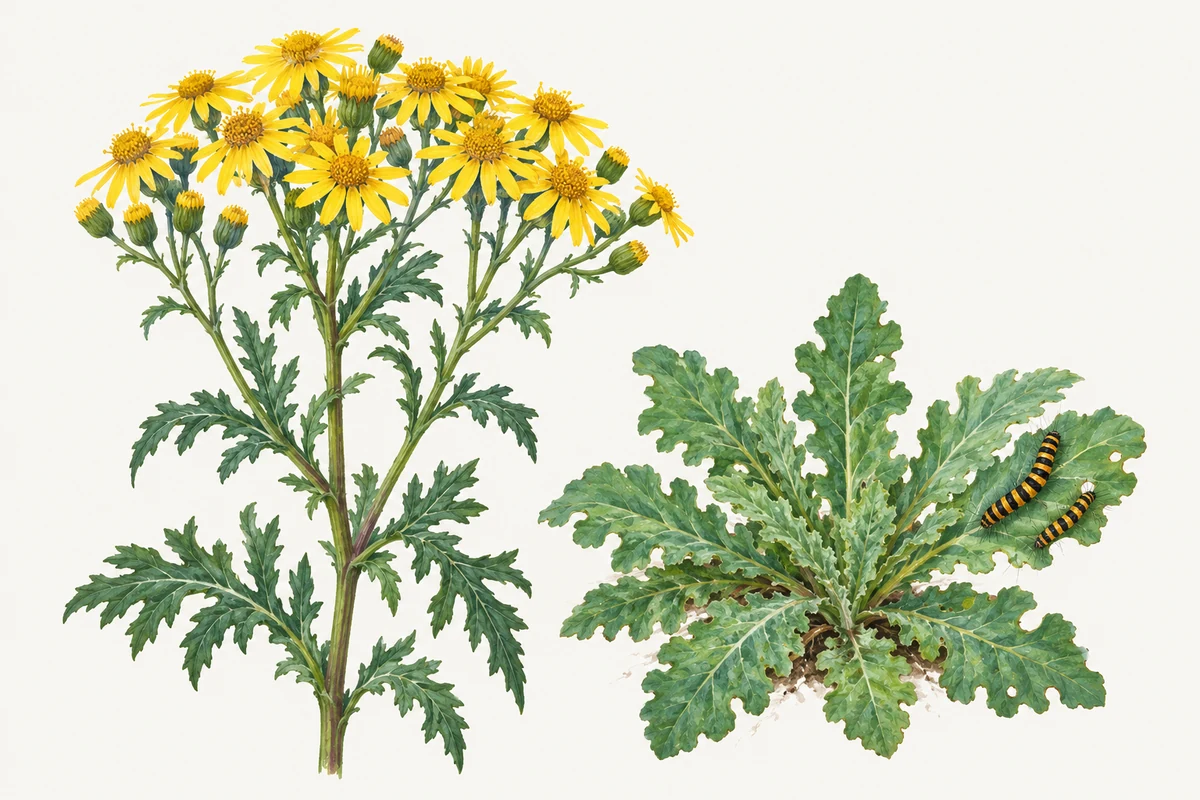
In short
Ragwort, or common ragwort (Jacobaea vulgaris, formerly Senecio jacobaea), is a UK native wildflower of the daisy family. In its first year it forms a low rosette of deeply lobed, ragged dark green leaves; in its second it sends up tough upright stems, often red at the base, usually 30 to 90 cm tall, topped by large flat clusters of bright yellow daisy-like flowers.
- Look for the flat-topped head: many small yellow daisy-like flowers, packed together at the top of branched stems.
- Check the leaves: deeply cut into irregular, jagged lobes, dark green and rather tough.
- Marsh, hoary and Oxford ragwort look similar; the RHS says they are also toxic to horses and livestock.
Field marks at a glance
- Scientific name
- Jacobaea vulgaris
- Family
- Asteraceae (daisy family)
- Type
- Weed, biennial
- First-year rosette
- A low rosette of 'feathery', deeply lobed, dark green leaves that overwinters (RHS). Seedlings, mostly in autumn, start with spade-shaped, wavy-edged, hairless leaves.
- Stems
- In the second year, one or more upright, tough stems, often tinged red near the base and bright green and branched above the middle (Defra Code of Practice).
- Leaves
- Deeply dissected into irregular, jagged-edged lobes; dark green, rather tough, sometimes sparsely hairy underneath. The rosette usually dies before flowering but the stem leaves remain.
- Flowers
- Large, flat-topped clusters of densely packed, bright yellow daisy-like flower heads, with yellow ray and disc florets.
- Flowering time
- June until late October (Defra Code of Practice); the RHS gives July to October. The plant usually dies after flowering.
- Height
- Usually 30 to 90 cm, sometimes over 1 m (Defra Code of Practice); the RHS gives up to 1.5 m, often much shorter.
- Seeds
- Seeds in the centre of each head carry a tuft of hairs and travel on the wind, giving the seedheads a fluffy look; the outer seeds have no hairs and drop nearby (RHS).
- Where it grows
- Widespread across the UK on grassland, pastures, verges, sand dunes, wasteland, railway land and woodland, especially where turf is broken or overgrazed.
Common ragwort (Jacobaea vulgaris, long known as Senecio jacobaea) is a native British wildflower in the daisy family. World Flora Online accepts Jacobaea vulgaris and lists Senecio jacobaea among its synonyms. It matters in the UK for two reasons that pull in opposite directions: Defra calls it very important for wildlife, and it is poisonous to horses and other livestock. Recognising it correctly is the first step either way.
How to identify common ragwort in four checks
1. The rosette (first year). Common ragwort is usually a biennial. According to the RHS, seedlings appear mostly in autumn with spade-shaped, wavy-edged, hairless leaves, then develop into an overwintering rosette of feathery, deeply lobed, dark green leaves. Below ground the taproot branches into thick, tough, pale roots.
2. The stems (second year). In its second year the rosette sends up one or more leafy stems. Defra's Code of Practice describes them as tough, often tinged red near the base, and bright green and branched above the middle, usually 30 to 90 cm tall and sometimes over 1 m.
3. The leaves. The stem leaves are deeply dissected, with irregular, jagged-edged lobes, which gives the plant its ragged look. They are dark green, rather tough and may be sparsely hairy underneath. The first-year rosette usually dies before flowering, while the stem leaves stay.
4. The flowers. At the top of the stems sits a large, flat-topped cluster of densely packed, bright yellow daisy-like flower heads, each with yellow ray and disc florets. Defra gives June to late October for flowering; the RHS gives July to October. After flowering the plant usually dies, and its seedheads turn fluffy as the central seeds, each with a tuft of hairs, are carried off on the wind.
If you'd like a second opinion, a photo of a flowering stem with some leaves in Plant Identifier gives you a name to check against these four points. The app shows no confidence score and no list of alternatives, so check the leaves and flower heads yourself, and confirm before any control work, as Defra asks. The wildflower identification guide covers other yellow flowers of verges and meadows.
Ragwort vs other ragworts and yellow wildflowers
Defra's Code and the RHS both warn that common ragwort is easy to confuse with its relatives and with other tall yellow wildflowers.
| Plant | Where Defra's Code says it grows | Notes |
|---|---|---|
| Common ragwort | Grassland, verges, wasteland, railway land, woodland, pastures | Specified weed under the Weeds Act 1959 |
| Marsh ragwort | Wet areas of fields, ditch banks, marshes | Not covered by the Weeds Act; RHS says also toxic to livestock |
| Hoary ragwort | Roadsides, semi-natural meadows, field boundaries | Not covered by the Weeds Act; RHS says also toxic to livestock |
| Oxford ragwort | Roadsides, railway land, old walls, unmanaged land | Not covered by the Weeds Act; RHS says also toxic to livestock |
| Fen ragwort | Fens and stream sides; very rare | Protected |
Defra's Code also lists tansy, fleabane, St John's worts, yellow loosestrife, goldenrod, agrimonies, mulleins and several hawkweeds and hawk's-beards as plants that can be mistaken for ragwort, with photos on its covers. Because fen ragwort is protected, Defra says it is important to identify common ragwort correctly before considering any control.
Ragwort is not ragweed. Common ragweed is a different plant, known for its allergy pollen. Another plant that needs care in the UK countryside is giant hogweed.
Why ragwort is a concern for horses and livestock
Defra's Code says ragwort contains toxins that can have debilitating or fatal consequences if eaten by horses and other grazing animals. It is less likely to be rejected by stock when dried, so contaminated hay, haylage and silage are a particular problem. The RHS adds that eating green or dried ragwort can cause serious liver damage in grazing animals. The Code also says all grazing animals are susceptible, so grazing should not be used to control it. People can be at risk through direct contact, such as hand pulling, so the Code says to wear sturdy waterproof gloves, cover arms and legs, and wash skin that touches the plant.
If you think a horse or other animal has eaten ragwort, call your vet. In the US or Canada, you can also call the ASPCA Animal Poison Control Center at (888) 426-4435 (a consultation fee may apply). If a person feels unwell after handling or swallowing it, call NHS 111 in the UK or Poison Control at 1-800-222-1222 in the US.
What UK rules and Defra's Code say
Ragwort is a specified weed under the Weeds Act 1959, together with spear thistle, creeping thistle, curled dock and broad-leaved dock. Under the Act, Natural England, acting for Defra, can serve a notice requiring an occupier to take action to prevent the spread of these weeds, and an unreasonable failure to comply with a notice is an offence. Responsibility for control rests with the occupier of the land where it grows. The Ragwort Control Act 2003 gives Defra's Code evidential status: failing to follow it is not an offence, but non-compliance may be used as evidence.
The Code does not seek to eradicate ragwort. It sets out a risk assessment: high risk where ragwort is flowering or seeding within 50 m of land used for grazing or forage, medium risk at 50 to 100 m, and low risk beyond 100 m. It asks for a control policy where a high or medium risk is identified. For disposal, it says pulled and cut plants stay toxic and may still set seed, so they should be kept away from animals, and that composting in the open is not recommended.
The RHS says that in most gardens, where there is no risk to livestock, ragwort can be left to grow, and that it supports more than 200 species of invertebrates, including cinnabar moth caterpillars. If you use a herbicide, follow the label and local rules. Outside the UK, check with your local or state agency for the rules that apply where you live.
For the general method on any unknown plant, see how to identify plants.
Look-alikes and how to tell them apart
Marsh ragwort (Jacobaea aquatica)
Defra's Code describes marsh ragwort as locally abundant in wet areas of fields, ditch banks and marshes. The RHS says it is also toxic to horses and livestock, though it is not covered by the Weeds Act.
Oxford ragwort (Senecio squalidus)
Defra's Code says Oxford ragwort grows widely on roadsides, railway land, old walls and unmanaged land. The RHS lists it among the ragworts that are also toxic to horses and livestock.
Hoary ragwort (Jacobaea erucifolia)
Defra's Code places hoary ragwort mainly on roadsides, semi-natural meadows and field boundaries. It is not covered by the Weeds Act, but the RHS says it is also toxic to horses and livestock.
Tansy, fleabane and other tall yellow wildflowers
Defra's Code lists tansy, fleabane, St John's worts, yellow loosestrife, goldenrod, hawk's-beards and others as plants that may be confused with ragwort, and shows photos of them on its covers. Compare before acting: fen ragwort, a rare look-alike, is protected.
What a photo can't settle
- A rosette photographed alone can look like many other lobed-leaf seedlings; photograph the flowering stem when you can.
- Marsh, hoary, Oxford and the protected fen ragwort look alike in photos; Defra says to identify common ragwort correctly before any control, so confirm with a local expert when it matters.
- A photo can't assess the risk to nearby grazing land; Defra's Code sets out how to judge it.
Questions people ask
What does ragwort look like?
In its first year, a low rosette of deeply lobed, ragged dark green leaves. In its second year, tough upright stems, often red near the base, usually 30 to 90 cm tall, topped with large flat clusters of bright yellow daisy-like flowers from early summer to October.
Is ragwort poisonous to horses?
Defra's Code of Practice says ragwort contains toxins that can have debilitating or fatal consequences if eaten by horses and other grazing animals, and that dried ragwort in hay or haylage is a particular problem. If you think an animal has eaten it, call your vet.
Is it illegal to have ragwort on my land?
No. Ragwort is a specified weed under the Weeds Act 1959, and Natural England can serve a notice requiring an occupier to prevent its spread; failing to comply without reason is an offence. Defra's Code says it does not seek to eradicate ragwort and focuses on the risk to grazing land.
Do I need to remove ragwort from my garden?
The RHS says it is prudent to control it if your garden borders grazing land or land used for forage, or contains a paddock. In most other gardens, where there is no risk to livestock, it says ragwort can be left as a wildflower that supports bees, butterflies and cinnabar moth caterpillars.
Is ragwort the same as ragweed?
No. Ragwort (Jacobaea vulgaris) has bright yellow daisy-like flowers in flat-topped clusters. Common ragweed (Ambrosia artemisiifolia) is a different plant, known for its allergy pollen rather than yellow flowers. See our common ragweed page for how to recognise it.
Sources
- Code of Practice on how to prevent the spread of ragwort — Department for Environment, Food & Rural Affairs (Defra), GOV.UK
- Ragwort: identification and control — Royal Horticultural Society (RHS)
- Jacobaea vulgaris Gaertn. — World Flora Online Plant List
- ASPCA Poison Control — ASPCA
- When to use NHS 111 — NHS