Weed profile
Crabgrass (Digitaria): how to identify it in your lawn
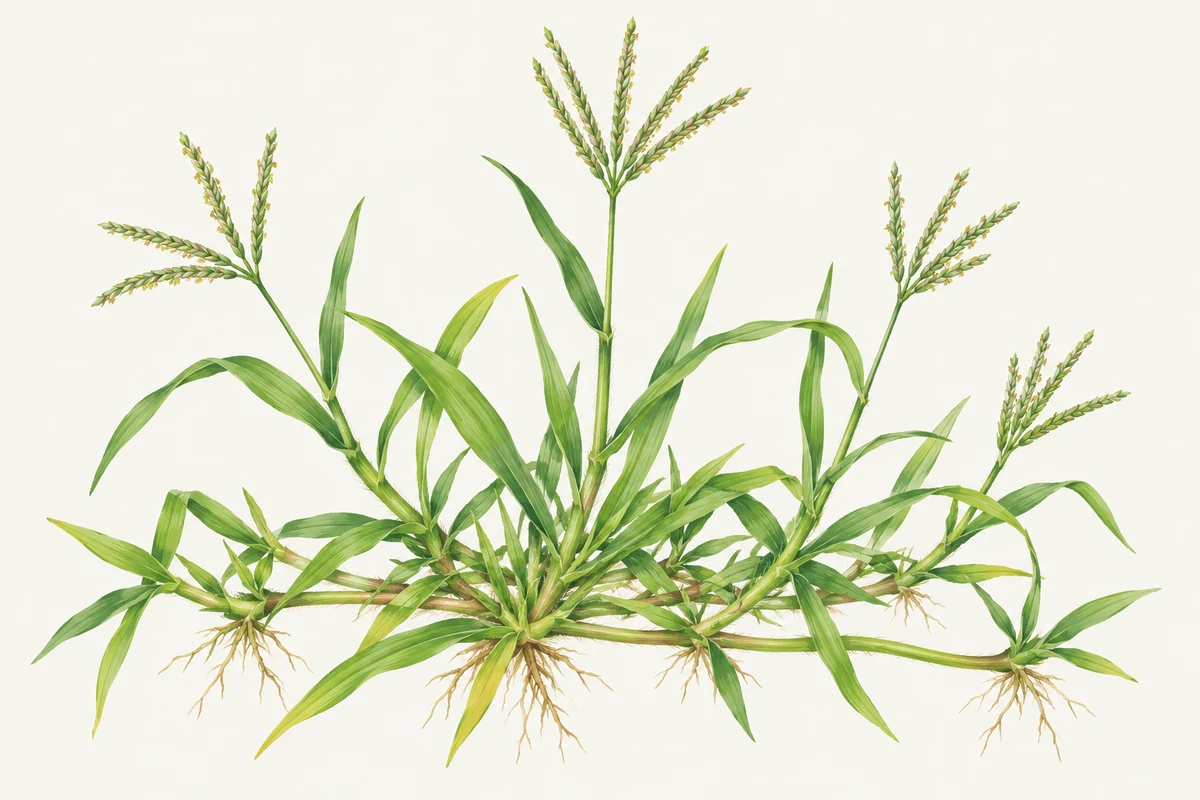
A summer annual grass with pale, wide blades that sprawls flat from a central point, roots at its lower joints and raises finger-like seed heads from midsummer.
In short
Crabgrass is a summer annual grass, usually smooth crabgrass (Digitaria ischaemum) or large crabgrass (D. sanguinalis), that sprouts in spring and dies at the first frost. Look for light green blades about ¼ inch wide that are paler than the lawn, stems sprawling flat and rooting at the lower joints, and seed heads of 3 to 11 thin, finger-like spikes at the stem tip.
- Pull back a blade where it meets the stem: crabgrass has a membranous ligule and no auricles, and its young leaves are rolled, not folded.
- Large crabgrass is hairy on both leaf surfaces and the sheath; smooth crabgrass is mostly hairless, with a few hairs near the base of the blade.
- Goosegrass also forms flat summer clumps, but its centre is whitish, its young leaves are folded, and it does not root at the joints.
Field marks at a glance
- Scientific name
- Digitaria ischaemum and Digitaria sanguinalis
- Family
- Poaceae (grass family)
- Type
- Grass, annual
- Life cycle
- Summer annual: seeds sprout in spring when the soil warms and the plants die with the first fall frost. In mild-winter areas of California, UC IPM says some plants can overwinter.
- Leaf blades
- Light green, paler than most lawn grasses, sharp-pointed. Smooth crabgrass blades are 0.2 to 0.4 inches wide (NC State) or ¼ to ⅓ inch wide and up to 5 inches long (UC IPM); large crabgrass blades are 0.2 to 0.6 inches wide and about 3 inches long.
- Hairs
- Large (hairy) crabgrass has short hairs on both leaf surfaces and long hairs on the sheath. Smooth crabgrass is smooth above, with a few hairs near the base of the blade and a hairless sheath.
- Leaf junction
- Young leaves rolled in the bud. A membranous ligule (1.5 to 3 mm and blunt in smooth crabgrass, 1 to 2 mm, toothed and often reddish in large crabgrass) and no auricles.
- Growth habit
- Sprawls flat from a central point, with stems that root at the lower joints where they touch soil. Unmowed, smooth crabgrass reaches about 6 inches and large crabgrass up to 2 feet.
- Seed heads
- Thin, finger-like spikes at the stem tip, attached ⅛ to ¼ inch apart rather than at one point: 5 to 7 spikes ½ to 2½ inches long in smooth crabgrass, 3 to 11 spikes about 2 to 5 inches long in large crabgrass (UC IPM).
- Colour
- Seedlings are pale green. Smooth crabgrass can be tinged purple or reddish at the base; large crabgrass sheaths often have purple veins.
- Germination
- Starts when soil reaches about 55°F for several days (UC IPM); March to early May in North Carolina, at 53 to 58°F at a 4-inch depth (NC State).
- Where it grows
- Thin lawns, garden beds, vegetable plots, roadsides and vacant lots; favoured by thin turf, mowing too short and light, frequent watering.
Crabgrass is the name for two closely related summer annual grasses, smooth crabgrass (Digitaria ischaemum) and large or hairy crabgrass (D. sanguinalis). UC IPM notes it also goes by crowfoot grass, fingergrass and summer grass, and that it is often mistaken for other grassy weeds. Because it lives for one season, it shows up as pale, flat patches in early summer and leaves brown gaps in the lawn after the first frost.
How to identify crabgrass in four checks
1. The colour. Stand back and look for patches that are lighter than the rest of the lawn. UC IPM's crabgrass Pest Note says seedlings are light green and easy to spot in an established lawn, and mature leaves stay smoother and paler than most lawn grasses. Smooth crabgrass is sometimes tinged red or purple at the base.
2. The habit. Kneel down and lift a patch. Crabgrass stems fan out flat from a central point, and the lower joints root where they touch the soil. NC State's smooth crabgrass page describes this prostrate habit. Even mowed as short as ½ inch, UC IPM says smooth crabgrass can still produce seed.
3. The leaf junction. Pull a blade back from the stem. Crabgrass has a thin membranous ligule (a small collar of tissue) at the base of the blade and no auricles, the claw-like ears some grasses have there. Its young leaves are rolled in the bud. The blades are sharp-pointed and wider than most fine lawn grasses: NC State gives 0.2 to 0.4 inches for smooth crabgrass and 0.2 to 0.6 inches for large crabgrass.
4. The seed head. From midsummer, crabgrass raises thin stalks topped with finger-like spikes. On crabgrass they start ⅛ to ¼ inch apart at the top of the stem, not all from one point. UC IPM counts 5 to 7 spikes, ½ to 2½ inches long, on smooth crabgrass and 3 to 11 longer spikes, about 2 to 5 inches, on large crabgrass.
To tell the two species apart, check the hairs. NC State's large crabgrass page says large crabgrass has short hairs on both leaf surfaces, rough hairy edges and a sheath with long hairs, often with purple veins. Smooth crabgrass is smooth above, with a few hairs near the base of the blade and a hairless sheath.
If you'd like a second opinion, one photo of a clump with a seed head in Plant Identifier gives you a name to check against these four points. The app shows no confidence score and no list of alternatives, so check the ligule and the rooting joints yourself.
Crabgrass vs goosegrass, quackgrass and tall fescue
| Feature | Crabgrass | Goosegrass | Quackgrass (couch grass) | Tall fescue |
|---|---|---|---|---|
| Life cycle | Summer annual | Summer annual | Perennial | Perennial |
| Spread | Seed, roots at lower joints | Seed only, no rooting at joints | Rhizomes and seed | Bunches, occasional short rhizomes |
| Look | Pale green, flat star | Whitish centre, wagon-wheel | Upright, up to 1 m if unmown | Coarse upright clumps |
| Seed head | Finger-like spikes, spaced | Spikes from one point | Single upright spike | Branched panicle |
The table draws on NC State's pages for goosegrass and tall fescue and the RHS page on couch grass.
Goosegrass is the closest match in a summer lawn. NC State says it has a flat habit and is often white in the centre, like a wagon wheel. Unlike crabgrass, it does not root at the joints, and it sprouts when the soil reaches 60 to 65°F, usually at least two weeks after crabgrass. It favours compacted soil and heavily used turf, such as paths and sports fields.
Quackgrass, called couch grass in the UK, is a perennial. The RHS describes a grass up to 1 m tall with flattened leaves up to 40 cm long and a dense network of pale rhizomes that run in straight lines from the parent plant. If a clump comes up with long white underground stems, it is not crabgrass.
Tall fescue is a lawn grass in its own right, the most widely grown cool-season grass in North Carolina according to NC State, but it becomes a weed as coarse clumps in a finer lawn. As a perennial it is still there after frost has killed the crabgrass, and its blades are deeply ridged on top, glossy underneath and rough at the edges.
UC IPM adds two more: bermudagrass, whose finger-like seed-head spikes all start from one point, and dallisgrass, whose spikes are spaced widely along the stem. Both are perennials that spread underground.
For broadleaf weeds as well as grasses, see the lawn weed identification guide.
Where crabgrass grows, and why lawns get it
UC IPM says smooth crabgrass is most often found in lawns, landscapes and vegetable gardens, while large crabgrass tolerates close mowing less well and is more common in orchards, vineyards and other farmland. Both grow in vacant lots and on roadsides.
Timing matters. Seeds start to sprout when the soil reaches about 55°F for several days in a row, according to UC IPM, often earliest near warm pavement and buildings. In North Carolina, NC State gives March to early May, at soil temperatures of 53 to 58°F at a 4-inch depth, and notes that alternating dry and wet soil in spring encourages germination. The plants die with the first frost, which is why crabgrass leaves bare patches in fall.
NC State lists the conditions that favour it: thin, open turf, mowing at the wrong height for your grass, summer fertilizing and light, frequent watering. A single large crabgrass plant can produce more than 100,000 seeds, and UC IPM says they can stay viable in the soil for at least 3 years.
Controlling crabgrass in a lawn
Extension advice centres on keeping the lawn dense. UC IPM recommends choosing a grass suited to your area, mowing at the right height for it and removing no more than about a third of the leaf at a time, feeding at the right time of year, and watering deeply and less often rather than a little every day. Overseeding thin areas helps keep turf thick.
Stop it before it seeds. UC IPM says to pull established crabgrass plants before they set seed; in garden beds, hand pulling and hoeing while plants are young, followed by mulch, controls it well. Because the seed lasts years in the soil, a patch you let go to seed will be back for several summers.
Herbicides exist for crabgrass, but extension services treat them as a supplement to good lawn care. If you use one, follow the label and local rules, and ask your local extension office about timing for your grass type and region.
To track where patches appear from year to year, the Plant Map in Plant Identifier keeps each located identification. For the general method on any unknown plant, see how to identify plants, and for creeping broadleaf weeds in the same lawn, see creeping Charlie.
Look-alikes and how to tell them apart
Goosegrass (Eleusine indica)
Look into the centre of the clump: goosegrass is often whitish there, like the hub of a wagon wheel, and its young leaves are folded, not rolled. Its stems do not root at the joints, its blade tips are blunt, and its seed-head spikes all start from one point. NC State says it sprouts at least two weeks after crabgrass.
Quackgrass, or couch grass (Elymus repens)
Dig up a clump: quackgrass is a perennial with a dense network of pale, pointed rhizomes running in straight lines underground, which crabgrass never has. Its flower spikes are upright and unbranched, with the buds held flat to the stem, not split into fingers.
Tall fescue (Festuca arundinacea)
Tall fescue is a perennial that grows in coarse, upright clumps, so it is still there in winter after crabgrass has died. Run a finger along the blade: it is deeply ridged on top, glossy underneath and rough at the edges, and its seed head is a branched panicle, not a set of fingers.
Bermudagrass (Cynodon dactylon)
Bermudagrass seed heads also look like fingers, but the spikes all start from the same point and are usually shorter. It is a perennial that spreads by slender rhizomes and above-ground runners, so a patch comes back from the same spot each year.
What a photo can't settle
- Young crabgrass without seed heads can be confused with goosegrass, quackgrass or a lawn grass seedling: photograph the whole clump and a close-up of the leaf where it joins the stem.
- Telling smooth from large crabgrass depends on hairs on the leaf and sheath, which a distant photo rarely shows; check them with a hand lens.
- A photo can't tell you why crabgrass has moved into your lawn (thin turf, mowing height, watering); a local extension office or soil test can.
Questions people ask
What does crabgrass look like?
A low, sprawling grass with pale, light green blades about ¼ inch wide that stand out against darker lawn grass. Its stems spread flat from a central point and root at the lower joints. From midsummer it raises thin, finger-like seed-head spikes at the tips of its stems.
What is the difference between smooth and large crabgrass?
Hairs and size. NC State says large, or hairy, crabgrass has short hairs on both leaf surfaces and long hairs on the sheath, with blades up to 0.6 inches wide. Smooth crabgrass is mostly hairless, smaller and tolerates close mowing better, so it is the one more often found in lawns, according to UC IPM.
Does crabgrass come back every year?
The same plants don't: UC IPM describes crabgrass as a summer annual that dies with the first frost. It returns from seed. A single large crabgrass plant can produce more than 100,000 seeds, and UC IPM says the seeds can stay viable in soil for at least 3 years.
How do I tell crabgrass from goosegrass?
Look at the centre of the plant and the young leaves. Goosegrass is often whitish in the middle, has folded young leaves and does not root at the joints. Crabgrass is pale green throughout, has rolled young leaves and roots where its lower stems touch the soil.
How do I get rid of crabgrass in my lawn?
Extension services start with the lawn: a dense turf mowed at the right height for your grass, watered deeply and less often, and fed at the right time of year. UC IPM says to pull plants before they set seed. For any herbicide, follow the label and local rules.
Sources
- Crabgrass (Pest Notes) — UC Statewide IPM Program, University of California Agriculture and Natural Resources
- Smooth Crabgrass — NC State Extension, TurfFiles
- Large Crabgrass — NC State Extension, TurfFiles
- Goosegrass — NC State Extension, TurfFiles
- Tall Fescue — NC State Extension, TurfFiles
- Couch grass — Royal Horticultural Society (RHS)