Field guide
How to identify a plant by its leaf
Seven leaf checks in a fixed order, from how leaves sit on the stem to how a crushed leaf smells, with houseplant, garden and weed examples for each.
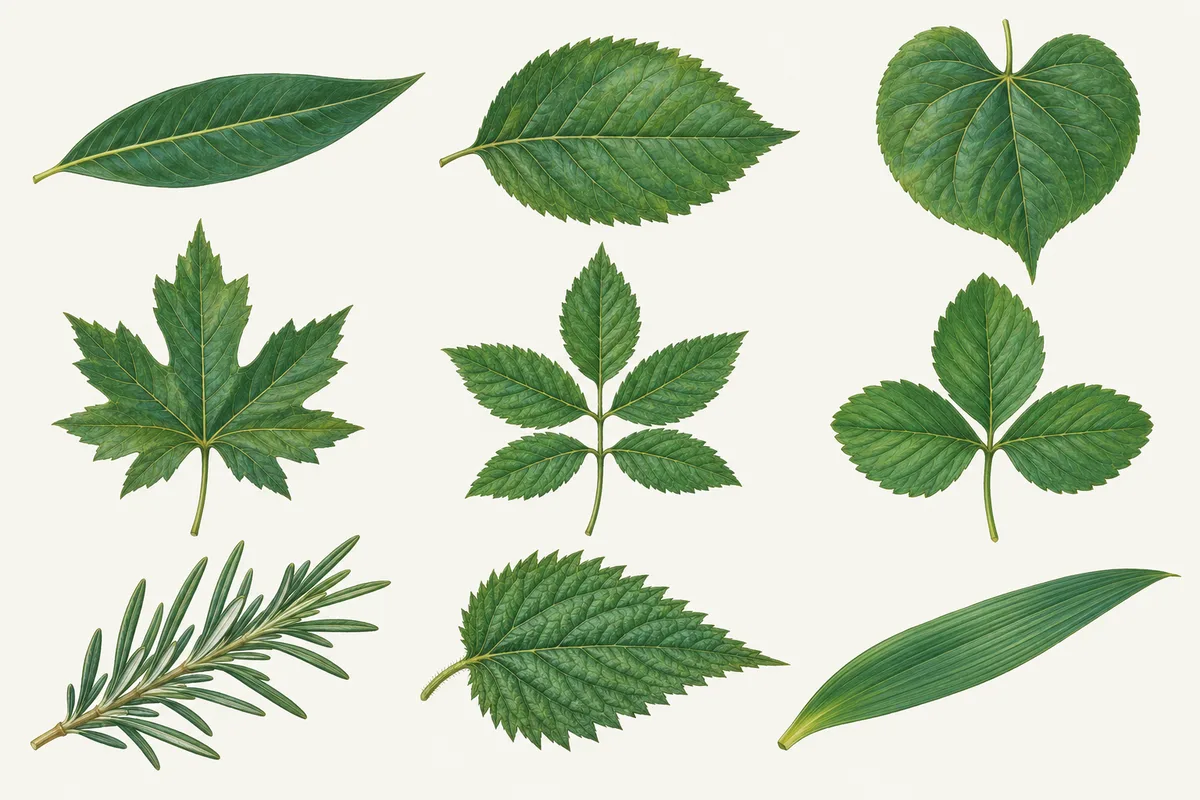
In short
To identify a plant by its leaf, check seven things in order: how leaves sit on the stem (alternate, opposite, whorled or a basal rosette), whether the leaf is simple or divided into leaflets, its outline, its edge, its vein pattern, its texture and hairs, and its smell when crushed. Cleavers carries leaves in whorls of six to eight, spider plant has parallel veins, and ground ivy smells minty.
- Arrangement on the stem narrows the field faster than leaf shape: whorls of six to eight narrow-pointed leaves on a sticky, four-sided stem mean cleavers.
- Find the bud: a leaflet has no bud at its base, a whole leaf does. That one test separates a compound leaf from a branch of small leaves.
- Crush a leaf and smell it, then wash your hands. Never taste a leaf to identify it.
A leaf is the part of a plant you can almost always find, in any season, on a houseplant that never flowers or a weed that was mowed last week. Read it in a fixed order: first how the leaves sit on the stem, then whether each leaf is one blade or many leaflets, then its outline, edge, veins, surface and smell. Each check splits the candidates into smaller groups, and together they often narrow a plant to its genus. This guide covers houseplants, garden plants and weeds; trees have their own guides on our sister site, treeidentifier.com.
Seven leaf checks, in the order that narrows fastest
- Arrangement: alternate, opposite, whorled or a basal rosette.
- Simple or compound: one blade, or a blade split into leaflets.
- Shape: the outline, plus the tip and the base.
- Margin: smooth, wavy, toothed, scalloped or lobed.
- Venation: parallel veins or a net of veins from a midrib.
- Texture and hairs: leathery, glossy, fleshy, velvety, woolly, rough.
- Smell when crushed: minty, garlicky or nothing at all.
Work on a healthy shoot in good light and look at several leaves, not one. Shade, damage and age all change a single leaf. NC State Extension's botany chapter of the Extension Gardener Handbook defines every term used below; it is the reference to keep open while you work. If you would rather follow a broader method that also covers flowers and fruit, start with the step-by-step plant identification guide.
Arrangement: alternate, opposite, whorled or a basal rosette
Find a node, the point where a leaf joins the stem, and count the leaves there, on more than one node: a single missing leaf turns an opposite pair into what looks like an alternate one.
- Alternate: one leaf per node, switching sides as you go up the stem. NC State calls this the most common arrangement. Pothos and heartleaf philodendron, the two trailing houseplants people mix up most, both carry alternate leaves; the pothos vs philodendron page separates them by the leaf stalk.
- Opposite: two leaves facing each other at the same node. Ground ivy and lamb's ear, both in the mint family, have opposite leaves on square stems. A square stem with opposite leaves is a strong pointer to the mint family; the creeping Charlie page shows how that pattern separates ground ivy from henbit, deadnettle and mallow in a lawn.
- Whorled: three or more leaves at one node, which NC State calls rare. Cleavers (Galium aparine), the sticky weed that clings to clothing, is the textbook case: the NC State Plant Toolbox describes narrow, pointed leaves in whorls of six to eight on weak, four-sided stems with hooked prickles.
- Basal rosette: all the leaves spring from a crown at ground level, on a compressed stem. Dandelion, first-year garlic mustard, spider plant and peace lily all grow this way. A rosette tells you to look at the leaf itself very closely, because there is no stem to read.
Simple or compound leaves
A simple leaf has one continuous blade. A compound leaf is one leaf divided into separate leaflets. NC State's test is the bud: there is one in the angle where a whole leaf's stalk meets the stem, and none at the base of a leaflet. On a branch of small leaves you will find a bud under each one; on a compound leaf, only under the whole group.
- Palmately compound: all leaflets spread from the tip of the stalk like fingers. The dwarf schefflera houseplant is the easy example: the NC State Plant Toolbox describes seven to nine glossy leaflets, 2 to 4.5 inches long, arranged like the spokes of an umbrella.
- Pinnately compound: leaflets on both sides of a central axis, like a feather. NC State calls this the more common type and gives nandina as a garden shrub whose leaves are divided three times over.
- Trifoliate: three leaflets, as in clover.
Deeply cut is not the same as compound. A dandelion leaf can be slashed almost to the midrib, but it is still one blade with one bud at its base.
Leaf shape identification chart
The outline is the clue most people start with, and the one that misleads most often, so read it after arrangement. NC State's handbook gives the standard terms; this leaf shape identification chart puts each term next to a plant you can check.
| Shape | What it looks like | Example to check |
|---|---|---|
| Linear | Narrow, five or more times longer than wide, the same width throughout | Spider plant (strap-like, 12 to 18 inches long) |
| Lanceolate | Lance-shaped, widest below the middle, tapering to the tip | Peace lily (ovate-lanceolate) |
| Elliptical | Widest in the middle, two or three times longer than wide | Lamb's ear (oblong-elliptical) |
| Ovate | Egg-shaped, widest below the middle | Many houseplant and garden leaves |
| Obovate | Egg-shaped but widest above the middle | Dwarf schefflera leaflets |
| Oblanceolate | Lance-shaped but widest above the middle, narrow at the base | Dandelion |
| Cordate | Heart-shaped, with a notch where the stalk joins | Pothos, second-year garlic mustard |
| Kidney-shaped (reniform) | Wider than long, rounded, notched base | Ground ivy, first-year garlic mustard |
| Sagittate | Arrowhead-shaped, two pointed lobes aimed backward | Arrowhead-type leaves |
Then note the tip (a long tapering point, a sharp point, rounded, notched) and the base (heart-shaped, wedge-shaped, square). Two leaves with the same outline often differ at the tip or base.
Margin: smooth, toothed, scalloped or lobed
Run a fingertip along the edge. NC State's terms:
- Entire: smooth, no teeth. Dwarf schefflera leaflets and spider plant leaves are entire.
- Undulate: a pronounced wavy edge.
- Crenate: rounded teeth, like scallops. Ground ivy's leaves have scalloped edges, and NC State describes lamb's ear margins as crenate too.
- Serrate: small sharp teeth pointing toward the tip. Dentate: larger blunt teeth pointing outward.
- Lobed and cleft: lobed cuts reach halfway or less to the midrib, cleft cuts more than halfway. Dandelion leaves, per NC State, are deeply toothed with backward-pointing teeth or lobes, which gave the plant its name ("lion's tooth").
The margin can change on one plant. Penn State Extension's garlic mustard page describes first-year leaves as kidney-shaped with rounded teeth, in a basal rosette, and second-year stem leaves as heart-shaped with pointed, irregular teeth.
Venation: parallel or netted
Hold the leaf up to the light. Parallel veins run side by side from base to tip, as in grasses, or run out from a central vein to the edge, as in bananas and cannas. NC State's spider plant page describes its grass-like leaves with 12 to 15 nerves and a deep central groove. Parallel veins usually mean a monocot: grasses, lilies, irises, orchids, spider plant.
Netted veins branch from a midrib and join in a mesh. They come in two kinds: pinnate, with side veins running from the midrib to the edge like a fishbone, and palmate, with several main veins fanning out from the top of the stalk. NC State notes the conspicuous palmate venation on the upper surface of ground ivy leaves.
Texture, hairs and smell
Texture. NC State lists the terms: succulent (fleshy and thick, storing water), coriaceous (leathery and tough), glabrous (smooth, shiny and hairless), and rough to the touch (scabrous). Pothos leaves are glossy and leathery; a jade plant's are succulent.
Hairs. Turn the leaf over and use a hand lens if you have one. African violet leaves carry so many hairs that they feel like velvet, says NC State's handbook. Lamb's ear is densely white-woolly (the term is tomentose), which gives the whole plant its silver color, and the NC State lamb's ear page gives leaves 4 to 6 inches long. Cleavers has hooked hairs that make it cling. Ground ivy's upper surface is hairy and its nodes often carry a fringe of long white hairs.
Smell. Crush a small piece of leaf between your fingers and sniff. The NC State ground ivy page notes that the leaf gives off an aroma when crushed, typical of the mint family. Penn State says garlic mustard rosettes produce a garlic odor when crushed, which separates them from native mustards with similar white flowers. NC State even notes that lamb's ear leaves may be unpleasantly aromatic. Wash your hands afterward.
Three rules for the smell test. Never taste a leaf to identify it. Don't crush any plant with milky sap or any plant you suspect is poison ivy or giant hogweed, and wear gloves when you have no idea what the plant is. Keep crushed leaves away from children and pets.
When a leaf alone isn't enough
A leaf narrows the list; it rarely closes it. Leaves change with age: NC State's handbook notes that a seedling's first leaves (cotyledons) are usually shaped differently from the leaves of the grown plant, and garlic mustard changes leaf shape between its first and second year. Different plants share the same outline: a heart-shaped, glossy, alternate leaf fits several trailing houseplants. And leaves vary on one plant with light and age.
So when the leaf checks leave two or three candidates, move on to the stem (round or square, sap or no sap), then to flowers and fruit. For houseplants that rarely flower, the houseplant identification key asks about leaf shape, texture and growth habit one question at a time.
A photo helps too. Plant Identifier has no separate leaf mode: you photograph a leaf, a flower or the whole plant, and the app returns a common and a scientific name from that one picture. It uses a cloud AI model, so it needs an internet connection, and it shows no confidence score or list of similar species, so check its answer against the seven checks above. If the arrangement or the margin doesn't match, it isn't that plant. The follow-up chat under each result in Plant Identifier lets you ask how the species differs from a look-alike, and its Diagnose tool is there when the question is a spotted or yellowing leaf rather than a name.
What a photo can't settle
- Young plants and seedlings often have leaves of a different shape from the adult plant, so a leaf from a seedling can point to the wrong species.
- Many unrelated plants share the same leaf outline. A leaf narrows the list; flowers, fruit or the whole plant usually settle it.
- A photo of a leaf can't show its smell, its hairs under a lens or how it sits on the stem, so photograph the stem with several leaves as well as the single leaf.
Questions people ask
Can you identify a plant from just one leaf?
Sometimes. A leaf with a distinctive outline, edge or smell, such as ground ivy's scalloped, minty leaf, can be enough. More often one leaf narrows the plant to a family or genus. Look at how the leaves sit on the stem, then at flowers or fruit, before you settle on a species.
What are the main leaf shapes?
NC State Extension's botany chapter lists linear (long and narrow), lanceolate (lance-shaped), elliptical, ovate (egg-shaped), cordate (heart-shaped) and sagittate (arrowhead-shaped) among the common shapes. Add the leaf tip, the base and the edge, smooth, toothed, scalloped or lobed, and you have a full description.
How do I tell a compound leaf from a branch with small leaves?
Look for the bud. A whole leaf has a bud in the angle where its stalk meets the stem; a leaflet has none. If the bud sits at the base of the whole group, you are holding one compound leaf, like the seven to nine leaflets of a dwarf schefflera.
Is it safe to crush a leaf to smell it?
Only for plants you are not worried about touching, and wash your hands afterward. Don't crush plants with milky sap or anything you suspect is poison ivy or giant hogweed, wear gloves if unsure, and never taste a leaf. If someone has eaten an unknown plant, call Poison Control or your vet.
Sources
- Extension Gardener Handbook, Chapter 3: Botany — NC State Extension
- Galium aparine (cleavers, catchweed bedstraw) — NC State Extension Gardener Plant Toolbox
- Glechoma hederacea (ground ivy, creeping Charlie) — NC State Extension Gardener Plant Toolbox
- Taraxacum officinale (dandelion) — NC State Extension Gardener Plant Toolbox
- Garlic Mustard — Penn State Extension
- Heptapleurum arboricola (dwarf schefflera, dwarf umbrella tree) — NC State Extension Gardener Plant Toolbox
- Stachys byzantina (lamb's ear) — NC State Extension Gardener Plant Toolbox
- Chlorophytum comosum (spider plant) — NC State Extension Gardener Plant Toolbox