Field guide
Cactus identification: how to tell common cacti apart
Confirm it is a cactus by its areoles, then read the body, the spines and the flowers to reach the genus, from pincushions to prickly pears.
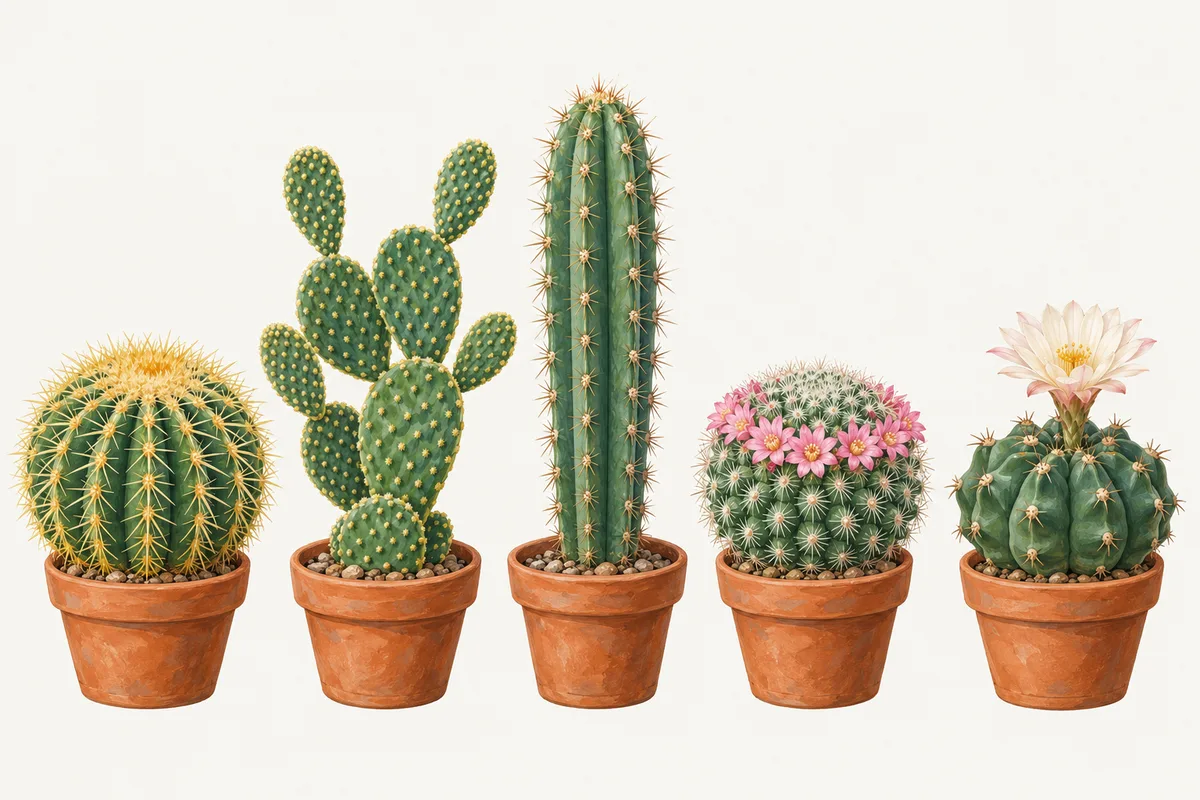
In short
Cactus identification starts with the areoles: small round or oval spots, often woolly, that carry the spines, and only cacti have them. Then read the body: ribs (barrel and column cacti), nipple-like tubercles (Mammillaria), flat pads with tufts of barbed glochids (Opuntia) or flat spineless segments (Christmas cactus). A spiny look-alike with paired spines and milky sap is a euphorbia.
- No areoles, no cactus: a spiny succulent whose spines come in pairs and that bleeds milky sap is a euphorbia, and the sap can irritate skin and eyes.
- Opuntia pads carry glochids, tiny barbed bristles that detach at a touch and stick in skin: handle prickly pears and bunny ears with gloves or tongs.
- Genus is a realistic target. Cacti are hybridized, grafted and relabeled, and many sold plants have no reliable species name.
A cactus on a windowsill rarely comes with a useful label, and a lot of what is sold as "cactus" isn't one. The quickest route to a name is four checks in order: confirm it is a cactus by finding its areoles, read the body (ribs, tubercles, pads or flat segments), look at the spines, and use the flowers when you get them. That usually gets you to a genus. Cacti are succulents, so for jade plants, aloes, echeverias and the rest, use the succulent identification guide; this page is about the cactus family itself.
Areoles: the mark that makes a cactus a cactus
An areole is a small round or oval spot on the stem, often padded with wool or felt, from which spines grow. The University of Arizona's Cooper Center background sheet, What is a cactus?, puts it plainly: only cacti have areoles. Flower buds and new stems grow from them too. You find them on the faces and edges of prickly pear pads, along the ribs of barrel, hedgehog and column cacti, and on the tips of the tubercles of pincushion cacti.
Three more family marks from the same sheet: the stems are thick, fleshy and green (they do the photosynthesis), most cacti have no leaves at all, and a cactus flower has many sepals and petals that grade into one another, with many stamens. Prickly pears and chollas are the exception on leaves: their new growth bears small leaves that soon drop.
The quick test, then:
- Spines growing from woolly spots, in clusters: a cactus.
- Spines in neat pairs, rising straight from the stem or from a ridge, no wool: a euphorbia (see the last section).
- Thorns on a woody branch, no fleshy stem: neither. The Cooper Center gives the ocotillo of the desert Southwest as a thorny plant people mistake for a cactus.
Cactus identification chart: the cacti people own
| Genus | Common names | Body | Spines | Flowers | Field test |
|---|---|---|---|---|---|
| Mammillaria | Pincushion cactus | Small balls or short cylinders, single or clumping | From areoles on the tips of tubercles; straight or hooked; some woolly | Small funnels, often with a dark mid-stripe, in a ring around the top | Nipple-like bumps in spirals, no ribs |
| Echinocactus and Kroenleinia | Barrel cactus, golden barrel | Ball to barrel, clear vertical ribs | Long, sharp, recurved, densely packed along the ribs | Yellow or pink funnels from a woolly crown | Straight ribs plus a wool cap on top |
| Gymnocalycium | Chin cactus, moon cactus | Small globe with notched ribs, often grayish green or reddish | 5 to 6 curved spines per areole on the chin cactus | Bud with no spines or hairs | Notched ribs; colored tops grafted on green stems |
| Echinopsis | Easter lily cactus, sea urchin cactus | Ribbed globes to tall columns, green to blue-green | Yellow or white | Large funnels on long stalks, opening in the evening | Large, showy flower on a long stalk |
| Cereus | Apple cactus, Peruvian apple cactus | Tall ribbed columns in clumps of erect stems | In clusters along the rib edges | Large white, opening at night | A column that keeps going up, 5 to 8 ribs |
| Opuntia | Prickly pear, bunny ears | Flat jointed pads | Spines in some species, plus tufts of glochids in every areole | Cup-shaped, 2 to 3 inches, orange, purple, red or yellow | Flat pads dotted with fuzzy-looking tufts |
| Schlumbergera | Christmas, Thanksgiving cactus | Flat, spineless, leaf-like segments in chains | None; soft bristles at segment tips | Tubular, red, pink or white, at segment tips | Hanging chains of flat segments |
Use the chart in this order: body first, then the field test, then the flowers to confirm. The sections below explain each column.
Ribs, tubercles or pads
Ribs are vertical ridges running the length of the stem, with areoles spaced along the edges. They mark the barrels, the hedgehogs (Echinopsis) and the columns (Cereus). Count them when you can: rib count separates species within a genus. NC State Extension's Echinopsis page lists, for example, 14 to 15 sharp ribs on the golden Easter lily cactus and 4 to 8 on a tree-like columnar species.
Tubercles are separate nipple-like bumps, each topped by an areole. NC State's Mammillaria page explains that the genus name means "nipple" and that the tubercles are arranged in a spiral. Some ribbed cacti have ribs so notched that they look half-way to tubercles; the chin cactus is one.
Pads are flattened stem segments, called cladodes. On Opuntia they are thick and fleshy, 4 to 16 inches long on the larger species. On Schlumbergera they are thin, glossy and leaf-like, joined end to end in chains. Either way, they are stems, not leaves.
Spines and glochids
Cactus spines are modified leaves, and they all grow from areoles. The Cooper Center sheet notes that spines may be straight, curved or hooked, and that a single central spine usually points outward with a group of radial spines spread around it. Hooked central spines are a good pincushion clue: NC State lists both straight and hooked spines in Mammillaria. Note the color too, but don't trust it alone, because spine color varies within a species.
Glochids are the hazard. They are tiny, hair-like barbed bristles, grouped in tufts in the areoles of prickly pears, bunny ears and chollas, and they look like harmless fuzz from a distance. The Cooper Center says they detach easily and get stuck in skin and clothing; NC State's Opuntia page notes they cause skin irritation and advises rubber or leather gloves when handling the plant. Bunny ears, Opuntia microdasys, is the classic case: the plants usually sold have no long spines, only pads dotted with tufts of glochids, so they look soft and aren't. Use tongs or folded newspaper to move one.
Growth form: globe, column, pads or hanging chains
Step back and read the shape of the whole plant.
- Globular: single balls or clumps of them. Mammillaria, the barrels, Gymnocalycium and many Echinopsis.
- Columnar: upright cylinders that keep growing upward, alone or branching. Cereus and some Echinopsis.
- Pads: branching chains of flat, jointed pads. Opuntia.
- Epiphytic and hanging: trailing chains of flat, spineless segments. Schlumbergera, the holiday cacti, which grow on trees in the wild.
Shape changes with light and age: a globular cactus in low light stretches into a pale, narrow column. Read the healthy, older part of the plant.
Flowers: the clue that settles it
Cactus flowers are large for the plant and often short-lived. Where they appear helps as much as their color. Mammillaria flowers come up in a ring or halo around the top of the plant. Barrel buds form a ring in the woolly crown. Echinopsis carries huge funnels on long stalks that open in the evening and usually last a single day. Christmas cactus flowers hang from the tips of the stem segments. If your cactus flowers, photograph it the same day.
Genus by genus
Mammillaria (pincushion cactus)
NC State counts 147 accepted species, native from the central and southwestern United States to Colombia and the Caribbean. Small globes or short cylinders, 0.4 to 16 inches tall, single or in clumps, covered in spiraling tubercles with straight or hooked spines; some are woolly or hairy. Flowers are small funnels, 0.3 to 1.6 inches across, white, green, yellow, pink or red, usually with a darker mid-stripe, and they form a ring around the top. A cactus with no ribs, only bumps, and a crown of small pink flowers is almost certainly a Mammillaria.
Barrel cacti: Echinocactus and the golden barrel
NC State's Echinocactus page notes that the genus now has only five accepted species and that the famous golden barrel has been moved: its current name is Kroenleinia grusonii (you'll still see Echinocactus grusonii on labels). Barrels are ball- or barrel-shaped with clearly defined rows of vertical ribs carrying long, sharp spines, and a wool-like fuzz on top where yellow or pink funnel-shaped flowers emerge. A pot-grown barrel stays much smaller than a wild one.
Gymnocalycium (chin cactus and moon cactus)
The name means "naked calyx": the flower buds carry no spines or hairs, which separates the genus from most look-alikes. The NC State chin cactus page describes Gymnocalycium mihanovichii as a grayish-green, often reddish globe with 8 narrow, notched ribs and 5 to 6 curved, grayish-yellow spines per areole, flowering pale green to brownish-yellow at the crown. The "moon cactus" of garden centers is a colored mutant of this species, red, yellow, pink or orange because it lacks chlorophyll, grafted onto a green, ribbed, spiny rootstock that feeds it. Two cacti stacked on top of each other, a colored ball on a green stem, means a moon cactus.
Echinopsis (Easter lily cactus, sea urchin cactus)
Ribbed stems, green to blue-green, from small flat globes in clumps to erect, tree-like columns; spines yellow or white. NC State describes large, showy, funnel-shaped flowers with many petals in a star-like pattern, on long stalks, opening in the late evening in spring or summer and usually lasting one day; white or pink in most species, red or orange in some. The fruit is round and hairy. Many hybrids are sold, in every flower color.
Cereus (column cacti)
Many of the tall, ribbed columns sold as houseplants belong to Cereus. Singapore's National Parks Board describes Cereus hildmannianus as clumps of erect stems with 5 to 8 ribs, spines in clusters along the rib edges (young stems often lack them), and white, trumpet-shaped flowers about 6 inches wide that open at night. A young potted Cereus is unlikely to flower, so rib count and the column habit are what you have, and labels on columnar cacti are often mixed up: treat the genus as the safe answer.
Opuntia (prickly pear and bunny ears)
Flat, jointed pads, green to bluish gray, with areoles spread across their faces. NC State notes the true leaves are inconspicuous and quickly wither, the larger species carry spines up to 3 inches long, and every areole holds glochids. Flowers are solitary cups 2 to 3 inches wide in orange, purple, red, white or yellow, followed by oval fruits that turn red to purple. Bunny ears, with its small segmented pads that NC State likens to rabbit ears, covered in tufts of bristly glochids, is the one most often grown indoors.
Schlumbergera (Christmas and Thanksgiving cactus)
NC State's Schlumbergera page describes epiphytes from the rainforests of southeast Brazil, a very different home from the desert cacti, with glossy, flat, leaf-like stem segments that carry no spines, branch in a Y, and have areoles at their tips where flowers and soft bristles emerge. Flowers are tubular, about 3 inches long, red, pink, white and more. The segment edge separates the two holiday cacti: Thanksgiving cactus (S. truncata) has pointed, claw-like projections, Christmas cactus scalloped, rounded notches. Easter cactus, often sold alongside them, is now Rhipsalidopsis gaertneri. The Christmas cactus page has the full ID card.
Euphorbia look-alikes: thorns, not areoles
Many succulent euphorbias are sold as "cactus", the African milk tree (Euphorbia trigona), with its three-angled columns, among them. For a cactus owner the deciding check is the areole test from the first section: NC State's Euphorbia page describes symmetrical pairs of spines arising from a shield or from old flowers, not from areoles. No wool, no clusters. African milk tree also carries small leaves along its ridges, which a mature desert cactus would not.
The sap is the reason to get this right. NC State says the milky white latex in all parts of the plant can cause mild to severe contact dermatitis, and that in the eyes it can cause temporary to permanent damage to the cornea. Don't break a stem to check for sap, wear gloves to handle a plant you think is a euphorbia, and keep your hands away from your eyes. The flower and sap checks are set out in the succulent identification guide, which also covers the euphorbias that pass as other succulents. If a child or pet has chewed one, call Poison Control or your vet.
When a photo helps
Spines and ribs photograph well; areoles and rib counts need focus. Take one sharp photo of the whole plant from slightly above and to the side, with the ribs or pads and a cluster of spines in focus, and a second of any flower. Plant Identifier returns a common and a scientific name from one photo; it shows no confidence score or list of alternative species, so check the answer against the areoles, the body type and the spines above. If the app says Mammillaria and your plant has ribs, it isn't a Mammillaria. The follow-up chat under each result in Plant Identifier is the place to ask how your plant differs from a look-alike, such as Thanksgiving versus Christmas cactus, before you trust the label.
What a photo can't settle
- Many cacti are sold as hybrids, grafts or mislabeled plants, so neither a photo nor a chart can promise a species name; the genus is often the honest answer.
- Flowers settle many cactus identifications, and most houseplant cacti flower rarely or not at all indoors. Without flowers, two genera can look the same.
- A photo can't tell a cactus from a euphorbia with certainty: check for areoles and paired spines in person, and don't break a stem to test for sap.
Questions people ask
How do I know if my plant is a cactus?
Look for areoles: small round or oval spots, often woolly, from which the spines, the flowers and new stems grow. Only cacti have them. If the spines grow in pairs straight from the stem or the plant bleeds milky sap from a break, it is most likely a euphorbia, not a cactus.
What are glochids?
Tiny, hair-like barbed bristles that grow in the areoles of prickly pears, bunny ears and chollas. University of Arizona educators note that they detach easily and stick in skin and clothing, and NC State Extension says they cause skin irritation. Handle these cacti with gloves or tongs.
Is a Christmas cactus a real cactus?
Yes. Schlumbergera is in the cactus family, but it is an epiphyte from the rainforests of southeast Brazil. Its flat green segments are stems, not leaves, and they carry areoles at their tips where the flowers and soft bristles grow. It has no sharp spines.
What is a moon cactus?
A brightly colored Gymnocalycium mihanovichii top grafted onto a green, ribbed, spiny rootstock. NC State Extension explains that the red, yellow, pink or orange top lacks chlorophyll and depends on the rootstock for food. The species itself is the chin cactus, grayish green with eight notched ribs.
Sources
- Cactus Close-Up (activity guide and background: What is a cactus?) — University of Arizona, Cooper Center for Environmental Learning
- Opuntia (prickly pear cactus, rabbit ears cactus) — NC State Extension Gardener Plant Toolbox
- Mammillaria (pincushion cactus) — NC State Extension Gardener Plant Toolbox
- Echinocactus (barrel cactus) — NC State Extension Gardener Plant Toolbox
- Gymnocalycium mihanovichii (chin cactus, moon cactus) — NC State Extension Gardener Plant Toolbox
- Echinopsis (Easter lily cactus, sea urchin cactus) — NC State Extension Gardener Plant Toolbox
- Schlumbergera (Christmas cactus, Thanksgiving cactus) — NC State Extension Gardener Plant Toolbox
- Euphorbia (spurge) — NC State Extension Gardener Plant Toolbox
Keep reading
- Field guideSucculent identification: how to identify succulents by shape, leaf and sap
- Succulent profileChristmas cactus leaf identification: Christmas, Thanksgiving or Easter cactus
- Field guideHow to identify a plant by its leaf
- Free toolHouseplant identification key
- Pet safety guidePlants toxic to cats, and what to do if your cat chewed one