Field guide
Succulent identification: how to identify succulents by shape, leaf and sap
Sort the plant by its shape first, then use one field test per look-alike group, from hens and chicks to string of pearls.
In short
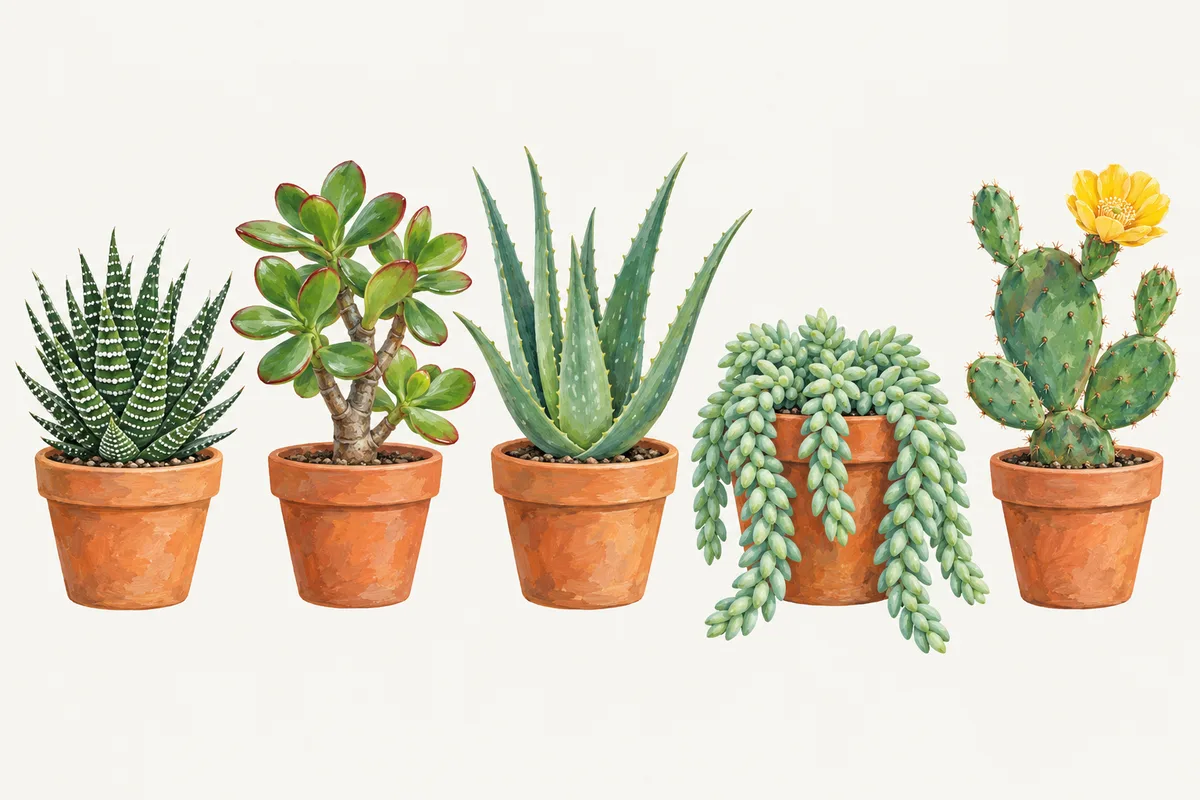
Succulent identification starts with the plant's shape: a stemless rosette, a branching stem with paired or scattered leaves, a column with spines, or a trailing stem. Then check one detail. Jade plant has thick egg-shaped leaves on stout trunks, elephant bush tiny round leaves on thin reddish stems. Aloe leaves have toothed edges and gel inside. A euphorbia bleeds milky sap and its spines grow in pairs.
- Common names overlap: "hens and chicks" is used for Sempervivum, Echeveria and Sedum alike, so aim for the Latin name on the label.
- A cactus-shaped plant with milky sap and paired spines is a euphorbia, not a cactus; the sap can irritate skin, so wear gloves.
- Jade plant and elephant bush look alike but are unrelated: compare leaf size and stem thickness.
Most succulents are sold with a vague label or none at all, and their common names overlap. The fastest route to a name is to read the plant's shape first, then one or two details that separate close look-alikes. This guide covers the groups people mix up most: rosettes (Echeveria, Sempervivum, Graptopetalum), the aloe family (Aloe, Haworthia, Gasteria), the jade plant and its double, the sedums, the cactus-shaped euphorbias, and two trailing favorites.
Start with the shape: a quick succulent key
| Shape | What you see | Likely group | Check next |
|---|---|---|---|
| Stemless rosette, soft fleshy leaves | A tight rosette, often blue-green, pink or near black | Echeveria, Sempervivum, Graptopetalum | Cold-hardiness, offsets, stem length, flowers |
| Stemless rosette, firm pointed leaves | Leaves dotted, striped or bumpy | Aloe, Haworthia, Gasteria (aloe family) | Leaf edge, size, sap, flower color |
| Branching stems, small tree | Thick fleshy leaves on woody-looking trunks | Jade plant or elephant bush | Leaf size, stem thickness and color |
| Many small fleshy leaves on creeping or upright stems | Mats, low mounds or taller clumps | Sedum (stonecrops) | Height and habit |
| Spiny column or angled stems | Looks like a cactus | Cactus or succulent Euphorbia | Where the spines start; milky sap |
| Long hanging stems | Beads or overlapping plump leaves | String of pearls, burro's tail | Leaf shape |
Shape is a starting point, not a verdict. Low light stretches rosettes into stems, and some rosette plants, such as the ghost plant below, grow long stems with age.
Rosettes: Echeveria vs Sempervivum vs Graptopetalum
All three are in the stonecrop family (Crassulaceae) and all three form rosettes, so the label "hens and chicks" lands on each of them. The UF/IFAS Extension succulents page points out that the name is used for Sempervivum, Echeveria, Sedum and others, and that the Latin name is the only clear one.
Sempervivum (houseleek). Native to Europe and described by UF/IFAS as exceptionally cold hardy, so a rosette that has lived outdoors through hard frosts points toward Sempervivum; in England and Wales houseleeks were traditionally grown on roofs. Look for the "chicks": small rosettes packed around the parent. A cobweb of fine white hairs across the center is the signature of Sempervivum arachnoideum, the cobweb houseleek.
Echeveria. A large group of mostly small rosettes, often only a couple of inches across, sold in pots in every color from blue-green to near black ('Black Prince'). UF/IFAS gives the blue rose echeveria (Echeveria imbricata), a native of Mexico, as the classic look: blue-green leaves with hints of pink, shaped like an open rose. With so many hybrids in the trade, a genus name is often the honest answer.
Graptopetalum (ghost plant). The NC State Extension Plant Toolbox describes Graptopetalum paraguayense as rosettes 3 to 6 inches across held at the tips of stems that keep growing and eventually hang over the pot edge. The leaves are whitish green, turning pink-tinged in hot, dry weather and bluish in partial shade. In spring it bears small star-shaped white flowers with small red dots. Rosettes on the end of long, sprawling stems plus a whitish pastel color point to ghost plant rather than an echeveria.
Aloe family: Aloe vs Haworthia vs Gasteria
These three belong to the aloe family (Asphodelaceae), and Wisconsin Extension notes that haworthias were once classed in the genus Aloe. They have firmer, pointed leaves than the stonecrop rosettes above.
- Aloe. NC State's aloe page gives the quick ID: a rosette of fleshy, lance-shaped leaves, often with white dots, serrate (toothed) margins, and soft leaves that break easily to show a gel-like sap. Tubular flowers cluster densely along leafless stalks. The genus has more than 500 species, from small rosettes to tree forms.
- Haworthia. Small: Wisconsin Extension's haworthia article puts single plants at 1 to 3 inches across. The leaves may be thin and bristly or thick and fat, plain or marked with lines, bumps, stripes or dots, and many plants produce offsets. The flowers are small and whitish.
- Gasteria. A smaller related genus of about 15 species, with red to orange flowers (Wisconsin Extension).
Field test: a large rosette with toothed edges and gel inside is an aloe. A rosette that fits in the palm, with bumps or stripes and small whitish flowers, is a haworthia. If a plant of this family flowers red or orange, look at Gasteria.
Jade plant vs elephant bush
The pair people confuse most. The NC State jade plant page describes Crassula ovata as a South African succulent shrub that takes the form of a miniature tree, with oval, egg-shaped, smooth-edged leaves and thick branched stems that carry prominent scars. It seldom flowers in homes; outdoors it bears tiny pink flowers in spring. Some cultivars change the leaf completely: 'Gollum' has tubular leaves with a suction-cup tip.
Elephant bush (Portulacaria afra) is sold as dwarf jade or miniature jade, but Wisconsin Extension's elephant bush article stresses that it is not related to jade plant. Its glossy, emerald-green leaves are only ½ to ¾ inch long, round to oval, almost stalkless and set in opposite pairs on brittle, reddish-brown stems that turn grayish with age. The test: jade has larger leaves on thick trunks; elephant bush has much smaller leaves closer together on thinner, reddish stems. The jade plant profile has the full ID card.
Sedums and the trailing succulents
Sedum (stonecrop). UF/IFAS describes sedums as ranging from a few inches to 3 feet tall, some trailing over container edges. In practice they fall into two groups you can see at a glance: low, creeping mats and ground covers (Sedum spurium cultivars such as 'Dragon's Blood', the chartreuse 'Angelina') and taller, upright plants up to about 3 feet. With so many species and cultivars, a genus name is the realistic target.
Burro's tail or donkey tail (Sedum morganianum). UF/IFAS describes trailing stems surrounded by smooth, lance-shaped, overlapping leaves that together look like an animal's tail. It is a sedum, so it belongs with the stonecrops above, not with the bead-leaved plant below.
String of pearls (Curio rowleyanus, formerly Senecio rowleyanus). The NC State string of pearls page describes tiny, pea-shaped leaves on trailing stems that spill over a pot like a string of beads; it is native to dry areas of South Africa and was moved from Senecio to Curio. The test against burro's tail: separate round beads on a thin stem, not overlapping lance-shaped leaves hiding the stem. NC State lists string of pearls as toxic to both people and pets, so hang it out of reach and check the plants toxic to cats guide if you share your home with one.
Cactus vs euphorbia: spines, thorns and milky sap
Many succulent euphorbias look exactly like cacti: thick, fleshy, angled stems with spines. Three checks tell them apart, and the third matters for your skin. Once you know it is a true cactus, the cactus identification guide takes it to a genus.
- Where the spines start. On a cactus, spines grow from areoles. NC State's Euphorbia page notes that cactus-like euphorbias have symmetrical pairs of spines arising from a shield or from old flower stalks, and not from areoles. Some euphorbias carry thorns on leafy, woody stems instead.
- Flowers. Euphorbia flowers are tiny and nondescript, often surrounded by showy bracts (the poinsettia is a euphorbia).
- Sap. NC State states that every euphorbia releases a toxic milky latex when cut. The sap can irritate skin or open wounds and cause nausea or vomiting if swallowed. Don't cut a plant to test it: if a broken stem already shows white sap, treat it as a euphorbia, wear gloves and wash off any sap that reaches your skin.
When a photo helps
A succulent is easy to photograph and hard to name, because so many are hybrids. Take one sharp photo of the whole plant from slightly above, with a leaf edge and any flower in view. Plant Identifier gives a common and scientific name from that one photo; it shows no confidence score and no list of alternative species, so confirm the answer with the field tests above. The app's Collection catalog has a succulent group of 20 entries that fills in as you identify plants, and the Toxicology tool in Plant Identifier gives AI-written notes on cats and dogs that you should check with your vet. For a houseplant that isn't a succulent, the houseplant identification key works through leaf shape and growth habit one question at a time.
What a photo can't settle
- Hybrids and cultivars are the norm: UF/IFAS counts thousands of hybrid cultivars among succulents, and neither a photo nor a key gives you a cultivar name with certainty.
- Color isn't a reliable clue. The same ghost plant turns pinkish in hot, dry weather and bluish in partial shade, and stressed or underlit succulents change shape as well as color.
- A photo can't confirm toxicity. String of pearls and every euphorbia are reported toxic or irritant by extension sources; if a pet or child has chewed one, call your vet or Poison Control (1-800-222-1222).
Questions people ask
How do I identify my succulent?
Decide its shape first: stemless rosette, branching stem, spiny column or trailing stem. Then check the leaf edge (smooth or toothed), the leaf size and arrangement, any sap already showing at a broken leaf (clear gel or milky) and any flowers. Those five notes usually narrow it to a genus, which is what most succulent labels give anyway.
Is a jade plant the same as a money tree or elephant bush?
Elephant bush (Portulacaria afra) is sold as dwarf or miniature jade, but Wisconsin Extension notes it isn't related to jade plant (Crassula ovata). Its leaves are much smaller, about half to three-quarters of an inch, and sit closer together on thinner reddish-brown stems.
How can I tell a cactus from a succulent euphorbia?
Look where the spines start. Cactus spines grow from areoles. NC State Extension notes that cactus-like euphorbias carry symmetrical pairs of spines that do not come from areoles, and every euphorbia releases milky latex when cut. That latex can irritate skin, so wear gloves.
What are hens and chicks?
Usually Sempervivum, cold-hardy rosettes that ring themselves with small offsets. UF/IFAS Extension points out that the name is also used for Echeveria, Sedum and other succulents that form plantlets around a parent, which is why the Latin name on the label matters.
Sources
- Succulents — University of Florida IFAS Extension, Gardening Solutions
- Crassula ovata (jade plant) — NC State Extension Gardener Plant Toolbox
- Elephant Bush, Portulacaria afra — University of Wisconsin–Madison Extension, Wisconsin Horticulture
- Graptopetalum paraguayense (ghost plant) — NC State Extension Gardener Plant Toolbox
- Haworthias: Super Succulents for Small Spaces — University of Wisconsin–Madison Extension, Wisconsin Horticulture
- Aloe — NC State Extension Gardener Plant Toolbox
- Euphorbia (spurge) — NC State Extension Gardener Plant Toolbox
- Curio rowleyanus (string of pearls) — NC State Extension Gardener Plant Toolbox