Plant profile
Jade plant (Crassula ovata): how to identify it
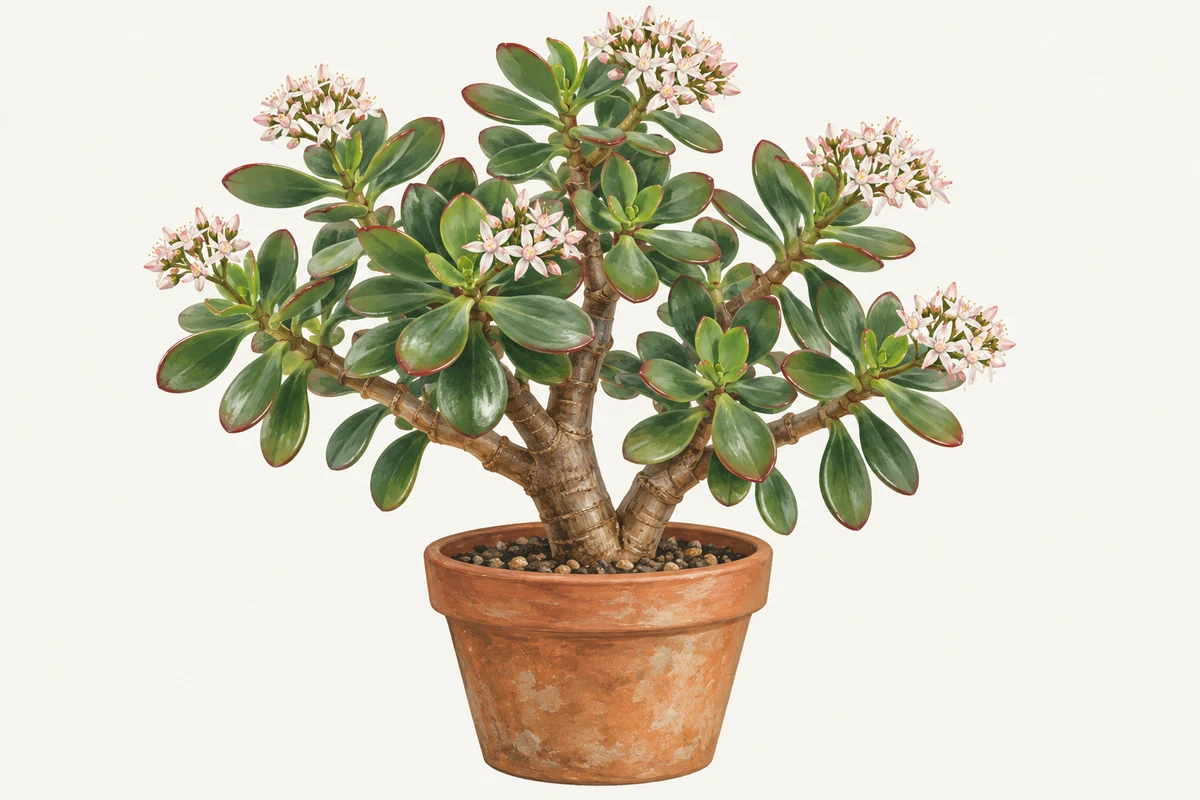
Thick, glossy, egg-shaped leaves in opposite pairs on fleshy stems that turn gray and woody with age. Here is what to check, and how to rule out the plants sold as "jade" that are not.
In short
Jade plant identification starts with the leaves: thick, glossy and egg-shaped, 1 to 3½ inches long, set in opposite pairs, mid to dark green, often red-edged in sun. Then check the stems: thick and fleshy, ringed with leaf scars, green or reddish when young and gray with age. Crassula ovata is a South African succulent that grows into a small tree, 3 to 6 feet tall.
- Leaf size settles most confusions: jade plant leaves are 1 to 3½ inches long, elephant bush leaves only ½ to ¾ inch.
- Blue-gray leaves with maroon edges and maroon speckles point to silver dollar jade (Crassula arborescens), not jade plant.
- 'Gollum' and 'Hobbit' are jade plants too: cultivars of Crassula ovata with tubular or spoon-shaped leaves.
Field marks at a glance
- Scientific name
- Crassula ovata
- Family
- Crassulaceae (stonecrop family)
- Type
- Succulent, perennial, evergreen
- Leaves
- Opposite, simple, nearly stalkless; oval to obovate, 1 to 3½ inches long and ¾ to 1½ inches wide; thick, fleshy and shiny with smooth (entire) edges.
- Leaf color
- Mid to dark green; the edges take on a red tint in direct sun. Leaves tend to cluster at the ends of the branches.
- Stems
- Branched, fleshy and thick, with distinct rings (stipular scars). New growth is green or reddish-brown, older growth gray; the same diameter along its length.
- Bark
- On old stems the bark turns woody and peels, keeping the rings. A potted plant of some years looks like a miniature tree.
- Size and form
- Erect, multi-stemmed, spreading shrub, 3 to 6 feet tall and 2 to 3 feet wide (NC State Extension).
- Flowers
- Rare on houseplants. Star-shaped, under 1 inch, white tinged with pink, 4 to 5 petals fused at the base, purple anthers, in spring clusters at the branch tips.
- Origin
- South Africa. Grown outdoors only in frost-free climates, such as parts of California and the Iberian peninsula; USDA zones 11 to 12.
- Old name
- Formerly Crassula argentea, the name the ASPCA plant list still uses. Other common names: money plant, lucky plant, jade tree.
Jade plant (Crassula ovata) is one of the most common succulents on windowsills, and also one of the most mislabeled: at least two unrelated or only distantly related plants are sold as "jade". Three checks sort it out, in this order: leaf size and shape, leaf color, then the stems.
What to check first: leaf size, leaf color, stems
1. The leaves. Lay a ruler next to a mature leaf. According to the NC State Extension Plant Toolbox, jade plant leaves are 1 to 3½ inches long and ¾ to 1½ inches wide, oval to obovate (widest toward the tip), thick, fleshy and shiny, with smooth edges. They grow in opposite pairs, almost without a stalk, and tend to bunch at the ends of the branches. The species name ovata means egg-shaped, after the leaves.
2. The color. A jade plant leaf is mid to dark green. In direct sun the rim turns red, which is normal. There are no speckles on the surface. Gray-blue leaves with a maroon rim and maroon dots belong to a different species (see the look-alikes below).
3. The stems. This is the check people skip. Jade plant stems are branched, fleshy and thick, and carry distinct rings where old leaves fell: NC State calls them stipular scars. New growth is green or reddish-brown, older growth gray, and with years the bark turns woody and peels. A stem that stays about the same thickness all the way up, with rings, points to jade plant.
If the plant also flowers (rare indoors), the flowers are small, star-shaped, white tinged with pink, with 4 or 5 petals fused at the base and purple anthers.
When you have no label and no idea where to start, one photo of the whole plant in Plant Identifier gives you a name to check against these three marks. The app shows no confidence score and no list of alternatives, so measure a leaf before you trust it, especially on a small cutting.
Jade plant vs elephant bush
Elephant bush (Portulacaria afra) is the plant most often sold as "dwarf jade", "miniature jade" or "small leaf jade". University of Wisconsin–Madison's Wisconsin Horticulture is clear that it is not related to jade plant, and molecular studies place it in a different family altogether (Didiereaceae, though it is often filed under the purslane family).
The field test is size and spacing:
- Elephant bush leaves are ½ to ¾ inch long, round to oval, glossy emerald green and nearly stalkless, crowded close together on thin, brittle, reddish-brown stems that turn grayish as they age.
- Jade plant leaves are 1 to 3½ inches long, spaced farther apart on thick, ringed stems.
Wisconsin Horticulture sums it up: elephant bush looks superficially similar but has much smaller leaves, closer together, on thinner stems. Its flowers, rare in cultivation, are tiny, pink or white, with 5 pointed petals.
Jade plant vs silver dollar jade (Crassula arborescens)
Silver dollar jade is a true relative, in the same genus and also from South Africa, and NC State lists one of its forms (subspecies undulatifolia, with wavy-edged leaves) among the plants most often confused with jade plant.
According to NC State's Crassula arborescens page, its leaves are up to 3 inches long, elliptical, fleshy and blue-gray, with maroon "piping" around the edges and small maroon speckles on the upper surface. The plant reaches about 4 feet. Jade plant leaves are green and glossy, never speckled. If you are looking at gray, powdery-looking leaves with red rims and dots, you have silver dollar jade.
'Gollum', 'Hobbit' and other jade plant cultivars
Some plants that look nothing like the classic jade are still Crassula ovata. NC State lists, among others:
| Cultivar | What the leaves look like |
|---|---|
| 'Gollum' | Tubular, with round tips like a small suction cup |
| 'Hobbit' | Spoon-shaped, curling inward |
| 'Skinny Fingers' | Long, thin and tubular |
| 'Variegata' | Light green, white, yellow and sometimes pink |
| 'Crosby's Compact' | Small, rounded, red, yellow and orange shades |
| 'Botany Bay' | Light greenish-yellow with red tips, compact |
So a "finger" or "trumpet" jade with the same thick, ringed stems is a jade plant cultivar, not a separate species. Cultivars are often sold without a label, and a photo can name the species far more reliably than the cultivar. For more succulents that get mixed up on garden-center shelves, see succulent identification.
Jade plant and pets
The ASPCA Animal Poison Control Center lists jade plant, under its old name Crassula argentea, as toxic to dogs, cats and horses. Its listed clinical signs are vomiting, depression and incoordination; the toxic principle is given as unknown. NC State also tags silver dollar jade as a problem for cats, dogs and horses.
If a pet has chewed a jade plant, call your veterinarian or the ASPCA Animal Poison Control Center at (888) 426-4435 (the ASPCA says a consultation fee may apply). If a person has eaten part of one, call Poison Control at 1-800-222-1222 (poison.org). The app's Toxicology tool gives AI-written notes on toxic parts and symptoms, which are a starting point, not a replacement for those calls. Other common houseplants on the same list are covered in plants toxic to cats.
A short care note
Care matters for identification only because a struggling jade plant looks different. NC State recommends a sunny spot indoors with some afternoon shade, well-drained potting soil, and watering in moderation when the soil is dry, less from fall to late winter. It notes that overwatering can cause leaf fall and root rot, and that mealybugs, scale, aphids and spider mites are occasional pests. Shriveled, soft or yellowing leaves are a watering or root question rather than an identification one: yellow leaves on plants walks through the usual causes, and Plant Identifier's Diagnose tool can give a first read from a photo of the affected leaves.
Look-alikes and how to tell them apart
Elephant bush (Portulacaria afra)
Measure a leaf. Elephant bush leaves are only ½ to ¾ inch long, round to oval and crowded on thinner, brittle, reddish-brown stems. Jade plant leaves are 1 to 3½ inches long on thick, ringed stems. The two are not related.
Silver dollar jade (Crassula arborescens)
Look at the color. Silver dollar jade has rounded blue-gray leaves with maroon edges and small maroon speckles on the upper surface. Jade plant leaves are glossy mid to dark green, with at most a red rim in sun and no speckles.
'Gollum' jade (Crassula ovata 'Gollum')
Not a look-alike but a cultivar of jade plant: its leaves are rolled into tubes with a round, suction-cup-like tip. If the stems are thick and ringed like a jade plant, a tubular leaf means 'Gollum' (or 'Skinny Fingers'), still Crassula ovata.
What a photo can't settle
- A photo of a young cutting can't always separate a jade plant from elephant bush: both have opposite, fleshy leaves on reddish stems. Measure a leaf before you trust any answer.
- Jade plant has many cultivars ('Gollum', 'Hobbit', 'Variegata', 'Crosby's Compact') and plants are often sold unlabeled; a photo can name the species but rarely settles the cultivar.
- Jade plant rarely blooms as a houseplant (NC State Extension), so the flower can't help on most indoor plants; leaves and stems have to carry the identification.
Questions people ask
How do I know if my plant is a real jade plant?
Check three things: leaves 1 to 3½ inches long, thick, glossy and set in opposite pairs; thick stems ringed with leaf scars that turn gray and woody; and a tree-like shape over time. Tiny leaves on thin red stems mean elephant bush; blue-gray, maroon-speckled leaves mean silver dollar jade.
Is a jade plant poisonous to cats and dogs?
The ASPCA lists jade plant (under its old name Crassula argentea) as toxic to dogs, cats and horses, with vomiting, depression and incoordination as signs. If a pet has chewed one, call your vet or the ASPCA Animal Poison Control Center at (888) 426-4435. For a person, call Poison Control at 1-800-222-1222.
Is elephant bush a type of jade plant?
No. Elephant bush (Portulacaria afra) is sold as dwarf jade or small leaf jade, but University of Wisconsin–Madison Extension notes it is not related to Crassula ovata. Its leaves are much smaller, ½ to ¾ inch, and sit closer together on thinner stems.
Why are the edges of my jade plant's leaves red?
NC State Extension notes that jade plant leaf margins acquire a red tint in direct sun, so red edges on otherwise firm, green leaves are normal. Soft, shriveled or yellowing leaves are a different matter and point to watering or root problems.
Sources
- Crassula ovata — NC State Extension, North Carolina Extension Gardener Plant Toolbox
- Crassula arborescens — NC State Extension, North Carolina Extension Gardener Plant Toolbox
- Elephant Bush, Portulacaria afra — Wisconsin Horticulture, University of Wisconsin–Madison Extension
- Toxic and Non-toxic Plants: Jade Plant — ASPCA Animal Poison Control Center
- Poison Control — National Capital Poison Center
Keep reading
- Field guideSucculent identification: how to identify succulents by shape, leaf and sap
- Succulent profileAloe vera: how to identify the plant
- Plant healthYellow leaves on plants, and what each pattern means
- Free toolHouseplant identification key
- Houseplant profileSnake plant (Dracaena trifasciata): how to identify it