Succulent profile
Aloe vera: how to identify the plant
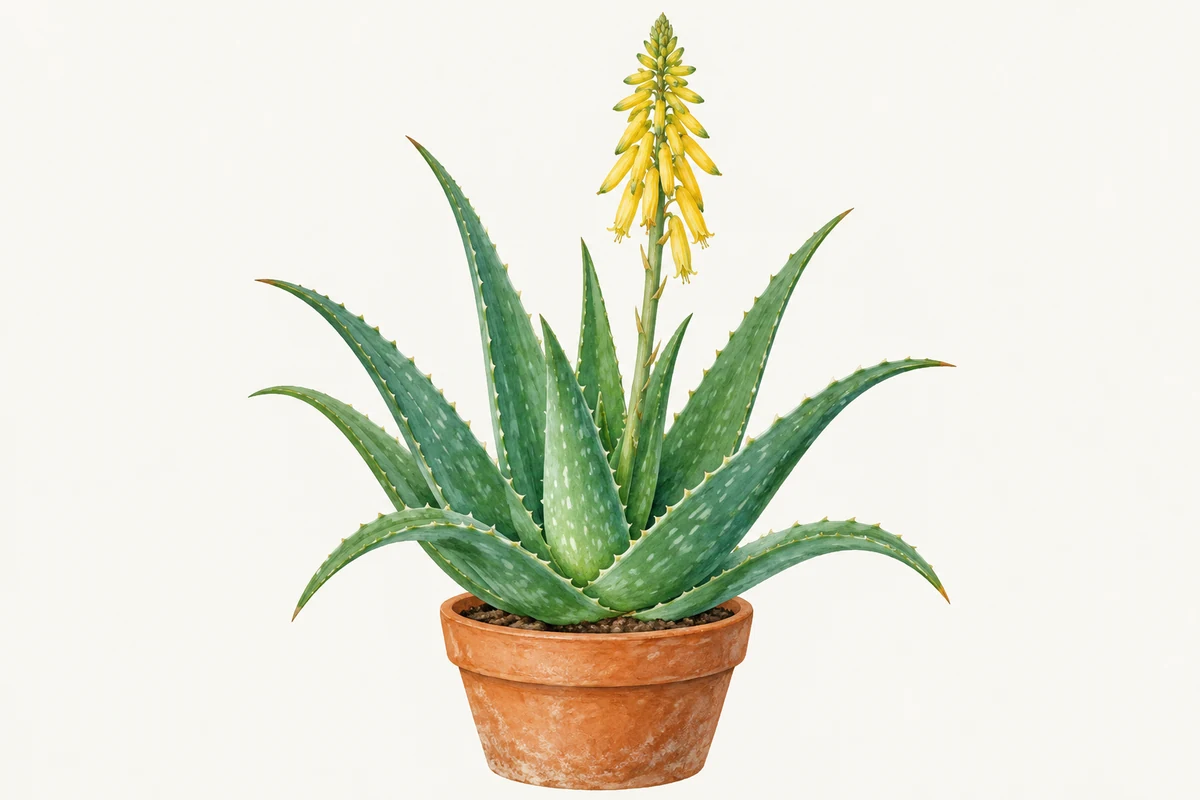
A stemless rosette of thick, gray-green, pointed leaves edged with small soft teeth, filled with clear gel, and offsets crowding the pot. Here is how to confirm it.
In short
How to identify an aloe vera plant: look for a rosette of thick, fleshy, lance-shaped leaves, gray-green to blue-green, edged with small white teeth and filled with a clear gel. The plant has a short, stout stem, spreads by offsets and reaches 1 to 2 feet tall (NC State). Mature plants send up a spike of tubular yellow to orange flowers.
- Toothed edges plus a soft, gel-filled leaf say Aloe; a stiff, fibrous leaf with a hard tip spine says Agave.
- Haworthias have translucent 'windows' near the leaf tips; gasterias have smooth, tongue-shaped leaves with white speckles.
- The ASPCA lists aloe as toxic to dogs, cats and horses. This page covers identification only.
Field marks at a glance
- Scientific name
- Aloe vera
- Family
- Asphodelaceae (asphodel family)
- Type
- Succulent, perennial, evergreen
- Leaves
- Thick, succulent, pointed and lance-shaped, in a basal rosette; up to 18 in long and 1 to 3 in wide (NC State).
- Color
- Gray-green to blue-green, smooth and hairless. NC State's aloe genus page lists white dots (maculation) on the leaves as a quick ID mark for aloes.
- Edges
- A margin of small white teeth (serrate). Small and evenly spaced along both edges.
- Inside the leaf
- Soft, easy to break, filled with a clear, gel-like sap (NC State), which also mentions a latex that can irritate skin.
- Stem
- Short and stout, often hidden by the rosette. New plants appear as offsets (pups) around the base.
- Flowers
- On plants at least about three years old: a spike up to nearly 3 ft carrying dense, drooping, tubular yellow to orange flowers that open from the bottom up, in winter or spring (NC State).
- Size
- 1 to 2 ft tall and up to 2.5 ft wide in NC State's attributes; UF/IFAS gives up to 2 ft.
- Native range
- The Arabian Peninsula (NC State), now spread to many other regions.
- Other names
- Aloe barbadensis (former name), Barbados aloe, true aloe.
Aloe vera is one of the most common succulents on windowsills, and most other rosette succulents get mistaken for it at some point. Three marks settle it: a soft, gel-filled leaf, a toothed edge and a gray-green rosette with pups around the base. This page covers identification only.
How to identify aloe vera in four checks
1. The rosette. Look down on the plant. Aloe vera grows as a rosette of thick, fleshy, pointed leaves from a short, stout stem, and it spreads by offsets, so an older pot is crowded with young plants. The NC State Plant Toolbox gives leaves up to 18 inches long and 1 to 3 inches wide, and a plant 1 to 2 feet tall in its attributes (2 to 3 feet in its description).
2. The edges. Run a finger carefully along a leaf margin. Aloe vera leaves carry a row of small white teeth. They are small and run the length of both edges. NC State's aloe genus page uses the toothed margin to tell aloes from haworthias.
3. The leaf's inside. Bend an old outer leaf gently. It is soft and breaks easily, and the inside is a clear, gel-like sap. NC State's genus page uses that gel and the leaf's thickness to tell aloes from agaves, whose leaves lack the gel. This is a test of texture only; it is not a reason to handle the gel.
4. The flowers, if any. Once a plant is at least about three years old, NC State says it may send up a spike up to nearly 3 feet tall, densely packed with drooping, tubular yellow to orange flowers that open from the bottom up, in winter or spring. UF/IFAS adds that plants grown indoors rarely bloom, so most identifications rest on the leaves.
If you are not sure which succulent you have, one photo of the whole rosette from above is enough for Plant Identifier to suggest a common and scientific name. The app shows no confidence score and no list of alternatives, so check its answer against the marks above.
Aloe vera vs agave, haworthia and gasteria
These succulents share the rosette and the thick leaves. The edge and the inside of the leaf separate them.
| Feature | Aloe vera | Agave americana | Haworthia | Gasteria |
|---|---|---|---|---|
| Family | Asphodelaceae | Asparagaceae | Asphodelaceae | Asphodelaceae |
| Leaf edge | Small white teeth | Spiny | Smooth or toothed | Smooth (entire) |
| Inside the leaf | Clear gel | No gel | Fleshy | Fleshy |
| Typical size | 1 to 2 ft | 6 to 10 ft | 2 to 12 in | About 6 in in a pot |
| Signature mark | Gel and teeth | Size, spines | Translucent leaf "windows" | Tongue-shaped, speckled leaves |
The agave figures are from NC State on Agave americana, which describes blue-green to gray-green leaves up to 6 feet long and a single flower stalk 15 to 30 feet tall after 10 to 25 years, after which the main plant dies. NC State on Haworthia notes that some species once in Haworthia now sit in Haworthiopsis, which have opaque leaves with raised white bumps underneath. NC State on Gasteria gracilis describes leaves deep green to gray and speckled with white dots. The succulent identification guide covers many more rosette succulents, and the cactus identification guide the spiny ones.
Names on the label
NC State lists Aloe barbadensis as a former name of aloe vera, along with the common names Barbados aloe and true aloe. The genus name comes from an Arabic word for a bitter, shiny substance, and vera is Latin for "true". The plant belongs to the asphodel family (Asphodelaceae); the ASPCA's entry still places it in the lily family (Liliaceae), an older classification. The genus has more than 500 species, from small rosettes to tree forms, and many hybrids are sold, so a small, heavily spotted aloe is often a hybrid rather than aloe vera itself. If it is a jade plant you are looking at, with round, glossy leaves on woody stems, see jade plant.
Is aloe vera toxic to pets
The ASPCA lists aloe (Aloe vera) as toxic to dogs, cats and horses. It names saponins and anthraquinones as the toxic principles and lists vomiting (not in horses), lethargy and diarrhea as clinical signs. NC State also lists the plant as a problem for cats, dogs and horses and rates its poison severity for people as low, naming the leaves.
If a pet has chewed a leaf, call your vet or the ASPCA Animal Poison Control Center at (888) 426-4435. If a person has swallowed part of the plant, call Poison Control at 1-800-222-1222 (poison.org). Plant Identifier's Toxicology tool gives AI-written notes for people, dogs and cats, but it does not replace that call. More plants on the ASPCA's list are gathered in plants toxic to cats.
A short care note
NC State and UF/IFAS describe an undemanding succulent. Give it full sun to bright light; NC State suggests a south- or west-facing window for aloes indoors. Use a very well-drained succulent mix in a pot with drainage holes; NC State says clay pots are best. Let the soil dry completely between waterings, water less in winter, and never let the pot stand in water: overwatering leads to root rot. UF/IFAS warns that a plant moved too quickly from low to bright light can sunburn, so make the change gradually. Watch for mealybugs and aphids.
Look-alikes and how to tell them apart
Agave, century plant (Agave americana)
Press a leaf. American century plant has large, spiny, blue-green to gray-green leaves up to 6 feet long, in rosettes 6 to 10 feet tall (NC State). NC State's aloe page says aloes are told from agaves by the leaf's thickness and gel-like sap.
Haworthia (Haworthia species)
Hold the rosette up to the light. Haworthias are small, 2 to 12 inches tall, and all form translucent 'windows' of clear tissue on or around the leaf tips (NC State). NC State separates aloes from haworthias by their toothed (serrate) margins.
Gasteria (Gasteria gracilis and relatives)
Run a finger along the edge. NC State describes gasteria leaves as thick, stemless and tongue-like, deep green to gray, speckled with white dots, with entire (untoothed) margins, about 6 inches tall in a pot. Its flowers dangle in two colors from long stems.
Other aloes and hybrids ('Minnie Belle', 'Delta Lights')
Compare size and pattern. NC State describes 'Minnie Belle' as small, dark green and spotted with white teeth, and 'Delta Lights' as small, with wide gray leaves striped white. Aloe vera is larger, plainer gray-green, with leaves up to 18 inches long.
What a photo can't settle
- Young aloe vera, spotted aloe hybrids and some other Aloe species look much alike before they flower; a photo of the leaves alone may only settle the genus.
- This page identifies the plant and does not cover any use of its gel or sap; questions about skin or health belong with a doctor or pharmacist.
- Neither a photo nor this page can say whether a pet ate enough to matter; that is a question for your vet or the ASPCA Animal Poison Control Center.
Questions people ask
How can I tell if my plant is aloe vera or agave?
Snap or press an old leaf. Aloe leaves are soft and full of clear gel, with small teeth along the edges. Agave leaves are large and spiny and lack the gel. NC State uses exactly that test: aloes are told from agaves by the leaf's thickness and gel-like sap.
Is aloe vera a cactus?
No. Aloe vera is a succulent in the asphodel family (Asphodelaceae), the same family as haworthia and gasteria. Cacti are a separate family; the cactus identification guide on this site covers them.
Why does my aloe vera never flower?
NC State says plants flower only once they are at least about three years old, and UF/IFAS notes that aloes grown indoors rarely bloom. A plant without flowers is still identified by its leaves: gray-green, toothed and gel-filled, in a rosette.
Is aloe vera toxic to cats and dogs?
The ASPCA lists aloe (Aloe vera) as toxic to dogs, cats and horses, naming saponins and anthraquinones, with vomiting (not in horses), lethargy and diarrhea as clinical signs. If your pet chewed a leaf, call your vet or the ASPCA Animal Poison Control Center at (888) 426-4435.
Sources
- Aloe vera — North Carolina Extension Gardener Plant Toolbox (NC State)
- Aloe — North Carolina Extension Gardener Plant Toolbox (NC State)
- Agave americana — North Carolina Extension Gardener Plant Toolbox (NC State)
- Haworthia — North Carolina Extension Gardener Plant Toolbox (NC State)
- Gasteria gracilis — North Carolina Extension Gardener Plant Toolbox (NC State)
- Aloe Vera — UF/IFAS Gardening Solutions
- Aloe — ASPCA Animal Poison Control Center
- Poison Control — National Capital Poison Center
Keep reading
- Field guideSucculent identification: how to identify succulents by shape, leaf and sap
- Plant profileJade plant (Crassula ovata): how to identify it
- Field guideCactus identification: how to tell common cacti apart
- Plant profileString of hearts (Ceropegia woodii): how to identify it
- Houseplant profileSnake plant (Dracaena trifasciata): how to identify it