Plant profile
String of hearts (Ceropegia woodii): how to identify it
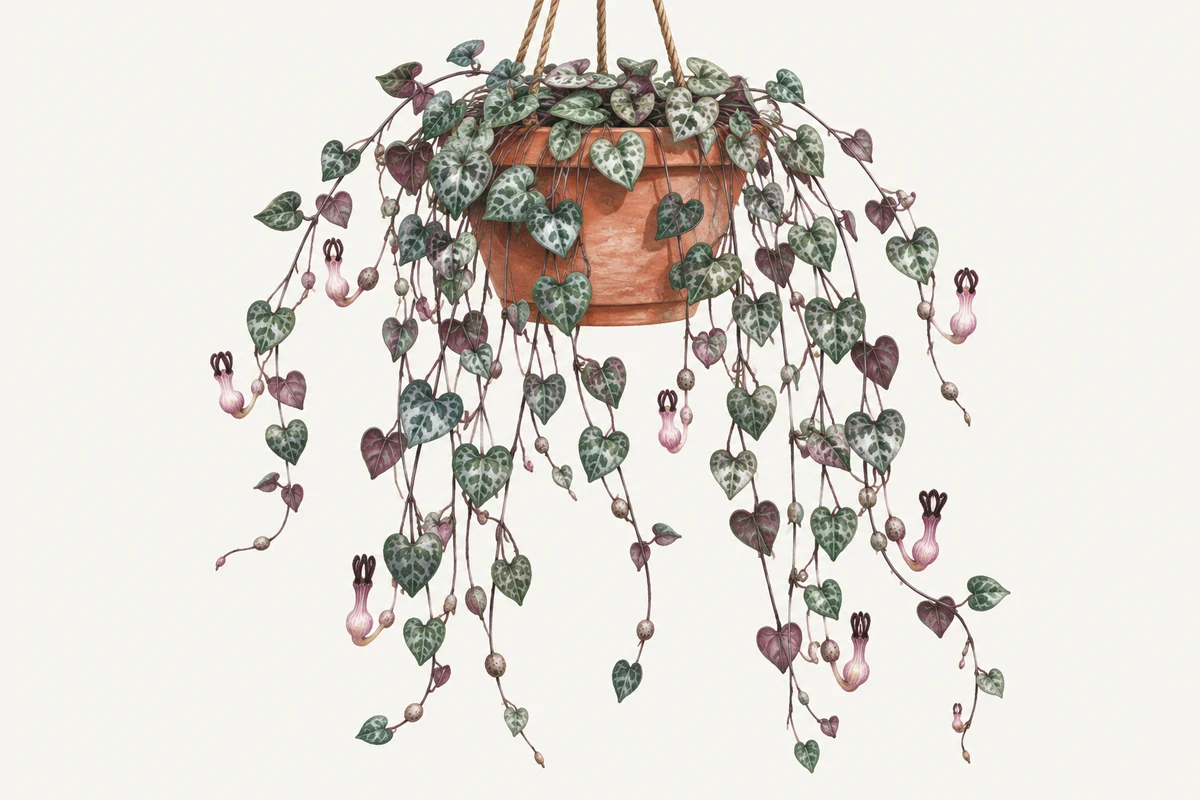
Small, heart-shaped leaves marbled with silver above and purple below, in pairs along thin, wiry stems that hang from the pot, with bead-like tubers between them. Here is what to check.
In short
String of hearts (Ceropegia woodii) is a trailing succulent vine from southern Africa with small, heart-shaped leaves under an inch long, dark green etched with silver above and purple beneath. The leaves grow in pairs about every 3 inches along long, wiry stems that hang about 3 feet, with bead-like aerial tubers forming between them. Its small flowers are purplish tubes.
- Paired, heart-shaped leaves etched with silver above and purple below, on wiry hanging stems, mean string of hearts.
- Round, pea-like leaves with a translucent stripe mean string of pearls; tiny round leaves patterned like a turtle shell, on red stems, mean string of turtles.
- The ASPCA's plant list has no entry for string of hearts; call your vet if a pet chews it.
Field marks at a glance
- Scientific name
- Ceropegia woodii
- Family
- Apocynaceae (dogbane family)
- Type
- Succulent, perennial, evergreen
- Leaves
- Simple, opposite (in pairs), small and heart-shaped to ovate, under 1 inch long and wide (NC State).
- Leaf color
- Dark green etched with silver on the upper surface and purple underneath (NC State).
- Stems
- Long, thin and wiry, draping over the pot and hanging about 3 feet; up to 12 feet in the wild (NC State). Leaves sit about every 3 inches.
- Tubers
- Bead-like aerial tubers form on the stem between the leaves; they root and make new plants where they touch soil (NC State).
- Flowers
- Purple to purplish-white, tubular, under 1 inch (NC State). Insects can be trapped inside for a while, but the plant is not carnivorous.
- Native range
- Hillsides of southern Africa: the Cape Provinces, Mozambique, Northern Provinces, Swaziland and Zimbabwe (NC State).
- Names
- Also chain of hearts, rosary vine, sweetheart vine and necklace vine. GBIF accepts Ceropegia woodii Schltr., family Apocynaceae.
String of hearts (Ceropegia woodii) is a trailing succulent from southern Africa, grown almost everywhere else in hanging pots. Several "string of" plants are sold side by side, so check the leaves, the stems and the tubers, in that order.
How to identify string of hearts in three checks
1. The leaves. Look at a pair. According to the NC State Plant Toolbox, the leaves are small, heart-shaped, under an inch long, and grow opposite each other along the stem. The upper surface is dark green etched with silver and the underside is purple; turn a leaf over to see it.
2. The stems. The stems are long and wiry and drape over the pot, hanging about 3 feet; NC State notes they can reach 12 feet in the wild. A pair of leaves sits about every 3 inches, so the strand looks sparse compared with string of pearls.
3. The tubers. Run a strand through your fingers. Between the leaves you will often find small, bead-like aerial tubers. NC State notes that they root and make a new plant if the stem touches soil, and they give the plant its other name, rosary vine.
If it flowers, the flowers are small purplish to purplish-white tubes, under an inch. NC State notes that insects are sometimes trapped inside the flower tubes for a time, but the plant is not carnivorous. Named forms vary: NC State lists f. variegata with cream and pink leaves, 'Silver Glory' with silver, apple-shaped leaves, and 'String of Arrows' with lime green and silver pointed leaves.
When you have a strand and no label, one photo in Plant Identifier gives you a name to check against these marks. The app shows no confidence score and no list of alternatives, so look at the leaf shape and the underside before you trust it, especially on a small cutting.
String of hearts vs string of pearls and string of turtles
The three are often sold on the same shelf. NC State's pages on string of pearls and string of turtles give the differences:
| Feature | String of hearts | String of pearls | String of turtles |
|---|---|---|---|
| Leaf shape | Flat heart, in pairs | Round, pea-shaped | Tiny, round, like a turtle shell |
| Leaf color | Silver-etched green above, purple below | Green | Green marbled darker green, white or silver |
| Stems | Thin, wiry, about 3 ft in a pot | Thin, trailing, 1 to 2 ft | Delicate, red, about 12 in |
| Beads on the stem | Aerial tubers between leaves | The leaves themselves | None |
| Family | Apocynaceae | Asteraceae (daisy) | Piperaceae (pepper) |
String of pearls has its own page, string of pearls. For more succulents that get mixed up on garden-center shelves, see succulent identification and the jade plant page, or try the houseplant identification key.
The name
The GBIF backbone taxonomy accepts Ceropegia woodii Schltr., in the family Apocynaceae. NC State explains that the genus name comes from the Greek keros, wax, and pege, fountain, for the waxy, fountain-shaped flowers, and that woodii honors John Medley Wood, a collector of native African plants. In southern Africa the plant is called Bushman's pipe.
Is string of hearts toxic to pets
The ASPCA's toxic and non-toxic plant list has no entry for Ceropegia woodii under string of hearts or rosary vine. A missing listing is not a guarantee.
If a pet has chewed string of hearts, call your vet or the ASPCA Animal Poison Control Center at (888) 426-4435. For a person, call Poison Control at 1-800-222-1222 (poison.org). Plant Identifier's Toxicology tool gives AI-written notes for people, dogs and cats; treat them as a starting point, not as the answer. Houseplants that are on the ASPCA's lists are covered in plants toxic to cats.
A short care note
NC State recommends a well-drained, sandy potting soil and bright, indirect light, letting the soil dry out completely between waterings and watering even less during winter dormancy. It warns that overwatering causes root rot and yellowing leaves, that wilted leaves mean underwatering, and that too much sun scorches the leaves. The plant likes to be crowded, so repot only when necessary; in USDA zone 10 it can grow outdoors, where it spreads easily.
Look-alikes and how to tell them apart
String of pearls (Curio rowleyanus)
Look at the leaf shape. String of pearls has round, pea-shaped leaves (NC State), not flat hearts, and its leaves alternate along the stem rather than in pairs. NC State lists 'rosary vine' as a name for both plants, so the label alone does not settle it.
String of turtles (Peperomia prostrata)
Check the stem and the pattern. String of turtles has tiny round leaves marbled like a turtle shell on delicate red stems that reach only about 12 inches (NC State). String of hearts has heart-shaped leaves with a purple underside on long, thin stems with bead-like tubers between the leaves.
What a photo can't settle
- Variegated and named forms such as 'Silver Glory' or 'String of Arrows' have different leaf shapes and colors; check for paired leaves and bead-like tubers rather than the color alone.
- Several trailing succulents share nicknames such as 'rosary vine', so a shop label is not proof of the species.
- Whether a pet that chewed a leaf needs treatment is for your vet or a poison control center to decide, not for this page or an app.
Questions people ask
What are the little balls on my string of hearts?
They are aerial tubers, also called tubercles. NC State says they form on the stem between the leaves and root to make a new plant if the stem touches soil. They are normal, and they give the plant its other name, rosary vine.
What is the difference between string of hearts and string of pearls?
The leaves. String of hearts has flat, heart-shaped leaves in pairs, silver-etched above and purple below. String of pearls has round, pea-shaped leaves (NC State). They belong to different families: string of hearts to Apocynaceae, string of pearls to the daisy family.
Why are there big gaps between the leaves?
NC State says large gaps between the leaves indicate that the plant is not getting enough light. Too much direct sun, on the other hand, scorches the leaves. Bright, indirect light is what it prefers.
Is string of hearts toxic to cats and dogs?
The ASPCA's toxic and non-toxic plant list has no entry for Ceropegia woodii, and that absence is not a guarantee. If your pet chewed it, call your vet or the ASPCA Animal Poison Control Center at (888) 426-4435. For a person, call Poison Control at 1-800-222-1222.
Sources
- Ceropegia woodii — North Carolina Extension Gardener Plant Toolbox (NC State)
- Curio rowleyanus — North Carolina Extension Gardener Plant Toolbox (NC State)
- Peperomia prostrata — North Carolina Extension Gardener Plant Toolbox (NC State)
- Ceropegia woodii, species match — GBIF Backbone Taxonomy (API)
- Poison Control — National Capital Poison Center