Plant profile
String of pearls (Curio rowleyanus): how to identify it
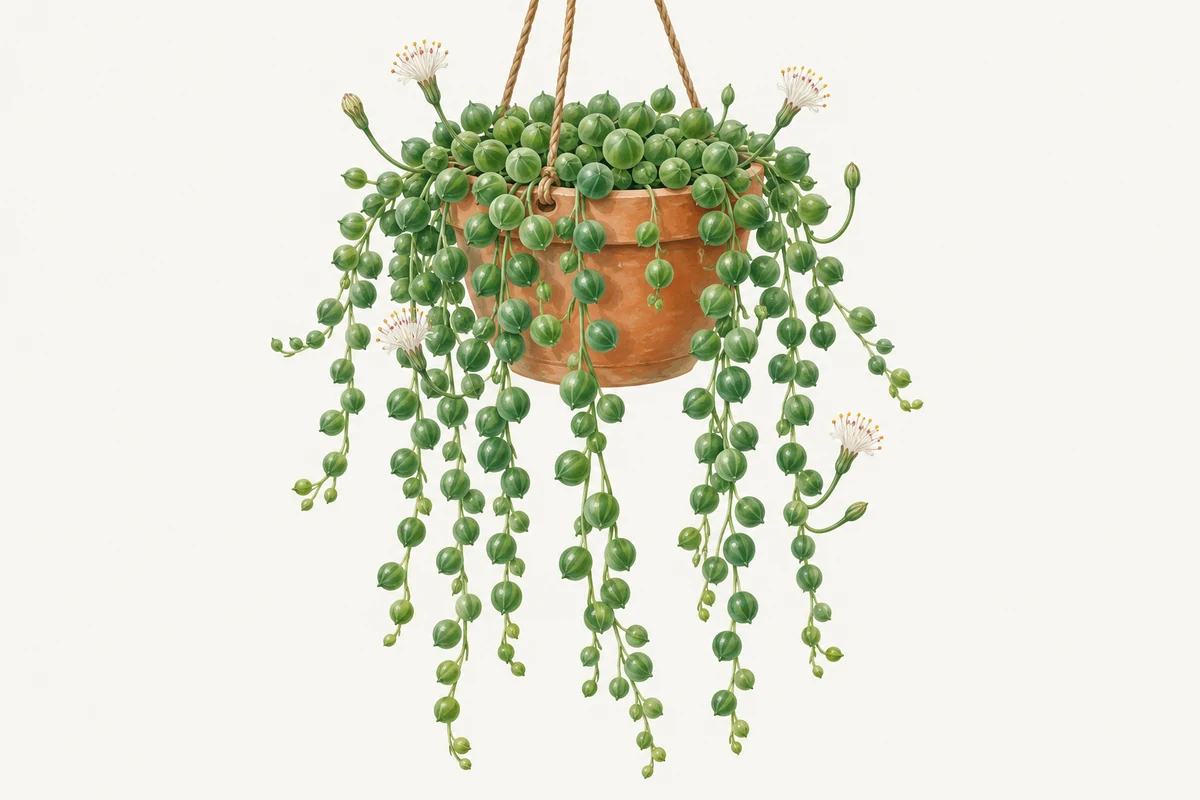
Round, pea-sized leaves, each with a small point and a see-through stripe, strung along thin stems that spill over the pot. Here is what to check, and how to rule out its banana-leaved cousin.
In short
String of pearls (Curio rowleyanus, also filed as Senecio rowleyanus) is a trailing South African succulent whose leaves are spheres only ¼ to ⅓ inch across, lime green, with a small pointed tip and a translucent stripe along one side. They sit along thin green stems that creep, root where they touch soil and hang 1 to 2 feet over a pot.
- Spherical leaves ¼ to ⅓ inch across, each with a translucent stripe and a tiny point, mean string of pearls.
- Curved, banana-shaped leaves about 1.2 inches long mean string of bananas (Curio radicans), a close relative.
- NC State lists string of pearls as poisonous to humans and a problem for cats, dogs and horses; its sap can irritate skin.
Field marks at a glance
- Scientific name
- Curio rowleyanus
- Family
- Asteraceae (daisy family)
- Type
- Succulent, perennial, evergreen
- Leaves
- Simple, alternate, fleshy and spherical, ¼ to ⅓ inch, like a pea or bead; lime green, hairless, with a small pointed tip (NC State).
- Leaf window
- A translucent stripe runs lengthwise along each leaf. Hold a leaf to the light to see it.
- Stems
- Thin, green, trailing stems lined with leaves; they creep along the ground and root wherever they touch soil (NC State).
- Size and habit
- 1 to 2 feet tall and 1 to 3 feet across, cascading or creeping; usually grown in hanging baskets (NC State).
- Flowers
- White pom-pom or cylindrical heads under 1 inch, with long red stamens and bright yellow anthers and a cinnamon scent, on 1.5-inch stalks, in summer. Rare indoors.
- Seeds
- Each seed carries a white, cotton-like tuft (pappus) and is spread by wind, as in other members of the daisy family.
- Origin
- Dry areas of the Cape Provinces, South Africa, often under bushes and rocks; outdoors only in USDA zones 9b to 12b (NC State).
- Names
- Also string of beads, rosary vine, necklace plant. NC State and GBIF use Curio rowleyanus; World Flora Online's June 2026 list accepts Senecio rowleyanus.
String of pearls is a trailing succulent from South Africa, grown almost everywhere else as a hanging-basket houseplant. Several "string of" succulents are sold next to it, so check the leaf shape, the leaf window and the stems, in that order.
How to identify string of pearls in three checks
1. The leaf shape. Pick one leaf. According to the NC State Plant Toolbox, string of pearls leaves are spherical, pea-shaped, ¼ to ⅓ inch across, lime green and fleshy, with a small pointed tip. They grow alternately along the stem. A leaf that is curved and elongated rather than round belongs to a different plant (see below).
2. The leaf window. Hold a strand up to a window. Each leaf has a translucent stripe running lengthwise, a see-through "window" in the green. It is normal, not a scar or a sign of rot.
3. The stems. The stems are thin, green and trailing, lined with leaves along their length. In its native dry areas of South Africa, NC State notes that the plant creeps along the ground under bushes and rocks and roots wherever a stem touches soil; in a pot, the stems hang 1 to 2 feet over the edge.
If it flowers, which is rare indoors, the flowers are white pom-pom or cylindrical heads under an inch across, with long red stamens and bright yellow anthers and a cinnamon scent, held on 1.5-inch stalks in summer. They are followed by seeds with white, cotton-like tufts.
When you have a strand and no label, one photo in Plant Identifier gives you a name to check against these marks. The app shows no confidence score and no list of alternatives, so look at the leaf shape on several strands before you trust it, especially on a small cutting.
String of pearls vs string of bananas
String of bananas (Curio radicans) is the closest relative and the most common mix-up. NC State's Curio radicans page notes that the two are related and describes the differences:
| Feature | String of pearls | String of bananas |
|---|---|---|
| Leaf shape | Spherical bead with a small point | Curved, banana-shaped, erect |
| Leaf size | ¼ to ⅓ inch across | About 1.2 inches long, 0.25 inch thick |
| Leaf window | One lengthwise translucent stripe | A translucent line on either side |
| Stems | Thin, green, trailing | Slender and wiry, green to blue-gray-green, up to about 40 inches |
| Hardiness outdoors | USDA zones 9b to 12b | USDA zones 10a to 11b |
String of dolphins is a third plant sold in the same section. The GBIF backbone lists it as Curio × peregrinus, a hybrid; we have no primary source describing its leaves yet, so this page does not give a field test for it. For more succulents that get mixed up on garden-center shelves, see succulent identification and the jade plant page.
Curio or Senecio: the name
String of pearls was described as Senecio rowleyanus in 1968 and later moved to the genus Curio. NC State and the GBIF backbone taxonomy use Curio rowleyanus. The World Flora Online Plant List, in its June 2026 classification, accepts Senecio rowleyanus. Either name, and the older Kleinia rowleyana that NC State also lists, refers to the same plant. The species name honors Gordon Douglas Rowley, a British botanist who specialized in succulents and cacti.
Is string of pearls toxic to pets
The NC State Plant Toolbox lists string of pearls as poisonous to humans and as a problem for cats, dogs, horses and children, with low poison severity. It names pyrrolizidine alkaloids as the toxic principle, says that eating the leaves can cause vomiting and diarrhea, and that the sap can cause skin irritation and rash. NC State lists string of bananas as a problem for cats and dogs too.
If a pet has chewed string of pearls, call your vet or the ASPCA Animal Poison Control Center at (888) 426-4435. For a person, call Poison Control at 1-800-222-1222 (poison.org). Plant Identifier's Toxicology tool gives AI-written notes for people, dogs and cats; treat them as a starting point, not as the answer. Other common houseplants on toxicity lists are covered in plants toxic to cats.
A short care note
NC State recommends bright, indirect light indoors, a cactus mix or potting soil mixed with sand or perlite, and infrequent watering, since overwatering can cause root rot. It suggests 70 to 80°F in summer and 50 to 60°F in winter, and notes that plants tend to die back after several years, so new plants are usually started from 3- to 5-inch stem cuttings.
Look-alikes and how to tell them apart
String of bananas (Curio radicans)
Look at the leaf shape. String of bananas leaves are curved like small bananas, about 1.2 inches long and 0.25 inch thick, with a translucent line on either side, on wiry stems up to about 40 inches (NC State). String of pearls leaves are round beads only ¼ to ⅓ inch.
What a photo can't settle
- String of pearls has close relatives and hybrids sold under similar 'string of' names, and young cuttings can be hard to tell apart in a photo; check the leaf shape on several strands.
- The scientific name is unsettled between Curio and Senecio; an app or a label may use either one for the same plant.
- Whether a pet or a child that chewed the leaves needs treatment is for your vet or a poison control center to decide, not for this page or an app.
Questions people ask
What is the difference between string of pearls and string of bananas?
The leaf shape. String of pearls has round, bead-like leaves ¼ to ⅓ inch across; string of bananas has curved, banana-shaped leaves about 1.2 inches long (NC State). Both are trailing Curio succulents from southern Africa with a translucent stripe on the leaves, and both are often sold side by side.
Is it Curio rowleyanus or Senecio rowleyanus?
Both names are in use. NC State and the GBIF backbone use Curio rowleyanus, after the plant was moved out of Senecio. World Flora Online's June 2026 classification accepts Senecio rowleyanus. Either name refers to the same plant.
What is the see-through line on the pearls?
A translucent stripe, or leaf window, that runs lengthwise along each leaf. NC State describes it on string of pearls and a similar line on string of bananas. It is a normal feature of the leaf, not damage.
Is string of pearls poisonous to cats and dogs?
NC State lists string of pearls as a problem for cats, dogs and horses and as poisonous to humans, with vomiting and diarrhea as signs. If your pet chewed it, call your vet or the ASPCA Animal Poison Control Center at (888) 426-4435. For a person, call Poison Control at 1-800-222-1222.
Sources
- Curio rowleyanus — North Carolina Extension Gardener Plant Toolbox (NC State)
- Curio radicans — North Carolina Extension Gardener Plant Toolbox (NC State)
- Senecio rowleyanus H.Jacobsen — World Flora Online Plant List (June 2026 classification)
- Curio rowleyanus, species match — GBIF Backbone Taxonomy (API)
- Poison Control — National Capital Poison Center
Keep reading
- Field guideSucculent identification: how to identify succulents by shape, leaf and sap
- Plant profileJade plant (Crassula ovata): how to identify it
- Succulent profileAloe vera: how to identify the plant
- Plant profileString of hearts (Ceropegia woodii): how to identify it
- Free toolHouseplant identification key