Houseplant profile
Snake plant (Dracaena trifasciata): how to identify it
Stiff, flat, sharp-pointed leaves rising straight from the soil, banded crosswise in gray-green, with no stem in sight. Here is the order to check them in.
In short
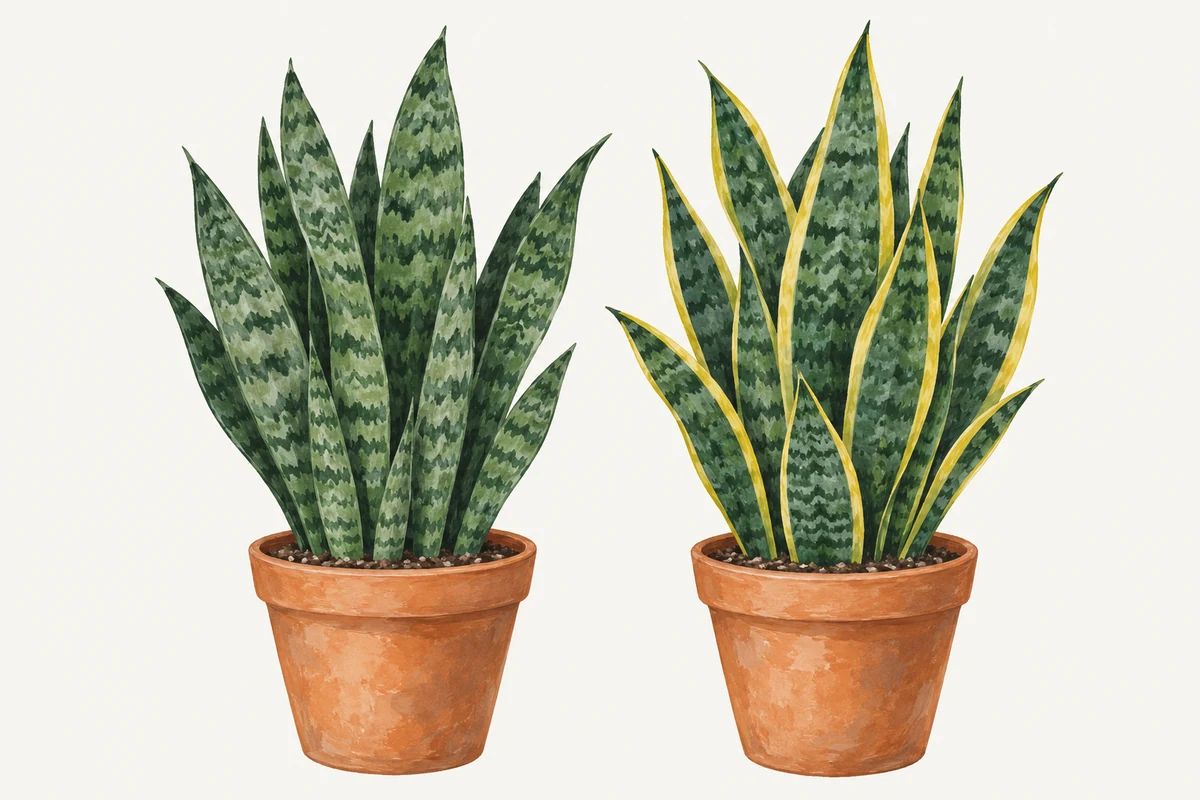
To identify a snake plant, look for stiff, flat, sword-shaped leaves that rise straight from the soil in a rosette, with no visible stem. The blades are fleshy, sharp-pointed and deep green with light gray-green crosswise bands, usually about 2 feet tall indoors. Its accepted name is Dracaena trifasciata; it was sold for decades as Sansevieria trifasciata, and many labels still say so.
- Flat leaf, crosswise bands, no stem: those three together point to Dracaena trifasciata.
- A round, pencil-like leaf belongs to the cylindrical snake plant, Dracaena angolensis, formerly Sansevieria cylindrica.
- The ASPCA lists snake plant, under its old name Sansevieria trifasciata, as toxic to dogs and cats.
Field marks at a glance
- Scientific name
- Dracaena trifasciata
- Family
- Asparagaceae (asparagus family)
- Type
- Houseplant, perennial, evergreen
- Leaves
- Stiff, erect, fleshy and sword-shaped, ending in a sharp point; flat in cross-section. NC State gives 2 to 4 inches wide; edges entire (smooth, untoothed).
- Pattern
- Deep green with light gray-green crosswise bands. The epithet trifasciata refers to the banding, usually three stripes, often more (NC State).
- Stem
- None visible. Leaves rise stiffly in a rosette from a thick rhizome under the soil (Missouri Botanical Garden).
- Texture
- Fleshy and leathery, hairless. A healthy leaf stands on its own and does not flop when you tilt the pot.
- Size
- 2 to 4 ft tall and 1 to 2 ft wide (Missouri Botanical Garden); up to 4 ft in the wild, often to about 2 ft indoors.
- Flowers
- Rare indoors. On mature plants in spring: small, fragrant, sticky, greenish-white flowers on an upright raceme, followed by orange berries.
- Native range
- Tropical West and West Central Africa (NC State; Missouri Botanical Garden says tropical western Africa).
- Other names
- Sansevieria trifasciata (former name), mother-in-law's tongue, good luck plant, golden bird's nest.
The snake plant (Dracaena trifasciata) is a stiff, upright houseplant that NC State says tolerates very low light, and it is easy to recognize once you know the three marks: a flat, sword-shaped leaf, crosswise bands, and no stem. Check them in the order below; the cultivar names come last.
How to identify a snake plant in four checks
1. The leaf shape. Look at a leaf from the side and then from above. A snake plant leaf is stiff, fleshy, sword-shaped and sharply pointed, and it is flat: it has a front and a back. The NC State Plant Toolbox gives a width of 2 to 4 inches and describes the leaves as stiff, upright and succulent, growing in rosettes or clusters. If the leaf is round like a pencil, you have the cylindrical snake plant instead (see below).
2. The bands. Turn the pot to the light. The standard species is deep green with light gray-green stripes that run across the leaf, not along it. The Missouri Botanical Garden describes them as horizontal stripes, and NC State notes that the epithet trifasciata, "three bands", refers to this pattern, though most leaves carry more than three.
3. The base. Push the leaves apart at soil level. There is no trunk and no branching stem: each leaf comes straight out of the soil from a thick, creeping rhizome, and new leaves appear as fresh shoots beside the old clump. A plant with a woody cane topped by a tuft of leaves is a different dracaena.
4. The edge. Run a finger along the margin. It is smooth, never toothed or spiny. Many cultivars add a yellow or cream edge or lengthwise stripes, but the smooth margin stays the same.
If the plant came without a label, one photo of a whole leaf in good light is enough for Plant Identifier to give you a common and scientific name. The app shows no confidence score and no list of alternatives, so compare its answer with the four checks above before you trust it.
Snake plant cultivars you will see in stores
Many snake plants are sold as named selections (cultivars) of the same species. NC State lists 14 of them, and Missouri Botanical Garden profiles several more. The ones you are most likely to meet:
- 'Laurentii': dark green with zigzags of lighter green and yellow edges (NC State). It is the classic yellow-edged snake plant.
- 'Hahnii': a dwarf with 6 to 12 leaves forming a short, funnel-shaped rosette, dark green with creamy white crosswise stripes (NC State). It is often called bird's nest snake plant.
- 'Moonshine': silvery-gray leaves with light green blotches and narrow dark green margins.
- 'Futura Superba': gray-green leaves with a yellow margin.
- 'Twisted Sister': twisting leaves variegated yellow-gold and green.
- 'Bantel's Sensation': dark gray-green leaves with vertical creamy white stripes, up to 3 feet tall and 1.25 inches wide (Missouri Botanical Garden).
- 'Black Robusta': dark green leaves with contrasting gray-green crossbands, up to 2 feet tall and 2.5 inches wide, spreading slowly by underground runners (Missouri Botanical Garden).
A cultivar keeps the species' flat, sword-shaped, stemless form, so the four checks still work. What changes is the color pattern and the height.
Snake plant vs cylindrical snake plant and ZZ plant
Two other low-light favorites are often sold beside it, and a quick look at one leaf separates them.
| Feature | Snake plant | Cylindrical snake plant | ZZ plant |
|---|---|---|---|
| Scientific name | Dracaena trifasciata | Dracaena angolensis (formerly Sansevieria cylindrica) | Zamioculcas zamiifolia |
| Leaf cross-section | Flat | Round or nearly round, about 1 inch thick | Flat leaflets on a thick round stalk |
| One leaf is | A single blade | A single spear | A stalk with two rows of leaflets |
| Pattern | Gray-green crosswise bands | Gray-green stripes | Plain glossy green |
| Family | Asparagaceae | Asparagaceae | Araceae (aroid family) |
The cylindrical snake plant can grow leaves up to 7 feet long. Its fan-shaped cultivar 'Boncel', nicknamed starfish, has thicker, shorter leaves that spread from the base like a fan. The ZZ plant has its own page: ZZ plant. The same leaf-first approach works for every houseplant in the houseplant identification key.
Why the label may say Sansevieria
Botanists have moved the snake plants from Sansevieria into Dracaena. NC State now files this plant as Dracaena trifasciata, "previously known as" Sansevieria trifasciata, and the cylindrical snake plant as Dracaena angolensis, previously Sansevieria cylindrica. Missouri Botanical Garden's Plant Finder and the ASPCA still use the old names, and so do many plant tags. Both names refer to the same plant, so search under either.
The family name moved too: the ASPCA entry gives Agavaceae, while NC State and Missouri Botanical Garden place it in Asparagaceae, the asparagus family.
Is snake plant toxic to pets
The ASPCA lists snake plant, under the name Sansevieria trifasciata, as toxic to dogs and cats. It names saponins as the toxic principle and lists nausea, vomiting and diarrhea as clinical signs. NC State rates the poison severity as low and lists every part of the plant.
If a pet has chewed a leaf, call your vet or the ASPCA Animal Poison Control Center at (888) 426-4435. If a person has eaten part of the plant, call Poison Control at 1-800-222-1222 (poison.org). Plant Identifier's Toxicology tool gives AI-written notes for people, dogs and cats, but it does not replace that call. Other common houseplants on the ASPCA's list are gathered in plants toxic to cats.
A short care note
Both sources describe a forgiving plant whose main enemy is water. Missouri Botanical Garden recommends a well-draining potting mix, regular watering in the growing season with much less from fall to late winter, and no water poured into the center of the rosette; it warns that overwatering often causes root rot. NC State suggests letting the soil dry between waterings from spring to autumn and watering only every one to two months in winter. The plant prefers warm, bright places, tolerates some shade and should be kept out of hot afternoon sun. Watch for mealybugs and spider mites.
Look-alikes and how to tell them apart
Cylindrical snake plant (Dracaena angolensis, formerly Sansevieria cylindrica)
Roll a leaf between two fingers. Cylindrical snake plant leaves are round or nearly round in cross-section, about 1 inch thick and striped gray-green, and can reach 7 feet (NC State). A snake plant leaf is flat, with a clear front and back, and 2 to 4 inches wide.
ZZ plant (Zamioculcas zamiifolia)
Count the parts of one leaf. A ZZ plant leaf is a thick stalk carrying 6 to 8 pairs of glossy, oval leaflets (Missouri Botanical Garden). A snake plant leaf is one single blade, with no stalk and no leaflets.
'Laurentii' and other yellow-edged cultivars
Same species, not a different plant. Look at the margin: 'Laurentii' is dark green with lighter green zigzags and yellow edges (NC State), and 'Futura Superba' is gray-green with a yellow margin. A plain-edged, banded leaf is the standard species.
'Hahnii' (bird's nest snake plant)
Also the same species. Check the shape of the plant: 'Hahnii' is a dwarf of 6 to 12 leaves in a short, funnel-shaped rosette, dark green with creamy white crosswise stripes (NC State), instead of tall, upright blades.
What a photo can't settle
- Cultivar names (Laurentii, Futura Superba, Black Robusta, Moonshine and many more) differ in color and size, and many look alike in a photo. A store label is a better guide to the cultivar than any app.
- Flowers and berries are rarely produced indoors, so the identification rests on the leaves alone; a young, plain-green leaf can be hard to place.
- Neither a photo nor this page can tell whether a pet ate enough to matter: that is a question for your vet or the ASPCA Animal Poison Control Center.
Questions people ask
Is a snake plant a succulent?
It stores water in its leaves the way succulents do. NC State describes it as an evergreen herbaceous perennial with stiff, upright, succulent leaves, and Missouri Botanical Garden lists it as drought tolerant. It belongs to the asparagus family (Asparagaceae), not the cactus or stonecrop families.
Is Sansevieria the same as a snake plant?
For the common snake plant, yes. The plant sold for decades as Sansevieria trifasciata is now Dracaena trifasciata; NC State lists Sansevieria trifasciata as its former name. Missouri Botanical Garden's Plant Finder and the ASPCA still file it under Sansevieria, so you will see both names on labels.
Does a snake plant flower?
Mature plants can, but rarely indoors. Missouri Botanical Garden describes small, fragrant, greenish-white flowers in spring followed by orange berries; NC State adds that the flowers are sticky and grow on an upright raceme. A flowering spike does not mean the plant is dying.
Is snake plant poisonous to cats and dogs?
The ASPCA lists snake plant (as Sansevieria trifasciata) as toxic to dogs and cats, naming saponins and listing nausea, vomiting and diarrhea. If your pet chewed a leaf, call your vet or the ASPCA Animal Poison Control Center at (888) 426-4435. For a person, call Poison Control at 1-800-222-1222.
Sources
- Dracaena trifasciata — North Carolina Extension Gardener Plant Toolbox (NC State)
- Dracaena angolensis — North Carolina Extension Gardener Plant Toolbox (NC State)
- Sansevieria trifasciata (snake plant), Plant Finder — Missouri Botanical Garden
- Sansevieria trifasciata 'Bantel's Sensation', Plant Finder — Missouri Botanical Garden
- Sansevieria trifasciata 'Black Robusta', Plant Finder — Missouri Botanical Garden
- Zamioculcas zamiifolia (ZZ plant), Plant Finder — Missouri Botanical Garden
- Snake Plant — ASPCA Animal Poison Control Center
- Poison Control — National Capital Poison Center
Keep reading
- Houseplant profileZZ plant (Zamioculcas zamiifolia): how to identify it
- Houseplant profileSpider plant (Chlorophytum comosum): how to identify it
- Houseplant profileUmbrella plant (Heptapleurum, formerly Schefflera): how to identify it
- Pet safety guidePlants toxic to cats, and what to do if your cat chewed one
- Field guideSucculent identification: how to identify succulents by shape, leaf and sap