Houseplant profile
ZZ plant (Zamioculcas zamiifolia): how to identify it
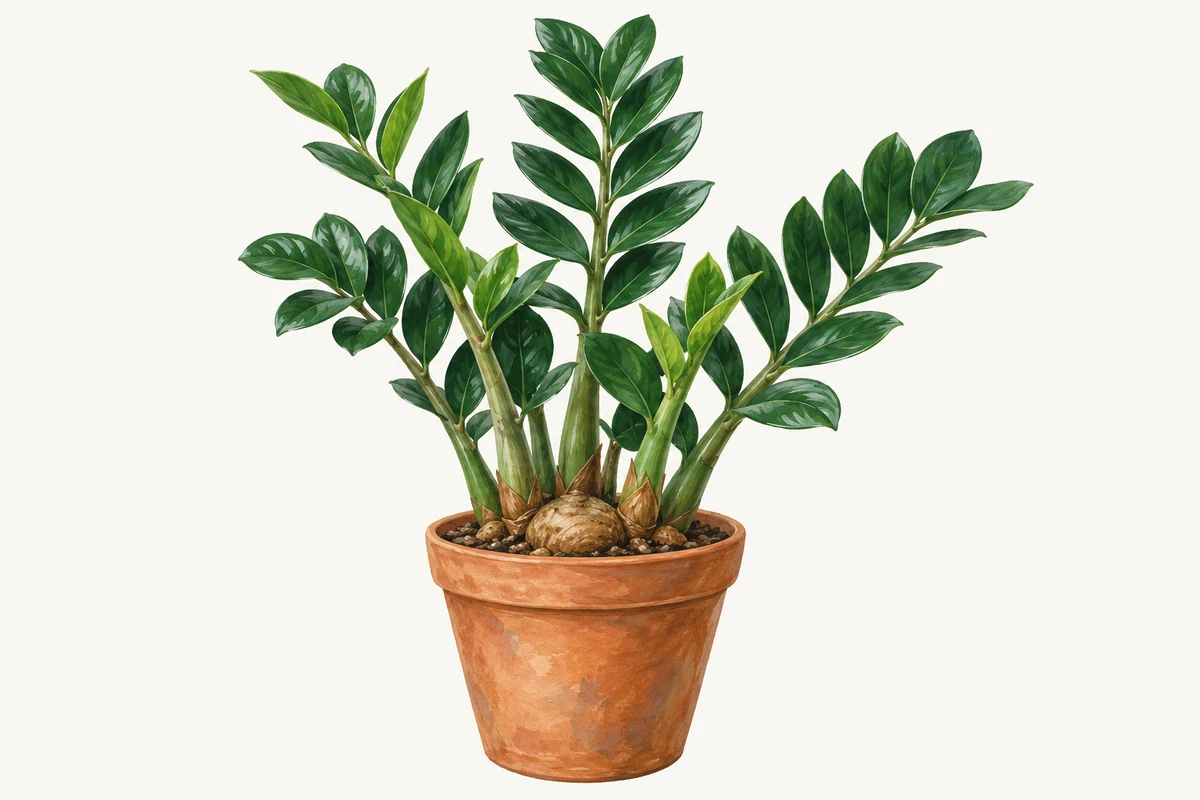
Upright, thick stalks lined with two rows of glossy, oval leaflets, all rising straight from the soil. One leaf is the whole stalk, not a single leaflet.
In short
How to identify a ZZ plant: look for stiff, upright stalks rising straight from the soil, each lined with two rows of glossy, oval, dark green leaflets. Each stalk is one compound leaf; its base is thick, fleshy and round, tapering toward the tip. Under the soil sits a swollen, water-storing rhizome. Zamioculcas zamiifolia is an aroid from eastern Africa, usually 2 to 3 feet tall indoors.
- One ZZ leaf is the whole stalk with its paired leaflets; what looks like a branch is a single compound leaf.
- 'Raven' is the same species with near-black leaves; its new growth comes up bright green.
- The ASPCA's plant list has no ZZ plant entry (checked 2026-10-21); NC State Extension lists it as toxic to cats and dogs.
Field marks at a glance
- Scientific name
- Zamioculcas zamiifolia
- Family
- Araceae (arum family)
- Type
- Houseplant, perennial, evergreen
- Leaves
- Pinnately compound: each leaf is an erect stalk 2 to 4 ft long carrying leaflets in two rows (NC State). Missouri Botanical Garden counts 6 to 8 pairs per leaf; NC State says around 25 leaflets.
- Leaflets
- Elliptic, glossy, dark green, fleshy and leathery, with smooth (entire) edges and no hairs; about 1 to 2 inches long according to NC State, up to 6 inches according to Missouri Botanical Garden.
- Leaf stalk
- Thick and fleshy, round in cross-section, green, and tapering toward the top (NC State). It feels firm, almost like a succulent stem.
- Underground
- A bulbous, fleshy rhizome that stores water, which is why the plant tolerates drought (NC State, UF/IFAS). It often shows when you repot.
- Stem
- None above ground: Missouri Botanical Garden calls it stemless, with every leaf rising from the rhizome. There is no branching and no woody trunk.
- Size
- Usually about 2 to 3 ft tall and wide (Missouri Botanical Garden); NC State gives 2 to 4 ft, and UF/IFAS up to 3 to 4 ft tall indoors. Slow-growing.
- Flowers
- Uncommon. On mature plants: a green, sheath-like spathe around an erect, creamy-white spadix of tiny flowers, the typical aroid structure.
- Native range
- Eastern Africa, in dry grassland and forest (Missouri Botanical Garden); NC State lists Kenya, Tanzania, Malawi, Mozambique, Zimbabwe and KwaZulu-Natal.
The ZZ plant (Zamioculcas zamiifolia) is a slow-growing aroid from eastern Africa, kept indoors for its glossy leaves and its tolerance of dry soil and low light. The key to identifying it is to see what a leaf really is: not one oval leaflet, but the whole upright stalk.
How to identify a ZZ plant in four checks
1. Find one whole leaf. Pick a stalk and follow it from the soil to the tip. That entire stalk is one leaf. The NC State Plant Toolbox describes the leaves as pinnately compound, erect and alternate, 2 to 4 feet long, rising from the rhizome. Nothing branches.
2. Count the leaflets. The Missouri Botanical Garden gives 6 to 8 pairs of elliptic, glossy green leaflets per leaf, up to 6 inches long; NC State counts around 25 leaflets of about 1 to 2 inches, so expect a range. They are fleshy and leathery, with smooth edges, and they look almost polished.
3. Squeeze the stalk base. Near the soil, the stalk is thick, fleshy, round and green, tapering toward the top (NC State). It is firm rather than woody.
4. Look under the soil. When you repot, you will find a swollen, fleshy rhizome that stores water. UF/IFAS Gardening Solutions credits these water-storing roots for the plant's drought tolerance.
If you are not sure where to start, Plant Identifier gives a common and scientific name from one photo; frame a whole stalk, not a close-up of one leaflet. The app shows no confidence score and no list of look-alikes, so check its answer against the four marks above.
ZZ plant cultivars: 'Raven' and others
The dark-leaved ZZ sold as 'Raven' is the same species. Missouri Botanical Garden's Raven profile describes very dark green to almost black foliage, with new leaves emerging bright green before maturing to near black; mature plants reach about 3 feet tall and wide. NC State lists it as Raven 'Dowon', with lime-green new growth that ages to dark purple-black.
NC State lists two more cultivars:
- 'Chameleon': leaves emerge golden-yellow and mature to dark green.
- 'Lucky': wide green leaflets with rounded tips.
A green shoot on a black-leaved plant is therefore normal for 'Raven': it is new growth that has not darkened yet. The stalk-and-leaflet structure is the same in every cultivar.
ZZ plant vs snake plant and jade plant
These three are often sold side by side as low-maintenance plants, and all three store water. One look at the structure of a leaf separates them.
| Feature | ZZ plant | Snake plant | Jade plant |
|---|---|---|---|
| Scientific name | Zamioculcas zamiifolia | Dracaena trifasciata | Crassula ovata |
| Family | Araceae | Asparagaceae | Crassulaceae |
| A leaf is | A stalk with two rows of leaflets | One flat sword-shaped blade | One thick oval pad, 1 to 3.5 in |
| Above-ground stem | None; stalks rise from the rhizome | None; leaves rise from the rhizome | Branched, thick, becoming woody |
| Surface | Glossy, plain green (near black in 'Raven') | Gray-green crossbands | Shiny, mid to dark green, red edges in sun |
The jade plant facts are from NC State, which describes opposite, fleshy leaves clustered at the branch tips and peeling bark with ring-like scars. Each of the other two has its own page: snake plant and jade plant.
Is the ZZ plant toxic to pets
The ASPCA's Toxic and Non-Toxic Plant List had no entry for ZZ plant or Zamioculcas when we checked on 2026-10-21. The ASPCA notes that its list is not all-inclusive, so a missing entry is not a verdict either way.
NC State Extension lists ZZ plant with medium poison severity, calcium oxalate as the toxic principle and the leaves as the poisonous part; eating them in quantity may cause vomiting and diarrhea, and it rates the toxicity to cats and dogs as medium. UF/IFAS states that all parts of the plant are toxic if ingested.
If a pet has chewed it, call your vet or the ASPCA Animal Poison Control Center at (888) 426-4435. For a person, call Poison Control at 1-800-222-1222 (poison.org). The plants toxic to cats guide covers the houseplants on the ASPCA's list.
A short care note
The sources agree that water, not neglect, is what kills a ZZ plant. NC State recommends well-drained potting soil allowed to dry out between waterings, about once a month in winter and up to twice a month in summer, and only when the soil is completely dry; UF/IFAS warns that roots left sitting in water may rot. Bright, indirect light suits it best, though it tolerates low light, and NC State notes that direct sun can scald and brown the leaves. Missouri Botanical Garden suggests bringing plants indoors when temperatures dip below 60°F. For leaves turning yellow, see yellow leaves on plants; Plant Identifier's Diagnose tool can also look at a photo of the affected stalk.
Look-alikes and how to tell them apart
Snake plant (Dracaena trifasciata)
Look for leaflets. A snake plant leaf is one flat, sword-shaped blade with gray-green crossbands and no stalk. A ZZ leaf is a round stalk carrying two rows of separate, oval, plain glossy leaflets.
Jade plant (Crassula ovata)
Follow a stem down to the soil. Jade plant has branched, thick stems that turn woody with peeling bark, and its oval leaves sit directly on the branches in opposite pairs, 1 to 3.5 inches long, often red-edged in sun (NC State). ZZ stalks never branch and every one rises straight from the soil.
'Raven' ZZ plant (Zamioculcas zamiifolia 'Raven')
Same species, different color. 'Raven' leaves are very dark green to almost black, and new leaves come up bright green before darkening (Missouri Botanical Garden). If an all-green plant has the same stalks and leaflets, it is the standard ZZ.
What a photo can't settle
- A photo of a single leaflet can be confused with many glossy houseplants; photograph a whole stalk from the soil to the tip so the paired leaflets show.
- Cultivars such as 'Raven', 'Chameleon' and 'Lucky' differ mostly in color and leaflet shape, and young growth of 'Raven' is green: a photo cannot always tell the cultivar.
- Whether a pet that chewed a ZZ plant needs treatment is a question for your vet or a poison control center, not for an identification app.
Questions people ask
What does ZZ stand for?
ZZ is short for the scientific name, Zamioculcas zamiifolia (UF/IFAS). Missouri Botanical Garden explains that the genus name joins Zamia, an unrelated cycad, with calcas, an Arabic name for elephant's ear, and that zamiifolia means with leaves like Zamia.
Is a ZZ plant a succulent?
Not botanically: it is an aroid, in the same family as anthurium and philodendron (UF/IFAS). It behaves somewhat like a succulent, though, because its fleshy rhizome and thick stalks store water, which is why NC State calls it highly drought tolerant.
Is the ZZ plant toxic to cats and dogs?
The ASPCA's plant list has no ZZ plant entry as of 2026-10-21, and that list is not all-inclusive. NC State Extension lists ZZ plant as toxic to cats and dogs (calcium oxalate). If your pet chewed it, call your vet or the ASPCA Animal Poison Control Center at (888) 426-4435. For a person, call Poison Control at 1-800-222-1222.
Why does my ZZ plant have black leaves?
If the leaves are glossy and evenly near-black, you most likely have the cultivar 'Raven', whose new leaves emerge bright green and darken as they mature (Missouri Botanical Garden). Black, soft or collapsing stalks are a different matter: check the soil and the rhizome for rot.
Sources
- Zamioculcas zamiifolia — North Carolina Extension Gardener Plant Toolbox (NC State)
- Zamioculcas zamiifolia (ZZ plant), Plant Finder — Missouri Botanical Garden
- Zamioculcas zamiifolia 'Raven', Plant Finder — Missouri Botanical Garden
- ZZ Plant — UF/IFAS Gardening Solutions
- Crassula ovata — North Carolina Extension Gardener Plant Toolbox (NC State)
- Sansevieria trifasciata (snake plant), Plant Finder — Missouri Botanical Garden
- Toxic and Non-Toxic Plant List — ASPCA Animal Poison Control Center
- Poison Control — National Capital Poison Center
Keep reading
- Houseplant profileSnake plant (Dracaena trifasciata): how to identify it
- Plant profileJade plant (Crassula ovata): how to identify it
- Houseplant profileYucca (Yucca gigantea): how to identify it
- Plant healthYellow leaves on plants, and what each pattern means
- Pet safety guidePlants toxic to cats, and what to do if your cat chewed one