Houseplant profile
Yucca (Yucca gigantea): how to identify it
The yucca sold as a houseplant is the giant or spineless yucca: a thick, woody trunk topped with rosettes of stiff, soft-tipped leaves. Here is what to check.
In short
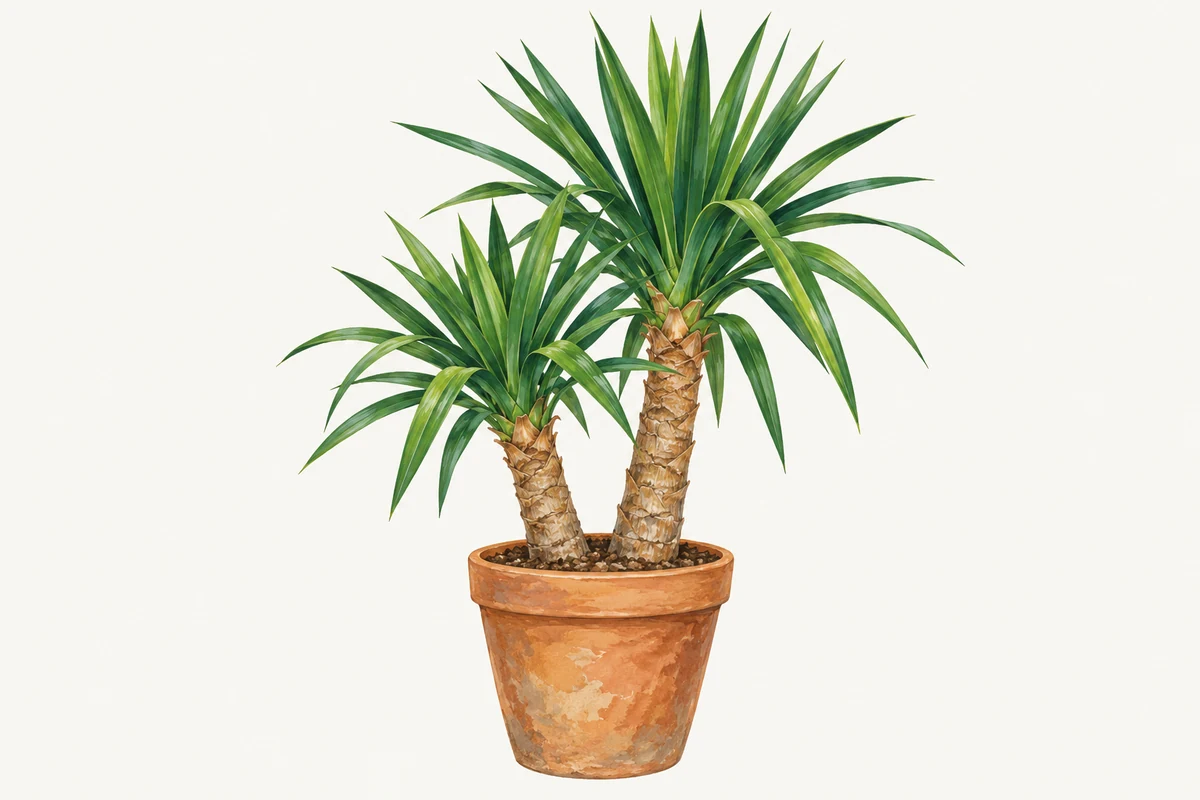
Yucca plant identification starts with the trunk and the leaves. The indoor yucca is usually Yucca gigantea, the giant or spineless yucca: a thick, woody trunk that swells at the base, topped with spiral rosettes of stiff, leathery, pale green to blue-green leaves 12 to 18 inches long with soft tips. Garden yuccas such as Adam's needle are stemless clumps with sharply pointed leaves.
- A thick, woody trunk plus rosettes of stiff, soft-tipped, blue-green leaves point to giant yucca (Yucca gigantea).
- Slender, flexible stems with narrow leaves suggest a dragon tree; a stemless clump of sharp leaves with curly threads is Adam's needle.
- The ASPCA lists yucca as toxic to dogs, cats and horses (saponins).
Field marks at a glance
- Scientific name
- Yucca gigantea
- Family
- Asparagaceae (asparagus family)
- Type
- Houseplant, perennial, evergreen
- Leaves
- Linear to lance-shaped, 12 to 18 inches long, in spiral rosettes at the top of the trunk or branches (NC State).
- Leaf texture
- Smooth, leathery and stiff, pale green to blue-green, with soft tips rather than sharp spines (NC State).
- Trunk
- Thick and woody, often swollen at the base; the old name Yucca elephantipes refers to a trunk like an elephant's foot (NC State).
- Habit
- A large, upright succulent shrub or small tree, often with several stems; potted plants may carry several heads of leaves (NC State).
- Flowers
- Creamy-white, bell-shaped, in clusters on tall stalks in late spring or summer (NC State). Rare on indoor plants.
- Size
- 15 to 30 ft tall and 15 to 25 ft wide outdoors; much more compact as a houseplant (NC State).
- Native range
- Central America (NC State). Hardy outdoors only in USDA zones 10 to 12.
- Names
- Accepted as Yucca gigantea Lem. by World Flora Online, with Y. elephantipes and Y. guatemalensis as synonyms. Cultivars include 'Marginata' and 'Variegata'.
The yucca sold as a houseplant is almost always the giant or spineless yucca (Yucca gigantea), a Central American plant grown for its upright trunk and rosettes of stiff leaves. Several other trunked or rosette plants look similar, so check the plant in the order below.
How to identify a yucca plant in four checks
1. The trunk. Look at the base. A giant yucca has a thick, woody trunk, and an old name, Yucca elephantipes, refers to a trunk that resembles an elephant's foot. The NC State Plant Toolbox describes it as a large, upright succulent shrub or small tree; potted plants are often sold with several stems or heads of leaves.
2. The leaf arrangement. The leaves grow in spiral rosettes at the top of each stem, so the plant looks like a tuft on a post.
3. The leaf itself. Feel a leaf. It is smooth, leathery and stiff, pale green to blue-green, linear to lance-shaped and 12 to 18 inches long. The tip is soft, which is why it is also called spineless yucca; NC State notes that most other yucca species have sharp, spine-tipped leaves.
4. Flowers, if any. Outdoors, creamy-white, bell-shaped flowers appear in clusters on tall stalks in late spring or summer, followed by oval, fleshy brown fruit. Indoor plants rarely flower, so do not rely on this check.
When a plant arrives without a tag, Plant Identifier can give a common and scientific name from one photo; frame the trunk and a rosette of leaves together. The app shows no confidence score and no list of alternatives, so compare its answer with the checks above.
Yucca names and cultivars
World Flora Online accepts Yucca gigantea Lem. and lists Yucca elephantipes and Yucca guatemalensis among its synonyms, so a tag with any of the three names means the same plant. NC State lists two cultivars:
- 'Marginata': pale green leaves with a narrow cream stripe along both edges, small teeth on the margins and soft tips.
- 'Variegata': soft-tipped, flexible, 12 to 18-inch pale green leaves with broad cream stripes.
Outdoors in USDA zones 10 to 12, giant yucca can reach 15 to 30 feet tall; as a houseplant it stays much more compact. The garden yuccas are a different story. UF/IFAS Gardening Solutions describes yuccas as having clusters of white flowers above strap-shaped leaves, often sharply pointed, and names Spanish bayonet, mound lily yucca and Adam's needle as Florida natives.
Yucca vs dragon tree, cabbage tree and Adam's needle
| Feature | Giant yucca | Dragon tree | Cabbage tree | Adam's needle |
|---|---|---|---|---|
| Stem | Thick, woody trunk | Slender, flexible stems | Cane-like trunk with age; none when young | None, a basal clump |
| Leaf size | 12 to 18 in | Long and narrow | About 3 ft by 3 in | Sword-shaped |
| Leaf tip | Soft | Pointed | Sword-like | Sharply pointed |
| Leaf edge | Smooth (small teeth in 'Marginata') | Often pink or red in cultivars | Plain or colored in cultivars | Curly, thread-like filaments |
| Grown | Indoors and in warm gardens | Indoors | Indoors and outdoors | Garden |
Sources: NC State on the dragon tree, NC State on the cabbage tree and NC State on Adam's needle. The dragon tree and the corn plant are covered in more detail on the dracaena page. For other tall, leafy houseplants, the houseplant identification key asks about leaf, stem and habit in turn, and succulent identification covers other fleshy-leaved plants.
Is a yucca toxic to pets
The ASPCA lists yucca (Yucca spp.) as toxic to dogs, cats and horses. It names saponins as the toxic principle and lists vomiting in dogs and cats, and liver disease and dermatitis in horses. NC State lists the leaves and roots as toxic to humans, cats, dogs and horses.
If a pet has chewed a leaf, call your vet or the ASPCA Animal Poison Control Center at (888) 426-4435. For a person, call Poison Control at 1-800-222-1222 (poison.org). Plant Identifier's Toxicology tool gives AI-written notes for people, dogs and cats; treat them as a starting point, not as the answer. More houseplants on the ASPCA's lists are in plants toxic to cats and poisonous plants for dogs.
A short care note
NC State describes giant yucca as drought tolerant and warns that overwatering can cause root rot. For a houseplant it recommends a mix of one part potting mix to three parts perlite or sand for drainage, and keeping the plant away from cold drafts and sudden temperature changes. Plants kept outdoors in summer need to come in when temperatures drop below 50°F. For yellowing leaves, see yellow leaves on plants.
Look-alikes and how to tell them apart
Dragon tree (Dracaena reflexa var. angustifolia, sold as Dracaena marginata)
Compare the stems. A dragon tree has slender, flexible stems that can be braided or spiraled and long, narrow leaves, often edged pink or red in cultivars such as 'Bicolor' and 'Magenta' (NC State). Giant yucca has a thick, woody trunk and broader, stiff, blue-green leaves.
Cabbage tree (Cordyline australis)
Measure a leaf. Cabbage tree leaves are sword-like and about 3 feet long by 3 inches wide, clustered at branch tips, and young plants sold indoors are a fountain of grass-like leaves with no trunk (NC State). Giant yucca leaves are 12 to 18 inches on a thick trunk.
Adam's needle (Yucca filamentosa)
Look at the leaf edges. Adam's needle is a stemless garden clump of sharply pointed, sword-shaped leaves with curly, thread-like filaments along the margins (NC State). Giant yucca grows a trunk and its leaves have soft tips and no threads.
What a photo can't settle
- Young yuccas without a visible trunk can look like cordylines or other rosette plants; a photo of the base of the plant helps.
- Many yucca species exist, and garden yuccas can be hard to tell apart from a photo of the leaves alone; flowers and fruit help.
- Whether a pet that chewed a leaf needs treatment is for your vet or a poison control center to decide, not for this page or an app.
Questions people ask
Is a yucca a palm or a cactus?
Neither. NC State places yucca in the asparagus family, Asparagaceae, and describes the giant yucca as a succulent shrub or small tree. Its trunk and tuft of leaves can look palm-like, but it is not related to palms or cacti.
Do houseplant yuccas have sharp leaves?
The usual houseplant, Yucca gigantea, is called spineless yucca because its leaves have soft tips, unlike most yuccas (NC State). The cultivar 'Marginata' has small teeth on the margins. Garden yuccas such as Spanish bayonet often have sharply pointed leaves (UF/IFAS).
What is the difference between yucca and Yucca elephantipes?
They are the same plant. Yucca elephantipes is an older name; World Flora Online accepts Yucca gigantea and lists Y. elephantipes and Y. guatemalensis as synonyms. Plant tags still use all three.
Is yucca poisonous to cats and dogs?
The ASPCA lists yucca as toxic to dogs, cats and horses, naming saponins and vomiting in dogs and cats as the clinical sign. If your pet chewed it, call your vet or the ASPCA Animal Poison Control Center at (888) 426-4435. For a person, call Poison Control at 1-800-222-1222.
Sources
- Yucca gigantea — North Carolina Extension Gardener Plant Toolbox (NC State)
- Yucca gigantea Lem. — World Flora Online Plant List
- Yucca — UF/IFAS Gardening Solutions
- Yucca — ASPCA Animal Poison Control Center
- Dracaena reflexa var. angustifolia — North Carolina Extension Gardener Plant Toolbox (NC State)
- Cordyline australis — North Carolina Extension Gardener Plant Toolbox (NC State)
- Yucca filamentosa — North Carolina Extension Gardener Plant Toolbox (NC State)
- Poison Control — National Capital Poison Center
Keep reading
- Houseplant profileDracaena: how to identify corn plant, dragon tree and their relatives
- Field guideSucculent identification: how to identify succulents by shape, leaf and sap
- Pet safety guidePlants toxic to cats, and what to do if your cat chewed one
- Pet safety guidePoisonous plants for dogs, and what to do if your dog ate one
- Houseplant profileSnake plant (Dracaena trifasciata): how to identify it