Houseplant profile
Spider plant (Chlorophytum comosum): how to identify it
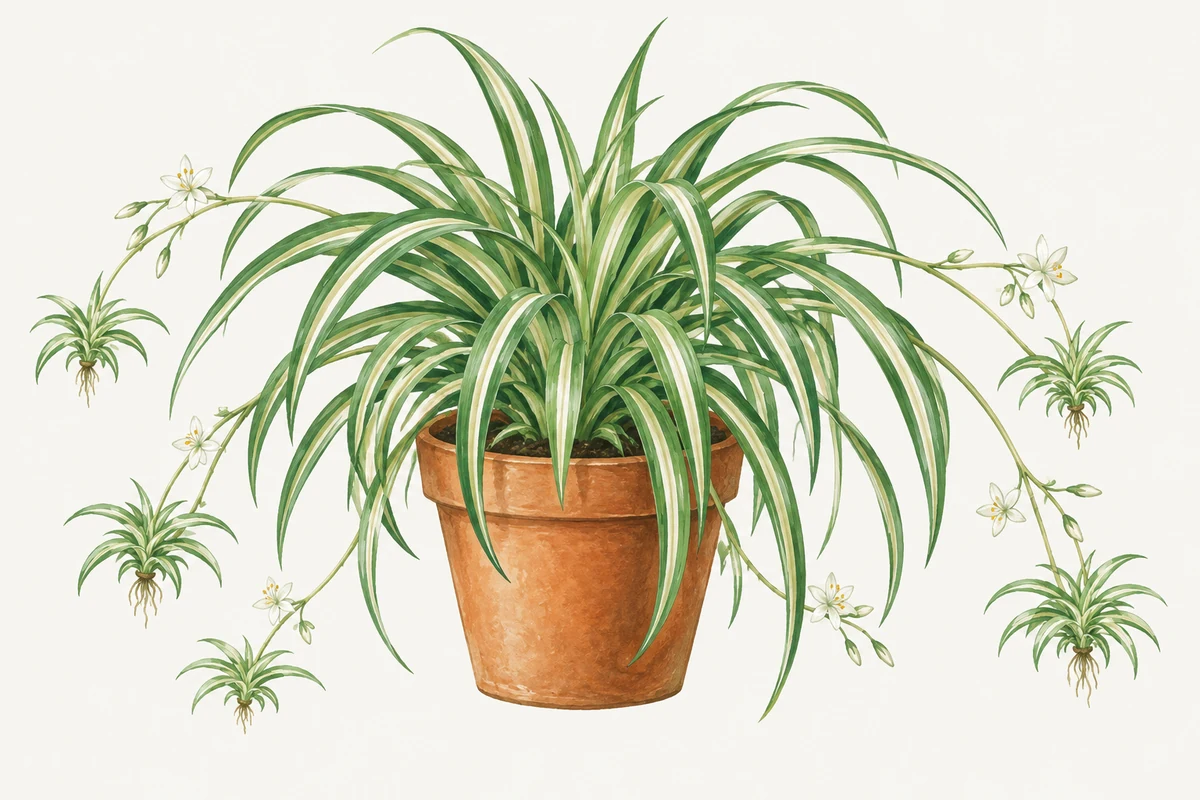
A fountain of narrow, arching leaves, usually striped cream or white, and long green runners that end in small rooted plantlets. That last mark is the one to look for.
In short
To identify a spider plant, look for a stemless rosette of narrow, arching, grass-like leaves about 12 to 18 inches long, usually green with a cream or white stripe down the center or along the edges. The clincher is the long green runners that carry tiny star-shaped white flowers and small plantlets with their own roots. Chlorophytum comosum grows 1 to 2 feet tall and is native to tropical and southern Africa.
- Runners with baby plantlets hanging from them are the mark no common look-alike shares.
- 'Vittatum' (cream center stripe) and 'Variegatum' (cream edges) are the same species; all-green plants are the rarest form.
- The ASPCA lists spider plant as non-toxic to dogs and cats; a listing is not a guarantee, and the ASPCA warns any plant can upset a pet's stomach.
Field marks at a glance
- Scientific name
- Chlorophytum comosum
- Family
- Asparagaceae (asparagus family)
- Type
- Houseplant, perennial, evergreen
- Leaves
- Simple, strap-like, linear to lanceolate and grass-like, crowded in a rosette; smooth edges, about 12 to 18 inches long, with many fine veins and a central groove (NC State).
- Color
- Green, or green with white or cream lengthwise stripes. UF/IFAS says most plants are striped down the center and all-green plants are the rarest.
- Runners
- Long green stolons (flowering stems) arch out of the clump and carry flowers and plantlets; UF/IFAS says the plantlets come pre-rooted at the tips.
- Flowers
- Small, white and star-shaped, about 1/4 inch across, with six separate tepals, in loose clusters on the runners (NC State).
- Roots
- Fleshy and tuberous; Missouri Botanical Garden warns they can burst a plastic pot before you divide and repot.
- Stem
- None visible: leaves rise from a short, compressed stem at soil level (NC State). There is no trunk or cane.
- Size and habit
- 1 to 1.5 ft tall and 1 to 2 ft wide (NC State; Missouri Botanical Garden gives 1 to 2 ft), arching to cascading; often grown in hanging baskets.
- Native range
- Tropical West Africa to Cameroon, and Ethiopia to South Africa (NC State). Missouri Botanical Garden gives South Africa.
The spider plant (Chlorophytum comosum) is one of the easiest houseplants to recognize, because it reproduces in plain sight: long runners arch out of the pot and hang miniature plants at their ends. Check the leaves first, then look for those runners.
How to identify a spider plant in four checks
1. The leaves. Spider plant leaves are narrow, strap-like and grass-like, crowded into a rosette and arching outward. The NC State Plant Toolbox describes them as linear to lanceolate, with smooth edges, many fine veins and a central groove, typically 12 to 18 inches long.
2. The stripes. Most plants are variegated. UF/IFAS Gardening Solutions says most are striped down the center in white or yellow and that all-green plants are the rarest; 'Vittatum', with a white center stripe, is the most common. The stripes always run along the leaf, never across it.
3. The runners and plantlets. This is the decisive mark. Long green stolons grow out of the clump and carry both flowers and plantlets (NC State). UF/IFAS describes the plantlets as pre-rooted at the tips; the Missouri Botanical Garden says they form at the flowering nodes. A plant with runners full of tiny rosettes is almost certainly a spider plant.
4. The flowers. Small, white, star-shaped flowers, about 1/4 inch across with six separate tepals, open in loose clusters along the runners (NC State). They are small enough to miss.
If you cannot decide, Plant Identifier can give a common and scientific name from one photo; frame the whole plant with a runner if there is one. The app does not show a confidence score or list alternatives, so check its answer against the runners and leaves above.
Spider plant varieties
All of these are cultivars of the same species, described by NC State:
- 'Vittatum': medium green leaves with a wide, creamy center stripe.
- 'Variegatum': green leaves edged in white or cream (the reverse of 'Vittatum').
- 'Bonnie': green leaves that curl and twist; 'Bonnie Variegated' adds creamy white stripes.
- 'Milky Way': a broad white or cream center with green margins.
- 'Picturatum': a central yellow stripe.
- 'Hawaiian': variegation on new leaves that fades with age.
Stripe width changes with light and the age of a leaf, so match the overall pattern rather than an exact width. The runners, plantlets and star-shaped flowers are the same in every cultivar.
Spider plant vs Dracaena marginata and lilyturf
Three different plants share the narrow-leaf, fountain-like look.
| Feature | Spider plant | Madagascar dragon tree | Lilyturf (liriope) |
|---|---|---|---|
| Scientific name | Chlorophytum comosum | Dracaena reflexa var. angustifolia (sold as D. marginata) | Liriope muscari |
| Stem | None visible | Slender tan stems with diamond-shaped leaf scars | None visible |
| Leaves | Arching, often cream- or white-striped | About 2 ft by 1/2 in, reddish edges, whorled on the stems | Dark green, narrow, arching |
| Runners with plantlets | Yes | No | No |
| Flowers | Small white stars on runners | Small white, rarely indoors | Purple to lavender spikes, late summer |
| Where you meet it | Hanging baskets, pots | Indoor pots | Garden edges and groundcover |
The dragon tree facts are from NC State on Dracaena marginata, which now files it as Dracaena reflexa var. angustifolia. The lilyturf facts are from NC State on Liriope muscari, which also notes shiny black berries that persist into winter and that lilyturf looks grass-like but is not a true grass. For other houseplants, the houseplant identification key works through the same leaf-first questions, and how to identify plants explains the method for any plant.
Is spider plant toxic to pets
The ASPCA lists spider plant (Chlorophytum comosum, also called ribbon plant and spider ivy) as non-toxic to dogs and cats. That is the ASPCA's classification, not a guarantee. Its plant list warns that eating any plant material may cause vomiting and stomach upset in dogs and cats, and that plants may differ in appearance from its photos, so it asks you to check the plant's name first.
If a pet is unwell after chewing a plant, call your vet or the ASPCA Animal Poison Control Center at (888) 426-4435. For a person, call Poison Control at 1-800-222-1222 (poison.org). Houseplants the ASPCA does list as toxic are gathered in plants toxic to cats.
A short care note
NC State and Missouri Botanical Garden describe an adaptable plant: bright, indirect light (direct sun scalds the leaves), moderately moist soil, and temperatures above 45°F. UF/IFAS suggests letting the top inch of soil dry briefly between waterings and, because the plant is sensitive to fluoridated water, using rainwater or distilled water. Missouri Botanical Garden notes the fleshy tuberous roots store food, so the plant needs little fertilizer, and that heavily fed plants may form fewer plantlets. Plantlets can be potted up to make new plants.
UF/IFAS adds a caution for Florida: it no longer recommends spider plant there, because its non-native plant assessment predicted the species would become invasive in the state.
Look-alikes and how to tell them apart
Madagascar dragon tree (Dracaena marginata, now Dracaena reflexa var. angustifolia)
Look for a trunk. The dragon tree's narrow leaves, about 2 ft long and 1/2 inch wide with reddish edges, grow in whorls on slender tan stems marked with diamond-shaped leaf scars, and the lower leaves fall with age (NC State). A spider plant has no stem at all and sends out runners with plantlets.
Lilyturf, liriope (Liriope muscari)
Check for flowers and berries. Lilyturf is a garden groundcover that forms dense clumps of dark green leaves and, in late summer, spikes of small purple to lavender flowers followed by shiny black berries (NC State). It never hangs plantlets on runners.
'Bonnie' and other spider plant cultivars
Same species. 'Bonnie' has leaves that curl and twist, 'Variegatum' has green leaves edged white or cream, and 'Vittatum' a wide creamy center stripe (NC State). If the plant makes runners with plantlets, it is a spider plant whatever the stripe.
What a photo can't settle
- Young spider plants without runners look much like other grassy-leaved plants; the identification is firmest once a runner with plantlets appears.
- Cultivar names ('Vittatum', 'Variegatum', 'Milky Way', 'Bonnie') depend on stripe width and leaf curl, which vary with light and age; a photo may not settle the cultivar.
- The ASPCA's non-toxic listing does not mean a pet can eat the plant without effects; only a vet can judge a pet that is unwell.
Questions people ask
Why is my spider plant not making babies?
Plantlets need short days. NC State says they form when the plant gets less than 12 hours of light for at least three weeks, and Missouri Botanical Garden adds long, uninterrupted nights. Both warn that heavy fertilizing reduces plantlet formation.
Why do spider plant leaves get brown tips?
Missouri Botanical Garden lists too little water, low humidity, too much salt and excess fluoride in the water as causes. NC State and UF/IFAS both say the plant is sensitive to tap water treated with chlorine or fluoride; UF/IFAS suggests rainwater or distilled water.
Is spider plant poisonous to cats?
The ASPCA lists spider plant as non-toxic to dogs and cats. That listing is not a guarantee: the ASPCA notes that eating any plant material may cause vomiting and stomach upset. If your cat is unwell after chewing it, call your vet or the ASPCA Animal Poison Control Center at (888) 426-4435.
Can spider plants grow outdoors?
In frost-free climates, yes: NC State lists USDA zones 9a to 11b. In Florida, though, UF/IFAS no longer recommends it because its non-native plant assessment predicted spider plant would become invasive there. Elsewhere it is grown mostly as a houseplant or summer basket.
Sources
- Chlorophytum comosum — North Carolina Extension Gardener Plant Toolbox (NC State)
- Chlorophytum comosum 'Vittatum' (spider plant), Plant Finder — Missouri Botanical Garden
- Spider Plant — UF/IFAS Gardening Solutions
- Spider Plant — ASPCA Animal Poison Control Center
- Toxic and Non-Toxic Plant List — ASPCA Animal Poison Control Center
- Dracaena reflexa var. angustifolia (Dracaena marginata) — North Carolina Extension Gardener Plant Toolbox (NC State)
- Liriope muscari — North Carolina Extension Gardener Plant Toolbox (NC State)
- Poison Control — National Capital Poison Center
Keep reading
- Houseplant profileYucca (Yucca gigantea): how to identify it
- Houseplant profileSnake plant (Dracaena trifasciata): how to identify it
- Pet safety guidePlants toxic to cats, and what to do if your cat chewed one
- Field guideHow to identify a plant, step by step
- Houseplant profilePothos (Epipremnum aureum): how to identify it