Houseplant profile
Pothos (Epipremnum aureum): how to identify it
Glossy heart-shaped leaves on trailing stems, a groove along each leaf stalk, and no papery sheath on new leaves. Then the variegation tells you the cultivar.
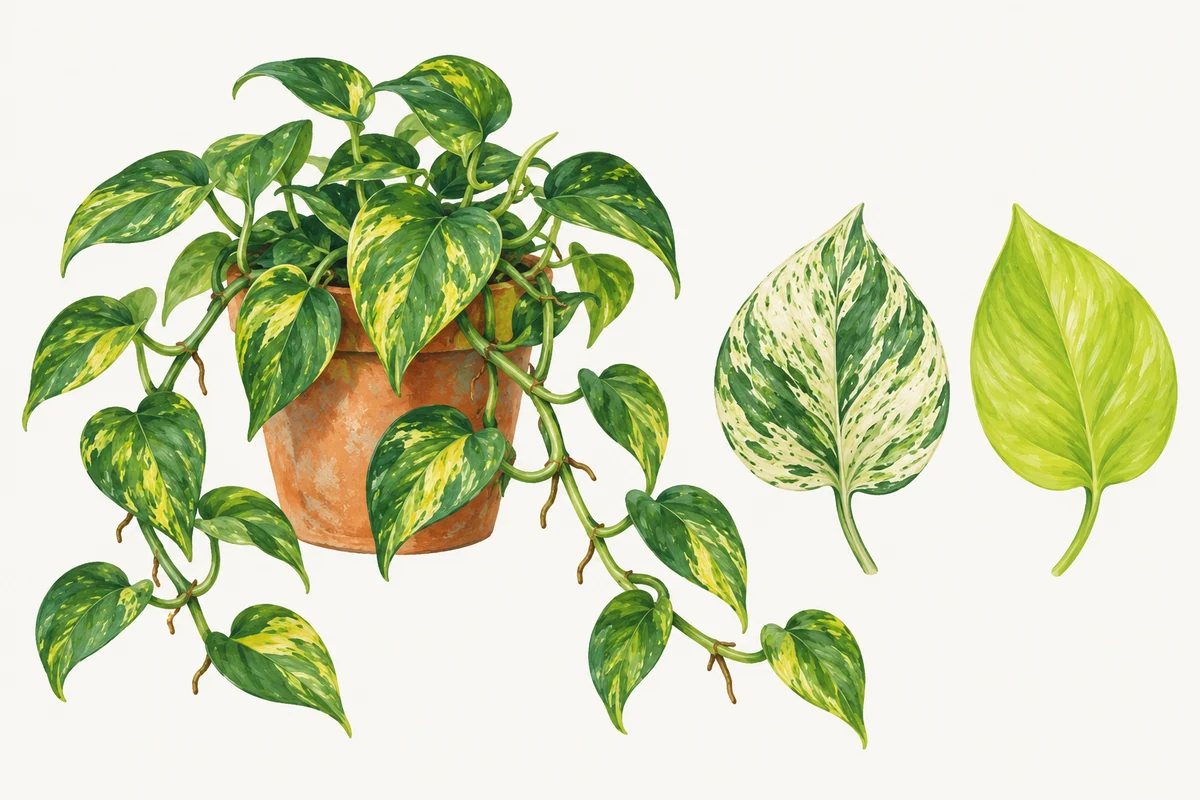
In short
A pothos plant (Epipremnum aureum) is a trailing aroid with glossy, leathery, heart-shaped leaves, usually 3 to 6 inches long, plain green or variegated yellow, cream or white. Check the leaf stalk: on pothos it is grooved where it clasps the stem, and new leaves unfold without a papery sheath. Heartleaf philodendron, its usual look-alike, has rounded stalks and sheathed new leaves.
- Grooved leaf stalk plus no sheath on the newest leaf: pothos. Rounded stalk plus a papery sheath: heartleaf philodendron.
- Golden, Marble Queen, Neon and N'Joy are cultivars of one species; the variegation pattern is the only difference that matters for naming them.
- The ASPCA lists golden pothos as toxic to cats and dogs.
Field marks at a glance
- Scientific name
- Epipremnum aureum
- Family
- Araceae (arum family)
- Type
- Houseplant, perennial, evergreen
- Leaves
- Alternate, heart-shaped to elliptic-ovate with a pointed tip, glossy and leathery; 3 to 6 in long on houseplants. They tend to fold inward along the midrib; the underside is paler.
- Color
- Plain green, or variegated with yellow, cream or white depending on the cultivar. Veins may be reddish. Low light can fade the variegation.
- Leaf stalk
- Slender, shorter than the blade and grooved, most visibly where it clasps the stem.
- New leaves
- Unfold without a separate papery sheath (cataphyll); the sheath is fused to the leaf stalk and its whitish edges dry and drop.
- Stems
- Slender, green, often striped white or yellow, with brown aerial roots that form at the nodes and grip a support.
- Habit
- Trails or climbs; usually 6 to 10 ft indoors, up to 40 ft or more outdoors in the tropics.
- Mature form
- On plants climbing a tree or pole in good light, leaves grow far larger, up to 30 in long, with deep lobes. Pots usually keep the juvenile leaf.
- Flowers and fruit
- Rarely seen, even in the wild. A boat-shaped spathe, yellow to green or purple; berries red-orange when ripe.
- Native range
- Society Islands of French Polynesia (NC State); Solomon Islands (Penn State Extension and the Missouri Botanical Garden's description).
Penn State Extension calls pothos ubiquitous in offices and homes, and it is the trailing houseplant people most often mix up with a philodendron. Its scientific name is Epipremnum aureum; you will still see the older names Scindapsus aureus and Epipremnum pinnatum 'Aureum' on labels. Two small checks settle almost every case, and the leaf color then tells you the cultivar.
What to check first: the leaf stalk and the newest leaf
1. The leaf stalk. Turn a leaf over and look at its stalk (petiole) where it meets the stem. The NC State Extension Plant Toolbox describes pothos petioles as slender, shorter than the blade and "grooved to clasp the stem," and gives "petioles are grooved" as one of its three quick ID hints. Penn State Extension adds that the groove is "especially noticeable where they seem to 'grasp' the stem." Run a fingernail along it to find the channel.
2. The newest leaf. Find the youngest leaf at a stem tip. Penn State explains that pothos leaves "emerge cleanly along the stem without a cataphyll," the protective sheath that wraps new philodendron leaves and later dries and drops. NC State puts it as "no free stipules on new growth."
3. The leaf itself. Pothos leaves are heart-shaped to elliptic-ovate with a pointed tip, glossy and leathery, 3 to 6 inches long on a houseplant, and paler underneath. Penn State notes that they fold inward along the midrib. The stems are slender, often striped white or yellow, and carry brown aerial roots; Penn State says these develop at each node.
If the stalk is grooved and the new leaf has no separate sheath, you have a pothos. If you are not sure where to start, one photo of a stem tip with a couple of leaves in Plant Identifier gives you a name to check; the app shows no confidence score and no list of alternatives, so confirm with the groove test. The houseplant identification key works through the same features for other common trailing plants.
Pothos cultivars by variegation
All the pothos sold under cultivar names are one species. Name them by color, as the sources describe them:
| Cultivar | Leaves (as the sources describe them) |
|---|---|
| 'Golden' (golden pothos) | Green with bright yellow variegation (Penn State); golden, yellow-green variegated (NC State) |
| 'Marble Queen' | Green leaves and stems marbled with white (NC State) |
| 'Neon' | Bright chartreuse (Penn State); emerge pale yellow-green and mature to chartreuse or lime green (Missouri Botanical Garden) |
| N'Joy (Beautifall 'Njoy') | Small, thinner green leaves with cream variegation (NC State) |
| 'Jade' | Solid dark green (NC State, Penn State) |
| 'Snow Queen' | Highly variegated green and white (NC State) |
The Missouri Botanical Garden's 'Neon' page adds that its stems can reach at least 20 feet in ideal conditions. Penn State notes that no pothos hybrids exist because the plant rarely flowers, even in its native habitat.
Light changes how a cultivar looks. NC State says low light can cause loss of variegation, and Penn State says a plant kept in low light eventually loses the variegation or brightness of its foliage. A pale 'Marble Queen' that turned mostly green in a dark corner is still a 'Marble Queen'.
Juvenile and mature pothos
The pothos on your shelf is a juvenile. NC State says that as a container plant it "generally retains its juvenile leaf shape," but if given a support to climb and enough light it begins to produce large, mature leaves. The Missouri Botanical Garden describes those mature leaves as up to 30 inches long with deep lobes, on vines that climb tree trunks by aerial rootlets and reach 40 feet or more. In warm climates such as southern Florida, NC State's photo captions show the vine at that full size, climbing high into trees.
Size indoors is far smaller: the Missouri Botanical Garden gives 6 to 8 feet for a houseplant, Penn State 8 to 10 feet or longer as a vine. Over time, NC State notes, older leaves yellow and fall, so the leaves concentrate at the stem tips unless you prune.
Flowers are rare. When they appear, NC State describes a boat-shaped spathe, yellow to green or purple, around a stout spadix, followed by berries that are red-orange when ripe.
Pothos vs heartleaf philodendron, satin pothos and arrowhead vine
Heartleaf philodendron (Philodendron hederaceum) is the classic confusion. NC State's heartleaf philodendron page separates it by "the conspicuous stipules on new growth, the messy, falling stipules on older growth, and by the non-grooved petioles," and says its leaves emerge bronze before turning green. The full set of tests, with a table, is on pothos vs philodendron.
Satin pothos (Scindapsus pictus) is not a pothos in the botanical sense. NC State's Scindapsus pictus page describes juvenile leaves 3 to 4 inches long with a satin texture, matte green to dark green with silver-gray blotches, and a paler underside without blotches. Glossy leaves with yellow, cream or white variegation mean pothos; matte leaves with silver blotches mean satin pothos.
Arrowhead vine (Syngonium podophyllum) has, according to NC State's Syngonium page, juvenile leaves that are arrowhead-shaped on long petioles and a bushy habit that turns vining with age, with adult leaves divided into 3 to 11 segments. A pothos leaf is heart-shaped and undivided.
A mature, climbing pothos with big lobed leaves can also be mistaken for a Monstera deliciosa; a monstera's mature leaves have holes inside the blade, not only lobes from the edge.
Toxicity and a short care note
The ASPCA lists golden pothos (Epipremnum aureum) as toxic to cats and dogs, with insoluble calcium oxalates as the toxic principle; Penn State notes that all parts contain calcium oxalate crystals, and NC State lists contact dermatitis. If a pet has chewed the plant, call your vet or the ASPCA Poison Control at (888) 426-4435 (a consultation fee may apply); for a person, call Poison Control at 1-800-222-1222.
Care, briefly: NC State recommends bright, indirect light (it survives long periods in low light) and letting a well-drained mix dry out between waterings. Penn State gives 60 to 80°F, no direct sun, and says pothos is better kept too dry than too wet, since overwatering leads to root rot. If leaves are turning yellow, Plant Identifier's Diagnose tool gives an AI check of a photo, with a severity badge the AI writes, and the yellow leaves guide covers the common causes.
Look-alikes and how to tell them apart
Heartleaf philodendron (Philodendron hederaceum)
Look at the newest leaf: a philodendron leaf emerges from a papery sheath that dries brown and falls off, and new leaves often open bronze. Its leaf stalks are rounded, not grooved. Pothos has a grooved stalk and no separate sheath.
Satin pothos (Scindapsus pictus)
Its leaves are matte with a satin texture and silver-gray blotches on the upper side only; the paler underside has no blotches. Pothos leaves are glossy, and their variegation is yellow, cream or white, not silver. Satin pothos also grows slowly.
Arrowhead vine (Syngonium podophyllum)
Juvenile leaves are arrowhead-shaped on long stalks, and the plant grows bushy before it vines; older leaves split into 3 to 11 segments. Pothos leaves stay heart-shaped and undivided on a pot-grown plant.
What a photo can't settle
- Pothos cultivars differ only in leaf color, and variegation varies from leaf to leaf and with light; a photo names the species, not reliably the cultivar on the label.
- The petiole groove and the sheath on new growth are small details: a photo taken from a distance, or of an old trailing stem with no new leaf, may not show either.
- Large lobed leaves on an old, climbing plant look nothing like the pot-grown juvenile form, so a mature pothos outdoors can be mistaken for a monstera or a philodendron.
Questions people ask
How do I know if my plant is a pothos?
Check three things: glossy, heart-shaped leaves on trailing stems; a leaf stalk with a groove along it, clearest where it clasps the stem; and new leaves that unfold without a separate papery sheath. If the stalk is rounded and the newest leaf sits in a drying brown sheath, it is a heartleaf philodendron.
What is the difference between Golden, Marble Queen and Neon pothos?
Only the leaf color. Golden pothos has green leaves variegated with yellow; Marble Queen has green leaves and stems marbled with white; Neon has bright chartreuse to lime leaves without variegation. N'Joy has small, thinner green leaves with cream variegation. All are Epipremnum aureum.
Is pothos toxic to cats and dogs?
The ASPCA lists golden pothos as toxic to dogs and cats, naming insoluble calcium oxalates. If your pet chewed it, call your vet or the ASPCA Poison Control at (888) 426-4435 (a fee may apply). For a person, call Poison Control at 1-800-222-1222.
Why is my pothos losing its variegation?
Usually light. NC State says low light can cause loss of variegation, and Penn State Extension says a pothos can survive low light for a long time but eventually loses the variegation or brightness of its foliage. Direct sun, on the other hand, yellows the leaves.
Sources
- Epipremnum aureum — NC State Extension Gardener Plant Toolbox
- Pothos as a Houseplant — Penn State Extension
- Epipremnum aureum (Plant Finder) — Missouri Botanical Garden
- Epipremnum aureum 'Neon' (Plant Finder) — Missouri Botanical Garden
- Philodendron hederaceum — NC State Extension Gardener Plant Toolbox
- Scindapsus pictus — NC State Extension Gardener Plant Toolbox
- Syngonium podophyllum — NC State Extension Gardener Plant Toolbox
- Golden Pothos (Epipremnum aureum) — ASPCA
Keep reading
- Houseplant comparisonPothos vs philodendron: how to tell them apart
- Houseplant profileOxalis (purple shamrock and woodsorrel): how to identify it
- Houseplant profileMonstera deliciosa (Swiss cheese plant): how to identify it
- Plant healthYellow leaves on plants, and what each pattern means
- Pet safety guidePoisonous plants for dogs, and what to do if your dog ate one