Houseplant profile
Oxalis (purple shamrock and woodsorrel): how to identify it
Three leaflets on a long stalk that fold down at night, and small five-petaled flowers. Indoors it is usually purple shamrock; in a lawn it is usually yellow woodsorrel. Here is what to check.
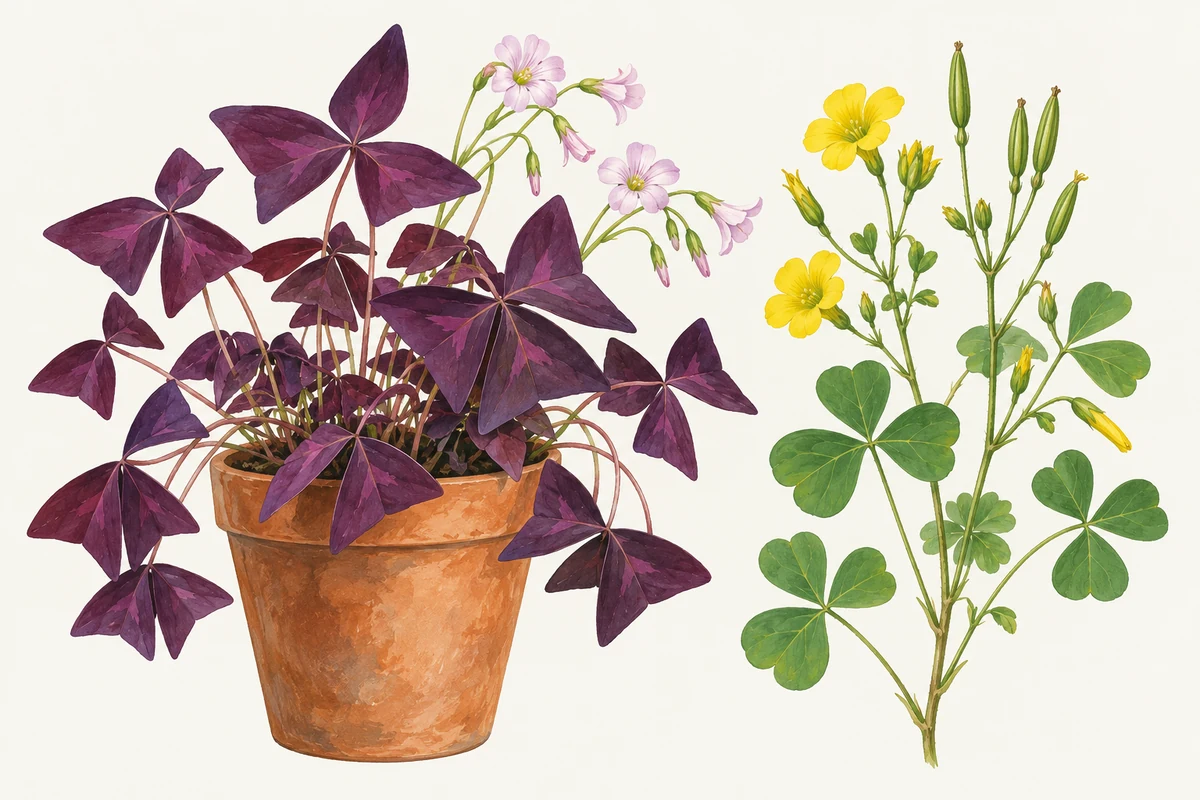
In short
An oxalis plant is a wood sorrel (Oxalidaceae) with leaves split into three leaflets that fold down at night. The purple shamrock houseplant, Oxalis triangularis, has deep maroon, triangular leaflets and white to pale pink five-petaled flowers, 6 to 18 inches tall. Lawn woodsorrels, Oxalis stricta and O. corniculata, have small heart-shaped leaflets and yellow flowers.
- Three triangular, maroon leaflets that close at night, on a low clump from rhizomes, point to purple shamrock, Oxalis triangularis.
- Heart-shaped leaflets with a center crease and yellow five-petaled flowers in a lawn mean woodsorrel; a round white flower head and a pale crescent on each leaflet mean white clover.
- The ASPCA lists shamrock plant (Oxalis spp.) as toxic to dogs, cats and horses (soluble calcium oxalates).
Field marks at a glance
- Scientific name
- Oxalis triangularis
- Family
- Oxalidaceae (wood sorrel family)
- Type
- Houseplant, perennial
- Leaves
- Trifoliolate: three leaflets joined at the tip of a long stalk, arranged in a basal rosette; 1 to 3 inches long and wide (NC State).
- Leaflet shape
- Triangular (deltoid), the narrow end at the stalk and the broad, flat end outward; the species name refers to this shape (NC State).
- Leaf color
- Deep maroon to green (NC State). Most plants sold as purple shamrock are maroon-purple, often with a paler center.
- Night movement
- The leaflets fold down and close at night, and the flowers close too (NC State).
- Flowers
- Five-petaled, white to pale pink, held above the leaves from early summer through fall (NC State).
- Roots
- Grows from rhizomes: a herbaceous perennial that can go dormant in autumn, or when too hot or too dry, then regrow (NC State).
- Size
- 6 to 18 inches tall and 1 to 2 ft wide (NC State).
- Native range
- South America (NC State). Grown as a houseplant, or outdoors in zone 8 and warmer.
- Lawn woodsorrels
- Oxalis stricta (common yellow woodsorrel), 2 to 12 inches, native to North America and Eurasia; Oxalis corniculata (creeping woodsorrel), 2 to 8 inches, on creeping stolons. Both have heart-shaped leaflets and yellow flowers (NC State).
Oxalis is a large genus in the wood sorrel family. In homes across the US, Canada and the UK it usually means purple shamrock, Oxalis triangularis, a low pot plant with maroon, triangular leaflets. In lawns and flower beds it usually means yellow woodsorrel, a small weed with heart-shaped leaflets. Both share the same leaf plan, so check the leaves and flowers in the order below.
How to identify an oxalis plant in four checks
1. Count the leaflets. An oxalis leaf is split into three leaflets that meet at the tip of a long, thin stalk. The NC State Plant Toolbox gives 1 to 3 inches long and wide for purple shamrock leaves.
2. Look at one leaflet's shape. On purple shamrock each leaflet is triangular: narrow where it joins the stalk and broad and flat at the outer edge, which is where the name triangularis comes from. On lawn woodsorrels each leaflet is heart-shaped, with a notch at the outer edge and a crease down the middle.
3. Watch it at dusk. Oxalis leaflets fold down along that center crease at night and open again in daylight. NC State notes that both the leaves and the flowers of purple shamrock close at night. 4. Check the flower. Oxalis flowers are single, five-petaled cups on their own stalks. Purple shamrock has white to pale pink flowers from early summer through fall; common yellow woodsorrel and creeping woodsorrel have bright yellow ones. A round head of many tiny white florets is clover, not oxalis.
When a shamrock arrives as a gift without a tag, Plant Identifier can give a common and scientific name from one photo; include several leaves and a flower if there is one. The app shows no confidence score and no list of alternatives, so compare its answer with the checks above.
Purple shamrock as a houseplant
NC State describes Oxalis triangularis as a rhizomatous, herbaceous perennial native to South America, 6 to 18 inches tall and 1 to 2 feet wide, with deep maroon to green leaves in a rosette and white to pale pink flowers. In areas colder than zone 8 it is grown as a houseplant. NC State advises a loamy potting mix with good drainage, letting the surface dry between waterings, and full sun to partial shade.
The trait that confuses most owners is dormancy. NC State notes that the plant may go dormant for a while in autumn, or if it gets too hot or too dry; the leaves collapse and the pot looks empty. The rhizomes are still alive. Cut back on watering and wait for new growth to appear. If the leaves are yellowing rather than collapsing, see yellow leaves on plants. A purple shamrock that folds its leaves at night is easy to mix up with a prayer plant; the prayer plant page shows how its leaves differ.
Oxalis in the lawn: yellow woodsorrel
Two woodsorrels are common in lawns and beds. The NC State page on Oxalis stricta describes common yellow woodsorrel as a perennial weed native to North America and Eurasia, 2 to 12 inches tall, with heart-shaped trifoliate leaflets, bright yellow five-petaled flowers and cylindrical seed pods that burst and can throw seeds up to 16 feet. It spreads by rhizomes, stolons and seed and can grow in poor soil.
Creeping woodsorrel, Oxalis corniculata, stays lower, 2 to 8 inches, and NC State notes that, unlike similar species, its leaves grow alternately along long creeping stolons that run above and below ground. Its heart-shaped leaflets can be green or purple, so a purple-leaved patch in a lawn is often creeping woodsorrel rather than an escaped houseplant. Its capsules also burst to fling seeds when ripe. If you decide to control woodsorrel with a herbicide, follow the label and local rules. For other common lawn weeds, see how to identify weeds in a lawn.
Oxalis vs white clover
Woodsorrel and white clover grow side by side in lawns and both have three leaflets, so they are often confused.
| Feature | Oxalis (woodsorrel) | White clover |
|---|---|---|
| Leaflet shape | Heart-shaped, notched, center crease | Oval, with a pale white crescent |
| Base of leaf stalk | No paired stipules | A pair of small light green stipules |
| Flower | Single five-petaled cup, yellow | Round white head of 40 to 100 florets |
| Height | 2 to 12 in | 4 to 6 in, flower stems to 12 in |
Source: NC State on white clover, which describes Trifolium repens as a mat-forming perennial native to Europe that roots at the nodes and has naturalized in lawns across North America, and lists Oxalis stricta among the plants it is confused with.
Is oxalis toxic to pets
The ASPCA lists shamrock plant (Oxalis spp., also good luck plant and sorrel) as toxic to dogs, cats and horses. It names soluble calcium oxalates as the toxic principle and lists kidney failure (rare in dogs and cats), tremors and salivation. NC State adds that all parts have toxic potential, that serious effects are usually limited to large quantities, and that oxalis can cause colic in horses.
If a pet has chewed a leaf or flower, call your vet or the ASPCA Animal Poison Control Center at (888) 426-4435. For a person, call Poison Control at 1-800-222-1222 (poison.org). Plant Identifier's Toxicology tool gives AI-written notes for people, dogs and cats; treat them as a starting point, not as the answer. More houseplants on the ASPCA's lists are in plants toxic to cats.
Look-alikes and how to tell them apart
White clover (Trifolium repens)
Look at one leaflet and the flower. White clover leaflets are oval, with a pale white crescent across the middle and a pair of small stipules at the base of each stalk, and the flower is a round white head of 40 to 100 florets (NC State). Oxalis leaflets are heart-shaped or triangular with a center crease, and the flowers are single, five-petaled cups.
Common yellow woodsorrel (Oxalis stricta) vs creeping woodsorrel (O. corniculata)
Follow a stem. Creeping woodsorrel spreads on long stolons that creep above and below ground, with leaves alternate along them, often purple-tinged, and stays 2 to 8 inches tall (NC State). Common yellow woodsorrel grows more upright, 2 to 12 inches, with green leaves; both have yellow flowers.
Purple shamrock vs green shamrock houseplants
Check the leaflet tip. Purple shamrock leaflets are triangular with a broad, flat outer edge, deep maroon to green (NC State). The ASPCA groups shamrock plants under Oxalis spp.; a green-leaved shamrock with notched, heart-shaped leaflets is another Oxalis, and a photo may name the genus but not the species.
What a photo can't settle
- There are many Oxalis species and cultivars sold as shamrock plants; a photo can usually name the genus but not always the species.
- Young woodsorrel without flowers can look like clover or black medic in a lawn photo. Wait for a flower, or check one leaflet closely.
- Whether a pet that chewed a leaf needs treatment is for your vet or a poison control center to decide, not for this page or an app.
Questions people ask
Why does my oxalis close at night?
That is normal. NC State notes that purple shamrock leaves close at night and the flowers close too; the leaflets fold down along their center crease and open again in daylight. It does not mean the plant is sick.
Why is my purple shamrock dying back?
It may be going dormant. NC State says Oxalis triangularis can go dormant for a while in autumn, or if it gets too hot or too dry. Cut back on watering and wait for new growth to appear from the rhizomes.
Is the oxalis in my lawn the same plant as the houseplant?
Same genus, different species. The houseplant is usually Oxalis triangularis, from South America. Lawn oxalis is usually common yellow woodsorrel, O. stricta, or creeping woodsorrel, O. corniculata, both with yellow flowers (NC State).
Is oxalis poisonous to cats and dogs?
The ASPCA lists shamrock plant (Oxalis spp.) as toxic to dogs, cats and horses, naming soluble calcium oxalates and signs such as tremors and salivation, with kidney failure rare in dogs and cats. If your pet chewed it, call your vet or the ASPCA Animal Poison Control Center at (888) 426-4435. For a person, call Poison Control at 1-800-222-1222.
Sources
- Oxalis triangularis — North Carolina Extension Gardener Plant Toolbox (NC State)
- Oxalis stricta — North Carolina Extension Gardener Plant Toolbox (NC State)
- Oxalis corniculata — North Carolina Extension Gardener Plant Toolbox (NC State)
- Trifolium repens — North Carolina Extension Gardener Plant Toolbox (NC State)
- Shamrock Plant — ASPCA Animal Poison Control Center
- Poison Control — National Capital Poison Center
Keep reading
- Lawn and gardenHow to identify weeds in your lawn
- Houseplant profilePrayer plant (Maranta leuconeura): how to identify it
- Pet safety guidePlants toxic to cats, and what to do if your cat chewed one
- Pet safety guidePoisonous plants for dogs, and what to do if your dog ate one
- Weed profileCreeping Charlie (Glechoma hederacea): how to identify ground ivy