Houseplant profile
Prayer plant (Maranta leuconeura): how to identify it
A low, spreading plant with oblong leaves, red fishbone veins and dark blotches either side of the midrib, which fold upward at night. Here is what to check.
In short
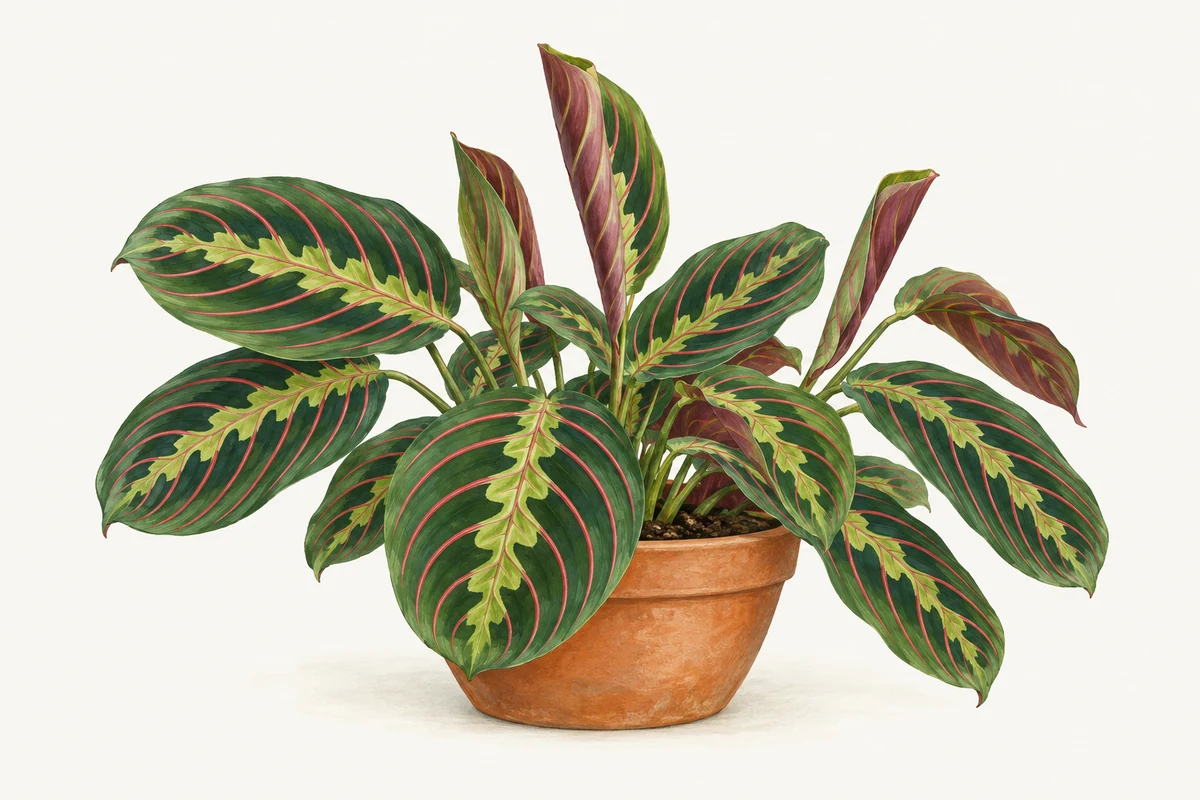
A prayer plant (Maranta leuconeura) is a low, spreading houseplant of the arrowroot family, usually 6 to 12 inches tall. Its oblong leaves have red or pale fishbone-patterned veins, dark blotches like rabbit tracks either side of the midrib and a reddish to gray-green underside. By day the leaves lie flat; at night they rise to an upright "praying" position.
- Oblong leaves with fishbone veins, dark spots beside the midrib and night folding point to Maranta leuconeura.
- A taller, upright clump of long-stalked, papery leaves with feathered patterns is more likely a calathea (Goeppertia).
- The ASPCA's Prayer Plant and Maranta entries are filed under Calathea insignis, not Maranta leuconeura; check the name before relying on them.
Field marks at a glance
- Scientific name
- Maranta leuconeura
- Family
- Marantaceae (arrowroot or prayer plant family)
- Type
- Houseplant, perennial, evergreen
- Leaves
- Simple, alternate and crowded, oblong-elliptic with a squared-off tip ending in a short sharp point and a rounded base; margins entire (NC State).
- Veins
- Prominent main veins in a fishbone pattern, colored red in the red-veined form, with pale green to yellow variegation along the midrib (NC State).
- Leaf markings
- Dark, rabbit-track-like spots on each side of the midrib; pale green margins (NC State).
- Underside
- Reddish to burgundy, or light gray-green to purple-green, depending on the form (NC State).
- Night movement
- Leaves lie parallel to the ground by day and rise to an upright 'prayer' position at night. New leaves unfurl from a rolled tube.
- Leaf stalk and stem
- Long, sheathing leaf stalks; stems short and rhizomatous, so the plant spreads sideways rather than growing tall (NC State).
- Flowers
- Rare indoors: small, two-lipped, white to purple or purple-spotted, under 1 inch, on slender stalks (NC State).
- Size
- 6 to 12 in tall and 6 in to 2 ft wide (NC State); often grown in hanging baskets.
- Native range
- Brazil (NC State). World Flora Online accepts the name Maranta leuconeura É.Morren and lists Calathea leuconeura as a synonym.
The prayer plant (Maranta leuconeura) is a low tropical houseplant grown for its patterned leaves, which lift and fold together at night. Several relatives in the same family look similar and fold their leaves too, so check the plant in the order below.
How to identify a prayer plant in four checks
1. The height and habit. Look at the plant from the side. A prayer plant is low and spreading: the NC State Plant Toolbox gives 6 to 12 inches tall and up to 2 feet wide. Its stems are short and creep along as rhizomes, so it spills over the pot edge and is often grown in hanging baskets. A plant over a foot tall with upright leaves is more likely a relative.
2. The leaf shape. Hold a leaf flat. It is oblong to elliptic, with a rounded base and a squared-off tip that ends in a short point. The edge is smooth, and each leaf sits on a long stalk that sheathes the stem at its base.
3. The markings. Look at the upper surface. The main veins run out from the midrib in a fishbone or herringbone pattern, red in the popular red-veined form. NC State's quick ID hints add dark, rabbit-track-like spots on each side of the midrib and a pale green to yellow stripe down the center. Turn the leaf over: the underside is reddish to burgundy, or gray-green in green forms.
4. The night movement. Check the plant after dark. By day the leaves lie almost flat; at night they rise to an upright position like hands in prayer, which gives the plant its name. New leaves unroll from a tight tube.
When a plant arrives without a tag, Plant Identifier can give a common and scientific name from one photo; include a whole leaf, top and underside if you can. The app shows no confidence score and no list of alternatives, so compare its answer with the checks above.
Prayer plant forms and cultivars
NC State lists the plant under several common names, including herringbone plant, rabbit tracks, cathedral windows and red-veined prayer plant, and names three cultivars:
- 'Fascinator Tricolor': dark green leaves with light green margins, red rib veins and a yellow center.
- 'Lemon' or Lemon Lime prayer plant: dark green with a yellowish-green center and striping.
- 'Silver Band': dark green with a broad silver-green patch down the center.
Older labels may still use names such as Maranta kerchoveana or M. leuconeura var. erythroneura, which NC State lists as previous names. World Flora Online accepts Maranta leuconeura É.Morren and lists Calathea leuconeura among its synonyms, which is one reason the two genera get mixed up in shops. NC State notes that the colors on both sides of the leaf fade in low light or low fertility, so a pale plant can still be a prayer plant.
Prayer plant vs calathea and ctenanthe
All three belong to Marantaceae, the prayer plant family, and all fold their leaves at night. Height and leaf shape usually settle it.
| Feature | Prayer plant | Calathea (peacock plant) | Ctenanthe (never never plant) |
|---|---|---|---|
| Height | 6 to 12 in, spreading | 1 to 2 ft, upright clump | Up to about 3 ft, bushy |
| Leaf shape | Oblong, squared-off tip | Egg-shaped, papery | Lance-shaped, leathery |
| Pattern | Fishbone veins, dark spots by the midrib | Dark green feathering on a pale background | Silver-white bands along the veins |
| Underside | Reddish to gray-green | Reddish-purple pattern | Purple-red |
Sources: NC State on the peacock plant and NC State on Ctenanthe oppenheimiana. For the many patterned calatheas, see the calathea identification page. For a step-by-step route through other houseplants, try the houseplant identification key.
Is a prayer plant toxic to pets
The ASPCA's Prayer Plant entry and its separate Maranta entry classify the plant as non-toxic to dogs, cats and horses. Both entries give the scientific name as Calathea insignis, not Maranta leuconeura, so the listing may not describe the exact plant on your windowsill. That is the ASPCA's classification, not a guarantee that a pet can chew the leaves without effect.
If a pet has chewed a leaf or flower, call your vet or the ASPCA Animal Poison Control Center at (888) 426-4435. For a person, call Poison Control at 1-800-222-1222 (poison.org). Plant Identifier's Toxicology tool gives AI-written notes for people, dogs and cats; treat them as a starting point, not as the answer. More houseplants on the ASPCA's lists are in plants toxic to cats and poisonous plants for dogs.
A short care note
NC State recommends bright, indirect light, since too much sun bleaches the leaf colors, and potting soil kept evenly moist in the growing season but allowed to dry more in winter. The plant needs high humidity, from a humidified room or a tray of wet pebbles, and dislikes cold drafts. NC State adds that leaves can burn from high fluoride or over-fertilizing, and that root rot can follow poorly drained soil. For yellowing leaves, see yellow leaves on plants.
Look-alikes and how to tell them apart
Calathea, peacock plant (Goeppertia makoyana)
Check the height and the leaf stalk. The peacock plant is an upright clump 1 to 2 ft tall with egg-shaped, papery leaves up to 12 inches long, each held erect on a long stalk, and a feathered dark green pattern on a pale background (NC State). A prayer plant stays low and spreading, with oblong leaves and red or pale fishbone veins.
Never never plant (Ctenanthe oppenheimiana)
Look at the size and the leaf shape. Ctenanthe is a bushy plant up to about 3 ft tall, with lance-shaped, leathery leaves marked silver-white along the veins and purple-red beneath (NC State). A prayer plant is under a foot tall, with broader oblong leaves and a squared-off tip.
What a photo can't settle
- Prayer plant cultivars differ mainly in vein and center color; a photo can name the species, but leaf color also fades in low light and low fertility (NC State).
- Several Marantaceae fold their leaves at night, so night movement alone does not prove a Maranta; check the height, leaf shape and markings too.
- Whether a pet that chewed a leaf needs treatment is for your vet or a poison control center to decide, not for this page or an app.
Questions people ask
Why does a prayer plant fold its leaves at night?
It is a normal daily movement, not wilting. NC State describes the leaves as held parallel to the ground by day and moving to an upright 'prayer' position at night, the habit behind the common name. Other members of the family, such as calatheas, do the same.
Is a calathea the same as a prayer plant?
No. Both belong to the prayer plant family, Marantaceae, but the plant sold as prayer plant is Maranta leuconeura: low and spreading, with fishbone veins and rabbit-track spots. Calatheas, now mostly Goeppertia, are taller clumps of long-stalked leaves. NC State lists them as often confused.
What are the red, green and lemon prayer plants?
They are forms and cultivars of the same species. NC State lists 'Fascinator Tricolor' with red rib veins and a yellow center, 'Lemon' or Lemon Lime with a yellowish-green center and striping, and 'Silver Band' with a broad silver-green center.
Is a prayer plant toxic to cats and dogs?
The ASPCA's Prayer Plant and Maranta entries classify the plant as non-toxic to dogs, cats and horses, but both are filed under Calathea insignis. That is the ASPCA's classification, not a guarantee. If your pet chewed it and seems unwell, call your vet or the ASPCA Animal Poison Control Center at (888) 426-4435.
Sources
- Maranta leuconeura — North Carolina Extension Gardener Plant Toolbox (NC State)
- Maranta leuconeura É.Morren — World Flora Online Plant List
- Goeppertia makoyana — North Carolina Extension Gardener Plant Toolbox (NC State)
- Ctenanthe oppenheimiana — North Carolina Extension Gardener Plant Toolbox (NC State)
- Prayer Plant — ASPCA Animal Poison Control Center
- Maranta — ASPCA Animal Poison Control Center
- Poison Control — National Capital Poison Center
Keep reading
- Houseplant profileCalathea (Goeppertia): how to identify it
- Pet safety guidePlants toxic to cats, and what to do if your cat chewed one
- Pet safety guidePoisonous plants for dogs, and what to do if your dog ate one
- Plant healthYellow leaves on plants, and what each pattern means
- Houseplant profilePeace lily (Spathiphyllum): how to identify it