Also in Deutsch
Weed profile
Creeping Charlie (Glechoma hederacea): how to identify ground ivy
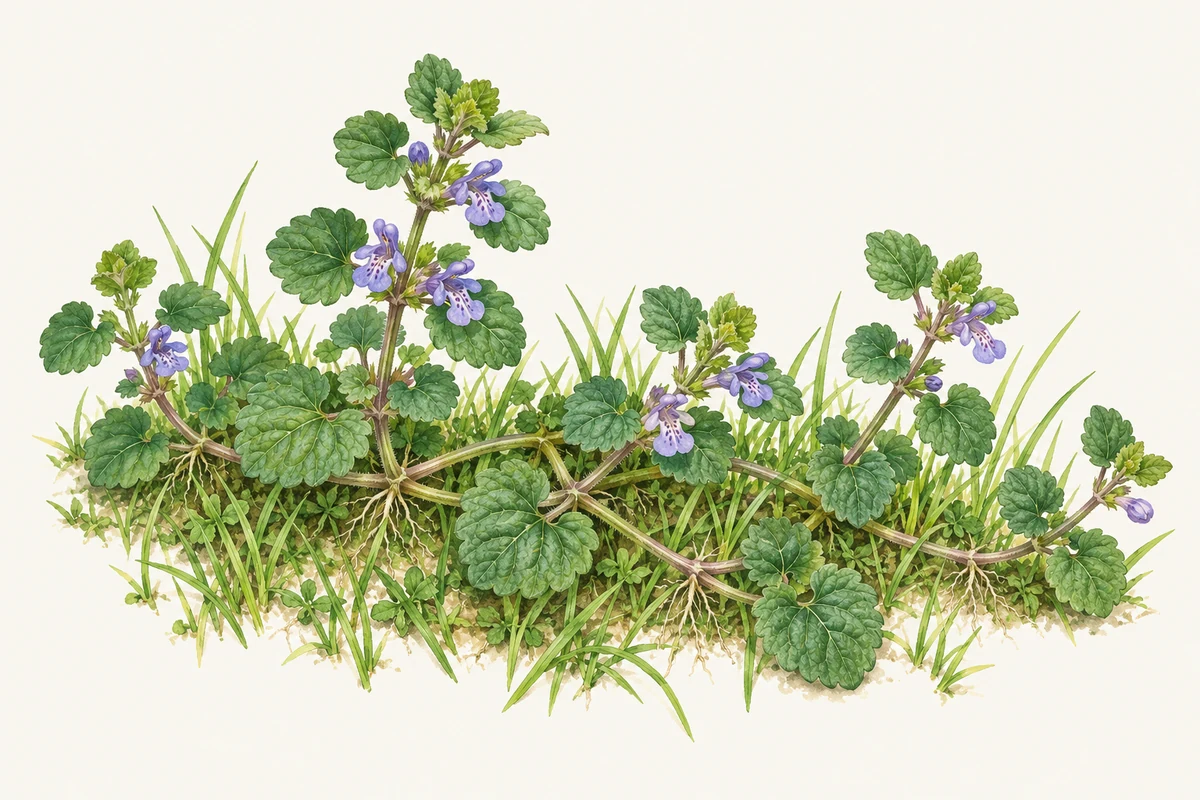
Square stems that run along the ground and root as they go, round scalloped leaves in pairs, a mint-family smell and small violet flowers in spring.
In short
Creeping Charlie, or ground ivy, is a low perennial of the mint family: square stems creep along the ground and root at the leaf nodes, carrying pairs of round to kidney-shaped leaves ½ to 1½ inches across with scalloped edges and long stalks. Crushed leaves smell strongly aromatic. From April to June, small blue-violet two-lipped flowers sit in the leaf axils.
- Roll a stem between your fingers: it is square, and where it touches the soil it puts down roots.
- Henbit and purple deadnettle also have square stems, but they are upright annuals that do not creep or root along the ground.
- Common mallow has round leaves too, but they are alternate, not paired, and its flowers are open five-petaled cups.
Field marks at a glance
- Scientific name
- Glechoma hederacea
- Family
- Lamiaceae (mint family)
- Type
- Weed, perennial, evergreen
- Stems
- Square (4-angled) and hairy, lying along the ground or slightly rising; they root at the leaf nodes where they touch soil. Nodes often carry a fringe of long white hairs.
- Leaves
- In opposite pairs on long stalks; round to kidney-shaped, heart-shaped at the base, ½ to 1½ inches long and wide, with scalloped (rounded-tooth) edges and a hairy upper surface.
- Smell
- Leaves give off a strong aromatic smell when crushed or mowed, typical of the mint family.
- Flowers
- Blue-violet, about ½ inch long, tubular and two-lipped, in groups of 3 to 7 in the leaf axils; the larger lower lip has darker violet lines.
- Flowering time
- Spring into early summer: April to June in North Carolina (NC State Extension); Kentucky Extension describes it as flowering in late spring.
- Growth habit
- A low mat, usually under 1 foot tall, spreading by creeping stems and by seed; it can go dormant in hot summer weather.
- Where it grows
- Lawns, shady spots, roadsides, thickets and waste places; prefers shade, moisture and fertile soil where turf is thin.
- Origin
- Native to Eurasia; introduced to North America, where USDA PLANTS lists it as introduced in the lower 48 states, Alaska and Canada.
Creeping Charlie, also called ground ivy (Glechoma hederacea), is a creeping perennial that NC State Extension calls a common lawn weed, most noticeable in spring when it flowers. It belongs to the mint family, which gives you three quick checks: a square stem, leaves in pairs and a strong smell when you crush a leaf. A fourth, its creeping, rooting stems, separates it from the mint-family weeds it is most often confused with.
How to identify creeping Charlie in four checks
1. The stem. Pick up a runner and roll it between your thumb and finger. Creeping Charlie's stem is square (4-angled) and hairy, according to the NC State Extension Plant Toolbox. It lies along the ground or rises slightly, and where a leaf node touches the soil it puts down small roots. Tug gently: a long runner comes up with a line of rooted nodes. NC State also notes a fringe of long white hairs at many nodes.
2. The leaves. Leaves come in opposite pairs on long stalks. Each is round to kidney-shaped, heart-shaped at the base, ½ to 1½ inches long and wide, with scalloped, rounded-tooth edges and a hairy upper surface with veins fanning out from the base. The University of Kentucky's henbit and purple deadnettle bulletin describes them as kidney-shaped and toothed, on long petioles.
3. The smell. Crush a leaf: NC State says it gives off an aromatic scent, the herbal smell of the mint family. Mowing a patch releases the same smell over the whole lawn.
4. The flowers. In spring, small blue-violet flowers, about ½ inch long, appear in groups of 3 to 7 in the leaf axils. Each is a narrow tube that opens into two lips; the larger lower lip carries darker violet lines that guide insects inside. NC State gives April to June for flowering in North Carolina, and Kentucky Extension describes it as a late-spring bloomer.
If you'd like a second opinion, one photo of a runner with a few leaves and a flower in Plant Identifier gives you a name to check against these four points. The app shows no confidence score and no list of alternatives, so confirm the square, rooting stem yourself. The flower identifier can help with other small violet flowers in the lawn.
Creeping Charlie vs henbit, purple deadnettle, mallow and violet
Four plants share lawns with creeping Charlie in spring, and two of them are in the same family.
| Feature | Creeping Charlie | Henbit | Purple deadnettle | Common mallow | Wild violet |
|---|---|---|---|---|---|
| Stem | Square, creeping, roots at nodes | Square, sprawling base, upright tips | Square, upright | Spreading, with abundant white hairs | No leafy stem above ground |
| Leaf arrangement | Opposite, all on long stalks | Opposite; upper leaves stalkless, clasping | Opposite; crowded, overlapping | Alternate | Basal rosette |
| Leaf shape | Round to kidney, scalloped | Kidney-shaped, rounded teeth | Heart-shaped to triangular, top leaves purplish | Round, 5+ shallow lobes | Heart-shaped, to 4 in |
| Flower | Blue-violet, two-lipped, in axils | Purple, two-lipped, in axils | Purple, two-lipped, in axils | 5 notched petals, white to pale pink | 5 unequal petals, single on a stalk |
| Life cycle | Perennial | Winter annual | Winter annual | Annual or perennial | Perennial |
The table draws on NC State's pages for henbit, purple deadnettle, common mallow and wild violet, and on Kentucky's bulletin.
Henbit and purple deadnettle are the hardest to separate, because they share the square stem and the two-lipped purple flowers. Kentucky Extension gives the decisive difference: they are winter annuals that flower in early spring and die in late spring, while creeping Charlie is a perennial that flowers in late spring and creeps across the lawn. Henbit's upper leaves have no stalks and clasp the stem; purple deadnettle's top leaves are small, crowded and purple-tinged.
Common mallow has round, scalloped leaves that look similar from a standing height. Kneel down: mallow's leaves alternate along the stem, one per node, on stalks about twice the length of the leaf, and its flowers are open cups of five notched petals.
Wild violet has heart-shaped leaves, but they all rise from a crown at the base. There is no leafy runner to pick up, and each flower stands alone on its own stalk.
For the full set of lawn weeds, see the lawn weed identification guide.
Where creeping Charlie grows, and why lawns get it
Creeping Charlie is native to Eurasia. NC State says it was introduced from Europe and grows on roadsides, in lawns, shady spots, waste places and thickets. The USDA PLANTS Database lists it as introduced in the lower 48 states, Alaska and Canada, and the NC Invasive Plant Council lists it as invasive.
In a lawn, NC State says it prefers shade, moist conditions and fertile, loamy soil where turf is thin or lacks cover. It forms a low mat, usually under a foot tall, spreads by seed and by stems that root at every node, and is most conspicuous in spring when it flowers. In hot summer weather it can go dormant, so a patch that looked thin in August may be thick again in the fall. NC State describes it as an evergreen creeper, so its leaves can still be found after other lawn weeds have died back.
Controlling it in a lawn
Extension advice centers on the lawn itself. NC State says maintaining a dense, healthy lawn helps keep ground ivy from establishing, and that hand removal works only if the entire plant comes out; pieces left behind regrow. Follow each runner back to its rooted nodes and lift them with their roots. Because it favors thin turf in shade, a patch often returns where the grass is struggling.
NC State also calls it difficult to destroy without herbicides. If you use one, follow the label and local rules, and check with your local extension office for advice suited to your grass type and region.
NC State's Plant Toolbox flags ground ivy as a problem for horses. If you think a horse or other animal has eaten a lot of it, call your vet or the ASPCA Animal Poison Control Center at (888) 426-4435 (a consultation fee may apply). In the UK, call your vet.
To see whether a patch is spreading from year to year, the Plant Map in Plant Identifier keeps each located identification. For the general method on any unknown plant, see how to identify plants.
Look-alikes and how to tell them apart
Henbit (Lamium amplexicaule)
Look at the upper leaves: on henbit they have no stalk and clasp the stem in pairs, while creeping Charlie's leaves all have long stalks. Henbit is a winter annual that flowers in early spring and dies in late spring; its stems do not creep or root along the ground.
Purple deadnettle (Lamium purpureum)
Purple deadnettle grows upright, with crowded, overlapping, heart-shaped to triangular leaves on short stalks; the top leaves are tinged purple and the lower third of the stem is often bare. It is a winter annual and does not root along the ground.
Common mallow (Malva neglecta)
Mallow leaves are alternate (one per node), round with 5 or more shallow lobes, on stalks about twice as long as the leaf. Its flowers are open, white to pale pink cups of 5 notched petals, about ¾ inch across, not violet two-lipped tubes.
Wild violet (Viola sororia)
Violet leaves rise straight from the base of the plant on long stalks, with no leafy creeping stem above ground, and they reach about 4 inches across. Each flower stands alone on its own stalk, with 5 unequal petals, not in clusters in the leaf axils.
What a photo can't settle
- Before it flowers, a photo of a single leaf can be confused with henbit, mallow or violet seedlings: include a stretch of stem so the square shape, the paired leaves and the rooting nodes show.
- Henbit and purple deadnettle flower at the same time of year with similar purple two-lipped flowers; a close-up of a flower alone may not separate them from creeping Charlie, so photograph the stem and upper leaves too.
- A photo can't tell you why ground ivy has spread in your lawn (shade, moisture, thin turf); a local extension office or soil test can.
Questions people ask
What does creeping Charlie look like?
A low, mat-forming plant with square stems that run along the ground and root at the nodes. Its leaves come in pairs on long stalks, round to kidney-shaped with scalloped edges, about ½ to 1½ inches across. In spring it has small blue-violet two-lipped flowers in the leaf axils.
Is creeping Charlie the same as ground ivy?
Yes. Creeping Charlie and ground ivy are two common names for Glechoma hederacea, a perennial in the mint family. NC State Extension lists other names too, including gill-over-the-hill, field balm and runaway robin. Older books file it as Nepeta glechoma or Nepeta hederacea.
How do I tell creeping Charlie from henbit?
Check the upper leaves and the habit. Henbit's upper leaves have no stalks and clasp the stem, and henbit is a winter annual that stands upright and dies in late spring. Creeping Charlie's leaves all have long stalks, and its stems creep along the ground and root as they go.
Why is creeping Charlie taking over my lawn?
NC State Extension says ground ivy prefers shade, moisture and fertile soil where turf is thin or lacks cover, and that a dense, healthy lawn helps keep it out. It spreads by creeping stems that root at each node as well as by seed, so a patch widens every season.
Can I pull creeping Charlie by hand?
NC State Extension says it can be removed by hand, but the entire plant must come out, or it will reappear from the pieces left behind. Follow the rooted stems back and lift them with their roots. For any herbicide, follow the label and local rules.
Sources
- Glechoma hederacea (ground ivy, creeping Charlie) — NC State Extension, North Carolina Extension Gardener Plant Toolbox
- Identification and Control of Henbit and Purple Deadnettle (AGR-226) — University of Kentucky Cooperative Extension Service
- Lamium amplexicaule (henbit) — NC State Extension, North Carolina Extension Gardener Plant Toolbox
- Lamium purpureum (purple deadnettle) — NC State Extension, North Carolina Extension Gardener Plant Toolbox
- Malva neglecta (common mallow) — NC State Extension, North Carolina Extension Gardener Plant Toolbox
- Viola sororia (common blue violet) — NC State Extension, North Carolina Extension Gardener Plant Toolbox
- Plant profile: Glechoma hederacea L., ground ivy — USDA NRCS PLANTS Database
- ASPCA Poison Control — ASPCA