Houseplant profile
Monstera deliciosa (Swiss cheese plant): how to identify it
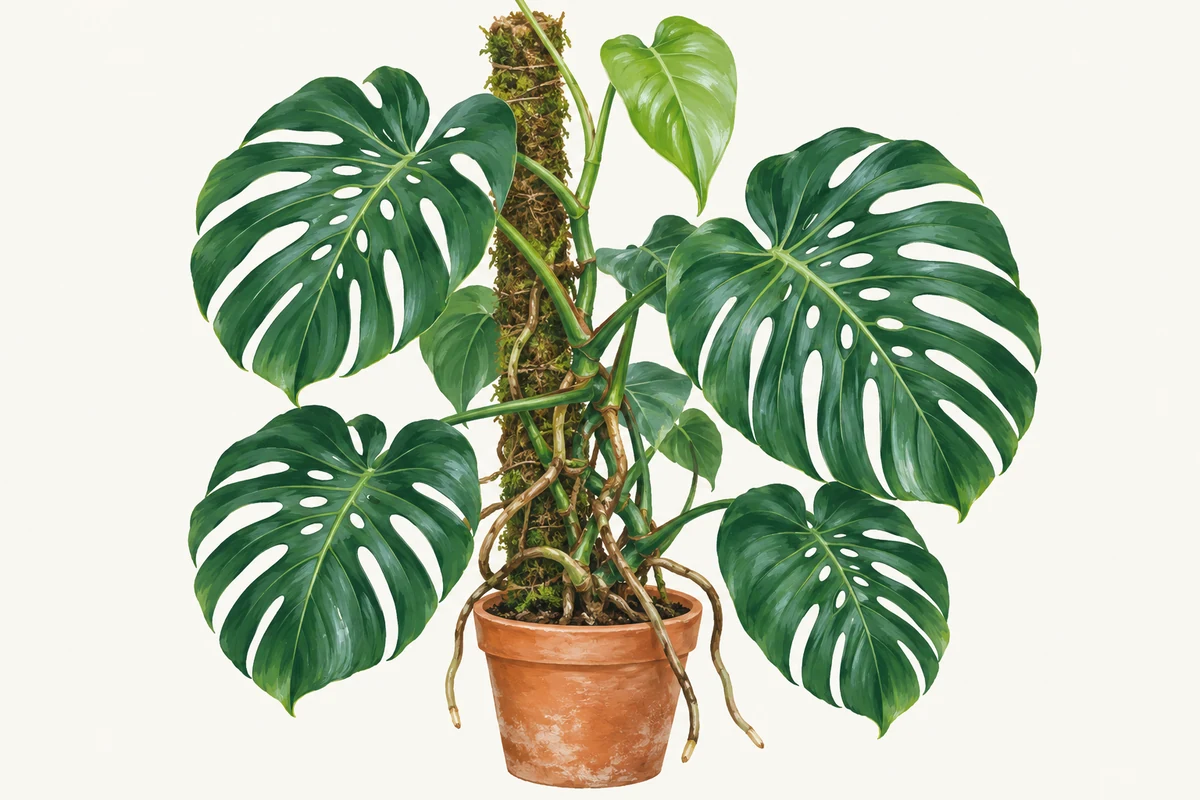
Big glossy leaves with holes inside the blade and splits that reach the edge, a hinge where leaf meets stalk, and thick cords of aerial roots. Young plants show none of the holes.
In short
Monstera deliciosa is a climbing aroid from Mexico to Panama whose mature leaves are glossy, leathery, heart-shaped and often a foot or more long, with holes inside the blade and splits that run out to the edge. Check for a distinct joint where the blade meets its long stalk and for thick, cord-like aerial roots. Juvenile leaves are small and mostly uncut, so a young plant can look like several other aroids.
- Holes inside the blade plus splits reaching the margin, on leaves a foot or more long, point to a mature Monstera deliciosa.
- Despite the name split-leaf philodendron, it is not a philodendron; NC State and the Missouri Botanical Garden both say so.
- The ASPCA lists it (as cutleaf philodendron) as toxic to cats and dogs.
Field marks at a glance
- Scientific name
- Monstera deliciosa
- Family
- Araceae (arum family)
- Type
- Houseplant, perennial, evergreen
- Mature leaves
- Glossy, leathery, dark green, broadly heart-shaped, often 1 ft or more long (1 to 3 ft on climbing plants in the wild), with holes inside the blade and splits that run out to the margin.
- Juvenile leaves
- Small, heart-shaped and mostly uncut. Holes appear only as the plant matures and develop as each leaf grows.
- Leaf joint
- Mature leaves show a distinct junction where the blade meets the long petiole, one of NC State's quick ID hints.
- Stems
- Thick, long and leafy; woody with age. Needs sturdy support indoors or the stems break or sprawl sideways.
- Aerial roots
- Long, cord-like brown roots from the stems. Lower ones can root into the soil; upper ones cling to a moss pole or tree.
- Flowers
- Rare indoors. A creamy-white spathe up to about 1 ft around a spadix about 10 in long and 1 in thick.
- Fruit
- Rare indoors. An aggregate of creamy-white berries over 3 in long, covered by green hexagonal scales.
- Size
- Climbs to 70 ft into trees in its native forests; usually 6 to 8 ft as a houseplant.
- Native range
- Mexico to Panama (NC State); Mexico and Central America (Missouri Botanical Garden). Grown outdoors only in USDA zones 10 to 12.
Monstera deliciosa is the big, holed-leaf climber sold as Swiss cheese plant and, misleadingly, as split-leaf philodendron. Three checks identify a mature plant in a minute: the holes and splits in the leaf, the hinge where the leaf meets its stalk, and the thick aerial roots. A young plant is harder, and that is where most mix-ups start.
What to check first: holes, the leaf hinge, the roots
1. The holes and splits. Look at the largest, newest leaf. On a mature plant the leaves are gigantic, a foot or more long, dark green, glossy and leathery, and "perforated with several holes throughout the blade, some extending to margin," according to the NC State Extension Plant Toolbox. The combination matters: holes enclosed inside the blade plus deep splits that open to the edge. A leaf with splits but no inner holes points to a lobed philodendron; a small leaf full of holes points to one of the smaller climbers below.
2. The hinge. Follow the leaf down to its stalk (petiole). NC State lists a distinct junction where the blade meets the petiole on mature leaves as one of its three quick ID hints, and describes the petioles as long.
3. The aerial roots. The Missouri Botanical Garden singles out "its long cord-like aerial roots" on thick stems. On an older houseplant they hang from the stems like brown cords, some reaching the soil.
If all three match, you have Monstera deliciosa. If you only have a young plant, use the size of the stems and the label, and come back when the first split leaf appears. When you have no idea where to start, one photo of the whole plant in Plant Identifier gives you a name to check against these marks; the app shows no confidence score and no list of alternatives, so confirm it with the hinge and the holes. The houseplant identification key walks through the same leaf features for other common houseplants.
Juvenile and mature leaves
Monstera deliciosa changes its leaves as it grows, and this is the most common reason people doubt their plant. The Missouri Botanical Garden describes juvenile leaves as "small and mostly uncut," while mature leaves are very large, glossy, deep green and "distinctively cut and perforated." NC State adds that only mature leaves have the holes, and that they develop as the leaf grows.
In practice:
- Small nursery plants carry plain heart-shaped leaves. At this stage the plant looks like many other young aroids, and the label is the safest guide.
- Mature leaves reach a foot or more (NC State), and 1 to 3 feet long on plants climbing trees in the wild (Missouri Botanical Garden), with holes inside the blade and splits reaching the margin.
- Each new leaf is the one to judge: the holes form as the leaf develops, so an old, uncut leaf low on the stem does not mean the plant is something else.
Support matters. In its native forests, NC State says, it starts life on the ground and turns epiphytic once it reaches a sturdy tree to climb. Indoors, a moss pole or trellis plays the tree's role; without support, the Missouri Botanical Garden notes, plants tend to grow horizontally.
Aerial roots, flowers and the fruit
Aerial roots. The brown cords that grow from the stems are aerial roots. The Missouri Botanical Garden says those on the lower parts of the plant can be rooted into the soil to help nourish it, and those higher up can be attached to a moss-like climbing pole or simply removed. In the wild they are how the plant holds on to tree trunks as it climbs.
Flowers. Indoor plants rarely flower. When they do, the bloom is the typical arum structure: a large creamy-white spathe, up to about a foot, around a spadix about 10 inches long and an inch thick (NC State).
Fruit. The fruit is the source of the species name. NC State describes it as an aggregate of creamy-white berries more than 3 inches long and 1 to 3 inches wide, covered by green hexagonal scales, and notes that houseplants rarely produce it. For identification, a spadix-shaped green fruit with a scaly, honeycomb-like skin on a holed-leaf climber is distinctive. This page gives no advice on eating any part of it: NC State lists every part of the plant, fruits included, among its poisonous parts.
Monstera deliciosa vs its look-alikes
Two smaller climbers and one shrub are sold under overlapping names. NC State lists Monstera adansonii and Rhaphidophora tetrasperma as the plants most often confused with Monstera deliciosa.
| Feature | Monstera deliciosa | Monstera adansonii | Mini monstera (Rhaphidophora tetrasperma) | Selloum (Philodendron bipinnatifidum) |
|---|---|---|---|---|
| Habit | Climbing vine, thick stems | Smaller climber, 3 to 8 ft indoors | Climber with slender stems | Upright shrub on a short, stout trunk |
| Mature leaf size | 1 ft or more indoors | Smaller | 6 to 12 in | Up to 4 ft |
| Holes inside the blade | Yes, on mature leaves | Yes, oval holes | Some leaves fenestrated, from a young age | No |
| Splits to the edge | Yes, some holes reach the margin | Not described by NC State | Not separated from holes by NC State | Deep lobes from the edge |
| Native range | Mexico to Panama | Southern Mexico to tropical America | Peninsular Thailand and Malaysia | Bolivia, Brazil, northeast Argentina |
Monstera adansonii. NC State's Monstera adansonii page warns that both species are called Swiss cheese plant and that Monstera deliciosa is the larger plant with bigger leaves. Its own leaves are heart-shaped with "unique oval holes."
Mini monstera. The Rhaphidophora tetrasperma page explains the name: it looks like a mini version of Monstera deliciosa but is neither a monstera nor a philodendron. Its leaves are smaller and its fenestrations appear at an earlier age, so a small plant with split leaves on thin stems is more likely to be mini monstera than a young Monstera deliciosa.
Selloum, the other split-leaf philodendron. NC State's Philodendron bipinnatifidum page describes glossy, leathery, deeply lobed leaves up to 4 feet long on long petioles, a short stem with leaf scars surrounded by stiff scales, and a shrubby habit. You may see it labeled Philodendron selloum or Thaumatophyllum bipinnatifidum; World Flora Online currently lists Philodendron bipinnatifidum as the accepted name, and NC State gives the other two as former names.
For the trailing heart-leaved vines often grown next to a monstera, see pothos vs philodendron.
Toxicity and a short care note
The ASPCA lists Monstera deliciosa, under the name cutleaf philodendron, as toxic to cats and dogs, with insoluble calcium oxalates as the toxic principle. NC State also lists contact dermatitis from the sap. If a pet has chewed the plant, call your vet or the ASPCA Poison Control at (888) 426-4435 (a consultation fee may apply); for a person, call Poison Control at 1-800-222-1222. Plant Identifier's Toxicology tool gives AI-written notes for people, dogs and cats, but it is not a substitute for that call. The plants toxic to cats guide lists other common houseplants on the ASPCA's list.
Care, briefly, from NC State: average warm temperatures of 60 to 85°F, moderate brightness without direct sun, and high humidity; water thoroughly, then let the top quarter to third of the pot dry out. The Missouri Botanical Garden adds to reduce watering from fall to late winter. Give it a sturdy support, because a mature plant is heavy. For the general method of naming any houseplant from its leaves, stems and flowers, see how to identify plants.
Look-alikes and how to tell them apart
Monstera adansonii (also sold as Swiss cheese plant)
A smaller climber, usually 3 to 8 ft indoors, whose leaves carry oval holes inside the blade. On a mature Monstera deliciosa the leaves are larger and some holes break through the edge as splits. Two plants sold under one name: check the label's scientific name.
Mini monstera (Rhaphidophora tetrasperma)
Slender stems and leaves only 6 to 12 in long that split and develop holes while still small. A Monstera deliciosa leaf that size is usually still uncut, and its stems are thick. Mini monstera comes from peninsular Thailand and Malaysia.
Split-leaf philodendron, selloum (Philodendron bipinnatifidum)
Its leaves are deeply lobed from the edge inward but have no holes inside the blade, and can reach 4 ft. It grows as an upright shrub on a short, stout trunk marked with prominent leaf scars, rather than as a long climbing vine.
What a photo can't settle
- A juvenile Monstera deliciosa has small, uncut heart-shaped leaves; a photo of a young plant cannot reliably separate it from other young aroids until fenestrated leaves appear.
- Variegated cultivars such as 'Albo Variegata' and 'Thai Constellation' are the same species, so a photo names the species but cannot confirm which cultivar label is true.
- Two different plants are sold as Swiss cheese plant and two as split-leaf philodendron; only the scientific name on a grower's label, or the field tests on this page, settles which one you bought.
Questions people ask
Is Monstera deliciosa a philodendron?
No. It is sold as split-leaf philodendron, but NC State and the Missouri Botanical Garden both say it is not a philodendron. Both genera belong to the arum family, Araceae, which is why the names got mixed up. The plant also called split-leaf philodendron or selloum is Philodendron bipinnatifidum, a different, shrubby plant.
Why doesn't my monstera have holes in its leaves?
Holes only appear on mature leaves. The Missouri Botanical Garden describes juvenile leaves as small and mostly uncut, and NC State says the holes develop as the leaf grows. A young plant, or new leaves on a plant kept in poor light without support, can stay uncut for a long time.
Is Monstera deliciosa toxic to cats and dogs?
The ASPCA lists Monstera deliciosa, under the name cutleaf philodendron, as toxic to dogs and cats, naming insoluble calcium oxalates. If your pet chewed it, call your vet or the ASPCA Poison Control at (888) 426-4435 (a fee may apply). For people, call Poison Control at 1-800-222-1222.
What are the long brown roots growing out of my monstera?
Aerial roots. The Missouri Botanical Garden calls them long and cord-like: in the wild they hold the plant to tree trunks. On a houseplant the lower ones can be guided into the soil, and the upper ones attached to a moss pole or trimmed off.
How do I tell Monstera deliciosa from Monstera adansonii?
Size and the leaf edge. Monstera adansonii is a smaller plant whose leaves have oval holes inside the blade. A mature Monstera deliciosa has much larger leaves, a foot or more long, and some of its holes break through the edge as deep splits. NC State notes both are sold as Swiss cheese plant, so check the label.
Sources
- Monstera deliciosa — NC State Extension Gardener Plant Toolbox
- Monstera deliciosa (Plant Finder) — Missouri Botanical Garden
- Monstera adansonii — NC State Extension Gardener Plant Toolbox
- Rhaphidophora tetrasperma — NC State Extension Gardener Plant Toolbox
- Philodendron bipinnatifidum — NC State Extension Gardener Plant Toolbox
- Philodendron bipinnatifidum Schott ex Endl. — World Flora Online
- Cutleaf Philodendron (Monstera deliciosa) — ASPCA
Keep reading
- Plant profileMoth orchid (Phalaenopsis): how to identify it
- Houseplant profilePothos (Epipremnum aureum): how to identify it
- Houseplant comparisonPothos vs philodendron: how to tell them apart
- Field guideHow to identify a plant, step by step
- Houseplant profileDracaena: how to identify corn plant, dragon tree and their relatives