Plant profile
Moth orchid (Phalaenopsis): how to identify it
No stem to speak of, a few broad leathery leaves, silvery roots climbing out of the pot and arching sprays of flat flowers. Here is how to read each part, and how to rule out the other common orchids.
In short
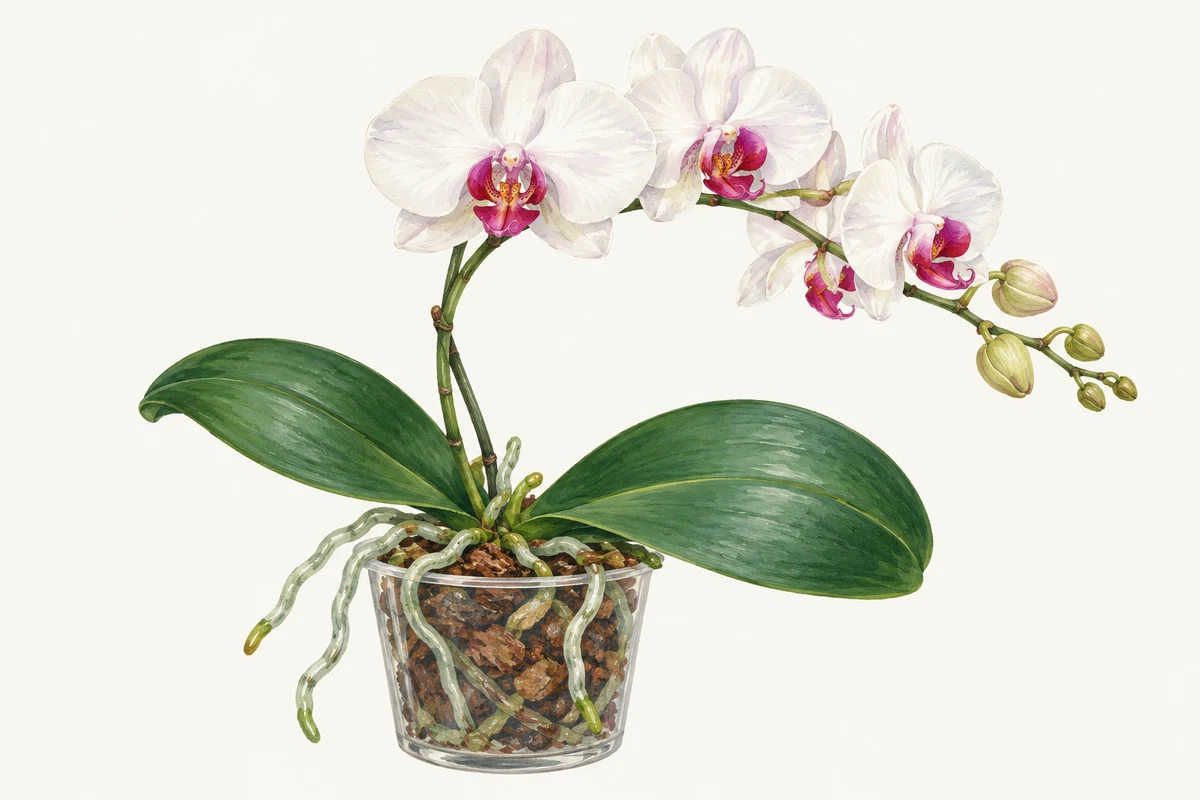
A moth orchid (Phalaenopsis) has no visible stem and no pseudobulbs: 3 to 6 thick, leathery leaves, 3 to 10 inches long, rise straight from the base, with plump silvery aerial roots spilling over the pot. The flowers open flat on long arching stems, each with 3 sepals, 2 broad petals, a smaller lip and a central column, and they last for months.
- Check the base first: Dendrobium, Oncidium and Cattleya grow from swollen pseudobulbs; a moth orchid has none and no visible stem.
- The lip and the column sit at the center of every orchid flower; on a moth orchid the lip is small compared with the two broad petals.
- A bright blue moth orchid has almost always been dyed: NC State Extension notes that dyed plants rebloom white.
Field marks at a glance
- Scientific name
- Phalaenopsis (genus; most plants sold are hybrids)
- Family
- Orchidaceae (orchid family)
- Type
- Houseplant, perennial, evergreen
- Growth form
- Epiphyte (grows on trees in the wild). No visible stem and no pseudobulbs: the leaves form a low rosette. Plants range from a few inches to 2 feet tall.
- Leaves
- 3 to 6 per plant, thick, leathery and glossy, oblong to ovate, 3 to 10 inches long, with few visible veins; alternate, in a low rosette. Young leaves clasp the flower stem.
- Roots
- Thick aerial roots grow over the pot rim and into the air. Healthy roots are plump, firm and silvery-white, with green tips; they can photosynthesize.
- Flower stem
- Long, arching spray (raceme) from between the leaves, often staked upright when sold. Small plantlets (keiki) sometimes sprout from its nodes.
- Flowers
- Flat, moth-like, 3 to 6 inches across on large hybrids and 1 to 2 inches on dwarf cultivars. 3 sepals, 2 broad petals, a lip (labellum) and a central column.
- Flower color
- Traditionally white, pale pink, or white with a pink lip; hybrids add yellow, cream, peach, purple-red and spotted or splashed patterns.
- Bloom time and length
- Usually once a year, and the sprays can appear in any season indoors. NC State Extension reports flowers lasting four months or more.
- Origin
- Tropical and subtropical Asia and northeastern Australia. Hardy only in USDA zones 10 to 12, so grown as a houseplant elsewhere.
- Old names
- Plants once sold as Doritaenopsis or Doritis are now placed in Phalaenopsis. Also called moon orchid.
Moth orchid is the orchid most people own: the RHS calls Phalaenopsis the most popular indoor orchid, and it is sold in supermarkets as well as garden centers. It is easy to recognize once you know which three parts to look at: the base of the plant, the roots and the flower.
What to check first: the base, the roots, then the flower
1. The base. Tip the pot and look under the leaves. According to the NC State Extension Plant Toolbox, a moth orchid has no visible stem: 3 to 6 thick, glossy, leathery leaves, 3 to 10 inches long, grow from a short crown and overlap in a low fan. There is no swollen bulb or cane. That one check separates it from the other orchids sold as houseplants, which all grow from pseudobulbs.
2. The roots. Moth orchids grow on trees in the wild, and it shows. Thick roots climb over the rim of the pot or snake through the air. The RHS growing guide describes healthy roots as plump, firm and silvery-white; their tips are green, and they can photosynthesize, which is why moth orchids are usually sold in clear pots.
3. The flower. The flower stem rises from between the leaves and arches outward, carrying a spray of flat, rounded flowers that NC State says look like moths (the genus name comes from the Greek for "moth-like"). On large hybrids each flower is 3 to 6 inches across, on dwarf cultivars 1 to 2 inches.
If the plant is out of flower and you want a starting point, one photo of the whole plant, roots and all, is enough for Plant Identifier to suggest a name. The app gives one answer, with no confidence score or alternatives, so confirm it with the base-and-roots check.
How to read a moth orchid flower
Every orchid flower is built on the same plan, and the moth orchid shows it clearly. NC State lists the parts as 3 sepals, 2 true petals, a lip and a column:
- Sepals (3): the outer segments, one at the top and two angled down at the sides.
- Petals (2): the two broad, rounded segments spread left and right. They give the flower its flat, wing-like look.
- Lip (labellum): a specially shaped petal at the bottom center. On a moth orchid it is small next to the two broad petals and often a different color or patterned.
- Column: the short, fleshy structure in the very center, just above the lip. It holds the flower's reproductive parts.
Colors were traditionally white, pale pink or white with a pink lip, according to NC State; modern hybrids add yellow, cream, peach, purple-red and spotted "harlequin" or splashed patterns. Bright blue flowers are the exception that proves the rule: NC State notes that the blue moth orchids in shops are white flowers dyed after the fact, and that they rebloom white.
Moth orchid vs Dendrobium, Oncidium and Cattleya
The three other orchids most often sold as houseplants all grow from pseudobulbs, swollen stems that store water. That makes the base of the plant the fastest test.
| Feature | Moth orchid (Phalaenopsis) | Dendrobium | Dancing lady (Oncidium) | Corsage orchid (Cattleya) |
|---|---|---|---|---|
| Base | No stem, no pseudobulb | Tall, segmented cane-like pseudobulbs | Clumps of swollen pseudobulbs | Upright pseudobulbs on a creeping rhizome |
| Leaves | 3–6 broad, leathery, in a low fan | Along the canes, mostly elliptical | Leathery, elliptical to lance-shaped | 1–2 stiff, waxy leaves per pseudobulb |
| Flowers | Flat, 1–6 in, small lip | Short nectar spur at the back | About 1 in, large ruffled "skirt" lip | Large, 4–10 in on most, big contrasting lip |
| Flower stem | Long arching spray from the base | From the top or along the canes | Long, branching, 25 or more flowers | 2–5 flowers from a sheath atop the pseudobulb |
Sources: NC State Extension pages for Dendrobium, Oncidium and Cattleya.
One naming trap: the popular hard-cane Dendrobium once called Dendrobium phalaenopsis (now D. bigibbum var. superbum, according to NC State) still turns up on labels under that name. It is a Dendrobium: look for the tall canes. If you are not sure what kind of flower you are holding at all, the flower identifier works through color and shape first.
Moth orchids and pets
The ASPCA Animal Poison Control Center lists the Phalaenopsis orchid (moth orchid, moon orchid) as non-toxic to dogs, cats and horses. That is the ASPCA's listing, not a guarantee: the introduction to its toxic and non-toxic plants list also warns that eating any plant material may cause vomiting and gastrointestinal upset in dogs and cats.
If a pet is unwell after chewing a plant, call your veterinarian or the ASPCA Animal Poison Control Center at (888) 426-4435. For a person, call Poison Control at 1-800-222-1222 (poison.org).
A short care note
NC State and the RHS agree on the basics: bright but filtered light (an east window is ideal; summer sun scorches the leaves), steady warmth, a loose bark-based orchid mix rather than potting soil, and watering about once a week so the roots never sit in water or dry out completely. NC State notes that large white spring-flowering hybrids need a week of cool nights, around 55°F, in autumn to set a flower spike; the RHS suggests a spot about 5°C (8°F) cooler for a month if a healthy plant won't flower.
Shriveled, wrinkled leaves, NC State adds, mean the leaves are not getting enough water, either because the mix is too dry or because the roots have rotted in a soggy one. Yellowing leaves have several causes, covered in yellow leaves on plants; for spots or rot on the leaves or roots, Plant Identifier's Diagnose tool gives a first read from a photo, and Flora, the AI assistant in the Plant Expert tab, can take follow-up questions.
Look-alikes and how to tell them apart
Dendrobium orchids (Dendrobium)
Look below the leaves. Dendrobiums grow from narrow, segmented, cane-like pseudobulbs that carry the leaves along their length, and their flowers have a short nectar spur at the back. A moth orchid has no cane at all. Beware the name: Dendrobium phalaenopsis is a Dendrobium.
Dancing lady orchids (Oncidium)
Oncidiums grow from clumps of swollen pseudobulbs and carry many small flowers, about 1 inch wide, usually yellow to brown with dark markings and a large ruffled lip like a skirt. Moth orchid flowers are larger and flat, with a small lip.
Corsage orchids (Cattleya)
Cattleyas grow from a creeping rhizome with upright pseudobulbs, each bearing one or two stiff, waxy leaves. Their flowers come from a sheath at the top of the pseudobulb, 2 to 5 at a time, and the frilled lip is large and often a contrasting color.
What a photo can't settle
- Most moth orchids are sold as unnamed hybrids (RHS), so a photo can tell you it is a Phalaenopsis but not which hybrid; named plants come only from specialist growers.
- Out of flower, a young moth orchid and some other leafy orchids can look alike in a photo. Check the base for pseudobulbs in person before deciding.
- Dyed flowers hide the true color: a photo of a blue or rainbow orchid shows the dye, not what the plant will produce next time.
Questions people ask
How can I tell if my orchid is a Phalaenopsis?
Look at the base and the roots. A Phalaenopsis has no stem or pseudobulbs, just 3 to 6 broad, leathery leaves in a low fan, plus thick silvery aerial roots. Its flowers open flat on a long arching spray. Swollen, cane-like or bulb-like stems at the base mean Dendrobium, Oncidium or Cattleya.
What are the lip and the column on an orchid flower?
The lip, or labellum, is the specially shaped petal at the bottom center of the flower; on a moth orchid it is small and often a different color. The column, just above it, holds the flower's reproductive parts. NC State lists 3 sepals, 2 true petals, a lip and a column.
Are blue moth orchids real?
Usually not. NC State Extension says genetically engineered blue moth orchids exist but are not widely available, and the blue, pink or other bright plants sold are white flowers that have been dyed. If they rebloom, the new flowers come out white.
Should I cut the roots growing out of the pot?
No. The RHS says these aerial roots are normal for an epiphyte, which in the wild uses them to cling to branches and take up nutrients. Don't bury or cut healthy ones; only snip roots that are brown, shriveled, mushy or hollow when you repot.
Sources
- Phalaenopsis — NC State Extension, North Carolina Extension Gardener Plant Toolbox
- How to grow Phalaenopsis (moth orchids) — Royal Horticultural Society (RHS)
- Dendrobium — NC State Extension, North Carolina Extension Gardener Plant Toolbox
- Oncidium — NC State Extension, North Carolina Extension Gardener Plant Toolbox
- Cattleya — NC State Extension, North Carolina Extension Gardener Plant Toolbox
- Toxic and Non-toxic Plants: Phalaenopsis Orchid — ASPCA Animal Poison Control Center
- Toxic and Non-Toxic Plants List — ASPCA Animal Poison Control Center
- Poison Control — National Capital Poison Center
Keep reading
- Free toolFlower identifier by description
- Houseplant profileKentia palm (Howea forsteriana): how to identify it
- Plant healthYellow leaves on plants, and what each pattern means
- Pet safety guidePlants toxic to cats, and what to do if your cat chewed one
- Houseplant profilePeace lily (Spathiphyllum): how to identify it