Houseplant profile
Umbrella plant (Heptapleurum, formerly Schefflera): how to identify it
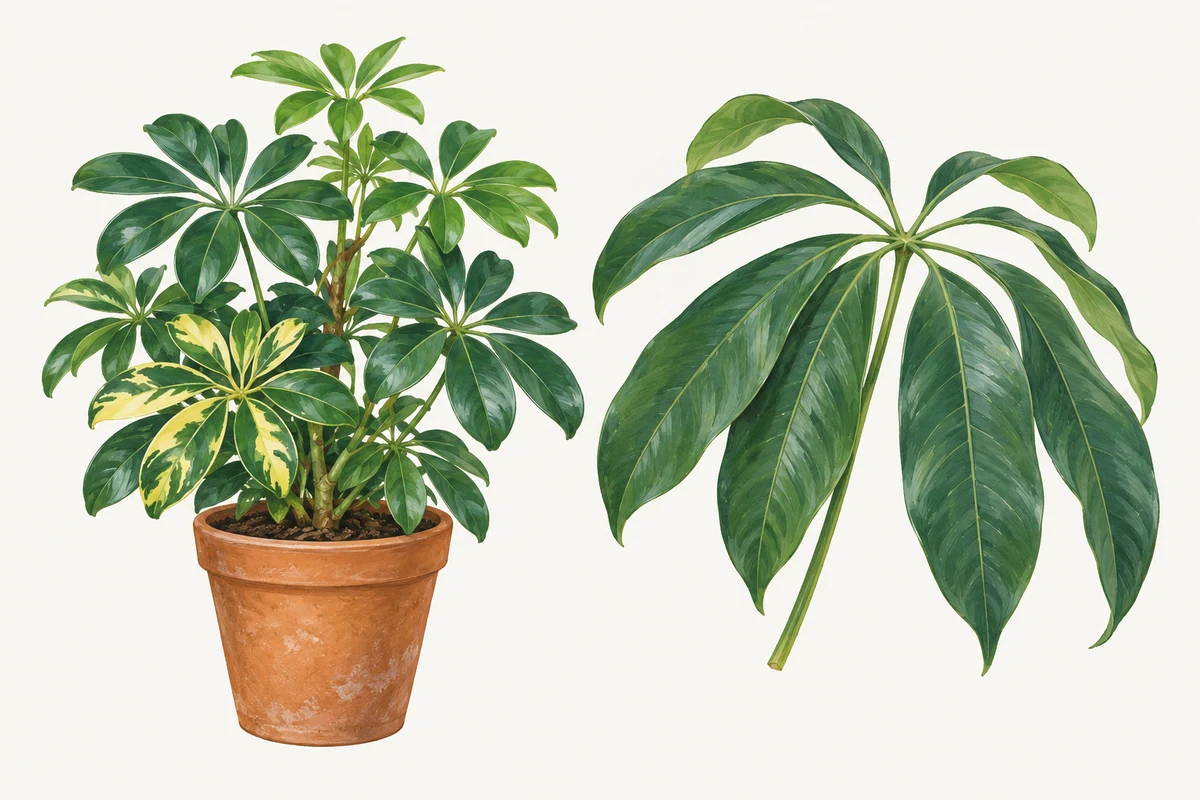
Glossy leaves split into 5 to 18 stalked leaflets that radiate from one point like the spokes of an umbrella. Here is how to tell the two species apart, and the plants that look similar.
In short
An umbrella plant is a schefflera, now named Heptapleurum: a shrub or small tree whose glossy leaves split into stalked leaflets arranged in a circle like umbrella spokes. The dwarf umbrella tree (H. arboricola) has 7 to 9 leaflets 2 to 4.5 inches long; the larger umbrella tree (H. actinophyllum) has 5 to 18 leathery, wavy-edged leaflets. Indoors both reach about 4 to 6 feet.
- Leaflets radiating from one point like umbrella spokes, on a woody shrub, point to a schefflera.
- Small leaflets (7 to 9, under 5 inches) mean dwarf umbrella tree; many large, wavy-edged leaflets mean umbrella tree.
- The ASPCA lists schefflera and umbrella tree as toxic to dogs and cats.
Field marks at a glance
- Scientific name
- Heptapleurum arboricola, Heptapleurum actinophyllum
- Family
- Araliaceae (ginseng or ivy family)
- Type
- Houseplant, perennial, evergreen
- Leaf type
- Palmately compound: stalked leaflets arranged in a circle at the end of a long leaf stalk, like the spokes of an umbrella (NC State).
- Dwarf umbrella tree leaflets
- H. arboricola: 7 to 9 leaflets, obovate to oblong, 2 to 4.5 inches long, bright green, glossy, smooth-edged (NC State).
- Umbrella tree leaflets
- H. actinophyllum: 5 to 18 leaflets, oblong to elliptic, leathery and glossy, with wavy (undulate) edges; 6 to 12 inches outdoors, 4 to 6 inches on indoor plants (NC State).
- Stem
- Woody shrub or small tree. The umbrella tree starts with a thin green trunk that becomes woody and grayish-brown, and is often multi-stemmed (NC State).
- Flowers
- Rare indoors. Tiny red flowers in panicles on the dwarf species; red to pinkish-red flowers in long, stiff arms like an octopus on the umbrella tree (NC State).
- Size
- Indoors about 4 to 6 ft for both; outdoors in the tropics 10 to 25 ft (dwarf) and up to 40 ft (umbrella tree) (NC State).
- Native range
- Dwarf umbrella tree: China and Taiwan. Umbrella tree: northern Australia and southern New Guinea (NC State).
- Old names
- Schefflera arboricola; Schefflera actinophylla and Brassaia actinophylla (NC State).
"Umbrella plant" usually means one of two shrubs sold as schefflera. The NC State Plant Toolbox now lists them under Heptapleurum: the dwarf umbrella tree (H. arboricola, formerly Schefflera arboricola) and the umbrella tree (H. actinophyllum, formerly Schefflera actinophylla). Both belong to the Araliaceae family. Check the leaf first, then decide which of the two you have.
How to identify an umbrella plant in three checks
1. The leaf pattern. Follow one leaf stalk to its tip. A schefflera leaf is palmately compound: several separate, stalked leaflets spread in a circle from one point, like the spokes of an umbrella. That pattern gives the plant its name.
2. The leaflets. Count them and measure one. NC State gives the dwarf umbrella tree 7 to 9 obovate to oblong leaflets, 2 to 4.5 inches long, bright green, glossy and smooth-edged. The umbrella tree has 5 to 18 oblong to elliptic leaflets that are leathery, glossy and wavy at the edge, paler underneath, 6 to 12 inches long outdoors and about 4 to 6 inches on indoor plants, each on a conspicuous stalk.
3. The stem. Both are woody. NC State describes the umbrella tree as often multi-stemmed, with a thin green trunk that becomes woody and grayish-brown with age. Indoors both usually reach about 4 to 6 feet.
When a plant arrives without a tag, Plant Identifier can give a common and scientific name from one photo; include a whole leaf with all its leaflets. The app shows no confidence score and no list of alternatives, so compare its answer with the checks above.
Dwarf umbrella tree vs umbrella tree
| Feature | Dwarf umbrella tree (H. arboricola) | Umbrella tree (H. actinophyllum) |
|---|---|---|
| Leaflets per leaf | 7 to 9 | 5 to 18 |
| Leaflet size | 2 to 4.5 in | 6 to 12 in outdoors, 4 to 6 in indoors |
| Leaflet edge | Smooth | Smooth but wavy |
| Flowers | Tiny red, in panicles | Red to pinkish-red, in arms up to 2 to 4 ft |
| Native range | China and Taiwan | Northern Australia, southern New Guinea |
| Outdoor height | 10 to 25 ft | Up to 40 ft |
Both rarely flower indoors. NC State lists dwarf cultivars such as 'Gold Capella' (yellow or gold and green), 'Trinette' (cream and green), 'Dazzle' (some leaves almost creamy white) and 'Compacta' (smaller, dense). It also notes that the umbrella tree is reported as an exotic pest plant in Florida.
Umbrella plant vs money tree and fatsia
Money tree (Pachira aquatica). Its leaves are also palmately compound, with 5 to 9 leaflets, but NC State describes them as lance-shaped, and the plant usually has several flexible trunks braided together over a swollen base (NC State on Pachira). A schefflera has unbraided stems and broader leaflets. See the full money tree profile.
Fatsia, Japanese aralia (Fatsia japonica). A relative in the same family, but its leaf is one blade deeply cut into 7 to 11 toothed lobes, up to 18 inches across (NC State on Fatsia). Look where the "leaflets" meet: on a fatsia the lobes join into one blade; on a schefflera each leaflet has its own stalk.
For a step-by-step route through other houseplants, try the houseplant identification key.
Is an umbrella plant toxic to pets
The ASPCA lists schefflera (also umbrella tree, Australian ivy palm, octopus tree, starleaf) as toxic to dogs and cats. It names calcium oxalate crystals as the toxic principle and lists oral irritation, intense burning and irritation of the mouth, lips and tongue, excessive drooling, vomiting and difficulty swallowing. Its separate umbrella tree entry (Brassaia actinophylla) also lists it as toxic to dogs and cats, naming terpenoids, saponins and insoluble oxalates, and says the most common effects seen are mild vomiting and diarrhea. NC State adds that the sap of both species can irritate skin.
If a pet has chewed a leaf, call your vet or the ASPCA Animal Poison Control Center at (888) 426-4435. For a person, call Poison Control at 1-800-222-1222 (poison.org). Plant Identifier's Toxicology tool gives AI-written notes for people, dogs and cats; treat them as a starting point, not as the answer. More houseplants on the ASPCA's lists are in plants toxic to cats and poisonous plants for dogs.
A short care note
For the dwarf umbrella tree, NC State recommends filtered light for 3 to 4 hours a day, since bright direct light indoors burns the leaves, letting the soil dry before soaking it thoroughly, and high humidity; it notes that soil kept too wet or too dry makes leaves drop. For the umbrella tree it gives temperatures above 60°F, ideally 65 to 90°F, and warns that underwatered plants drop their leaves and that cold drafts and heating vents stress the plant. For yellowing leaves, see yellow leaves on plants.
Look-alikes and how to tell them apart
Money tree (Pachira aquatica)
Look at the trunk. A money tree usually has several flexible trunks braided together, with a swollen base, and 5 to 9 narrow, lance-shaped leaflets (NC State). A schefflera has unbraided woody stems and broader, rounded or oblong leaflets.
Fatsia, Japanese aralia (Fatsia japonica)
Check whether the leaf is one piece. A fatsia leaf is a single blade deeply cut into 7 to 11 toothed lobes, up to 18 inches across (NC State). A schefflera leaf is split into separate stalked leaflets with smooth edges.
What a photo can't settle
- Variegated and compact cultivars change leaf color and size; a photo can name the genus but often not the cultivar.
- Other plants are also called umbrella plant in some regions. Check the leaflets-in-a-circle pattern before relying on the name alone.
- Whether a pet that chewed a leaf needs treatment is for your vet or a poison control center to decide, not for this page or an app.
Questions people ask
Is an umbrella plant the same as a schefflera?
Yes. Umbrella plant is a common name for the plants sold as schefflera. NC State now lists them as Heptapleurum: the dwarf umbrella tree was Schefflera arboricola and the umbrella tree was Schefflera actinophylla.
How do I tell a dwarf umbrella tree from an umbrella tree?
Count and measure the leaflets. NC State gives 7 to 9 glossy leaflets 2 to 4.5 inches long for the dwarf umbrella tree, and 5 to 18 leathery, wavy-edged leaflets, larger and with conspicuous stalks, for the umbrella tree.
Why is it called an octopus tree?
NC State says the umbrella tree's red flowers sit in stiff arms up to 2 to 4 feet long, held above the leaves like the ribs of an inverted umbrella or the tentacles of an octopus. It rarely blooms indoors.
Is an umbrella plant poisonous to cats and dogs?
The ASPCA lists schefflera and umbrella tree as toxic to dogs and cats. If your pet chewed it, call your vet or the ASPCA Animal Poison Control Center at (888) 426-4435. For a person, call Poison Control at 1-800-222-1222.
Sources
- Heptapleurum arboricola — North Carolina Extension Gardener Plant Toolbox (NC State)
- Heptapleurum actinophyllum — North Carolina Extension Gardener Plant Toolbox (NC State)
- Pachira aquatica — North Carolina Extension Gardener Plant Toolbox (NC State)
- Fatsia japonica — North Carolina Extension Gardener Plant Toolbox (NC State)
- Schefflera — ASPCA Animal Poison Control Center
- Umbrella Tree — ASPCA Animal Poison Control Center
- Poison Control — National Capital Poison Center
Keep reading
- Houseplant profileMoney tree (Pachira aquatica): how to identify it
- Houseplant profileRubber plant (Ficus elastica): how to identify it
- Pet safety guidePlants toxic to cats, and what to do if your cat chewed one
- Pet safety guidePoisonous plants for dogs, and what to do if your dog ate one
- Plant healthYellow leaves on plants, and what each pattern means