Houseplant profile
Rubber plant (Ficus elastica): how to identify it
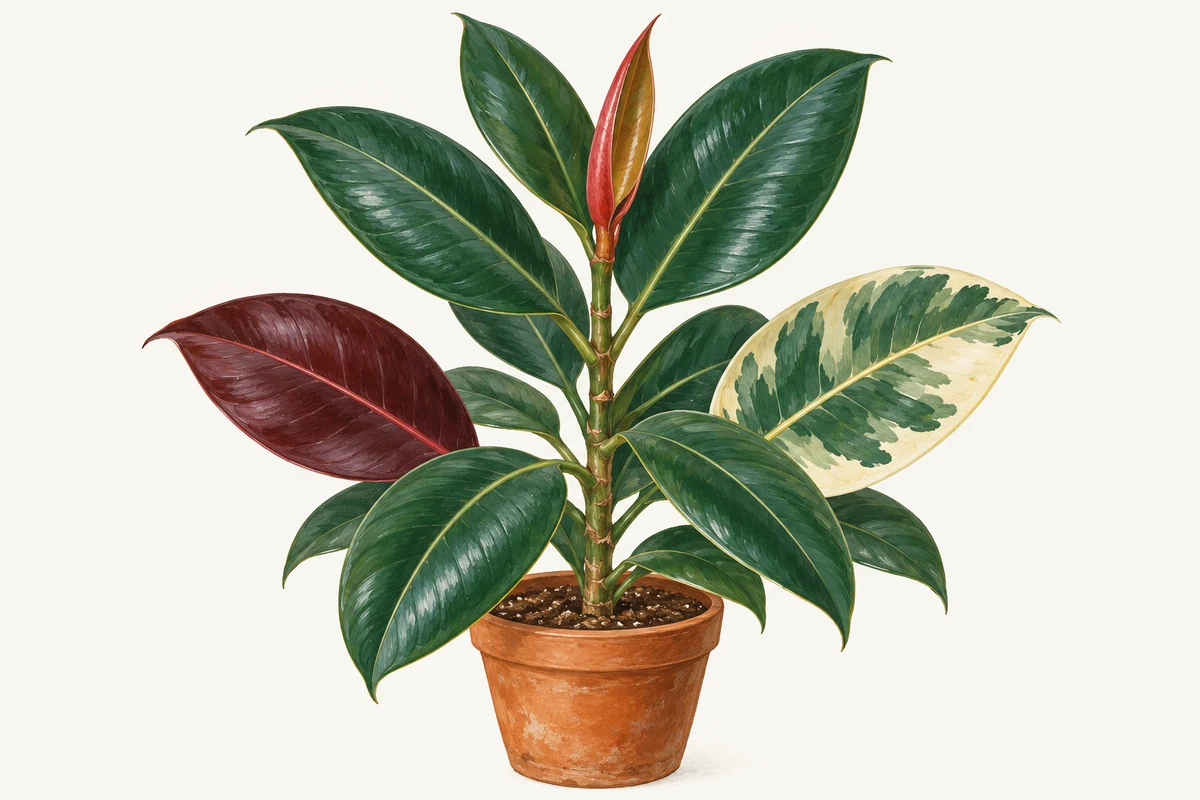
Big, stiff, glossy leaves with a raised midrib underneath, and at the top of every shoot a pointed, often pink or red sheath wrapped around the next leaf.
In short
To identify a rubber plant, look for large, stiff, glossy, oval leaves, widest in the middle, with smooth edges and a raised midrib on the underside that is pale to reddish. At the tip of each shoot, the next leaf is wrapped in a pointed sheath (a stipule), pink or purple on many plants. Cut leaves drip milky sap. NC State gives leaves up to 17 inches long.
- The colored sheath at the shoot tip and a glossy, oval leaf with a raised midrib together point to Ficus elastica.
- A dull, puckered, violin-shaped leaf belongs to the fiddle leaf fig; a small, pointed, drooping leaf to the weeping fig.
- The baby rubber plant is a Peperomia from the pepper family, not a Ficus.
Field marks at a glance
- Scientific name
- Ficus elastica
- Family
- Moraceae (mulberry and fig family)
- Type
- Houseplant, perennial, evergreen
- Leaves
- Very large, glossy, elliptic to oblong, stiff and leathery, with a short point at the tip and a rounded base; up to 17 in long and 6 in wide (NC State).
- Underside
- Paler than the upper side, with a raised midrib that is pale to reddish (NC State quick ID hints).
- Shoot tip
- The newest leaf unrolls from a pointed sheath (stipule); NC State describes the stipules as pink or purple.
- Edge and arrangement
- Margin entire (smooth, untoothed); leaves alternate, one per node, up a stiff stem that branches little when young.
- Sap
- Milky sap: NC State notes that cut leaves drip sap, and the species name refers to the latex once used to make rubber.
- Size
- Usually kept at 2 to 10 ft indoors; a tree up to 100 ft in the wild, with aerial roots and a spreading crown (NC State).
- Flowers and fruit
- Rare indoors. Tiny flowers sealed inside an oblong fig about 1/2 in long, green with darker flecks, ripening yellow.
- Native range
- Southeast Asia, from Nepal to China and western Malesia (NC State).
- Other names
- Rubber tree, Indian rubber plant, India-rubber fig. Cultivars include 'Robusta', 'Burgundy', 'Tineke' and 'Red Ruby'.
The rubber plant (Ficus elastica) is a fig from Southeast Asia grown indoors for its large, glossy leaves, and it carries a mark no other common houseplant shares: a pointed, often pink or red sheath at the tip of each shoot. Check the leaf first, then the shoot tip, then the sap.
How to identify a rubber plant in four checks
1. The leaf. Look at one mature leaf. It is big, stiff, thick and leathery, glossy deep green on top, elliptic to oblong and widest in the middle, with a short point at the tip and a smooth edge. The NC State Plant Toolbox gives leaves up to 17 inches long and 6 inches wide and sums the plant up in two quick ID hints: very large, glossy, elliptic, stiff, leathery leaves, and a midrib that is pale to reddish and raised underneath.
2. The underside. Turn a leaf over. It is paler than the top, hairless, and the midrib stands up like a ridge running from stalk to tip. On red-leaved cultivars the midrib is often red or pink.
3. The shoot tip. Look at the top of a growing stem. The next leaf is rolled up inside a pointed sheath, a stipule, that NC State describes as pink or purple. As the new leaf unrolls, the sheath opens and falls away, and the next one forms above it.
4. The sap. A cut leaf or stem bleeds white, milky sap. NC State notes that the species name refers to this sap, once used to produce rubber. Milky sap is common to all figs, so it confirms the genus rather than the species. NC State's genus page notes that fig latex can cause minor skin irritation, so wear gloves when pruning.
If you are still unsure, one clear photo of a leaf and the shoot tip is enough for Plant Identifier to suggest a common and scientific name. The app shows no confidence score and no list of alternatives, so compare its answer with the checks above.
Rubber plant cultivars you will see
NC State lists a dozen cultivars. The color varies; the glossy, oval leaf and the sheath do not.
- 'Robusta': the most common type, deep green, waxy leaves, up to 8 feet tall.
- 'Burgundy': dark green leaves with hints of burgundy, up to 6 feet.
- 'Decora': large, very thick, dark green leaves. UF/IFAS describes it as broad and reddish-green with ivory veins down the center.
- 'Tineke': green and cream or pale yellow variegated leaves.
- 'Tricolor': cream, pink and green leaves.
- 'Red Ruby': green leaves splashed with purple, red and white, with reddish pink stems and ribs.
- 'Doescheri': green leaves with gray and cream splotches and a pink midrib and stalks.
- 'Variegata': light green leaves with white or yellow margins. The UF/IFAS fact sheet gives this form 5- to 12-inch leaves.
Rubber plant vs fiddle leaf fig and other Ficus
Several figs share the stiff stem and milky sap. The leaf separates them.
| Feature | Rubber plant | Fiddle leaf fig | Weeping fig |
|---|---|---|---|
| Scientific name | Ficus elastica | Ficus lyrata | Ficus benjamina |
| Leaf shape | Elliptic, widest in the middle | Violin-shaped, widest near the tip | Ovate, long tapering tip |
| Surface | Glossy, smooth | Dull, puckered | Glossy, slightly folded |
| Leaf length | Up to 17 in | Up to 18 in | 2 to 5 in |
| Habit | Stiff, upright | Stiff, upright | Drooping branches |
The fiddle leaf fig facts come from NC State on Ficus lyrata, and it has its own page: fiddle leaf fig. NC State on Ficus benjamina describes the weeping fig's leaves as folded in toward the midrib and drooping, with 8 to 12 pairs of side veins, and notes that its stems are often braided. The baby rubber plant is not a fig at all: NC State on Peperomia obtusifolia places it in the pepper family. For any other glossy-leaved houseplant, try the houseplant identification key.
Is rubber plant toxic to pets
NC State lists Ficus elastica as a problem for cats, dogs and horses. The ASPCA has no entry under Ficus elastica: its Indian rubber plant entry gives the scientific name Ficus benjamina (the weeping fig) and lists it as toxic to dogs and cats, naming a proteolytic enzyme (ficin) and psoralen (ficusin). Because the two figs share a common name, ask your vet about the plant you actually have.
If a pet has chewed a leaf, call your vet or the ASPCA Animal Poison Control Center at (888) 426-4435. If a person has eaten part of the plant, call Poison Control at 1-800-222-1222 (poison.org). Plant Identifier's Toxicology tool gives AI-written notes for people, dogs and cats, but it does not replace that call. For dogs, see also poisonous plants for dogs.
A short care note
NC State recommends a soil-based potting mix, bright indirect light or partial shade, protection from afternoon sun and temperatures above 55°F. Water regularly but avoid overwatering, and water much less from fall to late winter. The plant dislikes being moved, drafts and cold, and overwatering or a sudden temperature drop can make it lose leaves; some lower leaves yellowing and dropping is normal. Wipe dust off with a damp cloth. Pruning the main stems makes it bushier; left unpruned it grows tall and narrow. Watch for mealybugs, scale and spider mites.
Look-alikes and how to tell them apart
Fiddle leaf fig (Ficus lyrata)
Tilt a leaf to the light. A fiddle leaf fig leaf is dull and puckered (bullate), broadest near a blunt tip and narrowed toward a heart-shaped base, like a violin (NC State). A rubber plant leaf is glossy, smooth and widest in the middle.
Weeping fig (Ficus benjamina)
Measure a leaf and look at the branches. Weeping fig leaves are 2 to 5 inches long, glossy, with a long tapering tip, on drooping branches (NC State). A rubber plant leaf is several times larger and the stems are stiff and upright.
Ficus 'Audrey' (Ficus benghalensis)
Turn a leaf over and touch it. Bengal fig leaves are 4 to 10 inches long with light-colored veins and a finely hairy underside and stalk (NC State); 'Audrey' has a white trunk. A rubber plant leaf is hairless on both sides.
Baby rubber plant (Peperomia obtusifolia)
Check the size and the shoot tip. The baby rubber plant is a bushy plant under 2 feet tall in the pepper family, with cupped, glossy, obovate leaves on pink-tinged stalks and cream flower spikes (NC State). It has no colored sheath at the shoot tip.
What a photo can't settle
- Rubber plant cultivars differ mainly in color ('Tineke' cream and green, 'Burgundy' with hints of burgundy, 'Tricolor' cream, pink and green), and several look alike in a photo; the store label is the best guide to the cultivar.
- A plant cut back to a bare stem, with no new shoot tip, loses its clearest mark, the colored sheath.
- Neither a photo nor this page can say whether a pet ate enough to matter; that is a question for your vet or the ASPCA Animal Poison Control Center.
Questions people ask
What is the red sheath on top of my rubber plant?
It is a stipule, a pointed sheath that wraps and protects the next leaf as it grows. NC State describes rubber plant stipules as pink or purple. The sheath opens and falls away as the new leaf unrolls; it is part of normal growth.
Is a rubber plant the same as a rubber tree?
Yes. Rubber plant, rubber tree and Indian rubber plant all name Ficus elastica. NC State notes that its milky sap was once drained to produce rubber, which gave the plant its names. UF/IFAS also uses India-rubber fig.
Is a baby rubber plant a small rubber plant?
No. The baby rubber plant is Peperomia obtusifolia, a bushy plant under 2 feet tall in the pepper family (Piperaceae), with cupped, glossy leaves on pink-tinged stalks (NC State). The rubber plant is a Ficus in the fig family that becomes a tree.
Is rubber plant toxic to cats and dogs?
NC State lists Ficus elastica as a problem for cats, dogs and horses. The ASPCA's Indian rubber plant entry, filed under Ficus benjamina, lists it as toxic to dogs and cats. If a pet chewed a leaf, call your vet or the ASPCA Animal Poison Control Center at (888) 426-4435.
Sources
- Ficus elastica — North Carolina Extension Gardener Plant Toolbox (NC State)
- Ficus elastica 'Variegata': 'Variegata' Rubber Tree — UF/IFAS Extension (EDIS)
- Ficus lyrata — North Carolina Extension Gardener Plant Toolbox (NC State)
- Ficus benjamina — North Carolina Extension Gardener Plant Toolbox (NC State)
- Peperomia obtusifolia — North Carolina Extension Gardener Plant Toolbox (NC State)
- Indian Rubber Plant — ASPCA Animal Poison Control Center
- Poison Control — National Capital Poison Center
Keep reading
- Houseplant profileFiddle leaf fig (Ficus lyrata): how to identify it
- Houseplant profileUmbrella plant (Heptapleurum, formerly Schefflera): how to identify it
- Pet safety guidePoisonous plants for dogs, and what to do if your dog ate one
- Pet safety guidePlants toxic to cats, and what to do if your cat chewed one
- Houseplant profileMonstera deliciosa (Swiss cheese plant): how to identify it