Houseplant profile
Fiddle leaf fig (Ficus lyrata): how to identify it
Huge, stiff leaves that widen toward a blunt tip and pinch in near the base like a violin, with a puckered, matte surface and milky sap in the stems.
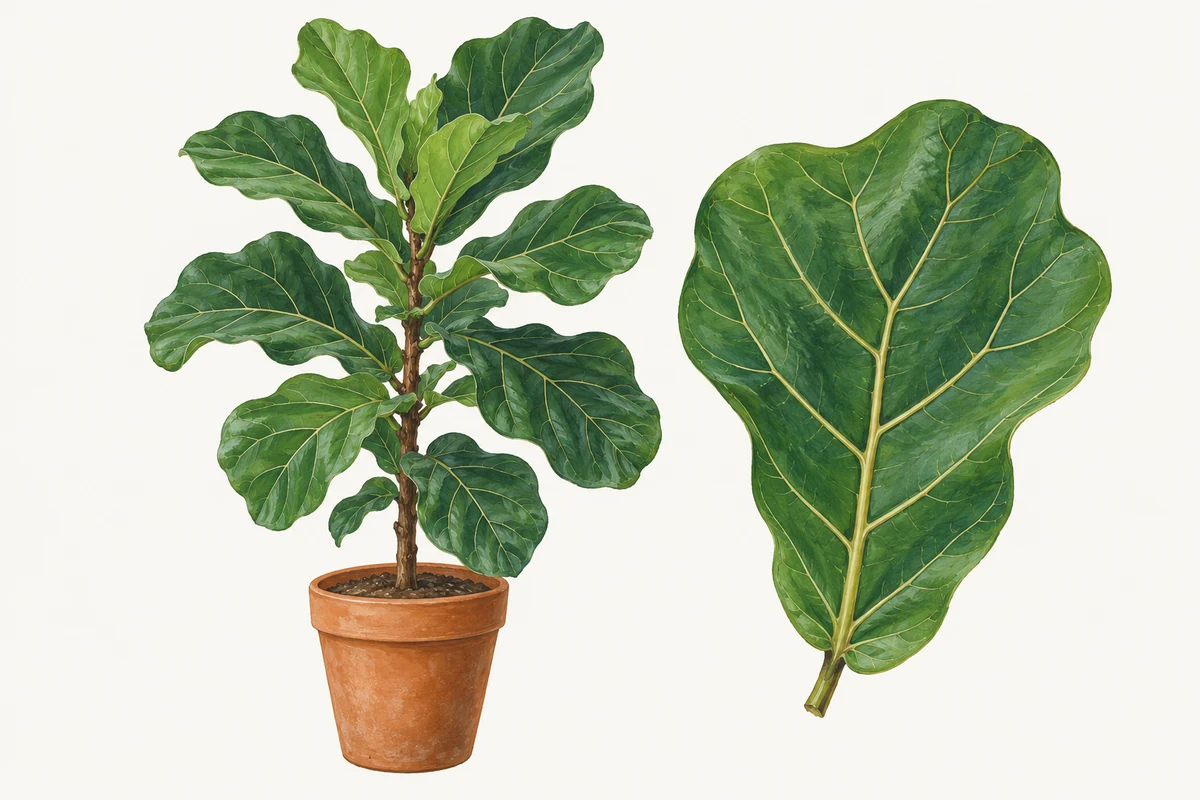
In short
A fiddle leaf fig (Ficus lyrata) is recognized by its leaves: large, stiff and leathery, wide and blunt at the tip and narrower toward a heart-shaped base, like a violin body. The surface is puckered and dull rather than glossy, with pale, prominent veins. NC State gives leaves up to 18 inches long, stems with milky sap, and a height of 2 to 10 feet indoors.
- Dull, puckered, violin-shaped leaf: that combination separates Ficus lyrata from the glossy, smooth-edged rubber plant.
- Ficus 'Audrey' is a Bengal fig (Ficus benghalensis): oval leaves with a fuzzy underside and a pale trunk.
- NC State lists the fiddle leaf fig as toxic to people, cats and dogs if eaten, and its milky sap can irritate skin.
Field marks at a glance
- Scientific name
- Ficus lyrata
- Family
- Moraceae (mulberry and fig family)
- Type
- Houseplant, perennial, evergreen
- Leaf shape
- Lyre- or violin-shaped (obovate to lyrate): broadest near the blunt, almost squared-off tip, narrowing toward a heart-shaped base (NC State).
- Leaf size
- Blade 8 to 15 inches long in NC State's leaf description; the same page gives up to 18 inches long and 12 inches wide for large leaves.
- Surface
- Bullate (puckered between the veins) and not glossy: dull green above, paler green below, thick and leathery, hairless once mature (NC State).
- Veins and edge
- Prominent pale veins; margin entire (untoothed) and often wavy (undulate).
- Arrangement
- Alternate, one leaf per node, spiraling up a stiff, sturdy stem that branches little on young plants.
- Sap
- Milky sap in the stems; NC State says it can irritate the skin and recommends gloves when pruning.
- Size
- 2 to 10 ft tall as a houseplant; 60 to 100 ft as a vase-shaped tree in the wild (NC State).
- Flowers and fruit
- Rare indoors. Tiny flowers hidden inside a fig; round figs 0.5 to 1.25 in across, green with white flecks, ripening red.
- Native range
- Tropical western and central Africa, from Sierra Leone and Guinea to Cameroon and Gabon (NC State).
The fiddle leaf fig (Ficus lyrata) is a tropical tree from West and Central Africa sold as a statement houseplant, and its leaves are its signature: stiff, puckered and shaped like the body of a violin. Look at a full-sized leaf first, then at its surface, then at the stem.
How to identify a fiddle leaf fig in four checks
1. The outline. Hold one mature leaf flat. A fiddle leaf fig leaf is broadest in its outer third, with a blunt, almost squared-off tip, and it narrows toward a heart-shaped base. Some leaves pinch in at the sides like a violin, which gives the plant its name; the epithet lyrata means "lyre-shaped". The NC State Plant Toolbox describes the leaves as obovate to lyrate, 8 to 15 inches long in the blade, and up to 18 inches long and 12 inches wide on large plants.
2. The surface. Look at the leaf against the light. It is puckered between the veins (botanists say bullate) and dull, not shiny: dull green above, paler below, thick and leathery. The veins are pale and stand out clearly, and the edge is smooth but often wavy. A glossy, flat, smooth leaf points to a different Ficus.
3. The stem and arrangement. Leaves alternate up a stiff, sturdy stem, and young plants branch very little, which is why many are sold as a single trunk topped by big leaves. There are no aerial roots. Brown bark flakes on young stems and turns gray and smooth with age.
4. The sap. A broken leaf or stem bleeds white, milky sap. NC State notes that this sap can irritate the skin and recommends gloves when pruning or propagating. Milky sap is common to the fig genus, so it confirms "Ficus" rather than the species.
If you still can't place the plant, one clear photo of a whole leaf is enough for Plant Identifier to suggest a common and scientific name. The app shows no confidence score and no list of alternatives, so check its answer against the four marks above.
Fiddle leaf fig vs rubber plant, 'Audrey' and banana leaf fig
Several figs are sold side by side in garden centers, and a single leaf separates them.
| Feature | Fiddle leaf fig | Rubber plant | Ficus 'Audrey' | Banana leaf fig |
|---|---|---|---|---|
| Scientific name | Ficus lyrata | Ficus elastica | Ficus benghalensis 'Audrey' | Ficus maclellandii 'Alii' |
| Leaf shape | Violin-shaped, widest near the tip | Elliptic, widest in the middle | Elliptical to ovate, pointed tip | Narrow, lance-shaped |
| Surface | Dull, puckered | Glossy, smooth | Smooth above, finely hairy below | Leathery, drooping |
| Leaf length | Up to 18 in | Up to 17 in | 4 to 10 in | 3 to 10 in |
The rubber plant facts come from NC State on Ficus elastica, which describes stiff, glossy, deep green leaves with a raised midrib and pink or purple stipules; it has its own page, rubber plant. NC State on Ficus benghalensis lists 'Audrey' as a Bengal fig cultivar 1 to 2 feet tall with a white trunk and glossy leaves with deep veins. NC State on Ficus maclellandii describes the banana leaf fig and its cultivar 'Alii', sometimes sold with a braided trunk.
Cultivars and other names
NC State lists four cultivars: 'Bambino', a dwarf that grows a few feet tall; 'Compacta', up to 5 feet tall with smaller leaves; 'Little Sunshine', a small plant with bright, violin-shaped leaves; and 'Variegata', with green and cream leaves, which is uncommon. Other common names are banjo fig and fiddle-leaf fig, and older books use the former scientific name Ficus pandurata.
All of them keep the dull, puckered, broad-tipped leaf, so the checks above still apply. A small 'Bambino' leaf can look rounder than a full-sized leaf; compare several leaves before you decide. For other large-leaved houseplants, the houseplant identification key works through the same leaf-first questions.
Is fiddle leaf fig toxic to pets
NC State lists the fiddle leaf fig as toxic to humans, cats and dogs if eaten, with a low poison severity. It names insoluble calcium oxalates as the toxic principle and lists oral irritation, burning of the mouth, excessive drooling, vomiting and difficulty swallowing. The ASPCA has no separate fiddle leaf fig page. Its weeping fig entry, filed under Ficus sp., lists the plant as toxic to dogs, cats and horses and names a proteolytic enzyme (ficin) and psoralen (ficusin).
If a pet has chewed a leaf, call your vet or the ASPCA Animal Poison Control Center at (888) 426-4435. If a person has eaten part of the plant, call Poison Control at 1-800-222-1222 (poison.org). Plant Identifier's Toxicology tool gives AI-written notes for people, dogs and cats, but it does not replace that call. More houseplants on the ASPCA's list are gathered in plants toxic to cats.
A short care note
NC State describes a plant that wants bright, indirect light or partial shade, protection from afternoon sun, and moist, well-drained soil, with temperatures above 55°F. It is sensitive to overwatering. Leaf drop can follow too much or too little water, brown spots can follow temperature swings near heating or cooling vents, and leaf scorch follows too much direct sun. Watch for scale, aphids, mealybugs, thrips and spider mites. Outdoors it is hardy only in USDA zones 10 to 12. For leaves turning yellow, see yellow leaves on plants.
Look-alikes and how to tell them apart
Rubber plant (Ficus elastica)
Tilt a leaf to the light. A rubber plant leaf is glossy, smooth and elliptic, widest in the middle, up to 17 inches long, with a raised, pale to reddish midrib underneath (NC State). A fiddle leaf fig leaf is matte, puckered and widest near the tip.
Ficus 'Audrey' (Ficus benghalensis)
Turn a leaf over and touch it. NC State describes Bengal fig leaves as elliptical to ovate with an acuminate tip and light-colored veins, smooth above and finely hairy beneath; 'Audrey' has a white trunk. A fiddle leaf fig leaf has a blunt tip and is hairless at maturity.
Banana leaf fig (Ficus maclellandii 'Alii')
Measure a leaf. Banana leaf fig leaves are narrow and lance-shaped, 3 to 10 inches long and 1.5 to 3.5 inches wide, and droop from the branches (NC State). A fiddle leaf fig leaf is several times wider.
Weeping fig (Ficus benjamina)
Look at the branches. A weeping fig has drooping branches and small, glossy leaves 2 to 5 inches long with a long, tapering tip (NC State). Nothing about it is violin-shaped.
What a photo can't settle
- Young fiddle leaf figs and the dwarf 'Bambino' can have small leaves that are less clearly violin-shaped, so a single small leaf may not settle the species.
- Many other Ficus species are sold as houseplants; where the leaf shape is in between, a store label or a botanist is a better guide than any photo app.
- Neither a photo nor this page can say whether a pet ate enough to matter; that is a question for your vet or the ASPCA Animal Poison Control Center.
Questions people ask
Is a fiddle leaf fig a real fig?
Yes, it is a true Ficus in the mulberry family. NC State describes small, round figs that ripen from green with white flecks to red, but notes that houseplants rarely flower or fruit. The flowers sit hidden inside the fig and are pollinated by fig wasps, which are absent indoors.
What is the difference between a fiddle leaf fig and a rubber plant?
Leaf surface and shape. A rubber plant leaf is glossy, smooth and elliptic, widest in the middle. A fiddle leaf fig leaf is dull, puckered and violin-shaped, widest near its blunt tip. Rubber plant shoots also end in a colored sheath, pink or purple on many plants according to NC State.
Is Ficus 'Audrey' a fiddle leaf fig?
No. NC State lists 'Audrey' as a cultivar of the Bengal fig, Ficus benghalensis, a different species. Its leaves are oval with a pointed tip, light veins and a finely hairy underside, and it has a pale trunk. A fiddle leaf fig leaf is violin-shaped and hairless when mature.
Is fiddle leaf fig toxic to cats and dogs?
NC State lists it as toxic to humans, cats and dogs if eaten, naming oral irritation, drooling and vomiting. The ASPCA has no separate fiddle leaf fig page; its weeping fig entry (Ficus sp.) is listed as toxic to dogs, cats and horses. If a pet chewed it, call your vet or the ASPCA Animal Poison Control Center.
Sources
- Ficus lyrata — North Carolina Extension Gardener Plant Toolbox (NC State)
- Ficus elastica — North Carolina Extension Gardener Plant Toolbox (NC State)
- Ficus benghalensis — North Carolina Extension Gardener Plant Toolbox (NC State)
- Ficus maclellandii — North Carolina Extension Gardener Plant Toolbox (NC State)
- Ficus benjamina — North Carolina Extension Gardener Plant Toolbox (NC State)
- Weeping Fig — ASPCA Animal Poison Control Center
- Poison Control — National Capital Poison Center
Keep reading
- Houseplant profileRubber plant (Ficus elastica): how to identify it
- Houseplant profileCalathea (Goeppertia): how to identify it
- Houseplant profileHoya (wax plant): how to identify it
- Plant healthYellow leaves on plants, and what each pattern means
- Houseplant profileMonstera deliciosa (Swiss cheese plant): how to identify it