Houseplant profile
Hoya (wax plant): how to identify it
A climbing or trailing vine with thick, waxy leaves in opposite pairs and round clusters of small, star-shaped, often fragrant flowers. Here is what to check.
In short
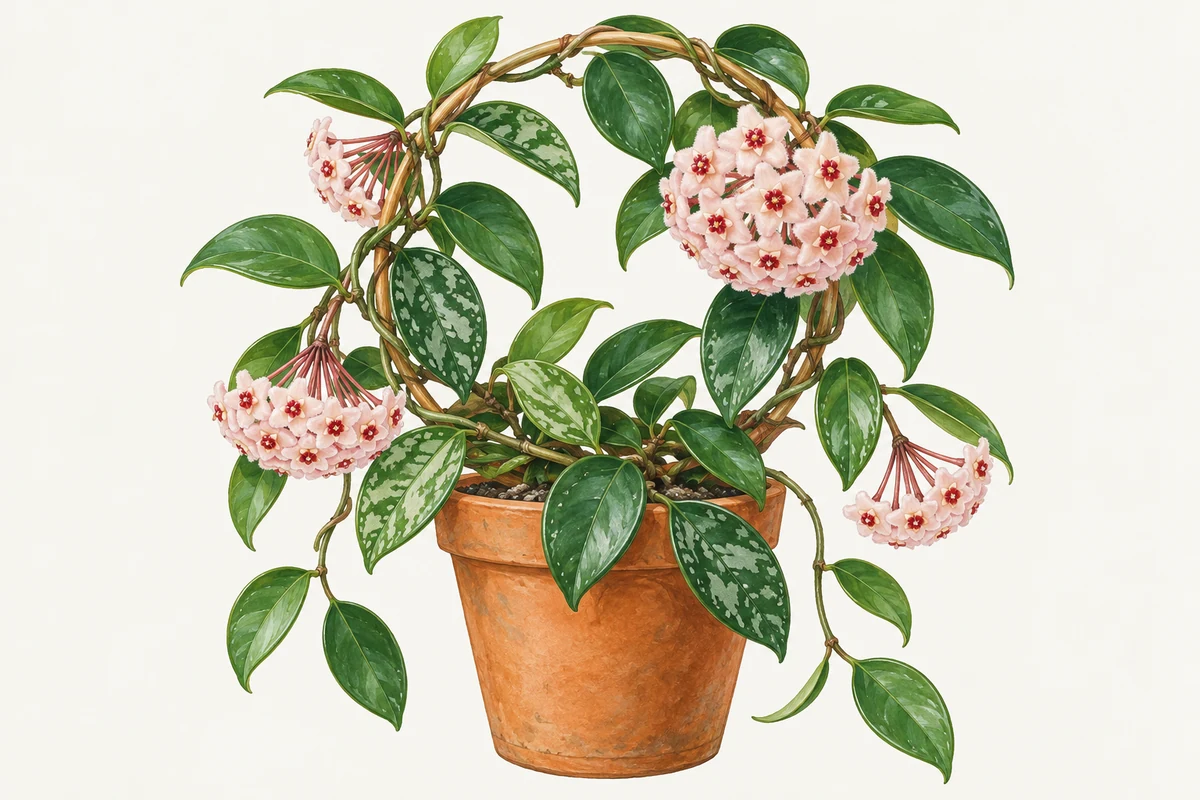
To identify a hoya plant, look for a twining or trailing vine with thick, waxy, leathery leaves set in opposite pairs, often flecked with silver or cream. Flowers come in rounded clusters of small, star-shaped, waxy blooms, white to pink with a five-pointed center, and form again on the same leafless spurs. The common wax plant is Hoya carnosa, in the dogbane family.
- Thick, waxy leaves in opposite pairs on a twining vine, plus star-shaped flowers in clusters, point to Hoya.
- Heart-shaped leaves set one at a time along the vine with aerial roots point to pothos; fleshy leaves on an upright woody stem point to jade plant.
- The ASPCA's Wax Plant and Porcelain Flower entries are filed under Hoya carnosa 'Krinkle Kurl'; other hoya species are not named there.
Field marks at a glance
- Scientific name
- Hoya spp.
- Family
- Apocynaceae (dogbane family)
- Type
- Houseplant, perennial, evergreen
- Habit
- Epiphytic, climbing or trailing evergreen vine; stems twine around supports and root along the stem (NC State). UF/IFAS describes the stems as woody.
- Leaves
- Simple, opposite, thick, leathery and waxy, with smooth edges; on Hoya carnosa ovate, 3 to 6 in long and 1 to 3 in wide (NC State).
- Leaf color
- Green, often flecked silver or cream-white; variegated cultivars have cream, white or pink margins or centers (NC State).
- Flowers
- Star-shaped, waxy, under 1 in, in rounded clusters (umbels) of up to 30 on Hoya carnosa; white to pink with a five-point center, often fragrant (NC State).
- Flower spurs
- Flowers form on short stalks (peduncles or spurs) that bloom again over several years; NC State and UF/IFAS advise not cutting them off.
- Sap
- Milky sap from cut stems; UF/IFAS notes hoyas are related to milkweed.
- Genus
- Over 550 species (NC State) or 200 to 300 (UF/IFAS); Hoya carnosa is the most commonly grown.
- Native range
- Tropical and subtropical Asia and the western Pacific islands (NC State); Hoya carnosa from Southeast Asia, Japan and Taiwan.
Hoyas, often called wax plants, are trailing and climbing vines grown indoors for their thick leaves and their clusters of star-shaped flowers. The genus is large and varied, so check the habit, the leaves and the flowers in the order below.
How to identify a hoya plant in four checks
1. The habit. Look at how the plant grows. A hoya is a vine: in the wild an epiphyte that climbs trees, indoors a plant that twines around a support or hangs from a basket. The NC State Plant Toolbox describes over 550 species of climbing evergreen perennials from tropical and subtropical Asia and the western Pacific, and notes roots forming along the stem of the wax plant.
2. The leaf arrangement. Follow a stem. Hoya leaves come in opposite pairs, two at each node. That alone separates a hoya from pothos and philodendron, whose leaves come one at a time.
3. The leaf texture. Press a leaf gently. It is thick, leathery and waxy, the trait behind the name wax plant. On Hoya carnosa the leaves are ovate, 3 to 6 inches long, green and often flecked with silver or cream (NC State).
4. The flowers. If the plant is in bloom, look for a rounded cluster of small, star-shaped flowers that look molded from wax or porcelain. On H. carnosa they are white to pink, hairy, with a five-pointed center, up to 30 per cluster, and may produce a sticky sap. They form on short spurs that flower again for several years. A cut stem bleeds milky sap; UF/IFAS Gardening Solutions notes that hoyas are related to milkweed.
When a plant arrives without a tag, Plant Identifier can give a common and scientific name from one photo; include a stem with a leaf pair and, if there is one, a flower cluster. The app shows no confidence score and no list of alternatives, so compare its answer with the checks above.
Common hoya species and cultivars
UF/IFAS counts 200 to 300 species and calls the wax plant, Hoya carnosa, probably the most commonly grown. NC State lists these, among others:
- Hoya carnosa (wax plant): thick, waxy, green leaves; fragrant pink or white flowers with a red center.
- H. carnosa 'Compacta' or 'Krinkle Kurl' (Hindu rope plant): leaves folded over, so the stems look like rope.
- H. carnosa 'Krimson Queen' or 'Tricolor': green center with creamy white to pink margins.
- H. kerrii (sweetheart hoya): thick, heart-shaped leaves.
- H. curtisii: miniature, with small round olive leaves mottled gray.
- H. lacunosa: deep green pitted leaves; fuzzy white flowers with a yellow center.
- H. shepherdii (string bean hoya): long, thin, succulent leaves.
World Flora Online places Hoya carnosa in the Apocynaceae, the dogbane family; older sources, including NC State's species page and the ASPCA, still use the former family name Asclepiadaceae.
Hoya vs pothos and jade plant
| Feature | Hoya | Pothos | Jade plant |
|---|---|---|---|
| Habit | Twining or trailing vine | Trailing or climbing vine | Upright shrub, woody succulent stems |
| Leaf arrangement | Opposite pairs | Alternate, one per node | Opposite, clustered at branch tips |
| Leaf | Thick, waxy, ovate (varies by species) | Heart-shaped, glossy, thinner | Fleshy, oval, almost stalkless |
| Leaf length | 3 to 6 in (H. carnosa) | 3 to 4 in | 1 to 3½ in |
Sources: NC State on pothos and NC State on jade plant. More detail is on the pothos and jade plant pages. For a step-by-step route through other houseplants, try the houseplant identification key.
Is a hoya toxic to pets
The ASPCA's Wax Plant entry, also listing Hindu rope plant and porcelain flower, classifies Hoya carnosa 'Krinkle Kurl' as non-toxic to dogs and cats. It names only that cultivar, not the hundreds of other hoya species. That is the ASPCA's classification, not a guarantee that a pet can chew the leaves without effect.
If a pet has chewed a leaf or flower, call your vet or the ASPCA Animal Poison Control Center at (888) 426-4435. For a person, call Poison Control at 1-800-222-1222 (poison.org). Plant Identifier's Toxicology tool gives AI-written notes for people, dogs and cats; treat them as a starting point, not as the answer. More houseplants on the ASPCA's lists are in plants toxic to cats and poisonous plants for dogs.
A short care note
NC State recommends bright indirect light, a loose, fast-draining potting mix and letting the soil dry between waterings; hoyas do not tolerate soggy soil. UF/IFAS advises letting the top third to half of the soil dry out, watering very sparingly in winter, and keeping the plant above 45°F. Both note that too little light is the usual reason a hoya does not flower.
Look-alikes and how to tell them apart
Pothos (Epipremnum aureum)
Check the leaf arrangement and shape. Pothos leaves are heart-shaped to elliptic, glossy rather than waxy, set one at a time along the stem, on grooved stalks that clasp the stem (NC State). Hoya leaves come in opposite pairs, are thick and waxy, and the flowers are star-shaped clusters.
Jade plant (Crassula ovata)
Look at the stem. Jade plant is an upright shrub, 3 to 6 ft, with thick, brittle, succulent stems and fleshy, oval, almost stalkless leaves clustered at the branch tips (NC State). A hoya's leaves are on short stalks along a thin, twining or hanging vine.
What a photo can't settle
- The genus has hundreds of species and many cultivars that differ mainly in leaf shape and markings; a photo can name the genus but often not the species without flowers.
- Young or leafless cuttings can look like other trailing succulents; wait for a flower cluster, or check the opposite leaf pairs and milky sap.
- Whether a pet that chewed a leaf needs treatment is for your vet or a poison control center to decide, not for this page or an app.
Questions people ask
How can I tell which hoya I have?
Start with the leaf. NC State describes heart-shaped leaves on Hoya kerrii, small round gray-mottled leaves on H. curtisii, pitted leaves on H. lacunosa, long thin succulent leaves on H. shepherdii and grass-like leaves on H. retusa. Hoya carnosa has ovate, waxy leaves 3 to 6 inches long.
What is a Hindu rope plant?
It is a cultivar of the wax plant, Hoya carnosa 'Compacta' or 'Krinkle Kurl'. NC State describes its leaves as folded over, giving the stems a rope-like look; UF/IFAS compares the curved leaves to fortune cookies.
Why has my hoya not flowered?
NC State notes that most wax plants do not flower until they are 2 or 3 years old, and UF/IFAS says too little light is usually the main reason. Leave the old flower spurs in place, because new flowers form on them.
Is a hoya toxic to cats and dogs?
The ASPCA's Wax Plant entry, filed under Hoya carnosa 'Krinkle Kurl', classifies it as non-toxic to dogs and cats. That is the ASPCA's classification, not a guarantee, and other hoya species are not named. If your pet chewed one and seems unwell, call your vet or the ASPCA Animal Poison Control Center at (888) 426-4435.
Sources
- Hoya — North Carolina Extension Gardener Plant Toolbox (NC State)
- Hoya carnosa — North Carolina Extension Gardener Plant Toolbox (NC State)
- Hoya — UF/IFAS Gardening Solutions
- Hoya carnosa — World Flora Online Plant List
- Wax Plant — ASPCA Animal Poison Control Center
- Epipremnum aureum — North Carolina Extension Gardener Plant Toolbox (NC State)
- Crassula ovata — North Carolina Extension Gardener Plant Toolbox (NC State)
- Poison Control — National Capital Poison Center
Keep reading
- Houseplant profilePothos (Epipremnum aureum): how to identify it
- Plant profileJade plant (Crassula ovata): how to identify it
- Houseplant profileWeeping fig (Ficus benjamina): how to identify it
- Pet safety guidePoisonous plants for dogs, and what to do if your dog ate one
- Houseplant profilePrayer plant (Maranta leuconeura): how to identify it