Houseplant profile
Weeping fig (Ficus benjamina): how to identify it
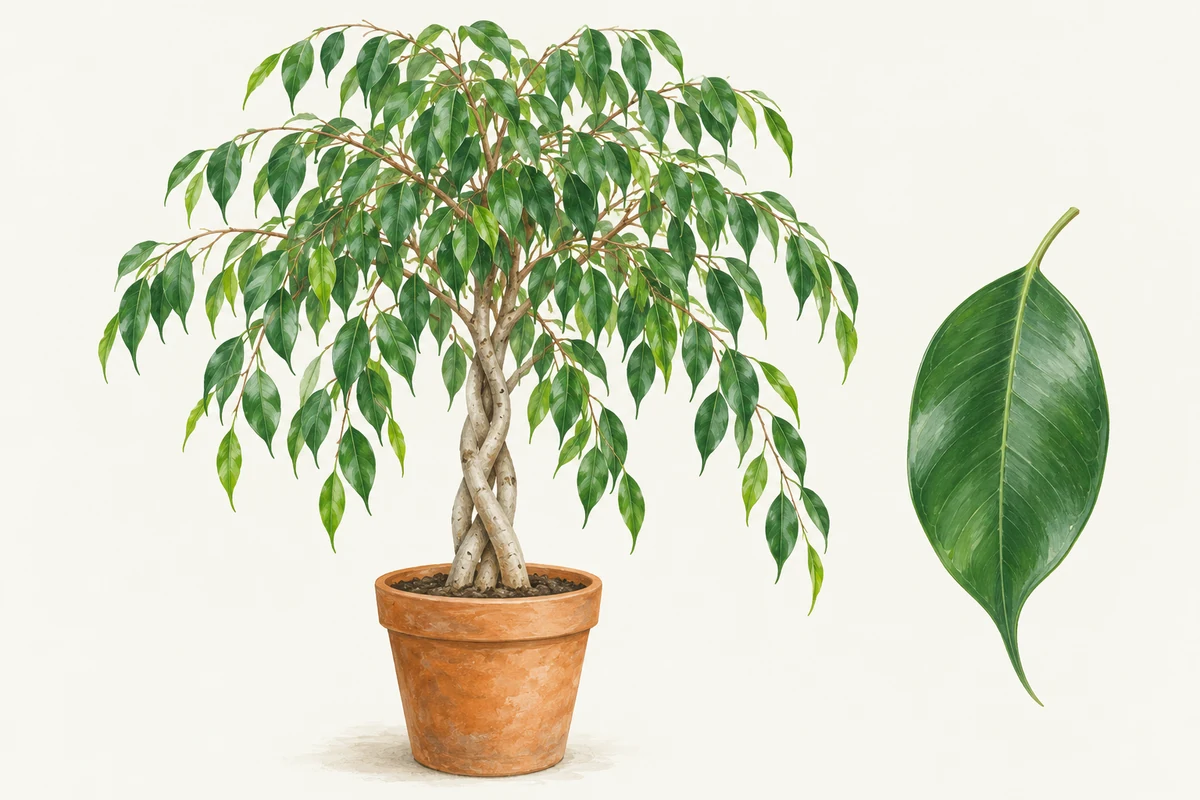
A small indoor tree with slender, drooping branches, glossy leaves 2 to 5 inches long that end in a long, tapering point, and stems often braided together. Here is what to check.
In short
A weeping fig (Ficus benjamina) is a broadleaf evergreen fig with slender, drooping branches and alternate, glossy, hairless leaves 2 to 5 inches long, ovate-elliptic with a long, tapering tip and 8 to 12 pairs of side veins. Indoors it is usually kept at 2 to 10 feet, often with braided stems. Small paired figs ripen from green to purple-black.
- Small, glossy leaves with a long, drawn-out tip on drooping branches point to Ficus benjamina.
- Leaves over 8 inches long mean rubber plant or fiddle leaf fig; short, blunt-pointed leaves on a thick trunk suggest Chinese banyan (F. microcarpa).
- The ASPCA lists Indian rubber plant (Ficus benjamina) as toxic to dogs and cats (ficin, ficusin).
Field marks at a glance
- Scientific name
- Ficus benjamina
- Family
- Moraceae (fig family)
- Type
- Houseplant, perennial, evergreen
- Leaves
- Simple, alternate, ovate-elliptic to oblong with a long, acuminate tip, 2 to 5 inches long (NC State); the attribute table gives 3 to 6 in long and 1 to 3 in wide.
- Leaf surface
- Glossy, leathery and hairless, with an entire (untoothed) margin and 8 to 12 pairs of side veins. Leaves fold in toward the midrib and droop (NC State).
- Branches
- Slender and drooping; NC State's quick ID hints note an interior tree with drooping branches and flexible stems that are often braided or trained.
- Bark
- Light brown with raised lenticels, sometimes with aerial roots; older specimens can have hanging aerial roots (NC State).
- Figs
- Small, under 1 inch, globose to slightly oblong, in pairs, green maturing to reddish then purple-black. The tiny flowers are hidden inside (NC State).
- Size
- Usually 2 to 10 ft as a houseplant; a tree of 40 to 50 ft with a 25 to 30 ft spread outdoors (NC State).
- Native range
- Southeastern Asia and Australia, extending into the southwestern Pacific (NC State). Hardy outdoors only in USDA zones 10a to 12b.
- Other names
- Benjamin tree, Java fig, small-leaved rubber plant, Indian rubber plant, Chinese banyan (NC State). Cultivars include 'Alii', 'Danielle', 'Too Little' and 'Variegata'.
The weeping fig (Ficus benjamina) is a tropical fig tree grown indoors for its arching, drooping branches and small, glossy leaves. Several other figs are sold as houseplants, so check the leaf, the branches and the trunk in the order below.
How to identify a weeping fig in four checks
1. The leaf size and tip. Hold a leaf flat. A weeping fig leaf is ovate-elliptic to oblong and ends in a long, drawn-out (acuminate) point. The NC State Plant Toolbox gives 2 to 5 inches in its leaf description, which is small for an indoor fig.
2. The surface and veins. The leaf is glossy, leathery and hairless, with a smooth edge and 8 to 12 pairs of side veins. NC State notes that the leaves fold in toward the midrib and droop toward the ground.
3. The branches. Look at the outline of the plant. Slender branches arch and droop, which gives the plant its common name. NC State's quick ID hints add that the stems are flexible and often braided or trained, so a pot with two or three twisted trunks is a strong clue.
4. The bark and figs. Check the trunk for light brown bark with raised lenticels, and sometimes aerial roots. If it fruits, the figs are small, under an inch, borne in pairs, and ripen from green to reddish and then purple-black.
When a plant arrives without a tag, Plant Identifier can give a common and scientific name from one photo; include a close view of a leaf and the branch habit. The app shows no confidence score and no list of alternatives, so compare its answer with the checks above.
Weeping fig cultivars and sizes
NC State describes the weeping fig as a broadleaf evergreen native to southeastern Asia and Australia, reaching 40 to 50 feet as a tree but usually kept at 2 to 10 feet as a houseplant. It lists these cultivars, among others:
- 'Alii': long and narrow green leaves.
- 'Danielle': weeping habit, glossy dark green leaves, slow growing.
- 'Samantha': smaller, variegated green, cream or yellow leaves.
- 'Variegata': green and white leaves with creamy yellow edges.
- 'Too Little': a dwarf popular for bonsai.
The GBIF Backbone Taxonomy accepts Ficus benjamina L. in the fig family, Moraceae. A narrow-leaved or variegated plant can still be a weeping fig: the long leaf tip and drooping branches stay the same.
Weeping fig vs rubber plant, fiddle leaf fig and Chinese banyan
All four are figs with milky sap, which is why they get mixed up. Leaf size usually settles it.
| Feature | Weeping fig | Rubber plant | Fiddle leaf fig | Chinese banyan |
|---|---|---|---|---|
| Leaf length | 2 to 5 in | Up to 17 in | 8 to 15 in | 2 to 2.5 in |
| Leaf shape | Ovate-elliptic, long tip | Elliptic, short point | Violin-shaped, blunt tip | Short, pointed, ridged tip |
| Surface | Glossy | Glossy, stiff | Dull, puckered | Deep glossy green |
| Branches | Slender, drooping | Stiff, upright | Stiff, upright | Dense crown, aerial roots |
Sources: NC State on rubber plant, NC State on fiddle leaf fig and NC State on Ficus microcarpa. For more detail, see our pages on the rubber plant and the fiddle leaf fig, or try the houseplant identification key.
Is a weeping fig toxic to pets
The ASPCA has two entries. Its Weeping Fig page gives the scientific name as Ficus sp., lists fig and Indian rubber plant as other names, and lists it as toxic to dogs, cats and horses. Its Indian Rubber Plant page names Ficus benjamina, lists fig and weeping fig as other names, and lists it as toxic to dogs and cats. Both name the proteolytic enzyme ficin and psoralen (ficusin) as the toxic principles.
If a pet has chewed a leaf or stem, call your vet or the ASPCA Animal Poison Control Center at (888) 426-4435. For a person, call Poison Control at 1-800-222-1222 (poison.org). Plant Identifier's Toxicology tool gives AI-written notes for people, dogs and cats; treat them as a starting point, not as the answer. More houseplants on the ASPCA's lists are in plants toxic to cats and poisonous plants for dogs.
A short care note
NC State recommends bright, indirect light, though the plant will survive in shade, and a soil-based potting mix watered just often enough to keep it from drying out completely. It is intolerant of cold and drafts, and light pruning for shape is best done in late autumn or winter. Because it reacts to changes in light, leaf drop after a move is common. For yellowing leaves, see yellow leaves on plants.
Look-alikes and how to tell them apart
Rubber plant (Ficus elastica)
Measure a leaf. Rubber plant leaves are stiff, glossy and up to 17 inches long, with a short point and a pink or purple sheath around the new leaf at the shoot tip (NC State). Weeping fig leaves are 2 to 5 inches with a long, drawn-out tip, on drooping branches.
Fiddle leaf fig (Ficus lyrata)
Look at the leaf outline. Fiddle leaf fig leaves are dull, puckered and violin-shaped, 8 to 15 inches long, broadest near a blunt tip (NC State). A weeping fig leaf is small, glossy, widest near the middle and long-pointed.
Chinese banyan, ginseng ficus (Ficus microcarpa)
Check the leaf tip and the trunk. NC State describes leathery, deep glossy green leaves 2 to 2.5 inches long with short, pointed, ridged tips, smooth gray bark and long, thin aerial roots. A weeping fig leaf ends in a longer, tapering point and its branches droop.
What a photo can't settle
- Weeping figs are sold as many cultivars, from variegated 'Samantha' to narrow-leaved 'Alii'; a photo can name the species but often not the cultivar.
- Several small-leaved figs, including Ficus microcarpa sold as ginseng ficus or bonsai, look alike at a glance. Check the leaf tip, the bark and the branch habit.
- Whether a pet that chewed a leaf needs treatment is for your vet or a poison control center to decide, not for this page or an app.
Questions people ask
Why is my weeping fig dropping leaves?
NC State describes the weeping fig as very sensitive to light: when the plant is moved, it may drop leaves and grow new ones suited to the new light. It is also intolerant of cold and should be kept away from drafts. Some leaf drop after a move is expected.
Is a weeping fig the same as a rubber plant?
No. Both are figs (Ficus), and Indian rubber plant is one of the common names NC State gives Ficus benjamina, but the rubber plant usually sold as such is Ficus elastica, with leaves up to 17 inches long. Weeping fig leaves are 2 to 5 inches.
How big does a weeping fig get?
As a houseplant it is usually kept at 2 to 10 feet tall, according to NC State. Outdoors in frost-free climates it can become a tree of 40 to 50 feet with a 25 to 30 foot spread. Dwarf cultivars such as 'Too Little' are used for bonsai.
Is a weeping fig poisonous to cats and dogs?
The ASPCA lists Indian rubber plant (Ficus benjamina) as toxic to dogs and cats, naming ficin and ficusin. If your pet chewed it, call your vet or the ASPCA Animal Poison Control Center at (888) 426-4435. For a person, call Poison Control at 1-800-222-1222.
Sources
- Ficus benjamina — North Carolina Extension Gardener Plant Toolbox (NC State)
- Ficus microcarpa — North Carolina Extension Gardener Plant Toolbox (NC State)
- Ficus elastica — North Carolina Extension Gardener Plant Toolbox (NC State)
- Ficus lyrata — North Carolina Extension Gardener Plant Toolbox (NC State)
- Weeping Fig — ASPCA Animal Poison Control Center
- Indian Rubber Plant — ASPCA Animal Poison Control Center
- Ficus benjamina L. — GBIF Backbone Taxonomy
- Poison Control — National Capital Poison Center
Keep reading
- Houseplant profileRubber plant (Ficus elastica): how to identify it
- Houseplant profileFiddle leaf fig (Ficus lyrata): how to identify it
- Pet safety guidePlants toxic to cats, and what to do if your cat chewed one
- Pet safety guidePoisonous plants for dogs, and what to do if your dog ate one
- Plant healthYellow leaves on plants, and what each pattern means