Houseplant profile
Money tree (Pachira aquatica): how to identify it
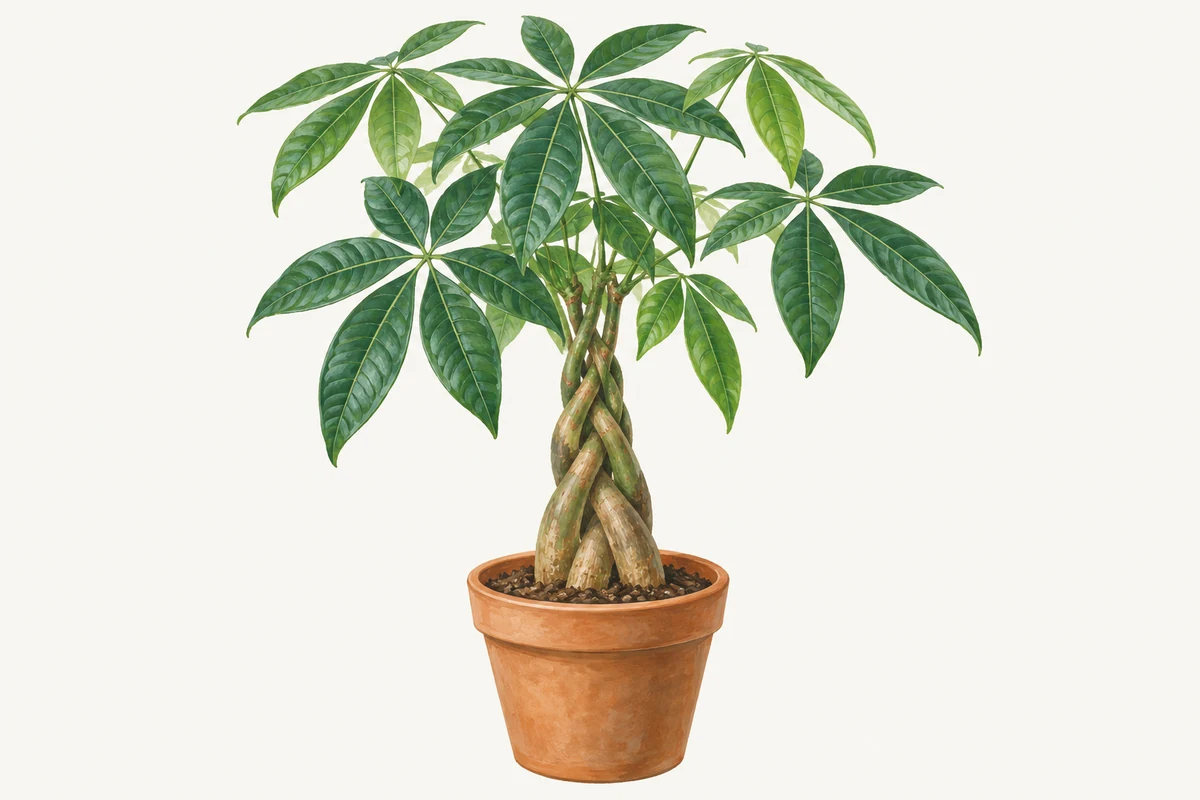
Braided green or brown trunks topped with glossy leaves split like an open hand into 5 to 9 leaflets. Here is what to check, and how it differs from the plants that share its name.
In short
The money tree sold as a houseplant is Pachira aquatica, a tropical tree in the mallow family. Look for several flexible trunks, often braided together, and shiny green, palmately compound leaves of 5 to 9 leaflets, 5 to 10 inches long, spreading like an open hand. Indoors it usually stays 6 to 8 feet tall and rarely flowers. It is not the jade plant.
- Braided trunks plus hand-shaped leaves of 5 to 9 leaflets point to Pachira aquatica.
- Smaller leaflets on a bushy, unbraided shrub suggest a dwarf umbrella tree; thick, fleshy oval leaves mean a jade plant.
- The ASPCA classifies Pachira aquatica as non-toxic to dogs, cats and horses; that classification is not a guarantee.
Field marks at a glance
- Scientific name
- Pachira aquatica
- Family
- Malvaceae (mallow family)
- Type
- Houseplant, perennial, evergreen
- Leaves
- Palmately compound: 5 to 9 leaflets spreading from the tip of one leaf stalk, the leaf 5 to 10 inches long (NC State).
- Leaf surface
- Shiny and green (NC State).
- Trunk
- Flexible enough that several trunks are often braided together as young plants, a practice NC State traces to Taiwan.
- Size
- Up to 60 ft in its native habitat and up to 30 ft in cultivation, but usually no more than 6 to 8 ft as a houseplant (NC State).
- Flowers
- Large, green to yellowish-white, with 5 cream petals around 200 to 250 red-tipped stamens 3 to 4 inches long; each lasts one day (NC State). Indoor and braided plants do not flower.
- Fruit
- A woody brown capsule about 12 inches long, seen only on mature outdoor trees (NC State).
- Native range
- Southern Mexico to Bolivia and northern Brazil, in freshwater swamps, estuaries, riverbanks and rainforest (NC State).
- Names
- Accepted as Pachira aquatica Aubl. by World Flora Online. Other common names include Guiana chestnut, Malabar chestnut, French peanut and Mexican fortune tree.
The money tree sold in garden centers and offices is Pachira aquatica, a tropical tree from Central and South America that is grown indoors as a small, often braided tree. The name is also given to other plants, so check the leaves and the trunk in the order below.
How to identify a money tree in four checks
1. The leaf. Look at one whole leaf. A money tree leaf is palmately compound: 5 to 9 leaflets spread from the tip of a single stalk like the fingers of an open hand. The NC State Plant Toolbox gives 5 to 10 inches for the leaf and describes it as shiny and green.
2. The trunk. Look at the base. Money tree trunks are so flexible that several young plants are often braided together, and most potted money trees are sold this way. A plant with a single, unbraided trunk can still be a money tree; the leaf is the stronger clue.
3. The size. NC State notes that the tree can reach 60 feet in its native swamps and riverbanks and up to 30 feet in cultivation, but as a houseplant it usually stays 6 to 8 feet tall.
4. Flowers and fruit, if any. Outdoors in warm climates, mature trees bear large, green to yellowish-white flowers with five cream petals around a brush of 200 to 250 red-tipped stamens, followed by a woody brown capsule about 12 inches long. Indoor and braided plants do not flower, so most owners will never see either.
When a plant arrives without a tag, Plant Identifier can give a common and scientific name from one photo; include at least one whole leaf. The app shows no confidence score and no list of alternatives, so compare its answer with the checks above.
The money tree name and its other plants
World Flora Online accepts Pachira aquatica Aubl. NC State lists its older names in Bombax and common names including Guiana chestnut, Malabar chestnut, French peanut, Mexican fortune tree and money plant. It places the tree in the mallow family (Malvaceae) and explains that the genus name refers to the fruit and aquatica to its wet native habitats.
NC State traces the money tree name to Taiwan in the 1980s, where the plant was valued in feng shui for prosperity and where braiding the stems began. The same nickname is used for the jade plant (Crassula ovata), a succulent with thick, fleshy leaves; it has its own page, jade plant, so it is not repeated here.
Money tree vs dwarf umbrella tree and jade plant
| Feature | Money tree | Dwarf umbrella tree | Jade plant |
|---|---|---|---|
| Leaf type | Palmately compound | Palmately compound | Simple |
| Leaflets | 5 to 9 | 7 to 9 | None, one oval leaf |
| Leaf texture | Shiny, thin | Glossy, thin | Thick, fleshy |
| Trunk | Often braided | Bushy, not braided | Thick, succulent stems |
| Indoor size | 6 to 8 ft | 4 to 6 ft | Shrub |
Sources: NC State on the dwarf umbrella tree and NC State on the jade plant. The dwarf umbrella tree is the closer lookalike: count the leaflets, check for braided trunks, and note that NC State lists all parts of it as seriously toxic to dogs and cats. For other indoor trees, compare the rubber plant and the fiddle-leaf fig, or use the houseplant identification key.
Is a money tree toxic to pets
The ASPCA lists the money tree (Pachira aquatica) as non-toxic to dogs, cats and horses. That is the ASPCA's classification, not a guarantee: the same entry lists nausea, vomiting and loose stool as clinical signs, and any plant can upset a pet's stomach. Make sure the plant really is Pachira aquatica, since the jade plant and the dwarf umbrella tree are listed differently.
If a pet has chewed a leaf, call your vet or the ASPCA Animal Poison Control Center at (888) 426-4435. For a person, call Poison Control at 1-800-222-1222 (poison.org). Plant Identifier's Toxicology tool gives AI-written notes for people, dogs and cats; treat them as a starting point, not as the answer. More houseplants on the ASPCA's lists are in plants toxic to cats and poisonous plants for dogs.
A short care note
NC State recommends indirect light or a mix of sun and shade, since direct sun can scorch the leaves, and a moist, well-drained potting mix; standing water is not tolerated and can cause root rot. It prefers humidity and 65 to 75°F, and plants kept outdoors should come in before temperatures drop to 45°F. NC State adds that dry soil can cause leaf drop and that low humidity or poor nutrition can cause yellow leaves; for more, see yellow leaves on plants.
Look-alikes and how to tell them apart
Dwarf umbrella tree (Heptapleurum arboricola, formerly Schefflera arboricola)
Check the trunk and the flowers. Dwarf umbrella tree also has glossy, palmately compound leaves of 7 to 9 leaflets, but it grows as a bushy shrub, 4 to 6 feet in a container, without braided trunks, and outdoors it bears tiny red flowers and small orange fruit turning black (NC State).
Jade plant (Crassula ovata), also sold as money plant
Squeeze a leaf. Jade plant leaves are simple, thick, fleshy and shiny ovals 1 to 3½ inches long on thick succulent stems (NC State). A money tree leaf is thin and split into 5 to 9 separate leaflets.
What a photo can't settle
- The common name money tree is used for several unrelated plants, so check the scientific name on the tag or from the leaf shape.
- A young, unbraided money tree can look like other plants with palmately compound leaves; a photo that shows a whole leaf and the trunk helps.
- Whether a pet that chewed a leaf needs treatment is for your vet or a poison control center to decide, not for this page or an app.
Questions people ask
Is a money tree the same as a jade plant?
No. The money tree is Pachira aquatica, a tree in the mallow family with hand-shaped compound leaves. The jade plant, Crassula ovata, is a South African succulent with thick, fleshy oval leaves; NC State lists money plant among its common names, which causes the mix-up.
Why is it called a money tree?
NC State says the name comes from a tale of a poor man who grew rich selling the tree's nuts, and that the plant became popular in Taiwan in the 1980s, valued in feng shui for prosperity. Braiding the stems also began in Taiwan.
Will my money tree flower indoors?
Unlikely. NC State notes that outdoor trees flower after 4 to 5 years, but money trees do not flower indoors or when braided. The flowers, where they appear, last one day and are fragrant at night.
Is a money tree toxic to cats and dogs?
The ASPCA classifies Pachira aquatica as non-toxic to dogs, cats and horses, but still lists nausea, vomiting and loose stool as possible signs. That classification is not a guarantee. If your pet chewed it, call your vet or the ASPCA Animal Poison Control Center at (888) 426-4435. For a person, call Poison Control at 1-800-222-1222.
Sources
- Pachira aquatica — North Carolina Extension Gardener Plant Toolbox (NC State)
- Pachira aquatica Aubl. — World Flora Online Plant List
- Money Tree — ASPCA Animal Poison Control Center
- Heptapleurum arboricola — North Carolina Extension Gardener Plant Toolbox (NC State)
- Crassula ovata — North Carolina Extension Gardener Plant Toolbox (NC State)
- Poison Control — National Capital Poison Center
Keep reading
- Plant profileJade plant (Crassula ovata): how to identify it
- Houseplant profileRubber plant (Ficus elastica): how to identify it
- Houseplant profileFiddle leaf fig (Ficus lyrata): how to identify it
- Houseplant profileWeeping fig (Ficus benjamina): how to identify it
- Pet safety guidePoisonous plants for dogs, and what to do if your dog ate one