Succulent profile
Christmas cactus leaf identification: Christmas, Thanksgiving or Easter cactus
Three holiday cacti share flat, jointed stems. The shape of each segment's edge, the angle of the flower and the bloom season tell them apart in a minute.
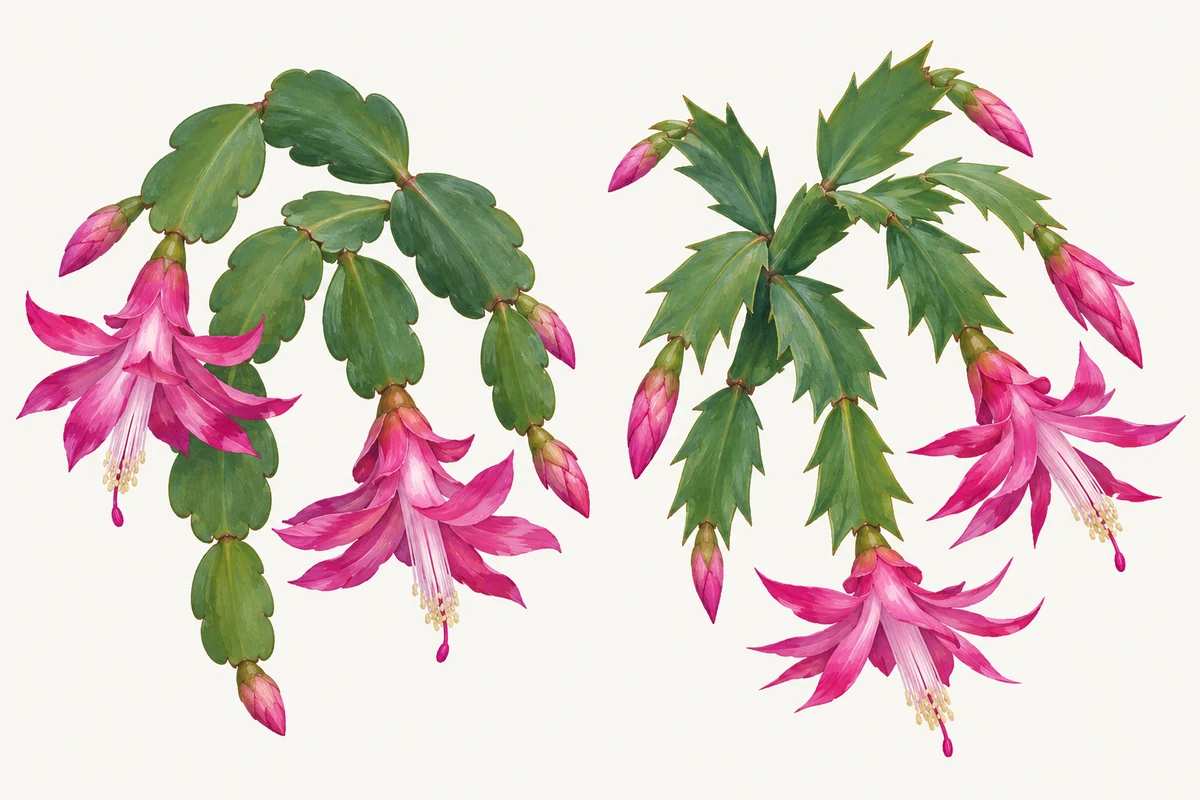
In short
Christmas cactus leaf identification starts with the edge of a stem segment, because the "leaves" are flat stem segments. True Christmas cactus (Schlumbergera × buckleyi) has rounded notches; Thanksgiving cactus (S. truncata) has pointed, claw-like teeth; Easter cactus (Rhipsalidopsis gaertneri, also Hatiora gaertneri) has soft scallops with bristles at the tips. Then check the flowers: hanging tubes, level tubes, or open stars in spring.
- Rounded notches on the segment edges point to Christmas cactus; pointed, claw-like teeth to Thanksgiving cactus.
- Easter cactus has scalloped segments with brownish or yellowish bristles at the tips and star-shaped flowers in spring.
- Labels mix the names up; the RHS treats both Schlumbergera truncata and S. × buckleyi as 'Christmas cactus', so trust the segment edge.
Field marks at a glance
- Scientific name
- Schlumbergera × buckleyi
- Family
- Cactaceae (cactus family)
- Type
- Succulent, perennial, evergreen
- Stem segments
- Flat, jointed, spineless green segments (cladodes) that work as leaves, about 2.5 in long and 0.75 in wide (NC State).
- Segment edge
- Rounded marginal notches, 2 or 3 shallow scallops per side, with no pointed teeth. Pointed teeth mean Thanksgiving cactus.
- Flowers
- Tubular, magenta-red to pink, about 3 in long, with spreading to curled-back tepals; they hang down from the segment tips.
- Flower symmetry
- Slightly lopsided (zygomorphic), with the mouth of the tube only weakly slanted; Thanksgiving cactus flowers are strongly slanted.
- Bloom time
- December to February on the true hybrid (NC State), when given long nights and cool temperatures in autumn.
- Fruit
- Red berries. NC State notes that most plants sold are sterile hybrids, so fruit on a shop plant is uncommon.
- Size and habit
- 6 to 12 in tall and 12 to 24 in wide, arching and weeping over the pot rim; ideal for a hanging basket.
- Origin
- A garden hybrid of S. russelliana × S. truncata, raised in England in the 1840s; both parents come from rainforests of southeastern Brazil.
The "leaves" of a Christmas cactus are not leaves. They are flat, jointed stem segments, and their edges are the fastest way to tell the three holiday cacti apart. Most plants sold as Christmas cactus turn out to be Thanksgiving cactus, and the segment edge settles it before a single flower opens.
The segment test: rounded notches or claw-like teeth
Pick one healthy segment near the end of a stem and look at its two long edges and its top corners.
- Rounded notches, no points: true Christmas cactus (Schlumbergera × buckleyi). The NC State Extension Plant Toolbox describes the stems as "flat, jointed, spineless, and segmented with rounded marginal notches," with 2 or 3 shallow scallops (crenations) per side. Each segment is about 2.5 inches long and 0.75 inches wide.
- Pointed, claw-like teeth: Thanksgiving cactus (Schlumbergera truncata). NC State's Schlumbergera truncata page gives "pointed, claw-like or teeth-like projections on the margins" as its first quick ID hint, and says the Christmas cactus "has rounded cladode margins that lack the pointed projections." Thanksgiving cactus segments are about 1.5 to 2.25 inches long and 0.75 to 1.5 inches wide, with hairs at the tip end. The common names crab cactus and claw cactus come from these teeth.
- Soft scallops with bristles at the tip: Easter cactus (Rhipsalidopsis gaertneri). NC State's Rhipsalidopsis gaertneri page describes segments that are rounded and weakly scalloped, 1.5 to 2.5 inches long, with a few brownish or yellowish bristles at the tips.
Run a fingertip gently along the edge: teeth catch, notches do not. If your plant has a mix, look at several segments; hybrids can be intermediate, which is one of the limits below. One photo of a segment edge in Plant Identifier gives a name to check against these marks; the app shows no confidence score and no list of alternatives, so the edge test is your confirmation.
Flowers and bloom season
The flower confirms what the segments suggest.
Christmas cactus. NC State describes delicate tubular flowers, magenta-red to pink and about 3 inches long, that "droop down" from the segment ends. The tube is long and only weakly slanted at the mouth, and the petal-like tepals spread or curl back. The hybrid blooms from December to February.
Thanksgiving cactus. Its flowers are also long tubes but, NC State says, they are erect and do not hang down like those of the Christmas cactus. The mouth is strongly slanted (one side longer than the other), the anthers are yellow, and the colors run from red, pink, purple and orange to creamy white. Flowering usually starts in late November and lasts about five weeks, with a possible second flush as days lengthen in February.
Easter cactus. The flowers are a different shape: wide, short-tubed stars 1.5 to 3 inches across in red, pink or white, opening between late March and May. The buds form only as days lengthen in late winter.
Bloom time is a weaker clue than the segments, because indoor light and temperature shift it. A toothed plant that flowers at Christmas is still a Thanksgiving cactus.
Why the names get mixed up
The names overlap on labels, in shops and in the sources themselves. The Royal Horticultural Society writes that "there are two species of Christmas cactus", Schlumbergera truncata and Schlumbergera × buckleyi, and treats both under the one common name. NC State keeps the names apart: Christmas cactus for S. × buckleyi, an artificial hybrid of S. russelliana and S. truncata raised by William Buckley at an English nursery in the 1840s, and Thanksgiving, crab or false Christmas cactus for S. truncata. It adds that there are over 200 cultivars.
The ASPCA's entry adds another layer: it files Christmas cactus under the older name Schlumbergera bridgesii and gives "Easter cactus" as an additional common name. The Easter cactus itself is a separate genus. World Flora Online accepts Rhipsalidopsis gaertneri, the name NC State uses, while many shops and databases still list it as Hatiora gaertneri or Schlumbergera gaertneri.
The practical answer: identify the plant by its segment edges and flowers, and treat the label as a hint.
| Feature | Christmas cactus | Thanksgiving cactus | Easter cactus |
|---|---|---|---|
| Scientific name | Schlumbergera × buckleyi | Schlumbergera truncata | Rhipsalidopsis gaertneri |
| Segment edge | Rounded notches | Pointed, claw-like teeth | Soft scallops, bristles at tip |
| Segment length | About 2.5 in | 1.5 to 2.25 in | 1.5 to 2.5 in |
| Flower shape | Long tube, hanging | Long tube, held level, strongly slanted | Wide star, short tube |
| Main bloom | December to February | Late November, about 5 weeks | Late March to May |
| Fruit | Red berries | Smooth, red, round to pear-shaped | Dull red, oblong, about 15 mm |
For other flat-stemmed and spiny cacti, see the cactus identification guide, and for fleshy-leaved plants such as jade, the succulent identification guide.
Pets, origin and a short care note
Pets. The ASPCA lists Christmas cactus as non-toxic to dogs, cats and horses. That is the ASPCA's classification, not a guarantee that a pet will have no reaction after chewing a plant; if your pet is unwell, call your vet or the ASPCA Animal Poison Control Center at (888) 426-4435 (the ASPCA says a consultation fee may apply). For a person, Poison Control is at 1-800-222-1222 in the US, or NHS 111 in the UK.
Origin. These are not desert cacti. NC State says Thanksgiving cactus grows on trees and rocks in the coastal mountain rainforests of southeastern Brazil, and Easter cactus comes from the coastal mountains of southern Brazil. That rainforest origin explains their flat, spineless stems and their dislike of strong sun.
Care, briefly, from the RHS: bright, indirect light (an east-facing windowsill is often ideal), about 18 to 20 °C (65 to 69 °F) in growth and in flower, and two cooler, drier rest periods at 12 to 15 °C (55 to 59 °F): one from mid-September until buds show, one after flowering. NC State adds that the plants need at least 13 hours of uninterrupted darkness each night in autumn to set buds, and that sudden temperature changes and drafts make buds drop. Plant Identifier's Care Guide can give general notes once the plant is named, but the long-night rule is the one that decides whether it flowers.
Look-alikes and how to tell them apart
Thanksgiving cactus (Schlumbergera truncata)
Run a finger along a segment edge: sharp, claw-like teeth catch where a Christmas cactus has only rounded notches. Its flowers are held erect instead of hanging, have yellow anthers and a strongly slanted mouth, and open from late November.
Easter cactus (Rhipsalidopsis gaertneri, also sold as Hatiora gaertneri)
Segment edges are softly scalloped with no teeth, and the segment tips carry a few brownish or yellowish bristles. The flowers are wide, short-tubed stars 1.5 to 3 in across, opening from late March to May.
What a photo can't settle
- Many plants sold today are hybrids between Christmas and Thanksgiving cactus, and some show intermediate segment edges; no photo can settle the exact parentage of a cultivar.
- A photo of a plant out of flower shows only the segments; when the teeth are worn or the picture is taken from above, the edge test needs the plant in hand.
- Easter cactus is listed under two genus names, Rhipsalidopsis and Hatiora; an app or a label may show either for the same plant.
Questions people ask
How do I tell a Christmas cactus from a Thanksgiving cactus by the leaves?
Look at the edges of the flat stem segments. NC State describes Christmas cactus segments with rounded marginal notches and Thanksgiving cactus segments with pointed, claw-like or tooth-like projections. If you can feel sharp points along the edge and at the upper corners, it is a Thanksgiving cactus, whatever the label says.
Is my Christmas cactus actually a Thanksgiving cactus?
Often, yes. Both are sold as Christmas cactus, and the RHS lists Schlumbergera truncata and S. × buckleyi as its two Christmas cactus species. A plant with toothed segments that flowers in late November, with flowers held level rather than hanging, matches NC State's description of Thanksgiving cactus.
How is an Easter cactus different from a Christmas cactus?
Easter cactus flowers in spring, between late March and May, with wide, star-shaped flowers instead of long tubes. Its segments have rounded scallops and a few brownish or yellowish bristles at the tips. NC State calls it more finicky than its holiday cousins and says it drops segments if over- or underwatered.
Is Christmas cactus toxic to cats?
The ASPCA lists Christmas cactus (as Schlumbergera bridgesii) as non-toxic to dogs, cats and horses. That is a listing, not a guarantee: a pet that is unwell after chewing any plant should see a vet, or you can call the ASPCA Animal Poison Control Center at (888) 426-4435 (a fee may apply).
Does a Christmas cactus have leaves?
No. NC State says the 'leaves' are cladodes: flattened green stem segments that work like leaves. Hairs and flowers emerge from areoles on the segments, and the plant has no spines. That is why identification relies on the segment edge rather than on leaf shape.
Sources
- Schlumbergera x buckleyi — NC State Extension Gardener Plant Toolbox
- Schlumbergera truncata — NC State Extension Gardener Plant Toolbox
- Rhipsalidopsis gaertneri — NC State Extension Gardener Plant Toolbox
- How to grow Christmas cactus — Royal Horticultural Society
- Christmas Cactus — ASPCA Poison Control
- Rhipsalidopsis gaertneri (Regel) Moran — World Flora Online
Keep reading
- Field guideCactus identification: how to tell common cacti apart
- Field guideSucculent identification: how to identify succulents by shape, leaf and sap
- Houseplant profilePoinsettia plant (Euphorbia pulcherrima): how to identify it
- Plant profileJade plant (Crassula ovata): how to identify it
- Succulent profileAloe vera: how to identify the plant