Houseplant profile
Poinsettia plant (Euphorbia pulcherrima): how to identify it
Colored bracts that look like petals, tiny yellow cups at their center, and milky sap in the stems. How to tell it from other red holiday plants, and what the ASPCA and Poison Control say.
In short
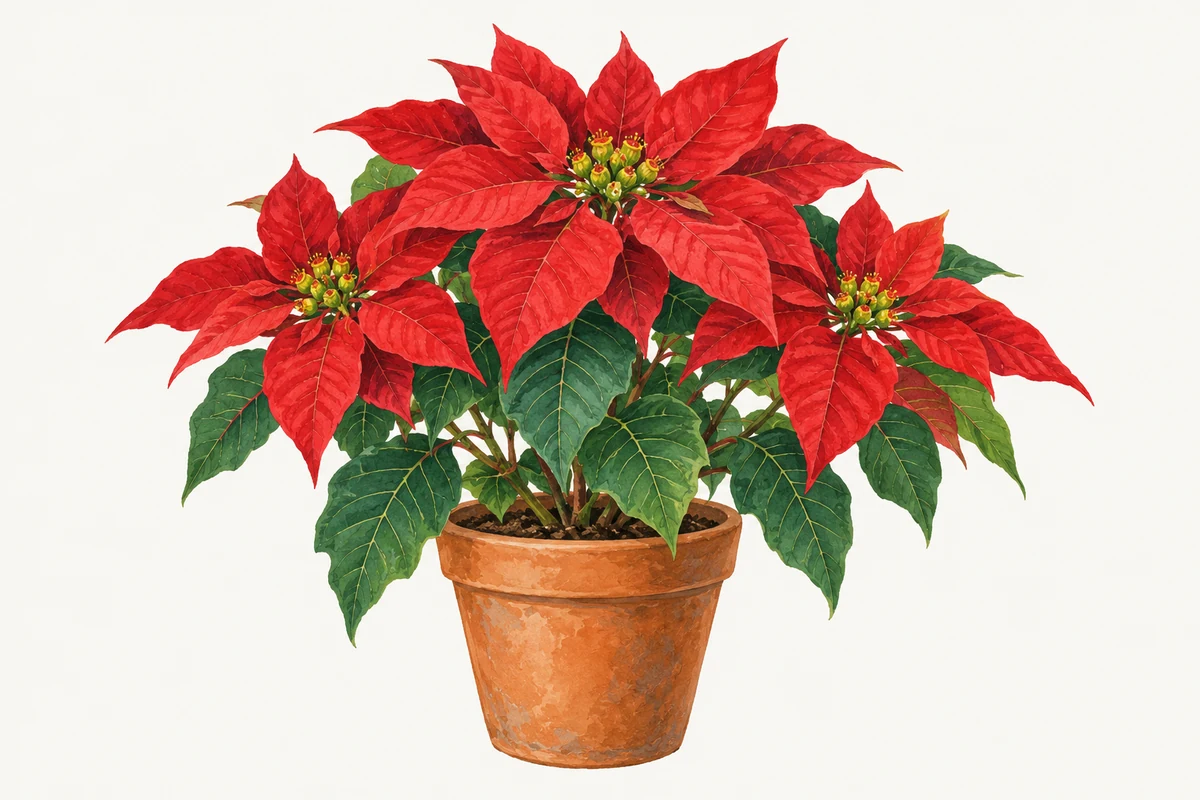
The poinsettia plant (Euphorbia pulcherrima) is a spurge-family shrub from Mexico and Guatemala grown for its red, pink or white bracts, which are modified leaves, not petals. Confirm it by three marks: tiny yellow cup-shaped flower clusters (cyathia) at the center of the bracts, dark green ovate leaves 3 to 6 inches long, and milky sap from a torn leaf or stem. The ASPCA lists it as toxic to cats and dogs.
- The red 'petals' are bracts (modified leaves); the true flowers are the tiny yellow cups, called cyathia, in the middle.
- Stems and leaves give a milky sap when torn, a mark of the spurge family (Euphorbiaceae).
- The ASPCA lists poinsettia as toxic to cats and dogs, names mouth and stomach irritation, and calls it generally over-rated in toxicity.
Field marks at a glance
- Scientific name
- Euphorbia pulcherrima
- Family
- Euphorbiaceae (spurge family)
- Type
- Houseplant, perennial, semi-evergreen
- Bracts
- The showy colored parts are bracts, modified leaves, not petals: red, pink, white or orangish-peach, sometimes marbled, speckled or two-toned (NC State, UF/IFAS).
- True flowers
- Tiny yellow cups (cyathia) clustered at the center of the bracts, each with a large yellow gland on its rim, under 1 in across.
- Leaves
- Dark green, ovate, alternate, about 3 to 6 in long; edges entire, lobed or bluntly toothed, often on the same plant.
- Sap
- Stems and leaves release a milky white sap when cut or torn. NC State tags it as a contact irritant and a concern for people with latex allergy.
- Stems
- Green, upright, multi-stemmed and very brittle: they snap easily when the plant is handled.
- Size
- Usually 2 to 3 ft as a potted plant; a shrub or small tree up to about 10 ft tall in its native range.
- Native range
- Mexico and Guatemala, in coastal areas and dry tropical forests. Grown outdoors only in USDA zones 9 to 11.
- Color season
- Bracts color under long nights: NC State gives 16 hours of uninterrupted darkness daily, starting in late September, for color at Christmas.
Poinsettia is the potted shrub with a crown of red, pink or white "petals" that are not petals at all. Three checks identify it: the colored bracts, the tiny yellow cups at their center, and the milky sap. The ASPCA lists it as toxic to cats and dogs; its own wording, quoted further down, is milder than holiday folklore.
How to identify a poinsettia: bracts, cyathia, sap
1. The bracts. Look at the colored rosette at the top of each stem. The NC State Extension Plant Toolbox calls these "showy red leafy bracts or modified leaves." UF/IFAS says the same in plainer words: the part most people think of as the flower is made of colorful leaves called bracts. Beyond red, bracts come in pink, white, orange and orangish-peach, and some cultivars are marbled, speckled or two-toned. Turn one over: it has the shape and veins of a leaf, which a petal would not.
2. The cyathia. In the middle of the bracts sits a cluster of small yellow-green cups. Each cup is a cyathium, the flower structure of the spurge genus Euphorbia: NC State describes cup-shaped yellow "flowers" with a large yellow gland on the rim, and the true flowers, egg-shaped and yellow, at the base of the bracts. They are under an inch across and easy to miss. If the center holds ordinary petals and stamens, the plant is something else.
3. The milky sap. NC State notes that the stems and leaves produce a milky sap when cut or torn. You do not need to break the plant to identify it, but a snapped stem or a torn leaf that bleeds white is a strong confirming clue. Wash your hands afterwards.
4. The leaves and stems. Below the bracts, the leaves are dark green, ovate and alternate, about 3 to 6 inches long, with edges that may be entire, lobed or bluntly toothed on the same plant. The stems are green, upright and very brittle.
If you have only a photo of a colorful houseplant and no idea where to start, one picture in Plant Identifier gives a name to check against these marks; the app shows no confidence score and no list of alternatives, so confirm it with the bracts and the cups. The houseplant identification key walks through leaf features for other common houseplants.
What the ASPCA and Poison Control say
The ASPCA's poinsettia entry lists Euphorbia pulcherrima as toxic to dogs, cats and horses. It names the toxic principle as "irritant sap" and describes the clinical signs in one line: irritating to the mouth and stomach, sometimes causing vomiting, "but generally over-rated in toxicity." That is the ASPCA's wording, not ours, and it is the reason two things are true at once: the plant is on the toxic list, and it is not the deadly plant of holiday folklore.
For people, Poison Control (the National Capital Poison Center) says the belief that poinsettia is deadly is wrong. It describes mouth irritation and stomach upset in children and pets who eat it, and a possible skin rash from the sap. It still advises keeping the plant out of reach, partly because a leaf can be a choking hazard.
What to do:
- Pet chewed a poinsettia: call your vet or the ASPCA Animal Poison Control Center at (888) 426-4435 (the ASPCA says a consultation fee may apply).
- Person swallowed part of one: call Poison Control at 1-800-222-1222 in the US, or NHS 111 in the UK. In an emergency, call 911 or 999.
- Sap on skin or in eyes: NC State notes the white sap can cause reactions, especially in people with latex allergy, and advises gloves and keeping it out of the eyes.
Plant Identifier's Toxicology tool gives AI-written notes for people, dogs and cats once a plant is named, but a note in an app is not a substitute for that call. The plants toxic to cats guide lists other common houseplants on the ASPCA's list.
Where it comes from and how big it gets
NC State gives the native range as Mexico and Guatemala, where poinsettia grows along the coast and in dry tropical forests as a deciduous to semi-evergreen shrub or small tree up to 10 feet tall and 8 feet wide. As a potted plant it rarely exceeds 2 to 3 feet. UF/IFAS adds that the common name honors Joel Roberts Poinsett, the first US ambassador to Mexico, who introduced the plant to the United States. World Flora Online accepts the name Euphorbia pulcherrima Willd. ex Klotzsch; you may see the old names Poinsettia pulcherrima or Euphorbia coccinea on older labels.
The bracts color in response to long nights. NC State says that, from late September, a plant needs 16 hours of uninterrupted darkness and 8 hours of bright light each day, plus night temperatures in the low 60s °F, to color again for Christmas. That is why a poinsettia kept under household lamps in autumn often stays green: it is the same plant, just without its bracts colored.
Poinsettia vs Christmas cactus, kalanchoe and crotons
Several red or flowering houseplants are sold in the same season and get confused in photos.
| Feature | Poinsettia | Christmas cactus | Florist kalanchoe | Croton |
|---|---|---|---|---|
| Colored part | Bracts around tiny yellow cups | True tubular flowers | True four-petaled flowers | The ordinary leaves |
| Leaves | Thin, ovate, alternate, 3 to 6 in | None; flat jointed stem segments | Fleshy, glossy, scalloped, opposite | Leathery, glossy, often crinkled |
| Sap from a torn leaf | Milky | Not milky | Not described as milky | Described by NC State as both milky and clear |
| Family | Euphorbiaceae | Cactaceae | Crassulaceae | Euphorbiaceae |
| ASPCA listing | Listed as toxic to cats and dogs | Classified non-toxic (a listing, not a guarantee) | Listed as toxic to cats and dogs | Not checked for this page |
Christmas cactus. It has no leaves at all, only chains of flat, jointed stem segments, with tubular flowers at the tips. See the Christmas cactus page for telling it from Thanksgiving and Easter cactus.
Florist kalanchoe. NC State's Kalanchoe blossfeldiana page describes thick, fleshy, dark green leaves with scalloped edges in opposite pairs, and tiny four-petaled flowers under half an inch wide in large clusters in red, orange, yellow, pink or white. The flowers are real flowers, and the leaves feel succulent. The ASPCA lists kalanchoe as toxic to dogs and cats.
Crotons. NC State's Codiaeum variegatum page describes leathery, glossy leaves up to 18 inches long, often crinkled or twisted, blotched and striped yellow, pink, orange, red, bronze and purple. A red croton is colored through every leaf on the stem, not in a rosette at the tip, and has no yellow cups. Crotons are in the same spurge family as poinsettia; NC State's page describes their sap both as milky and as clear, so do not rely on sap color to separate the two.
Florist's cyclamen is the other common holiday pot plant; its marbled leaves rise straight from a tuber. See the cyclamen page.
A short care note
From UF/IFAS: keep the plant in a well-lit spot away from drafts and direct hot sun, water when the soil surface is dry, and empty the saucer so the soil never stays soggy. NC State recommends 65 to 70 °F and keeping it away from heat vents and fireplaces. Handle it gently, because the stems break easily, and keep it where pets and small children cannot chew it.
Look-alikes and how to tell them apart
Christmas cactus (Schlumbergera)
No bracts and no ordinary leaves: the plant is a chain of flat, jointed green stem segments, and its tubular flowers hang from the segment tips. Tear nothing; the segments alone settle it.
Florist kalanchoe (Kalanchoe blossfeldiana)
Thick, fleshy, glossy leaves with scalloped edges in opposite pairs, and real four-petaled flowers under half an inch wide in dense clusters. Poinsettia leaves are thin, alternate and carry no fleshy feel.
Croton (Codiaeum variegatum)
The color runs through ordinary leathery leaves all along the stem, often crinkled or twisted and blotched yellow, orange, red and green. There is no rosette of colored bracts and no yellow cups at the top.
Florist's cyclamen (Cyclamen persicum)
Heart-shaped leaves with silver marbling grow straight from a tuber at soil level, and each flower sits alone on its own stalk with swept-back petals. Poinsettia has a woody, branched stem.
What a photo can't settle
- A photo of colored bracts names the species, but it cannot tell how much of the plant a pet ate or whether a reaction is from the plant; only a vet or poison control can judge that.
- Hundreds of cultivars differ in bract color and shape; a photo can name Euphorbia pulcherrima without confirming the cultivar on a label.
- After the bracts fade or drop, a green poinsettia is a plain shrub with ovate leaves; the milky sap and the brittle stems are then better clues than a picture.
Questions people ask
Is the poinsettia plant poisonous to cats?
The ASPCA lists poinsettia as toxic to cats, dogs and horses. It names an irritant sap and says the plant irritates the mouth and stomach, sometimes causing vomiting, but is generally over-rated in toxicity. If your cat chewed it, call your vet or the ASPCA Animal Poison Control Center at (888) 426-4435; a consultation fee may apply.
Are poinsettias deadly to children?
Poison Control (poison.org) says the belief that poinsettia is deadly is wrong: eating it can cause mouth irritation, nausea, vomiting or diarrhea, and the sap can cause a rash. It still advises keeping the plant out of reach. For any exposure, call Poison Control at 1-800-222-1222 in the US, or NHS 111 in the UK.
Are the red parts of a poinsettia flowers?
No. The red, pink or white parts are bracts, which are modified leaves. The true flowers are the tiny yellow cup-shaped clusters, called cyathia, at the center of each rosette of bracts. UF/IFAS and NC State both describe the colored parts as leaves rather than petals.
Why is there white sap when I break a poinsettia leaf?
Poinsettia belongs to the spurge family, Euphorbiaceae, and its stems and leaves produce a milky sap when cut or torn. NC State notes that the sap can cause reactions in people with latex allergies and advises gloves and keeping it away from your eyes.
What plant looks like a poinsettia but is not?
Red-leaved crotons, florist kalanchoe and Christmas cactus are the usual holiday mix-ups. A croton is colored through ordinary leathery leaves, kalanchoe has fleshy scalloped leaves and real four-petaled flowers, and Christmas cactus has flat jointed stems instead of leaves. Only poinsettia has a rosette of bracts around tiny yellow cups.
Sources
- Poinsettia — ASPCA Poison Control
- Are poinsettias poisonous? — Poison Control (National Capital Poison Center)
- Euphorbia pulcherrima — NC State Extension Gardener Plant Toolbox
- Poinsettia — UF/IFAS Gardening Solutions
- Kalanchoe blossfeldiana — NC State Extension Gardener Plant Toolbox
- Codiaeum variegatum — NC State Extension Gardener Plant Toolbox
- Euphorbia pulcherrima Willd. ex Klotzsch — World Flora Online
Keep reading
- Succulent profileChristmas cactus leaf identification: Christmas, Thanksgiving or Easter cactus
- Houseplant profileCyclamen plant: how to identify florist's and hardy cyclamen
- Pet safety guidePlants toxic to cats, and what to do if your cat chewed one
- Pet safety guidePoisonous plants for dogs, and what to do if your dog ate one
- Houseplant profilePhilodendron: how to identify the vining and split-leaf types